
Real Estate App Development Cost: Complete Guide 2026
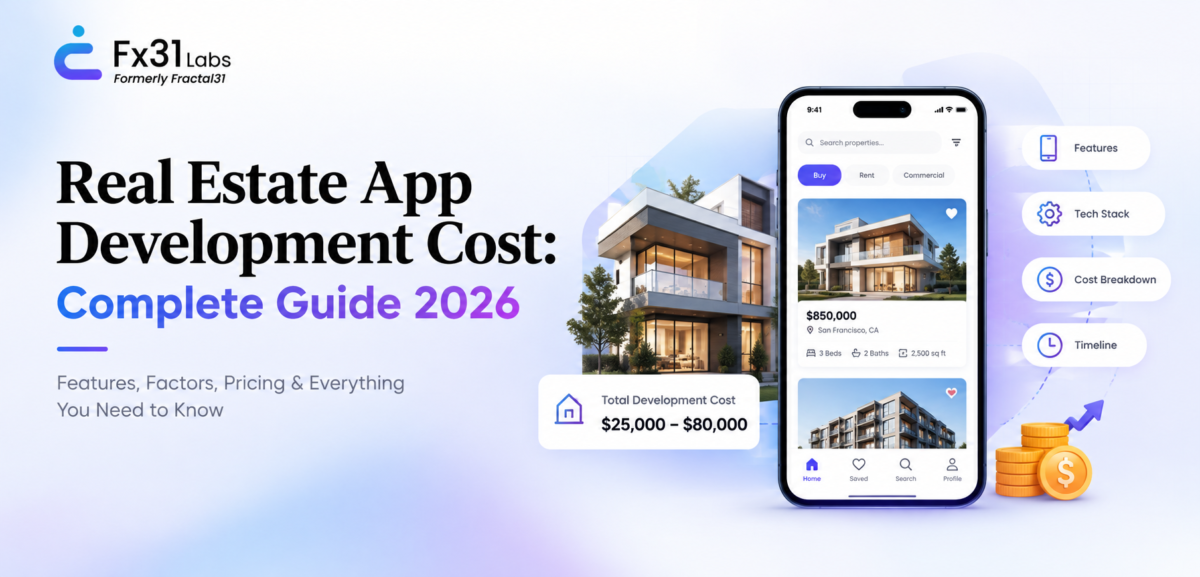
Key Takeaways: Real Estate App Development Cost
- Development budget: $25,000 for an MVP to $500,000+ for a regional portal.
- Timeline: 3-4 months for an MVP; 10-18 months for a regional portal.
- Biggest cost factors: User roles, listing data, integrations, and platform choice.
- MLS/IDX integration: $10,000 to $30,000 upfront, plus $50 to $500 per month per feed.
- Annual maintenance: 15% to 20% of the initial build cost, plus running expenses.
- Three-year budget: Around 1.6x to 2.1x the initial build cost.
- Best first step: Define one core workflow, run discovery, and launch a focused MVP.
Two real estate apps can look similar but cost $45,000 and $180,000 to build. The difference often comes down to listing data, user roles, integrations, and the experience of your mobile app development team.
For most US and UK brokerages and rental platforms, real estate app development costs range from $60,000 to $150,000, while a focused listing MVP can start at $25,000. Without a clear scope, essential features and listing data costs can get overlooked, leaving you with a budget that falls short before launch.
The market is growing, too. Grand View Research projects that real estate software will reach $31.96 billion by 2033, with a 12.2% CAGR.
Whether you’re building a property listing platform or a rental management app, understanding the costs upfront helps you choose the right approach.
In this guide, you’ll learn:
- Real estate app development costs by app type and project scope
- Feature costs, development phases, and MLS/IDX integration
- Native vs. cross-platform and custom vs. white-label options
- Team rates, hidden expenses, and what a complete quote should include
- Three-year running costs and practical ways to save
By the end of this guide, you’ll have a clearer budget for your property app and know which questions to ask before signing a development contract.
How Much Does It Cost to Build a Real Estate App?
The cost to build a real estate app depends on its features, listing data, and project scope. These four tiers show what each budget typically covers and how long development takes.
| Tier | What you get | Market range | Timeline |
| MVP listing app | Listings, search and filters, map view, favorites, inquiry form, and basic admin panel | $25,000 to $60,000 | 3 to 4 months |
| Mid-level brokerage or rental app | Buyer and agent roles, saved-search alerts, tour booking, chat, and one MLS or CRM feed | $60,000 to $150,000 | 4 to 7 months |
| Advanced marketplace or property platform | Multiple user roles, payments, e-signature, owner or landlord portals, AI search, and analytics | $150,000 to $250,000 | 6 to 10 months |
| Regional property portal | Multiple listing feeds, high-volume map search, agent subscriptions, ad products, web and app | $250,000 to $500,000+ | 10 to 18 months |
These market ranges cover a typical cross-platform app for iOS and Android, not a fixed quote. Offshore teams generally fall toward the lower end, while US and UK agencies tend to charge more.
Listing data can also raise the real estate app development cost because feeds need to be integrated, cleaned, and updated. This is one reason property platforms can cost more than our ecommerce app development cost estimates.
For a broader cost comparison across app categories, see our app development cost guide for startups. This guide focuses on the specific costs of building a real estate app.
Real Estate App Development Cost by App Type
The real estate app development cost depends on the app you build, its users, and the features it needs. Here’s how seven common property app types compare.
| App type | Main users | Market range | Timeline |
| Brokerage listing app | Buyers, sellers, and agents | $40,000 to $120,000 | 3 to 6 months |
| Agent productivity and showing app | Agents and team leads | $30,000 to $90,000 | 3 to 5 months |
| Rental marketplace app | Renters, landlords, and leasing agents | $80,000 to $220,000 | 5 to 9 months |
| Property management and tenant app | Tenants, owners, and property managers | $60,000 to $180,000 | 4 to 8 months |
| New-home and developer sales app | Home buyers and builders | $40,000 to $110,000 | 3 to 6 months |
| Real estate investment app | Investors, sponsors, and compliance teams | $100,000 to $250,000 | 6 to 10 months |
| Property portal like Zillow, Rightmove, or Zoopla | Buyers, renters, agents, and advertisers | $250,000 to $500,000+ | 10 to 18 months |
1. Brokerage Listing App
A brokerage app brings property listings, agents, and your brand together in one place. Costs cover search filters, map views, saved-search alerts, and lead routing. For US apps, MLS or IDX integration can be a major part of the budget.
2. Agent Productivity and Showing App
This app helps agents manage showings, client notes, CRM updates, and reminders instead of serving the public. Its budget depends on workflow complexity and integrations. According to NAR’s 2025 Profile of Home Buyers and Sellers, 88% of buyers purchased through an agent or broker.
3. Rental Marketplace App
A rental marketplace connects renters with landlords, so both need dedicated user flows. Costs include listing management, applications, screening, deposits, rent payments, and messaging. Verified listings and fraud checks can increase the budget.
4. Property Management and Tenant App
Property app development cost depends on how much of the property management workflow moves into the app. Tenants need rent payments, maintenance requests, and notices, while managers need work orders, vendor coordination, owner statements, and accounting integrations.
5. New-Home and Developer Sales App
Developers use these apps to market homes before construction is complete. Floor plans, lot maps, upgrade selectors, 3D tours, and appointment booking drive the cost. CRM and inventory integration also help prevent buyers from selecting already-sold properties.
6. Real Estate Investment App
Investment apps need more than portfolio dashboards because they may handle sensitive financial information and regulated offers. Costs can include identity verification, investor accreditation, payment flows, document storage, and portfolio tracking. Offers subject to SEC or FCA rules may also require legal review and compliance work.
7. Property Portal Like Zillow, Rightmove, or Zoopla
The cost to build an app like Zillow starts around $250,000 for a regional portal with multiple listing feeds and agent tools. National-scale platforms require much larger investments in data, infrastructure, and traffic handling. Starting with one region or niche can keep the initial scope manageable.
Real Estate App Development Cost Breakdown by Phase
For a $100,000 build, mobile development and the backend take up half the budget. The rest covers discovery, design, listing data, testing, and release.
| Phase | Share of budget | On a $100,000 build | Typical duration | What you pay for |
| Discovery and scoping | 8% | $8,000 | 2 to 4 weeks | User roles, workflows, data sources, MLS or CRM access, and project estimates |
| UI/UX design | 12% | $12,000 | 3 to 6 weeks | Wireframes, listing and map screens, and clickable prototypes |
| Mobile app build (one cross-platform codebase) | 25% | $25,000 | 8 to 14 weeks | iOS and Android apps using shared Flutter or React Native code |
| Per-platform option: two native apps | Replaces the line above | About $36,000 to $42,000 | 10 to 16 weeks | Separate Swift and Kotlin apps for capture-heavy products |
| Backend, APIs, and admin panel | 25% | $25,000 | 8 to 14 weeks | Database, listing APIs, user management, admin tools, and reporting |
| Listing data and integrations | 12% | $12,000 | 3 to 8 weeks | MLS, IDX or CRM feeds, maps, payments, and e-signature |
| QA and testing | 15% | $15,000 | Runs alongside the build | Device testing, search and map performance, and security checks |
| App store release | 3% | $3,000 | 1 to 2 weeks | Store listings, review fixes, and production setup |
| Yearly maintenance | 15% to 20% a year | $15,000 to $20,000 | Ongoing | OS updates, bug fixes, feed changes, and improvements |
Start with discovery. In 2 to 4 weeks, your team maps user roles, screens, workflows, and listing data access before development begins. This helps uncover costly issues early.
Design and development follow. Test listing pages, photos, and map search with real users, then build the mobile app and backend in parallel. Start MLS, IDX, and CRM integrations early because access and approvals can take weeks.
Test throughout the build. QA should run during each sprint, not just before launch. App store release then covers store listings, review fixes, and production setup.
Choosing two native apps instead of one cross-platform codebase raises the mobile development estimate from $25,000 to about $36,000 to $42,000. That adds roughly $11,000 to $17,000 before any extra QA.
Also Read: Building Scalable MVPs: Best Practices and Common Pitfalls
How Much Do Real Estate App Features Cost?
Feature costs depend on complexity and developer rates. The estimates below compare typical effort at $40 per hour offshore and $150 per hour onshore.
| Feature | Effort (hours) | Offshore at $40 an hour | Onshore at $150 an hour |
| Accounts, roles and profiles | 80 to 150 | $3,200 to $6,000 | $12,000 to $22,500 |
| Search, filters and sorting | 120 to 250 | $4,800 to $10,000 | $18,000 to $37,500 |
| Map search and neighborhood data | 120 to 250 | $4,800 to $10,000 | $18,000 to $37,500 |
| Listing pages, galleries and floor plans | 80 to 160 | $3,200 to $6,400 | $12,000 to $24,000 |
| Saved searches, favorites and alerts | 60 to 140 | $2,400 to $5,600 | $9,000 to $21,000 |
| Tour booking and calendar sync | 80 to 180 | $3,200 to $7,200 | $12,000 to $27,000 |
| In-app chat and inquiry routing | 100 to 220 | $4,000 to $8,800 | $15,000 to $33,000 |
| Push notifications | 40 to 100 | $1,600 to $4,000 | $6,000 to $15,000 |
| Mortgage and affordability calculator | 30 to 80 | $1,200 to $3,200 | $4,500 to $12,000 |
| Video walkthroughs and 3D tour embeds | 80 to 200 | $3,200 to $8,000 | $12,000 to $30,000 |
| Payments, deposits and rent collection | 100 to 250 | $4,000 to $10,000 | $15,000 to $37,500 |
| E-signature | 40 to 100 | $1,600 to $4,000 | $6,000 to $15,000 |
| CRM integration and lead routing | 100 to 250 | $4,000 to $10,000 | $15,000 to $37,500 |
| AI search and recommendations | 150 to 400 | $6,000 to $16,000 | $22,500 to $60,000 |
| Admin panel and analytics | 150 to 350 | $6,000 to $14,000 | $22,500 to $52,500 |
These estimates are building blocks, not a fixed shopping list. Features can share the same backend, account system, and design, so the total is rarely the sum of every row.
Features can significantly affect the real estate app development cost, so prioritize what users need at launch. Start with accounts, search, maps, listing pages, favorites, and inquiry routing for an MVP.
Add tour booking, chat, payments, and AI recommendations as demand grows. Keep search and maps reliable from day one because buyers need to find relevant properties quickly.
How Much Does MLS, IDX, and Listing Data Integration Cost?
MLS or IDX integration in the US typically costs $10,000 to $30,000 upfront, plus $50 to $500 per month per feed. In the UK, costs usually cover agency CRM integrations instead, as the market does not use an MLS system.
Listing data can significantly affect the real estate app development cost because every feed needs accurate, regularly updated property information.
How Listing Data Works in the US
US listings come from regional MLS databases, where brokers share property information. IDX allows participating brokers to display eligible listings from other brokers, subject to MLS rules for attribution, updates, and disclaimers.
Most new integrations use the RESO Web API, the modern standard for exchanging real estate data. Integration work includes mapping fields, syncing photos, updating listing status, removing duplicates, and following refresh schedules.
Your brokerage also needs MLS access and an approved data license. Allow several weeks for approval, and budget for extra fees and mapping work if you connect multiple MLS feeds.
How Listing Data Works in the UK
UK agents generally manage listings through their own CRM systems, which distribute property details to portals such as Rightmove, Zoopla, and OnTheMarket. A new app typically integrates with an agency’s CRM to display its own listings, with integration costs often around $10,000 to $30,000.
UK listings also need key property information. National Trading Standards guidance on material information covers details such as price, council tax band, and tenure. Include these fields in your data model from the start to avoid costly changes later.
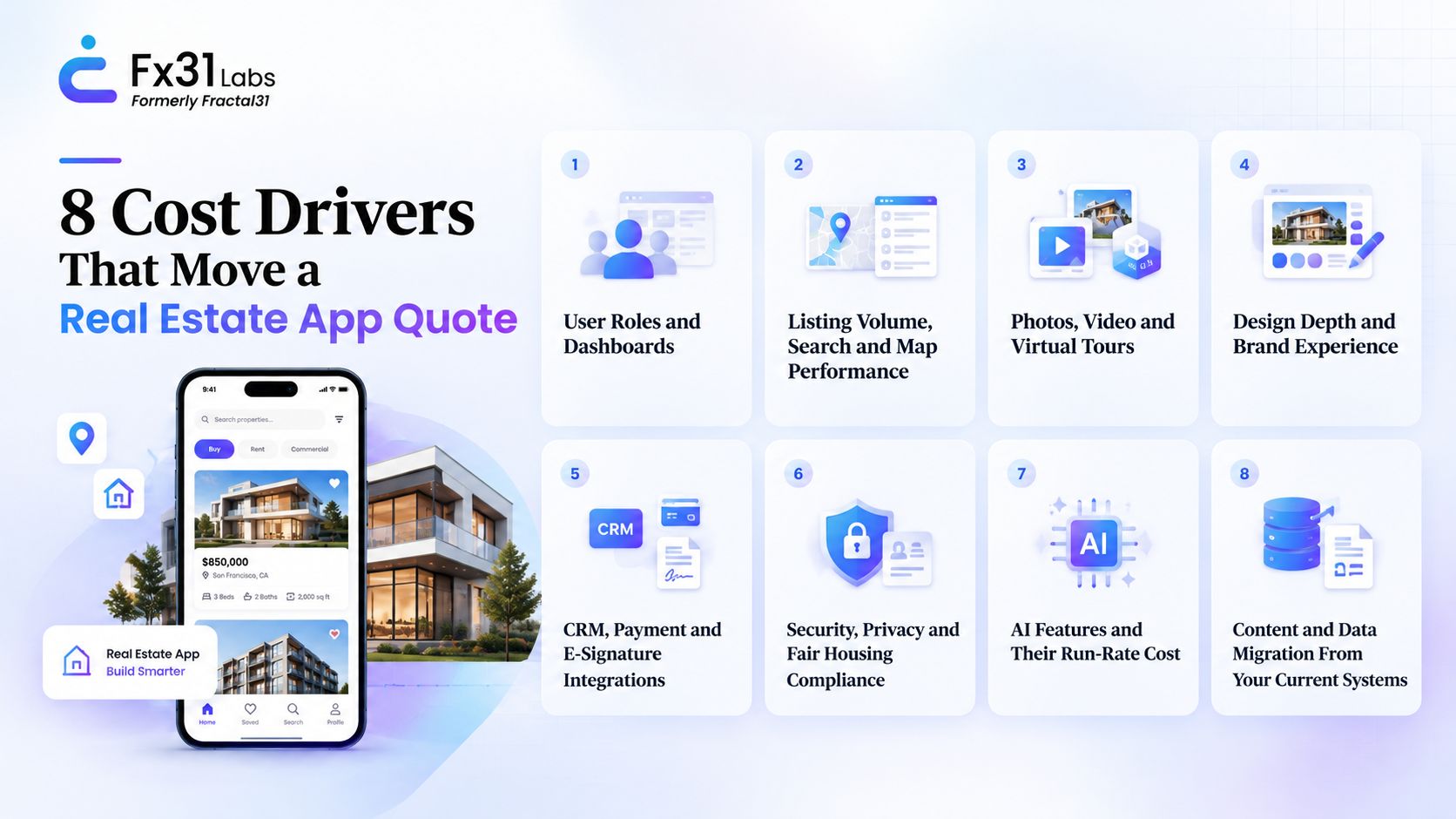
8 Cost Drivers That Move a Real Estate App Quote
Two apps with similar screens can have very different quotes. These eight factors explain why real estate app development cost varies and help you compare estimates before committing to a budget.
1. User Roles and Dashboards
Buyers, renters, agents, landlords, tenants, and admins each need specific screens, permissions, and alerts. Adding more roles increases backend work and testing. Define the essential roles before development to keep the initial scope under control.
2. Listing Volume, Search and Map Performance
Displaying 500 listings is simpler than handling 50,000 with fast filters and smooth map clustering. Larger platforms need search indexing, caching, and map optimization. Ask how the app will perform at ten times your expected launch volume.
3. Photos, Video and Virtual Tours
Property apps need fast-loading photos, galleries, and floor plans. Video walkthroughs and 3D tours add storage, delivery, and playback costs. Embedding a third-party tour is usually cheaper than building custom capture tools.
4. Design Depth and Brand Experience
Custom animations and map styling cost more than a standard design system. Prioritize listing pages, photo galleries, and search filters because these shape the property discovery experience. Keep less-used screens simple to control design costs.
5. CRM, Payment and E-Signature Integrations
CRM tools route leads, payment systems handle deposits and rent, and e-signature tools support leases. Each integration requires setup, testing, and ongoing updates. Check API availability early, as older systems may need custom workarounds.
6. Security, Privacy and Fair Housing Compliance
Apps handling identities, documents, or payments need encryption, access controls, and appropriate privacy safeguards under laws such as CCPA or UK GDPR. Use a PCI DSS-compliant payment provider rather than storing card details. Review ads and AI recommendations for potential Fair Housing Act violations.
7. AI Features and Their Run-Rate Cost
AI search, price estimates, and listing descriptions can improve the user experience, but add API fees, hosting, and evaluation work. Start with one feature tied to a clear business goal, measure its results, and expand when the value justifies the ongoing cost.
8. Content and Data Migration From Your Current Systems
Moving data from an existing website, CRM, or property management system takes time. Teams must clean duplicate contacts, map listing fields, and transfer tenant records accurately. Ask vendors to price migration separately so it does not disappear inside vague project estimates.
Also Read: Compliance-Ready Software Development: A Practical Guide for Enterprises
Who Should Build Your Real Estate App, and What Should the Quote Include?
A dedicated offshore or nearshore team can offer strong value for US and UK businesses. Compare experience, delivery ownership, and data integration skills, not just hourly rates.
Typical Development Rates by Region
| Region | Typical hourly rate |
| United States | $100 to $200 |
| United Kingdom | $70 to $150 |
| Eastern Europe | $40 to $80 |
| Latin America | $35 to $75 |
| India | $25 to $55 |
Lower hourly rates do not always mean a lower real estate app development cost. A team that takes twice as long can increase your total budget, so check its property app experience and senior developer involvement.
Which Development Model Fits Your Budget?
| Delivery model | Typical rate | Best for | Watch out for |
| In-house team | Full salaries plus benefits | Long-term platforms | High fixed costs and slow hiring |
| Freelancers | $30 to $150 an hour | Small fixes and prototypes | Gaps in QA and continuity |
| US or UK agency | $100 to $200 an hour | Onshore meetings and accountability | Higher cost per feature |
| Offshore or nearshore dedicated team | $25 to $80 an hour | MVPs and mid-level apps | Needs clear product leadership |
| Staff augmentation | $25 to $80 an hour | Adding developers to an existing team | Your managers handle delivery |
Before shortlisting a real estate app development company, use our guide to choosing a mobile app development partner to compare vendors and ask the right questions.
Still deciding between hiring and outsourcing? Our guide to dedicated development teams vs in-house hiring explains the key trade-offs.
What Should Your Development Quote Include?
A clear quote keeps your real estate app development cost predictable. Before signing, make sure it covers these eight items:
- MLS access and data licensing: Who handles approvals, feed fees, and access timelines.
- IDX display compliance: Required attribution, data refreshes, and disclaimers.
- Admin panel: Tools to manage listings, users, leads, and content without developer help.
- Media pipeline: Photo resizing, video hosting, CDN setup, and storage limits.
- Data migration: Moving existing contacts, listings, and tenant records.
- App store release: Store listings, review fixes, and resubmissions until launch.
- Warranty and support: Post-launch bug fixes and ongoing maintenance terms.
- Ownership: Source code, developer accounts, and MLS credentials registered to your company.
Also Read: Effective Nearshore Software Development for Mobile Apps: Everything You Need to Know
What Does a Real Estate App Cost to Run After Launch?
Building the app is only the first expense. Budget 15% to 20% of the build cost annually for maintenance, plus around $500 to $1,500 per month for hosting, media, maps, listing feeds, and messaging.
These ongoing expenses are part of the total real estate app development cost. Here is what to include in your budget.
| Cost item | Typical market range | What drives it |
| Apple Developer Program | $99 a year | App Store publishing |
| Google Play developer account | $25 one-time | Google Play publishing |
| Cloud hosting and database | $100 to $1,000+ a month | Users, listings, and search traffic |
| Media storage and CDN | $50 to $500 a month | Photo and video volume |
| Maps and geocoding | Free monthly cap, then pay per 1,000 calls | Map loads and address lookups |
| MLS or IDX feed fees | $50 to $500 a month per feed | Number of feeds and vendor pricing |
| SMS, email, and push messaging | $20 to $300 a month | Alerts, verification codes, and campaigns |
| AI model APIs | Tens to a few hundred dollars a month at first | Query volume and model choice |
| Monitoring, crash reporting, and analytics | $0 to $300 a month | Tools and data retention |
| Maintenance and updates | 15% to 20% of the build a year | Bug fixes, OS updates, and feed changes |
The Apple Developer Program costs $99 a year, while Google Play charges a one-time $25 registration fee. Register both accounts in your company’s name to keep ownership under your control.
Maps can add to monthly expenses as usage grows. Google Maps Platform provides free monthly usage caps by SKU. Geocoding, for example, includes 10,000 free events per month, then costs $5.00 per 1,000 up to 100,000.
What Will a Real Estate App Cost Over Three Years?
For a $100,000 mid-level app, the estimated three-year budget looks like this:
| Cost item | Three-year market range |
| Initial build | $100,000 |
| App store fees ($99 a year plus $25 once) | $322 |
| Hosting, media and CDN ($300 to $900 a month) | $10,800 to $32,400 |
| Maps, listing feeds and messaging ($200 to $600 a month) | $7,200 to $21,600 |
| Maintenance at 15% to 20% a year | $45,000 to $60,000 |
| Three-year total | $163,322 to $214,322 |
Your three-year spend could reach 1.6x to 2.1x the initial build budget. Include these ongoing costs in your real estate app development cost plan before development begins, not after launch.
Now that you know what it costs to build and run the app, let’s look at practical ways to reduce the budget.
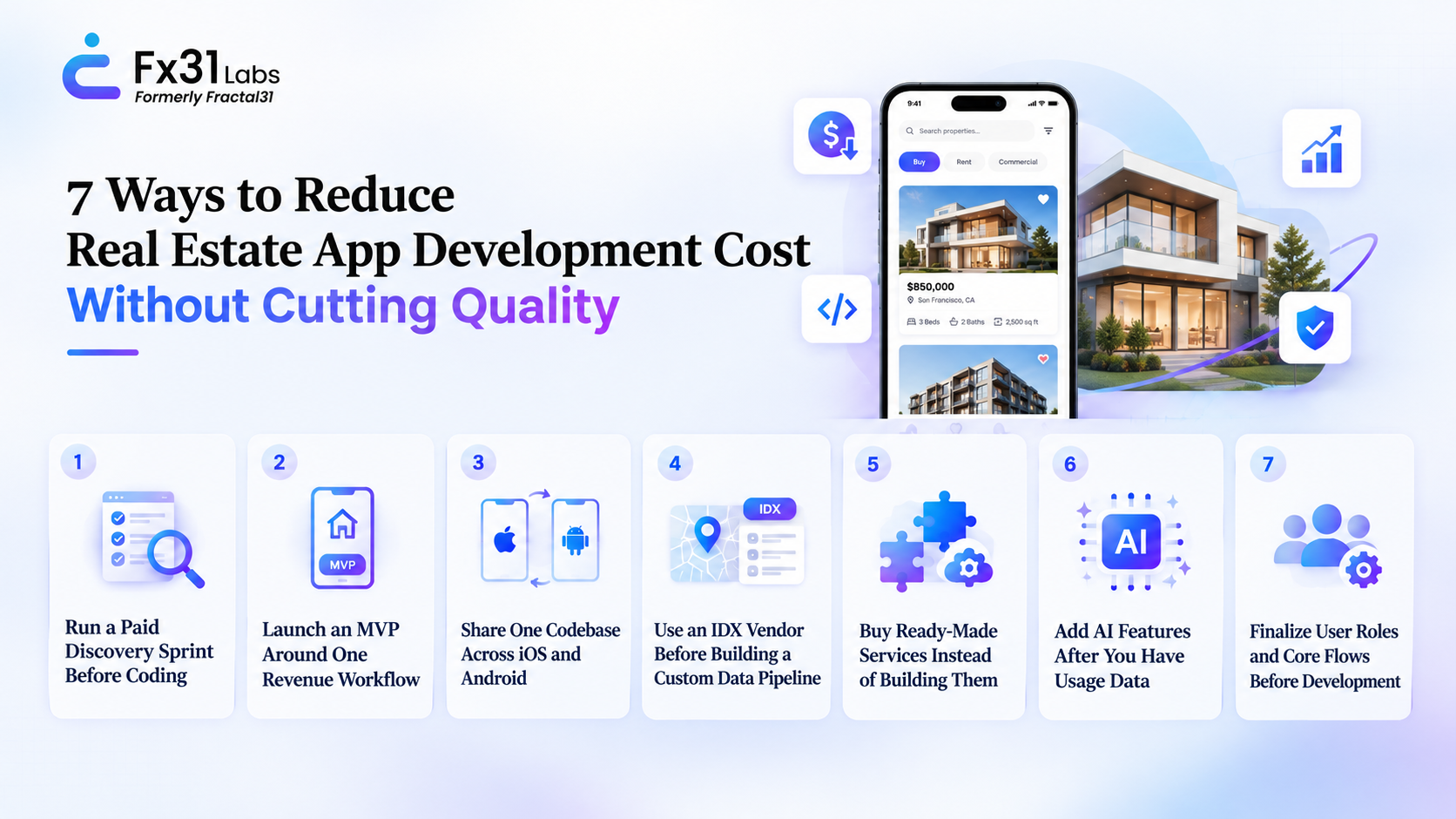
7 Ways to Reduce Real Estate App Development Cost Without Cutting Quality
You can reduce development costs without removing features users need. Focus on these seven ways to control spending while keeping your app useful and reliable.
1. Run a Paid Discovery Sprint Before Coding
Spend 2-4 weeks defining user roles, mapping screens, checking MLS or CRM access, and finalizing the scope. This gives your team a clickable prototype and a clearer estimate before development starts. It also helps prevent expensive changes caused by unclear requirements.
2. Launch an MVP Around One Revenue Workflow
Start with one workflow that supports your business, such as buyer leads, rental applications, or rent collection. Build that process end to end, launch it, and use feedback to decide what comes next. A focused MVP development approach can keep your first release near the $25,000 to $60,000 tier.
3. Share One Codebase Across iOS and Android
Use Flutter or React Native when your app does not need advanced platform-specific features. A shared codebase reduces duplicated development and lets one team manage testing and releases for both platforms. It can also lower maintenance work because fixes and updates are handled in one place.
4. Use an IDX Vendor Before Building a Custom Data Pipeline
A licensed IDX vendor can provide listing data through an API without requiring a custom pipeline from day one. Depending on your requirements, this can replace $10,000 to $30,000 in upfront integration costs with a recurring fee. Consider direct MLS integration later, when listing volume or multi-MLS coverage makes it worthwhile.
5. Buy Ready-Made Services Instead of Building Them
Use established services for payments, e-signatures, chat, identity checks, and virtual tours instead of developing every feature from scratch. These integrations can reduce build time while relying on vendors for supported functionality and service updates. Save custom development for search, matching, and workflows that differentiate your property app.
6. Add AI Features After You Have Usage Data
Launch with useful filters, saved searches, and alerts before investing in AI recommendations. Track what users search for, save, and ignore over the first few months. This helps you choose relevant AI features and control development and API costs instead of building features without evidence of demand.
7. Finalize User Roles and Core Flows Before Development
Confirm user roles, permissions, and key journeys before development sprints begin. Changes to these foundations can affect screens, backend logic, integrations, testing, and the overall real estate app development cost. Keep new ideas in a phase-two backlog so the current release stays within its agreed scope.
Why Trust Fx31 Labs for Your Real Estate App Development?
Building a property app takes more than coding. You need a team that can manage development, integrations, and quality while keeping your real estate app development cost under control as your product grows.
Fx31 Labs combines India-based engineering with a US office in New Jersey, supporting mobile apps, backend systems, and product development from discovery to launch.
- Marketplace Experience: We delivered a chemical marketplace platform that reduced transaction time by 50% and made onboarding 70% faster.
- Booking and Scheduling: Our super app for a UAE pet grooming business achieved 3x operational efficiency and 2x faster bookings. Similar scheduling workflows can support property tours and appointments.
- Faster MVP Development: Our rapid MVP approach can cut launch time by up to 40%, helping proptech teams test ideas and meet important launch deadlines.
- Founder-Ready Prototypes: For a VC studio, we prototyped 8 startup ideas and prepared 9 pitch decks. This experience can help founders validate a property app concept before seeking investment.
- Mobile and Web Development: Our mobile app and web development team builds iOS, Android, and Flutter apps with the backend and admin tools needed to support them.
Need a clear estimate for your project? Book a free consultation with our experts and we’ll help define the scope, technology stack, budget, and phased roadmap.
Conclusion: Plan Your Real Estate App Budget with Confidence
The real estate app development cost depends on your app type, listing data integrations, and long-term maintenance. A focused MVP may start at $25,000, while a regional property portal can cost $500,000+.
Start with one core workflow, choose the right data integration approach, and plan for ongoing costs before development begins. A clear scope helps you control spending without cutting essential features.
We hope this guide helps you understand property app development costs, compare your options, and plan a budget that fits your business goals.
Planning a real estate app? Connect with our experts and get a clear roadmap for your user roles, listing data flow, and phased budget.
Frequently Asked Questions
1. How much does it cost to build a real estate app?
Real estate app development cost starts around $25,000 for a listing MVP, while a mid-level app typically costs $60,000 to $150,000. Advanced regional portals can exceed $500,000.
2. How much does it cost to build an app like Zillow or Rightmove?
A regional portal usually starts at $250,000 and can exceed $500,000. Starting with one market or niche helps control costs.
3. How long does it take to build a real estate app?
An MVP takes 3-4 months, a mid-level app 4-7 months, and an advanced platform 6-10 months. Regional portals can take 10-18 months, plus time for MLS approvals where required.
4. How much does MLS or IDX integration cost?
The initial integration typically costs $10,000 to $30,000, plus $50 to $500 per month per feed. An IDX vendor may be a practical starting point.
5. Can my app show listings from Rightmove or Zoopla?
Typically, apps integrate with an estate agency’s CRM, which distributes listings to portals such as Rightmove, Zoopla, and OnTheMarket. Access depends on the available data feeds and permissions.
6. How much does real estate app maintenance cost each year?
Budget 15% to 20% of the initial build cost annually for updates, bug fixes, and feed changes. Hosting, maps, media, and messaging add further expenses.
7. How can I reduce real estate app development cost?
Start with a focused MVP, use cross-platform development, and choose an IDX vendor or CRM feed where suitable. Integrate ready-made services instead of building every feature from scratch.
8. How do real estate apps make money, and how does it affect development cost?
Apps earn through agent subscriptions, featured listings, lead fees, transaction fees, or advertising. Your model determines which billing, payment, and admin features the app needs.