
Compliance-Ready Software Development: A Practical Guide for Enterprises
Compliance ready software development refers to the process of building applications with the desire to meet and match regulatory and industry standards such as GDPR, HIPAA, or SOC 2 – from the start, instead of making additional changes or changing systems once the product is already built and established. It mostly involves mapping applicable requirements early, embedding controls into the development process itself, and documenting decisions as they’re made rather than reconstruction for an audit later on.
What Does Compliance-Ready Software Development Actually Mean?
At a basic level, this is about treating regulatory requirements as design inputs, similar to performance or usability requirements, instead of something addressed after the product works.
In practice, that tends to look like:
- Mapping which regulations actually apply before architecture decisions are locked in
- Building data handling, logging, and access control around those requirements from day one
- Keeping documentation current as the system evolves, not just at launch
- Testing for compliance the same way you’d test for functionality or performance
It’s worth being clear that “compliance-ready” doesn’t mean every possible regulation gets addressed upfront. It means the team has thought through what’s likely to apply and built the system so those requirements are reasonably straightforward to satisfy, rather than a major rework later.
Why Do Enterprises Need Compliant Software Development From the Start?
Compliant software development tends to be far cheaper when it’s part of the initial build rather than added afterward – and the gap between those two costs is usually bigger than teams expect going in.
A few reasons this matters more at the enterprise level:
- Retrofitting is expensive. Adding audit logging, encryption, or access controls to an already-built system often means touching code that was never designed with those requirements in mind.
- Enterprise customers ask about it early. Security and compliance questionnaires are increasingly part of procurement, sometimes before a contract is even discussed.
- Multiple frameworks often apply at once. A single enterprise product might need to satisfy GDPR, SOC 2, and an industry-specific regulation simultaneously, which is harder to sort out after the fact.
- The cost of getting it wrong isn’t just financial. Failed audits, delayed launches, and lost deals tend to hurt more than the immediate cost of the compliance work itself.
None of this requires solving every requirement before writing any code — it just tends to go more smoothly when compliance is part of the initial conversation, not introduced right before a customer’s security review. We’ve seen this come up often in projects involving legacy system modernization too, where an older system built without compliance in mind ends up being one of the more expensive parts of the upgrade.
What Are the Most Common Software Compliance Requirements?
Software compliance requirements vary by industry and geography, but a handful show up often enough to be worth planning for regardless of your specific sector:
| Framework | What It Covers | Who It Typically Applies To |
| GDPR | Data privacy and protection for EU residents’ data | Any company handling data from EU users, regardless of where the company is based |
| HIPAA | Protection of health information | Healthcare providers, insurers, and their technology vendors |
| SOC 2 | Security, availability, and confidentiality controls | B2B SaaS companies, especially those handling customer data |
| PCI DSS | Payment card data security | Any company processing, storing, or transmitting card payment data |
| CCPA/CPRA | Data privacy for California residents | Companies handling California consumer data, similar in spirit to GDPR |
Most enterprise software touches at least one of these, and it’s common for a single product to need to satisfy more than one at the same time – which is part of why mapping requirements early tends to save real time later.
How Does Compliance-Ready Development Differ From Secure Software Development?
These two get used somewhat interchangeably, but they’re not quite the same thing, and treating them as identical tends to leave gaps.
| Secure Software Development | Compliance-Ready Software Development | |
| Primary goal | Protect the system from threats and vulnerabilities | Meet specific regulatory and industry requirements |
| Typical focus | Encryption, authentication, vulnerability management | Documentation, audit trails, data handling rules, consent management |
| Driven by | Security best practices and threat modeling | External legal and regulatory frameworks |
| Success measured by | Fewer vulnerabilities, faster incident response | Passing audits, meeting documented control requirements |
A genuinely secure system isn’t automatically compliant SOC 2, for example, cares as much about documented processes and evidence as it does about the underlying technical controls. In practice, the two tend to overlap quite a bit and reinforce each other, but building one doesn’t guarantee the other.
How Do You Build Compliance Into Each Phase of Development?
This is usually where the “ready” part actually happens – spread across the development lifecycle instead of handled in a single review near launch.
| Phase | Typical Compliance Activity |
| Requirements | Identify applicable regulations, translate them into concrete technical requirements |
| Design | Data flow mapping, access control design, privacy-by-design decisions |
| Development | Secure coding standards, automated compliance checks in CI/CD pipelines |
| Testing | Compliance-specific test cases, data handling validation, penetration testing |
| Deployment | Configuration review, audit logging verification, access control validation |
| Maintenance | Ongoing monitoring, periodic compliance reviews, documentation updates |
Spreading the work this way tends to be less disruptive than treating compliance as a single gate right before release – and it usually produces better documentation along the way, since evidence gets captured as decisions are made rather than reconstructed later under time pressure.
What Does Enterprise Software Compliance Look Like in Practice?
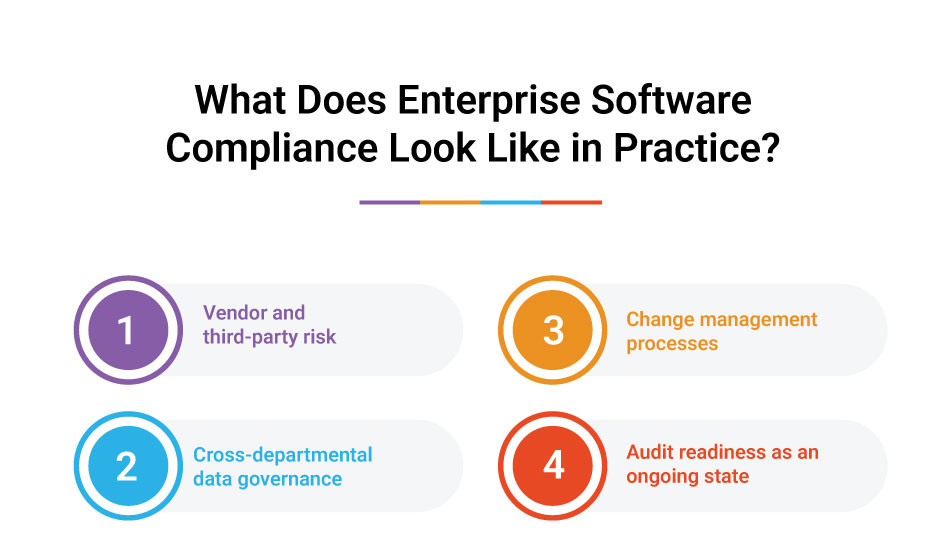
Enterprise software compliance tends to involve more moving parts than a smaller product, mainly because of scale – more integrations, more data flows, and often more overlapping regulatory obligations.
A few things that tend to matter more at enterprise scale:
- Vendor and third-party risk – enterprise systems typically integrate with more external services, each of which can introduce its own compliance exposure
- Cross-departmental data governance – the same data might be subject to different rules depending on which team or product is using it
- Change management processes – compliance reviews need to keep pace with release velocity, or they become a bottleneck teams learn to work around
- Audit readiness as an ongoing state – rather than a scramble that happens once a year, mature enterprise programs treat audit prep as a continuous, lower-effort process
Monitoring plays a bigger role here than teams sometimes expect – knowing what’s happening across your systems in near real time makes audit prep far less painful than reconstructing activity after the fact. Our piece on AI-driven cloud security strategies covers how automated monitoring fits into that picture.
Enterprises already handling sensitive data through private or self-hosted AI deployments tend to have a head start on some of this, since a lot of the same access control and data governance thinking applies. Our comparison of private AI models versus public AI for enterprise security covers some of that overlap if AI systems are part of your compliance scope.
How Does Compliance by Design Fit Into This?
Compliance by design is really the underlying principle that makes this whole approach possible – it’s the practice of treating compliance requirements as design constraints from the earliest planning stages, rather than a checklist applied after the fact.
A reasonably practical way to apply it:
- Identify applicable regulations before architecture decisions are finalized
- Translate each requirement into a specific technical decision – “data must be deletable on request” becomes a concrete database and API design choice, not a policy statement
- Document those decisions as they’re made, so the reasoning is available for audits later without reconstruction
- Involve legal or compliance stakeholders in design reviews, not just at the end of a project
Teams that treat compliance by design as a collaborative process between engineering and compliance -rather than compliance handing engineering a checklist after the architecture is set – tend to have noticeably smoother audits.
What Tools and Practices Support Compliance-Ready Software Development?
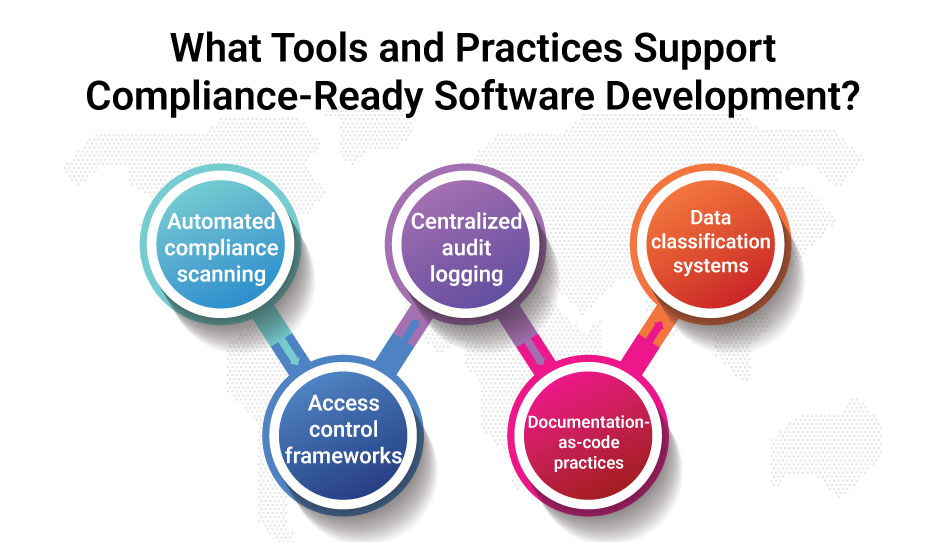
A handful of practical tools and habits tend to make the biggest difference:
- Automated compliance scanning integrated into CI/CD pipelines, catching issues before they reach production
- Centralized audit logging that captures who accessed what data and when, without relying on manual tracking
- Data classification systems that make it clear which data falls under which regulatory requirements
- Access control frameworks built around least privilege, so permissions map cleanly to compliance requirements
- Documentation-as-code practices, where compliance documentation lives alongside the codebase and gets updated as part of normal development, not as a separate afterthought
None of these tools replace the underlying process – automating a broken compliance process just produces bad results faster. But paired with the right process, they tend to meaningfully reduce the manual burden of staying audit-ready.
What Are Common Mistakes Enterprises Make?
A few patterns show up repeatedly across teams working toward this:
- Waiting until a customer or auditor asks before mapping applicable requirements, rather than doing it during initial planning
- Treating compliance as a legal-only responsibility, without involving the engineering teams actually building the system
- Under-documenting decisions, which turns every audit into a reconstruction exercise instead of a review
- Ignoring third-party and vendor compliance, even though vendor gaps often carry as much risk as internal ones
- Treating compliance as a one-time project rather than an ongoing practice that needs to evolve alongside both the product and the regulations
Most of these are avoidable with earlier planning and better cross-functional communication – tooling helps, but it doesn’t fix a process problem on its own.
Where to Start
Compliance-ready software development isn’t really a single milestone – it’s closer to an ongoing discipline that starts with mapping which regulations actually apply and carries through every phase of the development lifecycle. Teams that treat compliance as a design input from the beginning tend to spend far less time firefighting audits later, and the documentation habits that come with it tend to make the whole development process more transparent, not just more compliant. If you’re planning a new enterprise product or reworking an existing one to meet tighter compliance requirements, our engineering team can help you think through where compliance decisions belong in your specific architecture.
Frequently Asked Questions
What is compliance-ready software development?
Compliance-ready software development means building software so it can meet relevant regulatory and industry standards from the start, by mapping applicable requirements early and embedding controls into the development process rather than adding them after launch.
Is compliance-ready software development the same as secure software development?
Not exactly. Secure software development focuses on protecting the system from threats, while compliance-ready development focuses on meeting specific regulatory requirements. They overlap significantly but aren’t interchangeable.
What are the most common software compliance requirements enterprises deal with?
GDPR, HIPAA, SOC 2, and PCI DSS come up most often, depending on the industry and the type of data being handled. Many enterprise products need to satisfy more than one at the same time.
How much does compliance-ready development add to project timelines?
It typically adds some time upfront during requirements and design, but tends to save significantly more time later by avoiding rework, failed audits, or delayed launches caused by retrofitting compliance controls.
Do smaller companies need this too?
Often yes, especially if they’re selling to enterprise customers. Security and compliance questionnaires are increasingly part of B2B procurement, even for smaller vendors.