
Private AI vs Public AI Models: Which Is Better for Enterprise Security?
Private AI models are AI systems deployed within an enterprise’s own infrastructure on-premise or in a private cloud where data never leaves the organization’s control. Public AI models are accessed via shared APIs operated by third-party providers. The choice between them isn’t purely technical. It comes down to risk appetite, regulatory obligation, data sensitivity, and how much operational complexity your team can realistically absorb.
Why Does This Decision Matter More Than Ever in 2026?
Because employees are already making this decision for you and not carefully.
When teams use public AI tools through personal accounts or unapproved apps, they’re transmitting customer records, internal strategy documents, and proprietary data to servers they don’t control, governed by terms of service they’ve never read. This is the shadow AI problem, and it’s happening in most large enterprises right now regardless of what the official AI policy says.
Meanwhile, AI is being deployed into increasingly sensitive functions healthcare decision support, legal review, financial modeling, HR processes where a data exposure isn’t an operational inconvenience but a regulatory violation. Getting this architecture decision right from the start is far less expensive than fixing it after something goes wrong.
What Are Private AI Models, Exactly?
A private AI model is any AI system where inference happens entirely within infrastructure the enterprise controls. No query, no document, no data ever touches a third-party server.
This can mean:
- On-premise deployment — model runs on hardware in your own data center. Maximum control, highest capital cost.
- Private cloud deployment — model runs in an isolated cloud environment you control, not shared with other organizations.
- VPC-hosted open-weight models — models like LLaMA or Mistral deployed within your own virtual private cloud, accessed only via internal networking.
What these have in common: your data stays inside your perimeter. Queries don’t appear in anyone else’s logs. Model outputs aren’t used to improve a shared system. The regulatory exposure of sending sensitive data to a third party simply doesn’t exist.
This is what makes on-premise AI compelling for regulated industries not that private deployment is without tradeoffs, but that the alternative involves accepting data risks many compliance teams won’t sign off on.
Where Do Public AI Models Fall Short for Enterprises?
Public models accessed via shared APIs are powerful, fast to deploy, and require no infrastructure investment. For many use cases, they’re entirely appropriate.
But they have structural limitations that become serious when sensitive data is involved:
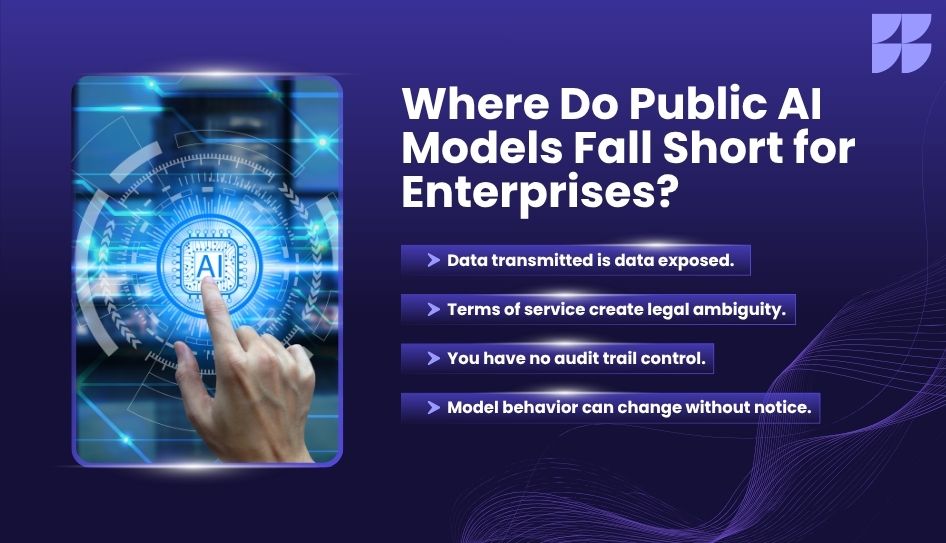
Data transmitted is data exposed. Queries traverse external networks and are processed on servers you don’t own. Even providers with strong security postures can’t eliminate this exposure entirely.
Terms of service create legal ambiguity. “We think our provider doesn’t train on our data” is not a defensible compliance position under GDPR, HIPAA, or similar regulations.
You have no audit trail control. With a private deployment, you control the logs. With a public API, you’re dependent on the provider’s reporting which isn’t sufficient for regulated industries where auditability is a legal requirement.
Model behavior can change without notice. Public models get updated in ways that alter output behavior. For enterprises with AI consistency requirements, an uncontrolled model update is a governance problem.
None of this makes public AI inappropriate for enterprise use. It makes it inappropriate for specific categories of use the ones involving data you can’t afford to expose.
Private vs Public AI: A Direct Security Comparison
| Security Dimension | Private AI | Public AI |
| Data residency | Fully within enterprise control | On third-party servers during inference |
| Network exposure | None | Data traverses external networks |
| Regulatory compliance | Easier to audit and demonstrate | Depends on provider agreements |
| Audit trail control | Full enterprise owns all logs | Dependent on provider |
| Model update control | Enterprise controls versioning | Provider updates may surprise you |
| Shadow AI risk | Lower controlled deployment | Higher employees may use personal accounts |
| Cost structure | High fixed, low variable at scale | Low fixed, high variable at scale |
The pattern is consistent: private AI trades upfront cost and operational complexity for control, compliance confidence, and reduced exposure. The question is always whether that tradeoff is justified for your specific data and use case.
What Does Running a Private LLM Actually Cost?
Honest answer: it’s a significant investment but the gap has closed considerably in 2026.
Hardware. Depending on model size and throughput, you’re looking at anywhere from one or two high-end GPUs for modest deployments to a multi-node cluster for high-volume enterprise use. Capital costs range from $50,000 to several million dollars.
Cloud compute alternative. Running private models on reserved GPU instances in an isolated cloud environment is increasingly cost-competitive and avoids the capital commitment of physical hardware.
Engineering overhead. Private LLM deployment isn’t set-and-forget. Model serving, scaling, monitoring, security patching, and versioning require ongoing engineering effort that needs to be budgeted honestly.
The break-even point. At high query volumes typically 5 to 50 million tokens per day depending on the model and API pricing private deployment often reaches cost parity with or beats public API costs. Below that threshold, public API is usually more economical once engineering overhead is factored in.
Understanding the full picture of end-to-end AI integration services costs is essential before committing to private infrastructure the GPU price tag is just one part of the equation.
When Does a Hybrid Approach Make Sense?
For most large enterprises, the real answer isn’t all-private or all-public it’s a hybrid that routes workloads to the right infrastructure based on data sensitivity.
Route by sensitivity. Customer-facing applications using non-sensitive data can use public APIs safely. Internal applications touching PII, proprietary data, or regulated information route to private infrastructure.
Prototype publicly, deploy privately. Many enterprises prototype against public APIs fast, cheap, no infrastructure setup then migrate to private deployment once a use case is validated and the production data sensitivity is assessed.
Classify every use case before deployment. Public, internal, confidential, or restricted map every AI use case to a data classification before choosing deployment model. This turns ad-hoc decisions into a repeatable, auditable process.
This is what digital transformation with AI looks like when security is a design constraint rather than an afterthought and it connects directly to having a mature AI governance framework for enterprises that governs these decisions consistently across teams.
How to Build a Secure AI Deployment Strategy
Regardless of which deployment model you choose, secure AI deployment requires the same foundational elements:
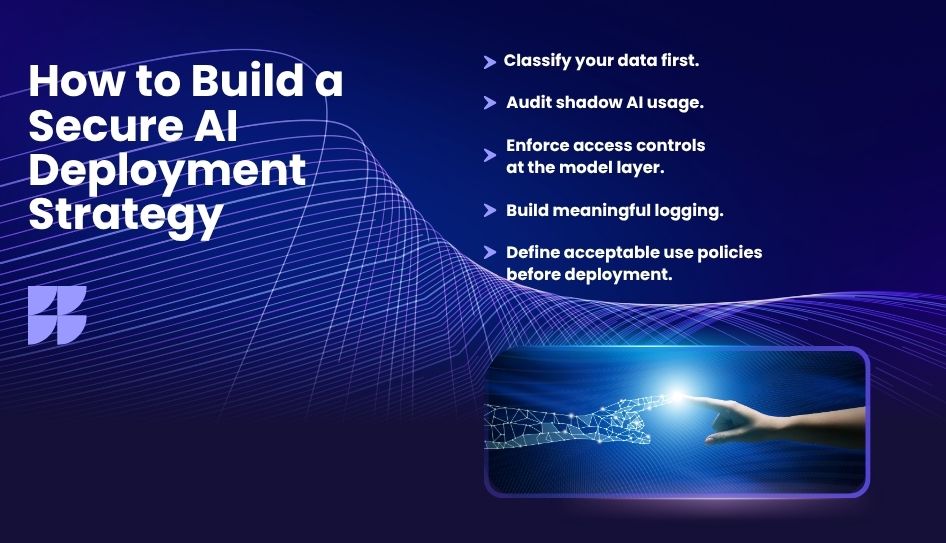
Classify your data first. You can’t secure what you haven’t categorized. A clear data classification framework is the prerequisite for every AI deployment decision.
Audit shadow AI usage. Discover every AI tool currently in use across the organization including the ones IT didn’t approve. You cannot govern what you don’t know exists.
Enforce access controls at the model layer. Not everyone needs access to the same AI capabilities, particularly systems that can retrieve or generate sensitive information.
Build meaningful logging. Logs should capture what data was sent, what was returned, and whether outputs triggered anomaly signals not just whether a call succeeded.
Define acceptable use policies before deployment. Clear policies about which data can go into which AI systems, documented and enforced, are the human layer of security that technical controls alone can’t replace.
This is the implementation of AI-driven cloud security strategies at the enterprise level and it applies whether your inference runs on your hardware or someone else’s. The principles around AI in enterprise software development reinforce the same point: security needs to be embedded in the architecture from the start, not bolted on after deployment.
Frequently Asked Questions
Is private AI always more secure than public AI?
Not automatically. Private AI eliminates third-party data transmission risks but introduces operational security responsibilities you must manage yourself. A poorly maintained private deployment can be less secure than a well-managed public API.
What industries typically require private AI?
Healthcare (HIPAA), financial services (FINRA, SEC), legal and professional services (privilege and confidentiality), government and defense, and pharmaceuticals and biotech. All involve data sensitivity or regulatory requirements that make public API usage legally or ethically problematic.
Can a mid-sized enterprise run a private LLM?
Yes. Capable open-weight models can run on a single high-end server for many practical enterprise use cases. Cloud-based private deployment also makes this accessible without large capital investment in physical hardware.
What is the biggest risk with public AI models for enterprises?
Data residency and auditability. When sensitive data is sent to a public API, you lose full control over where it’s processed, how it’s logged, and whether your use of it satisfies applicable privacy regulations.
How do model updates work in private deployment?
You control them. Updates don’t happen automatically you evaluate new model versions, test them against your workloads, and deploy on your schedule. This protects against unexpected behavior changes but requires a model lifecycle management process.