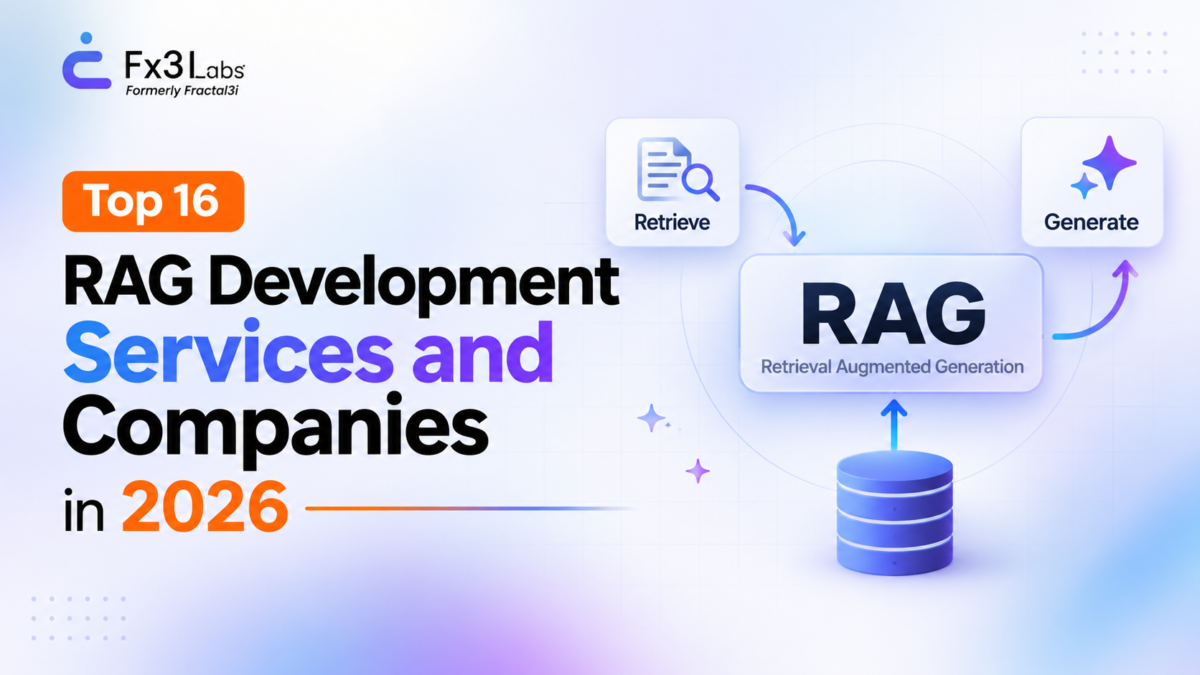
Top 16 RAG Development Services and Companies in 2026
Key Takeaways: RAG Development Services at a Glance
- What You’re Buying: RAG development services connect an LLM to your own documents, so it answers accurately and cites sources.
- What’s Included: Data parsing, retrieval tuning, access control, evaluation, and monitoring.
- Budget: Published vendor ranges put a pilot at $15,000 to $35,000 and a production system at $30,000 to $75,000, plus monthly running costs.
- How to Choose: Ask for production proof on similar documents and retrieval metrics in the contract.
- Where to Start: A one to two-week discovery, then a proof of concept scored on your own questions.
Most RAG assistants look brilliant in the demo and often start drifting within weeks of real use. Users bring scanned PDFs, old policies, and access rules, and the answers drift. Gartner’s 2026 Hype Cycle for GenAI warns that through 2028, at least 50% of GenAI projects will overrun their budgets because of poor architecture and missing operational know-how.
RAG development services exist to stop that drift before it reaches users. The right partner connects your documents to an LLM, proves cited answers on your own files, and runs a pilot for about $15,000 to $35,000 before you fund a production build.
Finding that partner is the hard part. Every AI agency now claims RAG, but few can show retrieval metrics and permission handling, or generative AI and LLM engineering built around retrieval rather than prompts.
In this guide, you’ll learn:
- What a RAG development partner should deliver
- 16 RAG development companies compared
- Which partner fits your scenario
- 8 factors to check before you sign
- What a RAG system costs to build and run
By the end of this guide, you’ll have a shortlist you can defend, sharper vendor questions, and a realistic budget for your first build.
What Are RAG Development Services?
RAG development services design, build, and run AI systems that answer from your own data, not the model’s memory. A good partner connects your documents to an LLM, tunes how evidence is found, and proves answers stay accurate and cited.
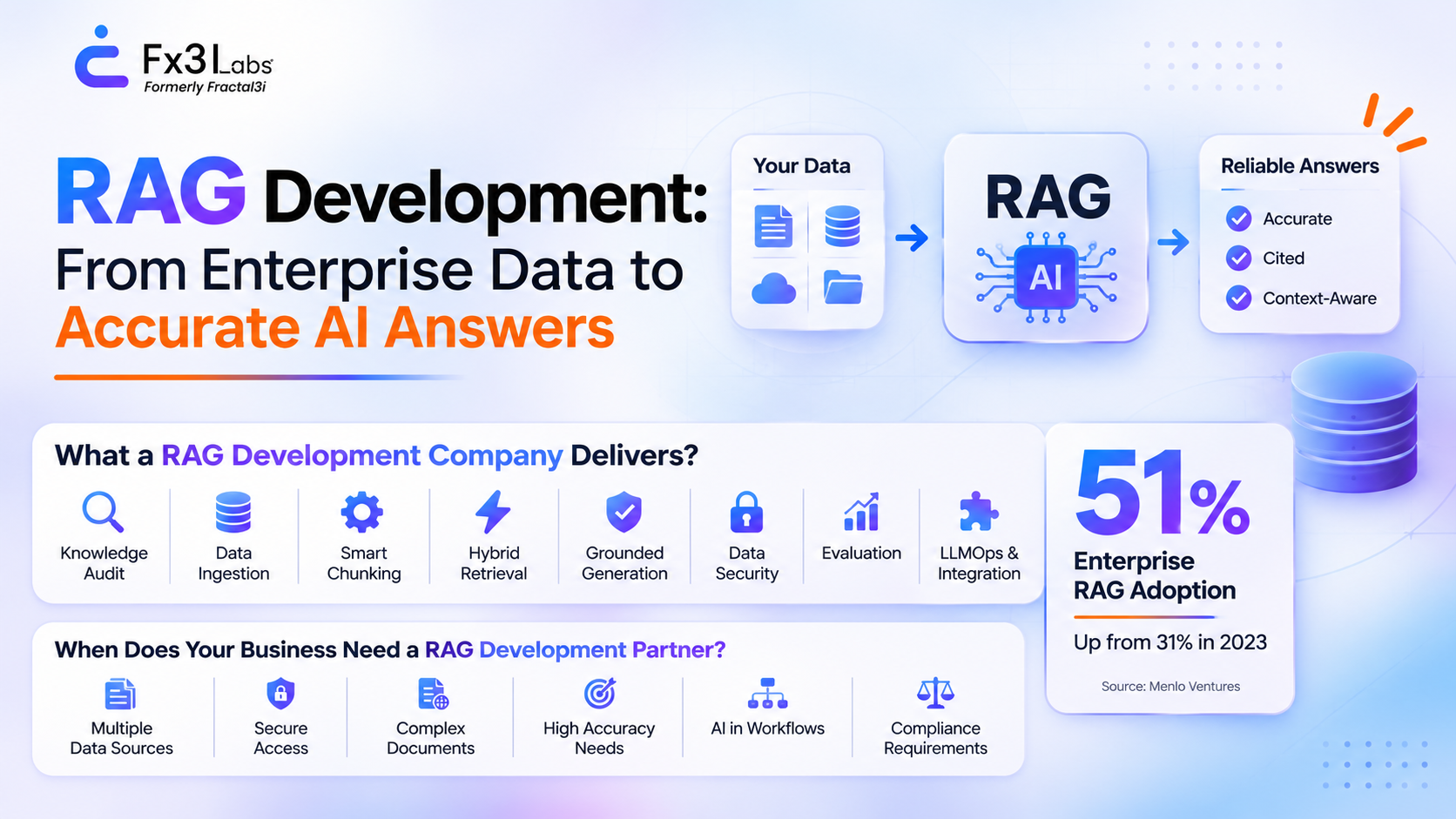
Retrieval has become the default way enterprises ground their AI. In its 2024 enterprise survey, Menlo Ventures found RAG at 51% adoption, up from 31% a year earlier. For the mechanics, our explainer on how RAG and LLMs work together covers the basics.
What Should a RAG Development Company Deliver?
A serious engagement goes well beyond wiring a chatbot to a vector database. Use this checklist to compare RAG development services proposals, because every row is where accuracy is won or lost.
| Delivery area | What you should receive |
| Use-case and knowledge audit | Target questions, users, sources, and refusal or hand-off cases |
| Data ingestion and parsing | Connectors for SharePoint, Confluence, drives, and databases, plus OCR |
| Chunking, metadata, and indexing | A chunking plan per document type, filter metadata, and an embedding model choice |
| Retrieval layer | Hybrid keyword and semantic search, metadata filters, query rewriting, and reranking |
| Grounded generation | Evidence-only prompts, source citations, and a refusal path |
| Access control and security | Permission-aware retrieval, encryption, audit logs, and clear data residency |
| Evaluation setup | A golden question set, retrieval and answer metrics, and regression tests |
| Integration and LLMOps | APIs or chat UI, monitoring, re-indexing, cost tracking, and handover |
RAG Development Company vs. RAG Platform vs. Large Consultancy: Which Do You Need?
Many shortlists mix three very different options. A RAG development company builds the system for you, a platform sells building blocks, and a consultancy wraps RAG inside a wider program.
| Option | What you get | Examples | Best when | Watch for |
| RAG development company | A custom pipeline tuned on your data | The 16 firms below | Knowledge spans systems and accuracy matters | Verify production proof |
| RAG platform or managed service | Vector databases, knowledge bases, and frameworks | Amazon Bedrock Knowledge Bases, Azure AI Search, Pinecone, LlamaIndex | You have engineers to tune it | You own tuning and evaluation |
| Large consultancy | RAG inside a multi-year transformation | Accenture, Deloitte, IBM Consulting | Global programs, large budgets | Higher cost, slower start |
Some teams don’t need a partner at all. If your documents are few, clean, and rarely change, a managed knowledge base can handle simple questions.
When Does Your Business Need a RAG Development Partner?
Specialist RAG development services earn their fee when retrieval gets hard. If two or more signals below match, custom RAG development will likely pay for itself.
- Knowledge Lives in Several Systems: Drives, wikis, CRMs, and databases need one retrieval layer.
- Users See Different Data: Retrieval must respect roles and document permissions.
- Documents Are Hard to Parse: Scanned PDFs, tables, and multiple languages need custom parsing.
- Wrong Answers Carry a Real Cost: Legal, financial, clinical, or safety questions need measured accuracy.
- Your Pilot Stalled After the Demo: It works on test questions but drifts once real traffic arrives.
- RAG Must Run Inside a Workflow: Answers feed an app, a ticketing system, or an AI agent.
- Compliance Sets the Rules: HIPAA, GDPR, UK GDPR, or the EU AI Act decide where data lives.
Also Read: RAG vs Fine-Tuning: Which Delivers Better ROI for Enterprises?
Top 16 RAG Development Companies for US and UK Buyers
Here is the full shortlist of RAG development services providers at a glance. Each one builds custom retrieval systems, but each is strongest in a different situation.
| Company | Base and US/UK presence | RAG strength | Delivery and deployment | Best for |
| Fx31 Labs | New Jersey, US; India engineering | Knowledge-retrieval assistants and LLM apps | Pilot, project, dedicated team, or AI engineers | Mid-market teams wanting a pilot first |
| Vstorm | Wrocław, Poland; US clients | Hard-document parsing and agentic RAG | Cloud, client VPC, or self-hosted models | Teams that want to own the system |
| CaliberFocus | Orlando, Florida, US | RAG tied to data and workflows | Data, AI, and governance programs | US healthcare and operations teams |
| Signity Solutions | US sales; India delivery | Agentic RAG and managed optimization | Build plus managed RAG services | One partner from strategy to support |
| Deviniti | Wrocław, Poland | Self-hosted, regulated RAG | Private infrastructure and local models | Banks and regulated teams |
| SoluLab | Los Angeles and New York, US | Published RAG price tiers | Readiness assessment, then fixed tiers | Buyers who want pricing upfront |
| GeekyAnts | San Francisco, London, Bangalore | RAG inside polished apps | Full product teams | Customer-facing products |
| ITRex Group | Sacramento, California; Warsaw | Metric-based RAG evaluation | Controlled environments with MLOps | Accuracy proven before launch |
| InterCode | Kennesaw, Georgia; Tallinn | Transparent build ranges | Fixed ranges, 6 to 10 weeks | SaaS teams on a set budget |
| Devox Software | Miami, Florida, US | Citation or refusal on every answer | Cloud, offline, and edge | High-risk answers |
| Intelliarts | Lviv and Warsaw | Contract and document analysis | PoC and MVP in 2 to 4 weeks | Fast, measurable proofs of concept |
| Clover Dynamics | Lviv, Ukraine | Real-time knowledge refresh | Projects or dedicated RAG developers | Content that changes daily |
| Prismetric | Jersey City, New Jersey, US | Multimodal RAG as a service | Consulting, build, and optimization | RAG plus the app around it |
| Groovy Web | London, UK; India delivery | Citation systems and agentic RAG | Fixed-scope AI Sprints | Startups wanting a fixed price |
| Relinns Technologies | Mohali, India | GraphRAG from a RAG product team | RAG pods or RAG as a service | GraphRAG and agentic retrieval |
| Railwaymen | Kraków and San Francisco | RAG over operational data | Web, mobile, and AI product teams | RAG inside dashboards and apps |
Let’s look at each company in detail.
1. Fx31 Labs
Fx31 Labs builds generative AI and LLM applications for mid-market companies and AI-product founders, including assistants that answer from company documents. Its AI, ML, and data science services handle the data preparation that retrieval depends on.
One example is a knowledge-retrieval assistant for a large manufacturer running multiple facilities. It reads manuals, SOPs, and compliance documents, then answers staff questions on equipment, safety, and troubleshooting across the plant floor.
The client reported shorter training time for new hires and fewer hours lost by senior staff answering repeat questions. For older systems, Coderbotics AI adds 40+ specialized agents for code and database modernization, including a Codebase Chat agent.
Key Highlights:
- RAG Capabilities: Document ingestion, retrieval-based assistants, LLM applications, and AI agents.
- Knowledge-Retrieval Case: A plant assistant that answers from manuals, SOPs, and compliance documents.
- Legacy Modernization: Coderbotics AI with 40+ specialized agents and 9+ supported languages.
- Engagement Models: Scoped pilot, project delivery, dedicated teams, and AI engineer augmentation.
- Pricing: No public rate card, so costs come from a scoped estimate.
Best for: Mid-market teams and AI-product founders who want a measured pilot before a full RAG build.
2. Vstorm
Vstorm is an AI engineering firm of 40+ people that treats RAG as part of an agent your team owns outright. It names its stack openly, from Qdrant, Milvus, and pgvector to reranking. For Mapline. AI, a US real estate startup, built a due-diligence agent that turned weeks of work into minutes.
Key Highlights:
- Messy Document Parsing: Specialized OCR for municipal PDFs with metadata filters.
- Agentic RAG: Retrieval built into agents with hybrid search.
- Full Ownership: A senior team hands over a system you control.
Best for: Mid-market teams that want a small senior team and full code ownership.
3. CaliberFocus
CaliberFocus builds enterprise RAG solutions inside wider data, AI engineering, and workflow programs, with teams across the USA, India, and the UAE. Its RAG guidance asks buyers to test eight delivery areas, from permission-aware retrieval to governance and operational ownership.
Key Highlights:
- Healthcare Depth: Healthcare first, plus logistics, finance, and enterprise operations.
- Connected Retrieval: Hybrid search linked to enterprise data, apps, and agents.
- Governance Built In: Data, AI, and governance run as one program.
Best for: Organizations that want RAG wired into analytics, not a stand-alone search box.
4. Signity Solutions
Signity Solutions offers RAG development services across the full lifecycle, from knowledge mapping and architecture to managed optimization after launch. It delivers with 250+ certified experts and reports 100+ RAG implementations, crediting its approach with fewer hallucinations.
Key Highlights:
- Agentic RAG: Dynamic retrieval and continuous learning for live content.
- Lifecycle Coverage: Consulting, building, and managing RAG after go-live.
- Industry Reach: BFSI, healthcare, retail, and SaaS projects.
Best for: Teams that want one partner from strategy through long-term support.
5. Deviniti
Deviniti is a software company of 330 IT experts that builds RAG for teams whose data cannot leave their own infrastructure. It holds ISO 27001 certification and helps develop Bielik, an open Polish language model. Its headline case is a Crédit Agricole agent that summarizes incoming customer messages.
Key Highlights:
- Self-Hosted Chatbots: Custom knowledge bases running on local models.
- Multi-Index Retrieval: Search across several indexes at once.
- Privacy Alignment: Infrastructure aligned with GDPR and CCPA.
Best for: Banks and regulated teams that must keep every prompt and document in-house.
6. SoluLab
SoluLab is an AI company with 250+ developers that stands out for publishing its RAG pricing. Projects start with a fixed-fee readiness assessment of one to two weeks, credited against the build. From there, a RAG MVP runs $15,000 to $30,000, and a multi-source production application runs $30,000 to $75,000.
Key Highlights:
- Clear Price Ladder: Assessment, MVP, production, and enterprise tiers.
- Compliance-Ready Design: Access controls aligned to GDPR and the EU AI Act.
- Ongoing Optimization: A monthly retainer for tuning after launch.
Best for: Buyers who want a clear budget before the first sales call.
7. GeekyAnts
GeekyAnts is a product engineering company with 550+ engineers and deep roots in React Native and design systems, a natural fit when RAG must live inside a polished app. For a real estate company, it built Property AI, a production RAG system that supports property inspections with chatbots and QR code intelligence.
Key Highlights:
- Production RAG Features: Retrieval inside mobile and web products.
- Full Product Teams: Design, front end, back end, and AI in one team.
- App-First Experience: Strong UI and UX for customer-facing tools.
Best for: Product companies that want RAG features shipped inside a customer-facing app.
8. ITRex Group
ITRex Group is a data and AI engineering firm with 250+ professionals that treats RAG evaluation as a named service. It scores retrieval and generation separately with Ragas, DeepEval, and custom test sets. In one training project, its pipeline built a course in 4 to 5 hours and cut onboarding from six months to two weeks.
Key Highlights:
- Advanced Retrieval: Multimodal RAG, adaptive chunking, and hallucination filters.
- Metric-Based Evaluation: Separate scores for retrieval and answer quality.
- Published Entry Point: MVPs from $25,000 to $35,000 in 6 to 10 weeks.
Best for: Teams that want accuracy proven with numbers before anything goes live.
Have a RAG pilot that works in demos but fails on real documents? Get in touch to scope a proof of concept scored on your own files. You’ll see clear accuracy targets and monthly running costs before the build starts.
9. InterCode
InterCode is a compact team of 30+ engineers, designers, and product strategists whose RAG work sits inside an AI integration practice for SaaS products. It publishes clear ranges: a single-corpus system costs $20,000 to $60,000, while enterprise builds with evaluation tooling run $60,000 to $150,000.
Key Highlights:
- Core RAG Stack: Ingestion pipelines, vector stores, and hybrid search.
- Evaluation Infrastructure: Testing tools included in enterprise builds.
- Hosting Estimates: About $50 to $500 a month for vector database hosting.
Best for: SaaS companies adding a grounded AI feature on a defined budget.
10. Devox Software
Devox Software makes grounding a hard rule: every production RAG system it ships includes a citation layer or a refusal path for low-confidence answers. Engagements open with a one- to two-week discovery that sets costs and success metrics. For manufacturers, it builds retrieval over thousands of technical documents.
Key Highlights:
- Built-In Guardrails: Toxicity and off-topic detection in the generation step.
- Observability: Monitoring for multilingual technical retrieval.
- Edge Deployment: Offline and edge setups for plant facilities.
Best for: Teams where a wrong answer carries legal, safety, or financial risk.
11. Intelliarts
Intelliarts has focused on AI and machine learning for more than five years, with a mostly senior team of AWS-certified engineers. In logistics, its RAG work analyzes complex carrier contracts so clients pick the best shipping options with less manual review, using OCR plus LLMs for scanned files.
Key Highlights:
- Contract Analysis: Retrieval over complex carrier documents.
- OCR Pipelines: Scanned and digital files processed in one flow.
- Semantic Search: Meaning-based search across large document sets.
Best for: Logistics and document-heavy teams that want a fast, measurable proof of concept.
12. Clover Dynamics
Clover Dynamics is an AI-native engineering company whose RAG service lists real-time knowledge refreshing as a core capability, which matters when content changes daily. The team also covers chunking, embedding, and enterprise data connectivity. Its published case is a conversational bot for a digital entertainment platform.
Key Highlights:
- Live Knowledge Updates: Retrieval that stays current as content changes.
- Hybrid Search Tuning: Ongoing keyword and semantic search optimization.
- Domain Knowledge Integration: Industry-specific sources in one knowledge base.
Best for: Teams with product catalogs or support content that change daily.
13. Prismetric
Prismetric is an app and AI development company that packages its work as RAG as a service, from data preparation to monitoring, with further offices in Sydney, Hamburg, and Gandhinagar. Its offering covers custom knowledge bases and domain-specific RAG across healthcare, logistics, fintech, travel, education, retail, and media.
Key Highlights:
- Multimodal RAG: Retrieval across text, images, and other media.
- RAG Model Integration: Retrieval systems connected to your apps.
- Post-Launch Tuning: Monitoring with AI and data engineers on hire.
Best for: Buyers who want one vendor for RAG and the web or mobile app around it.
14. Groovy Web
Groovy Web has built AI-first products for 200+ clients, with a further office in Australia and senior AI engineers who work US hours. Its RAG service covers hybrid retrieval, reranking, grounding, and evaluation. Fixed-scope AI Sprint packages start from $15,000, and AI-native MVPs launch in two to six weeks.
Key Highlights:
- Citation Systems: Grounded answers with traceable sources.
- Agentic RAG: Multi-step retrieval for complex questions.
- Forward Deployed Engineers: Engineers who embed with your team.
Best for: Startups and product teams that want a fixed-price RAG sprint.
15. Relinns Technologies
Relinns Technologies is the team behind BotPenguin, which it calls its flagship enterprise RAG platform, where the AI decides retrieval depth and response format. That product experience feeds its custom RAG development work, which spans agentic RAG, GraphRAG with hybrid retrieval, and multimodal RAG for global clients.
Key Highlights:
- Dedicated RAG Pods: ML engineers, data architects, and DevOps experts.
- Secure Retrieval: Role-based access control and private deployment.
- Early Validation: Proof of concept before a full build.
Best for: Teams that want GraphRAG from a vendor that runs its own RAG product.
16. Railwaymen
Railwaymen is a software house of 55+ people that builds web, mobile, and AI products for FoodTech, FinTech, and construction. Its published RAG work is an AI FoodTech assistant for restaurant brands in the Gulf Cooperation Council (GCC) region, answering questions from sales data such as revenue trends and order mix.
Key Highlights:
- Operational Data RAG: Assistants that answer from live business metrics.
- End-to-End Product Teams: Web, mobile, and AI built together.
- Product Partner: Long-term builds beyond the first release.
Best for: Product companies that want RAG inside an operational dashboard or app.
Now that you’ve seen what each company brings, let’s match them to the situation your team is actually in.
Which RAG Development Company Fits Your Scenario?
The right partner depends on your data, risk level, and budget more than on any ranking. Match your situation to a row below, then shortlist the strong fit and one alternative.
| Your scenario | Strong fit | Why it fits | Also consider |
| Data must stay on your own servers | Deviniti | Self-hosted models and ISO 27001 | Vstorm |
| HIPAA-sensitive healthcare knowledge | CaliberFocus | US-based with a healthcare focus | ITRex Group |
| Messy PDFs, tables, and scanned records | Vstorm | OCR and metadata-filtered retrieval in production | Intelliarts |
| Accuracy proven with metrics before sign-off | ITRex Group | Ragas and DeepEval scoring on custom test sets | Devox Software |
| A fixed-price first build | SoluLab | Published tiers from MVP to enterprise | InterCode |
| Knowledge that changes every day | Clover Dynamics | Real-time knowledge refreshing | Signity Solutions |
| Images, audio, or video in the knowledge base | Prismetric | Multimodal RAG as a service | ITRex Group |
| GraphRAG or agentic retrieval | Relinns Technologies | Runs its own RAG product, BotPenguin | Signity Solutions |
| RAG inside a customer-facing app | GeekyAnts | Product teams with app and AI skills | Railwaymen |
| A scoped pilot plus AI engineers in your team | Fx31 Labs | Pilot first, then project, team, or engineer models | Groovy Web |
Once you have two or three RAG development services providers on your list, put each one through the same eight factors below.
How to Choose the Right RAG Development Services Partner: 8 Factors That Matter
The right partner proves accuracy on your documents, protects your data, and leaves you owning the system. Score every RAG development services vendor on these eight factors before you sign.
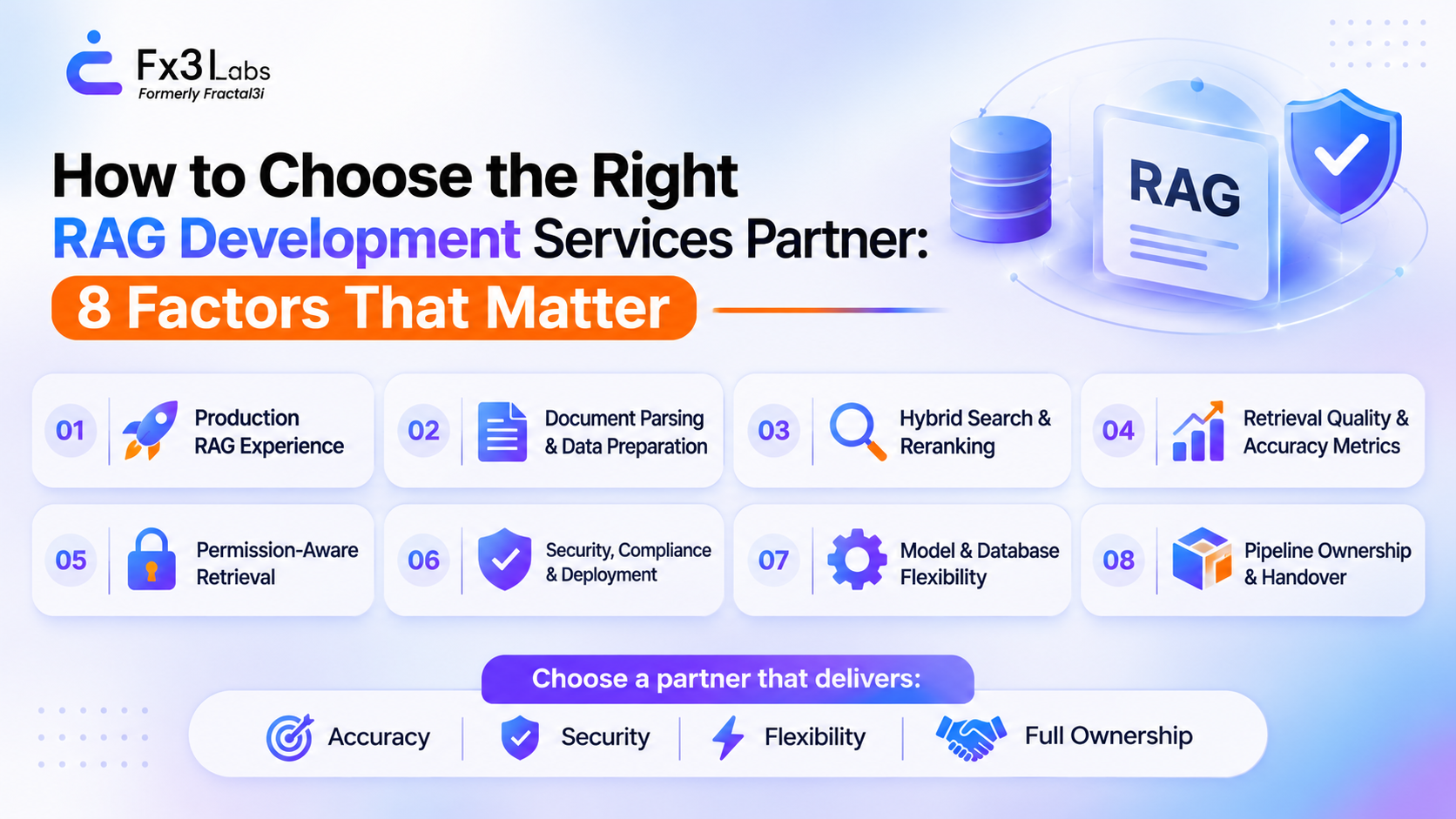
1. Have They Shipped RAG to Production on Documents Like Yours?
Ask for a RAG system that is live today on documents like yours in size, format, and mess. A demo on clean web pages says little about scanned contracts. Request the corpus size, question types, and one metric the client tracks.
2. How Will They Prepare Messy PDFs, Tables, and Scanned Files?
Parsing decides accuracy long before the model sees a question. Ask how they handle scanned files, tables, multi-column layouts, and version history. If your content needs cleanup, our guide to data readiness for AI shows what to fix.
3. Do They Go Beyond Basic Vector Search With Hybrid Search and Reranking?
Basic vector search often misses exact terms like part numbers, policy codes, and names. Strong partners combine keyword and semantic search, filter by metadata, and rerank results. Ask how each step changed accuracy in a past project.
4. Which Retrieval Quality Metrics Will They Commit to in Writing?
You need numbers here, not impressions from a demo. Build a golden question set from your own data and write these metrics into the statement of work. Then rerun them after every index or model change.
| Metric | What it tells you | What to agree before sign-off |
| Context precision | How much retrieved content is relevant | A minimum score on your question set |
| Context recall | Whether retrieval found all the evidence needed | A minimum score for multi-part questions |
| Faithfulness | Whether answers stay within retrieved evidence | A cap on unsupported claims |
| Answer relevance | Whether the answer addresses the question | A target score with human spot checks |
| Citation accuracy | Whether each cited source supports the claim | A sampled audit per release |
| Refusal behavior | Whether the system declines when evidence is missing | Test questions with no answer in your data |
| Latency and cost per query | Response time and spend per answer | A p95 latency limit and cost ceiling |
5. Will Retrieval Respect Your Existing User Permissions?
A RAG system should never show users documents they couldn’t open themselves. Ask how the partner syncs permissions from SharePoint, Google Drive, or your identity provider. For multi-tenant products, run the same check on every customer’s data.
6. What Security, Compliance, and Deployment Proof Can They Share?
Ask where your data, embeddings, and logs will live, and whether self-hosted models are an option. Request evidence for HIPAA, GDPR, UK GDPR, or SOC 2, not a slide of logos. Our breakdown of LLM security risks covers the tests worth requiring.
7. Can You Switch Models or Vector Databases Without a Rebuild?
Models and vector databases change fast, so you should be able to swap either without starting over. Ask for a model-agnostic design and an export path for your index. Our comparison of private and public AI models explains when self-hosting pays off.
8. Who Owns the Pipeline, Index, and Prompts After Launch?
Get ownership in writing for code, prompts, evaluation sets, embeddings, and infrastructure scripts. Confirm who re-indexes documents, monitors drift, and owns the handover. If the partner keeps all the knowledge, you’ve bought a dependency, not a system.
Also Read: Top 21 LLM Development Company Options
How Much Do RAG Development Services Cost?
Published vendor pricing puts a RAG proof of concept or MVP at $15,000 to $35,000. Production builds run $30,000 to $75,000, and enterprise platforms $60,000 to $150,000 or more. These are market ranges from published vendor pricing, not Fx31 Labs prices or quotes.
1. RAG Development Cost by Project Stage
Quotes for RAG development services grow with every data source, permission rule, and compliance control. Use these market ranges to sanity-check any quote.
| Stage | Typical scope | Timeline | Market range (USD) |
| Discovery and readiness assessment | Data audit, scoping, architecture, and a cost model | 1 to 2 weeks | Fixed fee, often credited to the build |
| Proof of concept or RAG MVP | One data source, basic retrieval, citations, and one interface | 2 to 10 weeks | $15,000 to $35,000 |
| Production RAG application | Multiple sources, hybrid retrieval, access controls, and monitoring | 8 to 16 weeks | $30,000 to $75,000 |
| Enterprise RAG platform | Agentic workflows, compliance controls, audit logs, and multi-team rollout | 3 to 6 months | $60,000 to $150,000+ |
2. What Does a RAG System Cost to Run After Launch?
The build is only half the budget. Plan for these monthly running costs from day one.
| Cost line | What drives it | How to keep it in check |
| Vector database hosting | Stored vectors, query volume, and plan minimums | Use a usage-based tier and archive stale content |
| Embeddings and re-indexing | How often documents change and the embedding model | Re-embed only changed chunks |
| LLM tokens per answer | Context per prompt and model tier | Rerank to fewer chunks and route simple questions to smaller models |
| Hosting and infrastructure | Private cloud, self-hosted models, and GPUs | Right-size compute after the pilot |
| Evaluation and monitoring | Test runs, tracing, and dashboards | Automate regression tests |
| Support and optimization | Tuning, model updates, and new sources | A monthly retainer with clear scope |
For scale, Pinecone’s pricing lists a $20 monthly Builder plan, a $50 monthly minimum on Standard, and $500 on Enterprise. Token spend usually grows faster than hosting, so our guide to AI token consumption explains how to control it.
3. Which Delivery Model Fits Your Budget and Team?
How you buy RAG implementation services matters almost as much as who you hire.
| Model | How it is priced | Best for | Watch for |
| Fixed-scope pilot or sprint | One fixed fee | Proving accuracy on one use case | Vague success criteria and scope creep |
| Project-based build | Time and materials, or milestones | Multi-source production systems | Budget drift without change control |
| Dedicated RAG team | Monthly fee per team | An ongoing roadmap of AI features | Underused capacity between releases |
| AI engineer augmentation | Monthly fee per engineer | In-house teams missing retrieval skills | Knowledge leaving when engineers roll off |
| In-house build | Salaries, tools, and hiring time | Strong ML teams wanting full control | Slow hiring and a steep learning curve |
If you plan to add specialists to your own team, our guide on how to hire LLM developers without overpaying covers rates and vetting.
4. What Pushes RAG Development Cost Up or Down?
Two projects with the same goal can differ by tens of thousands of dollars. These eight drivers explain most of the gap.
- Document Mess: Scanned files, tables, and inconsistent formats add parsing and testing work.
- Number of Sources: Every new connector adds build and upkeep effort.
- Permission Model: Role-based and per-document rules need careful testing.
- Accuracy Bar: Higher targets need larger question sets and more tuning rounds.
- Deployment Choice: Self-hosted models and private infrastructure cost more than managed cloud.
- Languages and Media: Multilingual or multimodal content needs extra models and evaluation.
- Agentic Actions: Systems that call tools or update records need guardrails and more testing.
- Compliance Scope: HIPAA, GDPR, UK GDPR, or EU AI Act duties add logging and reviews.
Also Read: How Much Does It Cost to Build an AI Agent?
Why Choose Fx31 Labs for RAG Development Services?
The best RAG development services prove accuracy on your own documents first, then give you a clean path to production when the numbers hold up.
At Fx31 Labs, we put the unglamorous work first, from parsing messy files to proving accuracy before launch. Our work includes a GenAI-assisted in-house HRMS built in five weeks by a two-person team and ERP integration for retail. Delivery runs on India-based engineering, backed by a US office in New Jersey.
Why teams choose us:
- Pilot Before You Commit: We scope a proof of concept around your own documents and agree on success metrics first.
- Proven Knowledge Retrieval: A plant assistant for a large manufacturer that answers staff questions from manuals, SOPs, and compliance documents.
- Fast GenAI Delivery: A functional HRMS portal built in 5 weeks by a two-person team using GenAI, with launch times reported up to 40% faster.
- Security in the Contract: Encryption, access controls, and NDAs cover the people and the data on your project.
- Honest Scoping: If a managed knowledge base will do the job, we say so before you spend on a custom build.
Ready to see what RAG can prove on your documents? Book a free consultation with our team and share one use case.
Conclusion: Choose the RAG Partner That Proves Accuracy on Your Own Documents
Every company on this list can talk about RAG with confidence. Far fewer can show retrieval metrics, permission handling, and running costs built on your real files, and that gap decides whether a pilot reaches production.
Start with the scenario table, shortlist three names, and run each through the eight factors. Compare RAG development services quotes for the same scope, including monthly running costs, then fund a proof of concept scored on your own question set.
We hope this guide helps you understand what RAG development services include, what they cost, and how to pick a partner you can trust.
Want a partner that can scope it, build it, and stay for the next stage? Connect with our experts to scope a pilot built on your own files and see the accuracy, timeline, and monthly running cost before you commit.
Frequently Asked Questions
1. What do RAG development services include?
RAG development services cover a knowledge audit, data parsing, indexing, retrieval tuning, cited answers, access control, and evaluation. Strong partners also set up monitoring and hand over documentation.
2. How much do RAG development services cost?
A proof of concept or MVP costs $15,000 to $35,000, and production systems run $30,000 to $75,000. Enterprise platforms reach $60,000 to $150,000+, plus monthly running costs.
3. How long does a production RAG build take?
A single-source build takes 6 to 10 weeks, while multi-source production builds take 8 to 16 weeks. Enterprise platforms with compliance controls take 3 to 6 months.
4. How do I choose the right RAG development company?
Ask for a live system on documents like yours, then check retrieval depth, permissions, and security proof. Get metrics like context precision and faithfulness in writing.
5. How is RAG different from fine-tuning?
RAG pulls current facts from your documents for each question, so answers stay fresh and cited. Fine-tuning changes how the model behaves through extra training.
6. Should we build RAG in-house or hire a RAG development company?
Build in-house if you have ML engineers and clean data governance. Hire a partner for RAG development services when you need production in weeks or face strict compliance rules.
7. Can a RAG system handle HIPAA or GDPR-regulated data?
Yes, if data, embeddings, and logs stay in approved environments and access rules apply at retrieval time. Ask for encryption, audit logs, and a signed BAA where HIPAA applies.
8. What is agentic RAG, and does our project need it?
Agentic RAG lets an AI agent run several searches and use tools before answering. You need it when questions span systems or trigger actions; simple document Q&A doesn’t.