
Top 21 LLM Development Company Options in 2026
Quick Answer: Your LLM Development Shortlist at a Glance
- What an LLM development company does: Builds LLM applications, RAG assistants, AI agents, and custom AI solutions.
- Typical cost: $5,000 for a proof of concept to $500,000+ for enterprise platforms, plus ongoing costs.
- How to choose: Check production experience, data security, evaluation, integration, and ownership terms.
- Best next step: Compare three suitable vendors and test your use case with a paid pilot.
An LLM can answer customer questions, summarize documents, and help automate business tasks in seconds. But when it gives inaccurate answers, struggles with company data, or produces rising API costs, a promising pilot can fall apart before reaching production.
That is why businesses need an LLM development company that can build reliable applications using RAG, fine-tuned models, backed by solid generative AI and LLM engineering. The challenge is finding a partner that can turn an impressive demo into a secure, practical solution that works with real business data.
Not every LLM development company takes the same approach. Some specialize in custom LLM development, while others focus on RAG pipelines, AI agents, or integrating existing models. Choosing the wrong fit can waste time and budget.
In this guide, you’ll learn:
- 21 LLM development company options worth shortlisting and their core strengths
- Which LLM approach fits your project
- 10 factors to evaluate before choosing a partner
- Questions to ask and red flags to watch for
- LLM development costs, timelines, and ongoing expenses
By the end of this guide, you’ll have a practical LLM development company shortlist and a clearer idea of which partner, approach, and budget fit your project.
What Does an LLM Development Company Do?
An LLM development company builds business applications around large language models (LLMs). It connects models to your data, improves their responses, integrates business systems, and ensures reliability after launch.
Unlike model providers such as OpenAI, Anthropic, and Google, development partners build and maintain solutions around these models. Learn more in our guide to choosing a generative AI development company.
Key LLM development services include:
- LLM strategy: Choosing the right model and approach for your use case.
- RAG development: Connecting models to business documents and databases.
- Fine-tuning: Adapting models to domain-specific tasks and outputs.
- AI agents: Automating tasks across tools and business systems.
- System integration: Connecting LLM applications with CRMs, ERPs, and APIs.
- Private deployment: Hosting models in controlled cloud or on-premises environments.
- Evaluation and guardrails: Testing accuracy, hallucinations, and safety.
- LLMOps and maintenance: Monitoring performance, reliability, and token costs.
Choose a partner that can handle testing, deployment, and ongoing maintenance, not just build a demo.
Which LLM Approach Does Your Project Actually Need?
Most projects can start with an existing model, prompting, and retrieval-augmented generation (RAG). Fine-tuning helps when you need consistent outputs or specialized domain language, while training from scratch is rarely necessary for typical business applications.
Approach | What it means | Indicative cost (market range) | Typical timeline | When it fits |
|---|---|---|---|---|
| Prompting plus RAG | Connects an existing model to your documents and data | $15,000 to $60,000 for a pilot | 4 to 12 weeks | Knowledge assistants, support, and internal search |
| Fine-tuning (LoRA or PEFT) | Trains a model further on examples | Adds $5,000 to $50,000 per training cycle | 4 to 8 extra weeks | Consistent formats, domain language, or smaller models |
| Continued pretraining | Trains a base model on a larger domain-specific dataset | Six figures and up | Several months | Specialized fields where fine-tuning falls short |
| Training from scratch | Builds a new foundation model | Millions in compute | 12+ months | Large platforms and model labs |
Start with RAG, measure its limitations, and fine-tune only when evaluations show a clear benefit. Our guide to RAG vs fine-tuning for enterprise ROI explains the trade-offs.
This distinction matters when comparing vendors. A custom model can increase development costs and maintenance needs without improving results. A capable LLM development partner should recommend the simplest approach that meets your requirements.
Also Read: Custom AI Development vs Off-the-Shelf AI: Which Fits Your Business?
How We Selected Each LLM Development Company on This List
We evaluated each LLM development company using the same five criteria, prioritizing verified services, real project evidence, and suitability for US and UK buyers. We checked company websites first and public directories second.
- Verified LLM services: Evidence of RAG, fine-tuning, AI agents, evaluation, or private deployment.
- Public proof: Named case studies or products demonstrating LLM work.
- Company size: Specialist and mid-size firms, excluding global consultancies, talent marketplaces, and model labs.
- US and UK fit: Offices, sales presence, or time-zone overlap for buyers in these markets.
- Delivery model: Team location and engagement options that affect cost and project risk.
We excluded third-party ratings and hourly rates because they can change frequently across platforms. Instead, each company profile includes its best-fit use case and a relevant caveat.
The list covers product development, scalable engineering teams, enterprise data platforms, AI agents, regulated industries, and nearshore delivery options aligned with US time zones.
Top 21 LLM Development Company Options for US and UK Buyers
Compare each LLM development company below by expertise, delivery model, locations, and best-fit projects.
Company | Offices | LLM focus | Delivery model | Best for |
|---|---|---|---|---|
| Fx31 Labs | Short Hills, NJ (US); India engineering | GenAI, LLM apps, RAG, AI agents, code modernization | Project builds, dedicated teams, AI talent augmentation | Startups and mid-market teams moving pilots to production |
| SoluLab | Los Angeles area and New York (US); Ahmedabad (India) | Custom LLMs, RAG, agents, private deployment | US-facing, India delivery | End-to-end GenAI and agent development |
| TechAhead | Agoura Hills, CA (US); Noida (India); Dubai | Domain-specific LLMs, RAG, multi-agent systems, red-teaming | US contract, offshore delivery | Mobile apps and GenAI under a US-based contract |
| Miquido | Kraków, Poland | Mobile LLM features, RAG, on-device AI | European delivery | UK and EU consumer brands and fintechs |
| Bacancy Technology | US, London (UK), and India | Custom LLMs, fine-tuning, self-hosted AI | Offshore teams with US and UK contacts | Scaling LLM engineering capacity |
| LeewayHertz | Gurugram, India; part of The Hackett Group | LLM applications and agents using ZBrain | Project-based and dedicated teams | Platform-led agentic AI for large organizations |
| Kanerika | Austin, TX (US); India; Singapore | LLMs across Microsoft Fabric, Databricks, and Snowflake | US-led, India delivery | LLM projects built around existing data platforms |
| Simform | US and India; UK presence via Armakuni | Agentic AI, RAG, AgentOps | Hybrid co-engineering | Azure-based agent programs and governance |
| Softweb Solutions | Plano, TX, and Chicago area (US); India | GenAI for IoT, manufacturing, and supply chains | US-led hybrid delivery | Industrial and supply-chain AI |
| Datatonic | London (UK); Europe; Canada | GenAI agents and GenOps on Google Cloud | UK and European consulting | Enterprises using Google Cloud |
| Vstorm | Wrocław, Poland | Agentic AI, RAG, LLMOps | Specialist remote team | Python-based AI agents and stalled pilots |
| Addepto | Warsaw, Poland; US entities | RAG, knowledge assistants, RAG evaluation | European delivery; part of KMS Technology | Document AI and knowledge assistants |
| Markovate | San Francisco and Chicago area (US); Toronto; India | Document and drawing AI, agents | Product development and services | Manufacturing and construction document AI |
| Master of Code Global | Redwood City, CA (US); Winnipeg, Canada | Conversational AI, LLM security, RAG | Consulting-led managed teams | Secure customer-facing AI assistants |
| EffectiveSoft | San Diego and other US cities; Costa Rica; Poland | LLM integration, evaluation pipelines, LLMOps | US, nearshore, and European teams | Healthcare and fintech applications |
| MindInventory | Ahmedabad, India; Ohio (US); Stafford (UK) | Evaluation, private deployment, AI agents | Offshore engineering with US and UK contacts | Healthcare projects needing UK-based contact |
| Geniusee | Austin, TX (US); Warsaw; Stockholm; Kyiv | LLM products, RAG, guardrails | Dedicated teams, primarily Ukraine-based | Fintech and edtech scale-ups |
| InData Labs | Nicosia, Cyprus; Miami sales office (US) | Data science and LLM integration | Remote agile delivery | Startups combining machine learning and LLMs |
| HatchWorks AI | Atlanta, Chicago, and Dallas (US); Latin America | Fine-tuning, evaluation, model routing, agents | US-led, nearshore engineering | US mid-market teams seeking time-zone overlap |
| Azumo | San Francisco (US); remote teams in Latin America | RAG, fine-tuning, guardrails, private hosting | Nearshore remote teams | US product teams needing LLM engineers |
| Rootstrap | Los Angeles (US); Montevideo; Buenos Aires; Medellín | LLM features and evaluation for live products | Nearshore product engineering | Growth-stage SaaS companies adding LLM features |
Let’s take a look at each one in detail.
1. Fx31 Labs
Fx31 Labs helps businesses build and scale AI solutions, from generative AI applications and RAG-powered assistants to AI agents and custom machine learning systems. Its team supports the entire development journey, with dedicated engineers available as your project grows.
The results? Fx31 Labs built an in-house HRMS in just 5 weeks using GenAI and a two-person team. Its automated code refactoring platform also achieved over 70% precision and reduced refactoring time by 30% to 40%.
These results demonstrate how Fx31 Labs applies AI to solve practical business challenges, speed up development, and improve operational efficiency.
If you’re looking for an LLM development partner to turn your AI ideas into scalable, production-ready solutions, Fx31 Labs is worth considering.
Key Highlights:
- Office locations: Short Hills, New Jersey, with India-based engineering.
- Delivery options: Project-based development, dedicated teams, and AI talent augmentation.
- LLM and ML services: Covers custom ML and data science alongside generative AI and LLM applications.
- Code modernization: Its Coderbotics AI platform uses 40+ specialized agents to support legacy code modernization and migration.
- Pricing: No public rate card. Costs are scoped according to project requirements.
Best for: Startups and mid-market businesses that need production-ready LLM applications, custom AI development, or dedicated engineering support without enterprise-level overhead.
Connect with our experts to scope your LLM pilot and get a realistic estimate.
2. SoluLab
SoluLab builds custom LLM applications, AI agents, and copilots, covering fine-tuning, RAG, and private deployment. Its portfolio includes enterprise AI platforms, while its hybrid delivery model supports businesses moving from early-stage development to more complex GenAI solutions.
Key Highlights:
- Fine-tuning: Supports LoRA and QLoRA for specialized model adaptation.
- AI products: Its portfolio includes UpdateIA and InfuseNet.
- Industry focus: Has a strong Web3 background, so check its experience in your sector.
Best for: Startups and mid-market businesses building end-to-end GenAI solutions, particularly in fintech.
3. TechAhead
TechAhead combines custom LLM development with mobile and enterprise app engineering, helping US businesses build AI features into complete products. Its services include RAG, multi-agent systems, and private deployment, with evaluation and red-teaming to test safety before launch.
Key Highlights:
- Safety testing: Includes red-teaming and evaluation to identify risks before deployment.
- Public proof: ERIN, an agentic AI platform for employee referrals.
- Industry fit: Its mobile app background makes production LLM references worth checking.
Best for: US businesses building an app and GenAI solution together.
4. Miquido
Miquido is a Krakow-based product studio that adds LLM capabilities to mobile-first products. Its AI Kickstarter framework helps move ideas toward working products, with RAG, AI agents, on-device AI, and guardrails among its capabilities.
Key Highlights:
- AI features: Supports switching between large and small language models.
- Public proof: Built a travel-insurance voice assistant for PZU and a credit-scoring product for Nextbank.
- Product focus: AI complements its core mobile development work.
Best for: UK and EU consumer brands and fintechs adding AI to customer-facing apps.
5. Bacancy Technology
Bacancy Technology offers LLM development alongside a broad engineering workforce, with US and UK contact points and delivery teams in India. Its services cover custom models, RAG, fine-tuning, self-hosted deployment, and multilingual AI for businesses scaling their development capacity.
Key Highlights:
- Model adaptation: Supports LoRA and QLoRA fine-tuning.
- Public proof: Indite.io, a low-code enterprise AI workflow platform.
- Team selection: Ask for named senior LLM engineers rather than a general talent pool.
Best for: Businesses that need to expand LLM engineering capacity quickly.
6. LeewayHertz
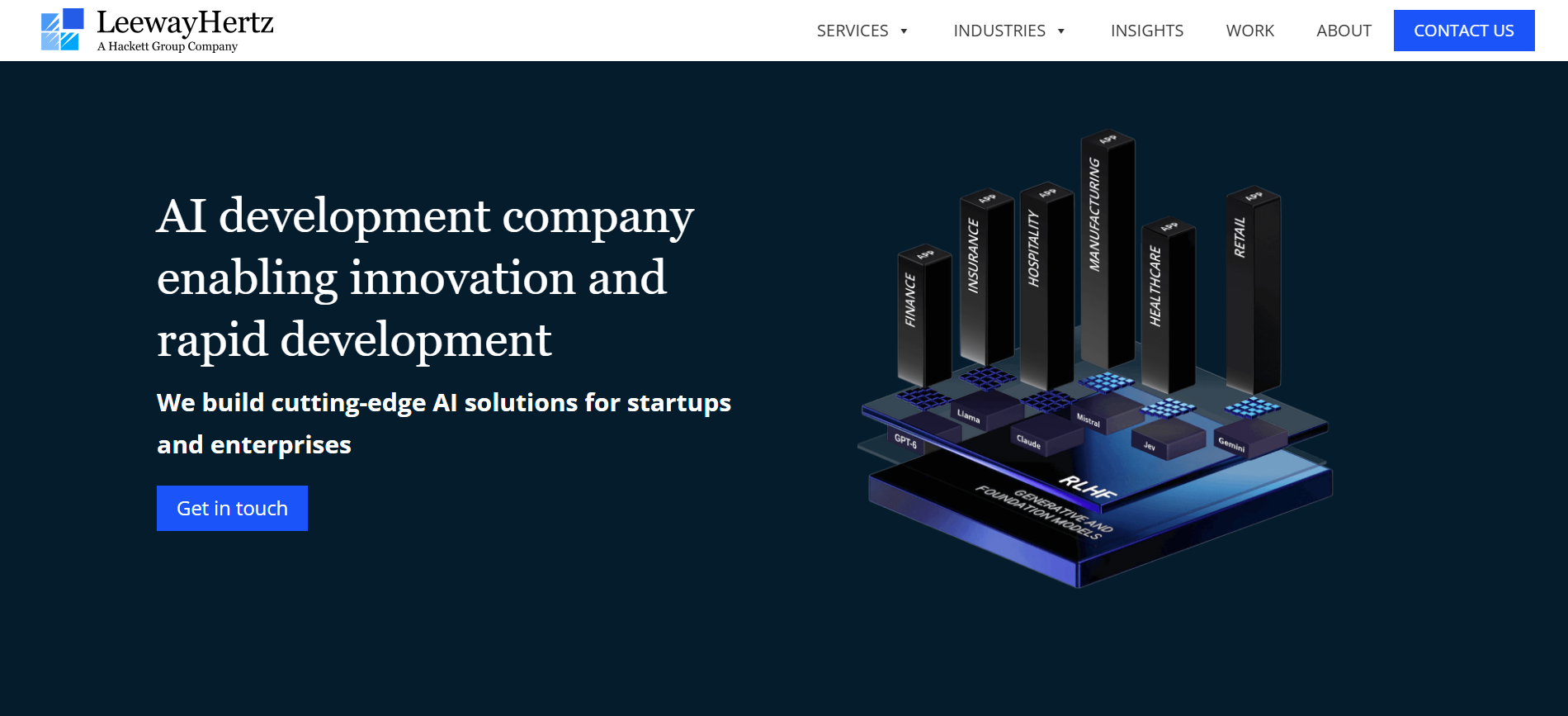
LeewayHertz, now part of The Hackett Group, develops LLM applications and AI agents through services and its ZBrain orchestration platform. ZBrain supports multiple model ecosystems, including Azure AI Foundry, AWS Bedrock, and Google Vertex AI, for enterprise AI workflows.
Key Highlights:
- Model flexibility: Supports multiple cloud AI platforms through ZBrain.
- Public proof: Its portfolio includes machinery troubleshooting and clinical decision-support applications.
- Vendor lock-in: Confirm whether ZBrain is required and how it affects future platform choices.
Best for: Large organizations building governed, platform-led AI agent solutions.
7. Kanerika
Kanerika brings its data engineering and analytics expertise into LLM development, making it relevant when AI must work with established enterprise data. Its services include RAG, fine-tuning, multi-model orchestration, and security controls across existing data environments.
Key Highlights:
- Data platforms: Works with Microsoft Fabric, Databricks, and Snowflake environments.
- Public proof: Includes vendor agreement processing and automated ticket resolution.
- UK presence: No UK office is listed, which may matter for buyers needing local support.
Best for: Businesses building LLM applications on top of existing data platforms.
8. Simform
Simform is a digital engineering firm with an agentic AI practice focused on enterprise platforms, particularly Microsoft Azure. Its ThoughtMesh framework covers LLM integration, RAG, and governance, alongside services for managing AI agents throughout their lifecycle.
Key Highlights:
- AgentOps: Supports agent monitoring and lifecycle management.
- Public proof: Built an LLM-powered research retrieval platform for a psychology research community.
- Technology fit: Its Microsoft focus may be less suitable for teams centered on AWS or Google Cloud.
Best for: Azure-based enterprises developing governed, multi-agent AI systems.
9. Softweb Solutions
Softweb Solutions, an Avnet company, focuses on generative AI for industrial and operational data. Its Needle framework supports document and data intelligence projects, making its work particularly relevant to manufacturers and supply-chain businesses connecting AI with real-world operations.
Key Highlights:
- Industrial expertise: Combines GenAI with IoT and operational data.
- Public proof: Its portfolio includes a patent data intelligence system built on Needle.
- Specialization: Less suited to startups building standalone LLM products.
Best for: US manufacturers and supply-chain businesses adopting GenAI.
10. Datatonic
Datatonic is a London-based data and AI consultancy specializing in Google Cloud. It develops GenAI agents for customer service, back-office operations, and productivity, with managed GenOps services to help businesses run and maintain them after deployment.
Key Highlights:
- GenAI operations: Supports MLOps and Gemini Enterprise rollout.
- Public proof: Projects include holiday planning for Hotelplan Suisse and invoice processing for Liberty Global.
- Platform fit: Its Google Cloud focus may not suit Azure- or AWS-first teams.
Best for: UK and European enterprises building production GenAI on Google Cloud.
11. Vstorm
Vstorm is a specialist consultancy focused on agentic AI, RAG, and Python-based LLM applications. Its team contributes to open-source AI frameworks and also helps businesses recover stalled pilots, with services covering evaluation, deployment, and ongoing operations.
Key Highlights:
- Open-source expertise: Works with Pydantic AI, LangChain, and LlamaIndex.
- Public proof: Projects include medical triage using clinical guidelines and an order recommendation agent for Mixam.
- Location consideration: Based in Poland, with no US or UK office confirmed on its own site.
Best for: Engineering teams building Python AI agents or rescuing stalled pilots.
12. Addepto
Addepto is a Warsaw-based AI consultancy now part of KMS Technology. It combines LLM development with knowledge products and evaluation tooling, including ContextCheck, an open-source tool for testing RAG chatbots, helping teams assess retrieval quality before deployment.
Key Highlights:
- Evaluation tools: ContextCheck supports RAG chatbot testing.
- Public proof: Its portfolio includes an AI assistant for passenger experience in aviation.
- Company structure: Its integration into KMS Technology is a factor to consider when selecting the delivery team.
Best for: Businesses building document AI and knowledge assistants with evaluation built in.
13. Markovate
Markovate combines LLM development with vertical AI products for manufacturing and construction. Its tools for blueprint classification and AI estimating focus on practical tasks such as interpreting drawings, processing documents, and preparing quotes, rather than general-purpose chat alone.
Key Highlights:
- Vertical products: Offers blueprint classification and AI estimating tools.
- Public proof: Its work includes ERP order-management agents and insurance document processing.
- Delivery clarity: Confirm engineering locations and team structure before signing.
Best for: Manufacturing and construction firms automating document-heavy workflows.
14. Master of Code Global
Master of Code Global brings deep conversational AI experience to LLM development, including LOFT, its open-source LLM orchestration framework. It also offers fixed-budget AI pilots, helping businesses test a use case before committing to a larger implementation.
Key Highlights:
- Security: Offers LLM security filtering and AI bot security audits.
- Public proof: Its portfolio includes a HIPAA-compliant bot.
- Technical fit: Check its experience with back-end AI agents beyond conversational systems.
Best for: Brands building secure, customer-facing AI assistants.
15. EffectiveSoft
EffectiveSoft combines software engineering with LLM integration, evaluation, and governance. Its services cover everything from fine-tuning and API integration to LLMOps, with particular relevance for businesses that need to manage accuracy, security, and compliance in production.
Key Highlights:
- Evaluation: Supports LLM-as-a-judge pipelines and guardrails.
- Public proof: Its work includes AI integration for medical coding software and an ETL platform modernized with agentic AI.
- Model selection: Ask which current models it recommends for your use case.
Best for: Healthcare, fintech, and software companies adding LLMs to regulated products
16. MindInventory
MindInventory combines LLM engineering with structured testing and deployment practices. Its approach includes gateway fallbacks, tracing, evaluation harnesses, and model decision records, helping teams monitor application quality and make model choices more transparent.
Key Highlights:
- Evaluation: Uses testing harnesses to assess LLM performance.
- Public proof: Sully AI, a multi-agent clinical documentation product.
- Team structure: Confirms the support and communication arrangements across its regional offices.
Best for: US and UK businesses, especially healthcare providers, seeking a disciplined LLM implementation.
17. Geniusee
Geniusee develops LLM products across the full delivery cycle, from data preparation and prompt design to deployment. Its services cover RAG, fine-tuning, guardrails, and evaluation, with private, on-premises, and hybrid options for different infrastructure needs.
Key Highlights:
- AI delivery: Covers development from data preparation through deployment.
- Public proof: Its portfolio includes customer-support AI agents developed with Forethought and its Imagine AI recruitment platform.
- Team continuity: Ask how engineering coverage is maintained if disruptions affect its Ukraine-based team.
Best for: Fintech and edtech scale-ups needing full-cycle LLM development.
18. InData Labs
InData Labs builds on its data science and machine learning expertise to develop LLM applications. Its services span strategy, proofs of concept, RAG, fine-tuning, and AI agents, making it relevant for businesses that need more than a model integration alone.
Key Highlights:
- ML expertise: Combines traditional machine learning with LLM development.
- Client portfolio: Names Flo and Captiv8 among its clients.
- Production evidence: Ask for examples of LLM applications already running in production, as many published cases focus on analytics.
Best for: Startups and mid-market businesses combining machine learning with LLM features.
19. HatchWorks AI
HatchWorks AI combines US-led delivery with nearshore engineering across Latin America. Its forward-deployed engineers work closely with client teams, while its AI-driven development approach aims to move projects from initial strategy into production.
Key Highlights:
- Model optimization: Covers benchmarking, model routing, and cost and latency tracking.
- Public proof: Its projects include RAG-based fleet insights for Cox and an AI virtual assistant for aircraft maintenance.
- Geographic fit: Its delivery model favors the Americas rather than UK-based collaboration.
Best for: US businesses seeking AI development with strong time-zone overlap.
20. Azumo
Azumo provides nearshore AI engineering for businesses that want their development teams working in compatible time zones. Its LLM services include RAG with citations, model fine-tuning, AI agents, and deployment across major cloud AI platforms.
Key Highlights:
- Fine-tuning methods: Supports SFT, RLHF, and DPO.
- Public proof: Its portfolio includes a GenAI content platform for Omnicom and semantic search for Meta.
- Remote collaboration: UK buyers should account for limited working-hour overlap.
Best for: US product teams that need a nearshore LLM engineering partner.
21. Rootstrap
Rootstrap helps businesses add LLM features to established digital products, covering RAG over proprietary data, agentic workflows, and voice AI. Its delivery approach also includes evaluations and observability to help teams track quality after release.
Key Highlights:
- Product monitoring: Uses evaluations and observability to track LLM performance.
- Client relationships: Its portfolio includes long-running product work for MasterClass and Madison Reed.
- Case-study validation: Ask for examples specifically demonstrating LLM features, as its named client work is not all LLM-focused.
Best for: Growth-stage SaaS companies adding AI capabilities to existing products.
Now you have seen the 21 companies side by side, so let’s take a look at what makes a strong LLM development partner.
How to Choose the Right LLM Development Company: 10 Factors That Matter
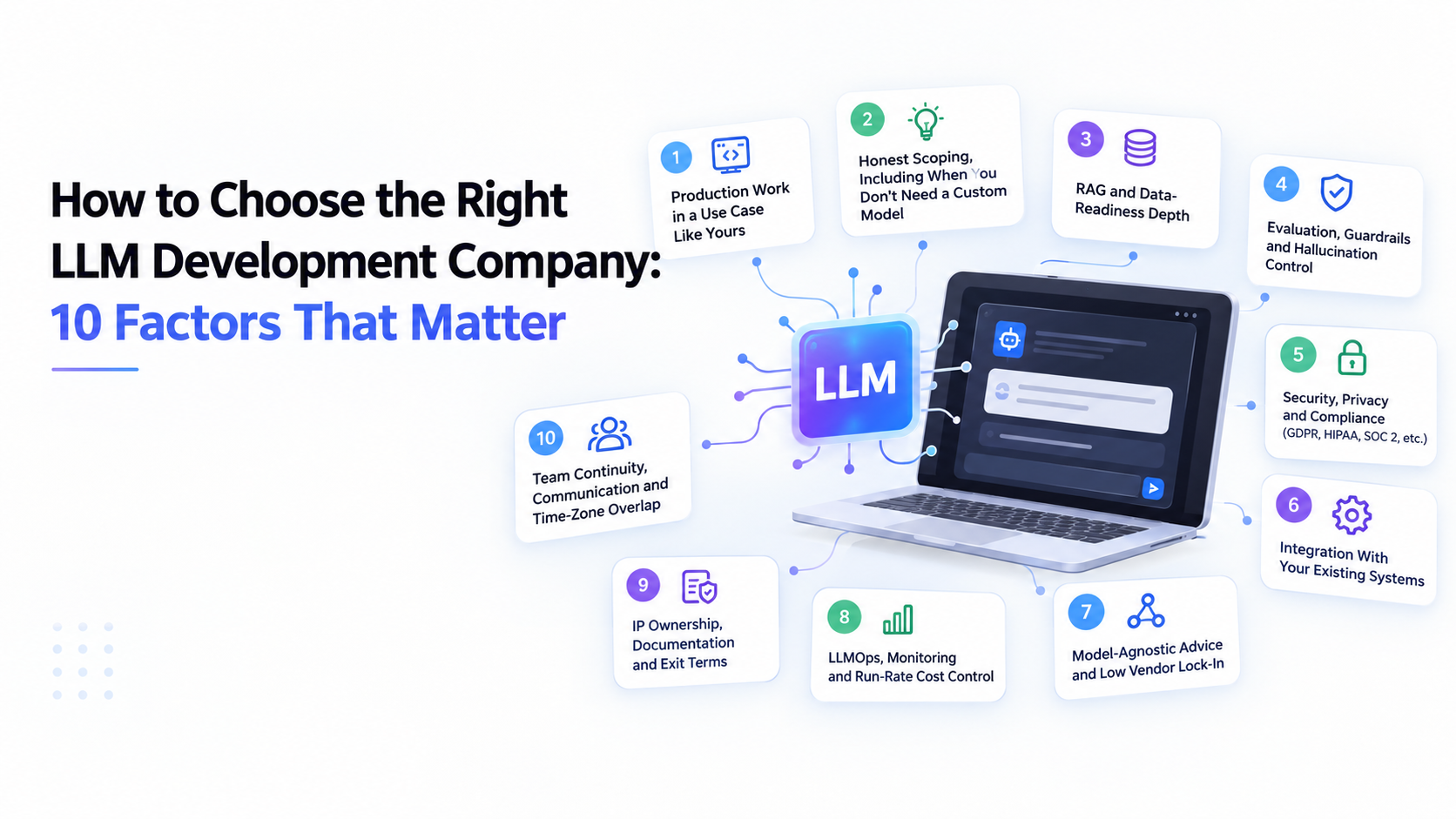
Choose a partner with proven production experience, honest recommendations, strong security, and clear ownership. Use these ten criteria to compare every LLM development company fairly.
1. Production Work in a Use Case Like Yours
Ask for a live LLM application built for a use case similar to yours, not just a polished demo. Check how the team handled real users, messy documents, and unexpected inputs after launch. Relevant production experience shows whether the vendor can build a reliable solution beyond the prototype stage.
2. Honest Scoping, Including When You Don’t Need a Custom Model
A reliable partner recommends the simplest approach that meets your needs, even if it means a smaller project. Prompting and RAG may be enough, while fine-tuning makes sense only when testing shows a clear benefit. Be cautious if every proposal pushes custom model development without explaining why.
3. RAG and Data-Readiness Depth
RAG quality depends on how well your data is prepared, indexed, and retrieved. Ask how the team handles document cleaning, chunking, permissions, and outdated information. If the vendor cannot explain its data strategy clearly, accuracy may suffer when the system meets real business content.
4. Evaluation, Guardrails and Hallucination Control
Do not accept claims like “it looks accurate” without measurable results. Ask for tests based on real business questions, with accuracy, retrieval quality, and hallucination risks evaluated before launch. Guardrails should also be built early to filter unsafe inputs and unreliable outputs.
5. Security, Privacy and Compliance (GDPR, UK GDPR, HIPAA, SOC 2, EU AI Act)
Ask where your data is stored, which model providers receive it, and who can access prompts and logs. Confirm how the solution addresses applicable requirements, including GDPR, UK GDPR, HIPAA, SOC 2, and the EU AI Act. Our guide to LLM security risks covers key threats to discuss.
6. Integration With Your Existing Systems
An LLM delivers limited business value if it cannot connect with your CRM, ERP, or ticketing tools. Ask about previous integrations, authentication, data permissions, and how the application writes results back to existing systems. Integration complexity can affect delivery time more than the choice of model.
7. Model-Agnostic Advice and Low Vendor Lock-In
A strong partner compares OpenAI, Anthropic, Google, and open-weight models such as Llama or Mistral against your actual requirements. Be cautious if a vendor pushes one provider or proprietary platform without clear technical reasons. Flexible architecture helps you change models as performance, pricing, and business needs evolve.
8. LLMOps, Monitoring and Run-Rate Cost Control
LLM costs and performance can change after launch, so monitoring must continue in production. Ask how the team tracks latency, token usage, quality drift, and failures, and who handles issues after go-live. Cost controls such as caching, alerts, and routing simpler tasks to cheaper models can reduce ongoing spend.
9. IP Ownership, Documentation and Exit Terms
Your contract should clearly define ownership of source code, prompts, configurations, and custom model assets. Confirm how data, embeddings, and fine-tuned models are handled under the agreement, since ownership can depend on the technology and contract terms. Require clear documentation and an exit plan, so another team can take over if needed.
10. Team Continuity, Communication and Time-Zone Overlap
Ask who will work on your project, who leads technical decisions, and whether the same people will stay through delivery. Confirm working-hour overlap, meeting frequency, progress reporting, and how decisions are documented. Clear communication and team continuity help prevent delays, rework, and unexpected costs.
Also Read: Private AI Models vs Public AI: What Enterprises Should Know About Security.
Red Flags and Questions to Ask Before You Sign
Vague answers about testing, data security, or ownership are warning signs. Use this checklist to assess every LLM development company on your shortlist before signing.
Red Flags That Should End the Conversation
- No production references: Every example is a demo, prototype, or project the vendor cannot verify.
- Custom models by default: The proposal recommends fine-tuning or training before testing whether RAG will work.
- No evaluation plan: The vendor promises accuracy but cannot explain how it will be measured.
- Vague data handling: The team cannot confirm where your data is stored or which models can access it.
- Unclear ownership: The contract does not define ownership of code, prompts, embeddings, or fine-tuned models.
- Provider lock-in: The solution depends on one model provider or proprietary platform without a clear reason.
- Fixed pricing without discovery: The vendor quotes a firm price before reviewing your data, systems, and requirements.
Questions to Ask on the First Vendor Call
Ask these questions to compare vendors on technical ability, security, cost, and long-term support. Strong answers should include clear examples, measurable plans, and named responsibilities. If a vendor avoids specifics, ask for written details before moving forward.
- Can you show us an LLM application you built that is live in production?
- Would you recommend RAG, fine-tuning, or another approach for our use case, and why?
- How will you measure accuracy, retrieval quality, and hallucination rates before launch?
- Where will our data be processed and stored, and which third-party models will receive it?
- Who owns the code, prompts, embeddings, and custom model assets when the project ends?
- Which named engineers will work on our project, and how much time will they commit?
- What will our monthly operating costs look like after launch, and how will you control them?
- How can we transfer the system to another team or vendor if our needs change?
Also Read: Switching Software Development Vendors: 7-Step Guide to a Smooth Transition.
1. Build Cost by Stage: Proof of Concept to Enterprise Scale
Your budget depends on the solution’s complexity, data needs, integrations, and production requirements. Use these ranges to estimate the initial build cost, delivery time, and monthly operating expenses. Actual costs vary with scope, traffic, security, and the level of ongoing support required.
| Stage | What you get | Build cost (market range) | Typical timeline | Monthly run-rate |
|---|---|---|---|---|
| Proof of concept | Working prototype using one model and a small data sample | $5,000 to $15,000 | 2 to 4 weeks | Minimal |
| MVP or pilot | One use case with RAG, basic evaluation, and limited users | $15,000 to $60,000 | About 3 months | $500 to $3,000 |
| Production system | Integrations, guardrails, monitoring, and access controls | $60,000 to $180,000 | 3 to 6 months | $3,000 to $10,000 |
| Enterprise scale | Multi-workflow or multi-agent platform with governance and compliance | $180,000 to $500,000+ | 6 to 9 months | $10,000 to $100,000+ |
These estimates align with the market ranges in our AI agent development cost breakdown, which explains each cost tier in more detail.
2. Run-Rate Costs Most Budgets Miss
Development is only the upfront expense because a live LLM application continues to incur costs after launch. Include these recurring and periodic expenses in your budget to avoid underestimating the total cost of ownership.
- Model API usage: Around $500 to $15,000 per month for a low-traffic workflow, with higher costs for busy, multi-agent systems.
- Vector database and hosting: Around $50 to $5,000 per month for retrieval infrastructure, plus cloud compute that increases with usage.
- Evaluation and observability: Around $200 to $5,000 per month for tools that track quality, latency, errors, and spending.
- Human review: Often $2,000 to $15,000 per month when experts must check outputs before they reach users.
- Retraining cycles: Around $5,000 to $50,000 per cycle for fine-tuning and model refreshes, when required.
- Maintenance and support: Budget for fixes, model updates, monitoring, and improvements based on the system’s complexity and service needs.
As a planning estimate, budget 1.5 to 2 times the initial build cost for the first 12 months, then adjust it to your expected usage and support needs. Our guide to AI token consumption and cost optimization explains ways to manage model spending.
3. Hourly Rate Bands by Delivery Region
Engineering rates vary by region, experience, and project complexity. These blended market ranges help you compare delivery options, but time-zone overlap and the total hours required also affect the final cost.
| Delivery region | Blended hourly rate (market range) | Time-zone fit for US buyers | Time-zone fit for UK buyers |
|---|---|---|---|
| US and Canada | $150 to $300 | Full overlap | Partial overlap |
| Western Europe and UK | $80 to $200 | Partial overlap | Full overlap |
| Eastern Europe | $40 to $100 | Limited overlap | Strong overlap |
| Latin America | $50 to $90 | Strong overlap | Limited overlap |
| India and South Asia | $25 to $60 | Limited overlap, often bridged by shift planning | Partial overlap |
Hourly rates alone can be misleading. A lower-cost team that takes twice as long may cost more overall, so compare the estimated cost to reach production, including rework, integration, and ongoing maintenance.
4. What Pushes LLM Project Cost Up or Down
The largest cost differences usually come from data quality, integration complexity, security requirements, and model choice. Review these factors when comparing proposals, and ask vendors to explain the assumptions behind each estimate.
- Data readiness: Scattered, outdated, or poorly structured data can increase cleaning, preparation, and retrieval costs.
- Integration depth: Read-only connectors are usually simpler, while each write-back integration may add $5,000 to $25,000 or more for major enterprise systems.
- Compliance scope: Preparing for HIPAA, SOC 2, GDPR, or the EU AI Act can add $15,000 to $100,000+, depending on the system and applicable requirements.
- Approach choice: RAG with an existing model is generally less expensive than repeated fine-tuning or continued pretraining.
- Traffic and model choice: High usage of large models increases monthly spending, while routing simpler tasks to smaller models can reduce it.
- Security testing: Red-teaming and prompt-injection defenses may add $5,000 to $50,000 upfront, with further costs for ongoing testing.
Why Trust Fx31 Labs for Custom LLM Development?
Choosing an LLM development company is easier when its experience matches your product, data, and delivery needs.
Fx31 Labs builds AI and software products with India-based engineering and a US office in New Jersey. Its published work includes a GenAI-built HRMS delivered in 5 weeks and AI predictive analytics for commodity trading at 99.99% uptime.
Its team supports the journey from LLM application development to deployment, including RAG, AI agents, system integration, and code modernization. Flexible engagement options help businesses start with a defined project and expand engineering support as their needs grow.
- Full LLM development: Generative AI applications, RAG, AI agents, and system integration handled by one team.
- Flexible engagement: Project-based builds, dedicated teams, and AI talent augmentation to match your roadmap.
- Legacy modernization: Coderbotics AI uses 40+ specialized agents to support code modernization and migration.
- Faster first releases: Fx31 Labs reports that its rapid MVP approach can reduce launch time by up to 40%.
Want to see how these capabilities translate into real projects?
Ready to build your LLM solution? Book a free consultation with our LLM experts today and get a tailored roadmap for your project.
Conclusion: Choose Your LLM Partner Based on Proof
Choosing the right LLM development company comes down to proven results, technical expertise, clear costs, and control over your solution. Focus on what each team has delivered, not just its promises or position on a list.
Start with one business use case, compare three suitable vendors, and ask each LLM development company how it will measure accuracy, latency, and cost. Run a paid pilot with clear acceptance criteria before committing to a larger build.
We hope this guide helps you compare vendors, understand LLM development costs, and choose an approach that fits your business needs.
Frequently Asked Questions
1. What does an LLM development company do?
It builds LLM applications such as RAG assistants, AI agents, and fine-tuned models, including integrations, testing, and ongoing maintenance.
2. How much does LLM development cost?
A proof of concept may cost $5,000 to $15,000, a pilot $15,000 to $60,000, and a production system $60,000 to $180,000. Enterprise platforms can exceed $500,000, plus ongoing costs.
3. How long does an LLM project take?
A pilot typically takes around three months, a production system three to six months, and an enterprise platform six to nine months.
4. Do I need a custom LLM, or is RAG enough?
Most projects can start with an existing model and RAG. Fine-tuning is useful when you need more consistent outputs or specialized domain language.
5. What is the difference between an LLM developer and an LLM provider?
Providers such as OpenAI and Anthropic supply models. An LLM development company builds applications around them, including data pipelines, integrations, testing, and maintenance.
6. Is it safe to share business data with an LLM development partner?
It can be, with proper safeguards. Confirm data storage, model access, log permissions, contract terms, and private deployment options.
7. Should US and UK businesses hire an offshore or nearshore LLM development company?
Yes, if the team has the right expertise, communication, and working-hour overlap. Latin America often suits US teams, while Eastern Europe and India can suit UK teams.
8. Who owns the code, prompts, and fine-tuned models after delivery?
Your contract should clearly define ownership of code, prompts, retrieval components, embeddings, and custom model assets. Require documentation and a clear handover process.