
Healthcare App Development Cost in 2026: Features, Compliance and Timelines
Key Takeaways: Healthcare App Development Cost
- Build budget: MVPs cost $40,000 to $90,000, while production apps typically cost $90,000 to $200,000.
- Compliance costs: HIPAA safeguards can add $15,000 to $50,000, with additional costs for NHS or medical device requirements.
- Development timeline: MVPs take 3 to 5 months, while production apps typically need 5 to 9 months.
- Long-term expenses: Total yearly running costs, including hosting, security, and services, usually reach 40% to 60% of the build.
- Smarter savings: Focus on essential features, shared codebases, and proven integrations without cutting security or compliance.
All figures are market estimates, not fixed vendor quotes. Actual costs depend on your app’s scope, integrations, compliance needs, and development team.
Healthcare app development costs can climb from $40,000 for a focused MVP to more than $500,000 for a regulated enterprise platform. Most production apps cost between $90,000 and $200,000, but the final budget depends on clinical workflows, integrations, security, and compliance.
Missing these requirements early can turn an affordable estimate into an expensive project, so it helps to understand the full scope of mobile app development before you set a budget.
That risk is significant in healthcare, where protecting patient data is essential. In 2025, more than 770 breaches affecting 500 or more people were reported to the US Department of Health and Human Services (HIPAA Journal, 2026).
Meeting HIPAA controls, EHR integrations, and NHS assessments takes extra planning and development work, which can raise your total cost if overlooked.
So, what should you budget for before development begins? This guide breaks down healthcare app development cost by app type, features, compliance requirements, and development timelines, helping you understand where the money goes and how to avoid unexpected expenses.
In this guide, you’ll learn:
- Healthcare app development cost by build tier and app type
- Feature-level pricing and typical development hours
- How HIPAA, UK GDPR, NHS, and FDA requirements affect your budget
- Realistic development timelines and common delays
- Healthcare app maintenance cost and three-year ownership expenses
- Ways to reduce costs without compromising security or compliance
By the end of this guide, you’ll have a practical healthcare app development cost range, a clearer view of the compliance requirements for your market, and a checklist of what a complete development quote should include.
How Much Does It Cost to Build a Healthcare App?
Most healthcare apps cost $40,000 to $200,000 to build, while regulated platforms can exceed $500,000. Your healthcare app development cost depends on the app type, features, integrations, and compliance requirements.
| Build tier | What you get | Market range | Typical timeline |
| Clickable prototype | Interactive screens and user flows for testing, without live patient data | $8,000 to $25,000 | 2 to 4 weeks |
| Focused MVP | One core workflow, cross-platform app, and essential security controls | $40,000 to $90,000 | 3 to 5 months |
| Production app | iOS and Android apps, backend, admin panel, integrations, and HIPAA or UK GDPR controls | $90,000 to $200,000 | 5 to 9 months |
| Enterprise or regulated platform | Multiple roles and sites, deep integrations, NHS assurance, or medical device requirements | $200,000 to $500,000+ | 9 to 18 months |
These are market estimates, not fixed quotes. Your final healthcare app development cost depends on your location, team model, scope, and required safeguards.
5 Steps to Estimate Your Healthcare App Development Cost
Step 1. Pick your build tier: Decide whether you need a prototype, an MVP for early users, or a production-ready app. Use the table above to set a realistic starting budget.
Step 2. Choose your app type: Match your product to the closest category in the next section. This helps identify the features, integrations, and compliance requirements to budget for.
Step 3. List essential features: Estimate development hours using the feature-cost table. Prioritize what users need at launch and move non-essential features to later releases.
Step 4. Add compliance costs: Check which rules apply to your target markets and include the relevant costs from the compliance table. If you operate in both the US and the UK, account for both sets of requirements.
Step 5. Budget for contingency and running costs: Set aside an additional 15% to 20% for unexpected work (separate from yearly maintenance). Also plan for annual operating costs of roughly 40% to 60% of the initial build cost.
For a useful comparison, see our app development cost guide for startups to understand how non-regulated apps are priced.
Healthcare App Development Cost by App Type
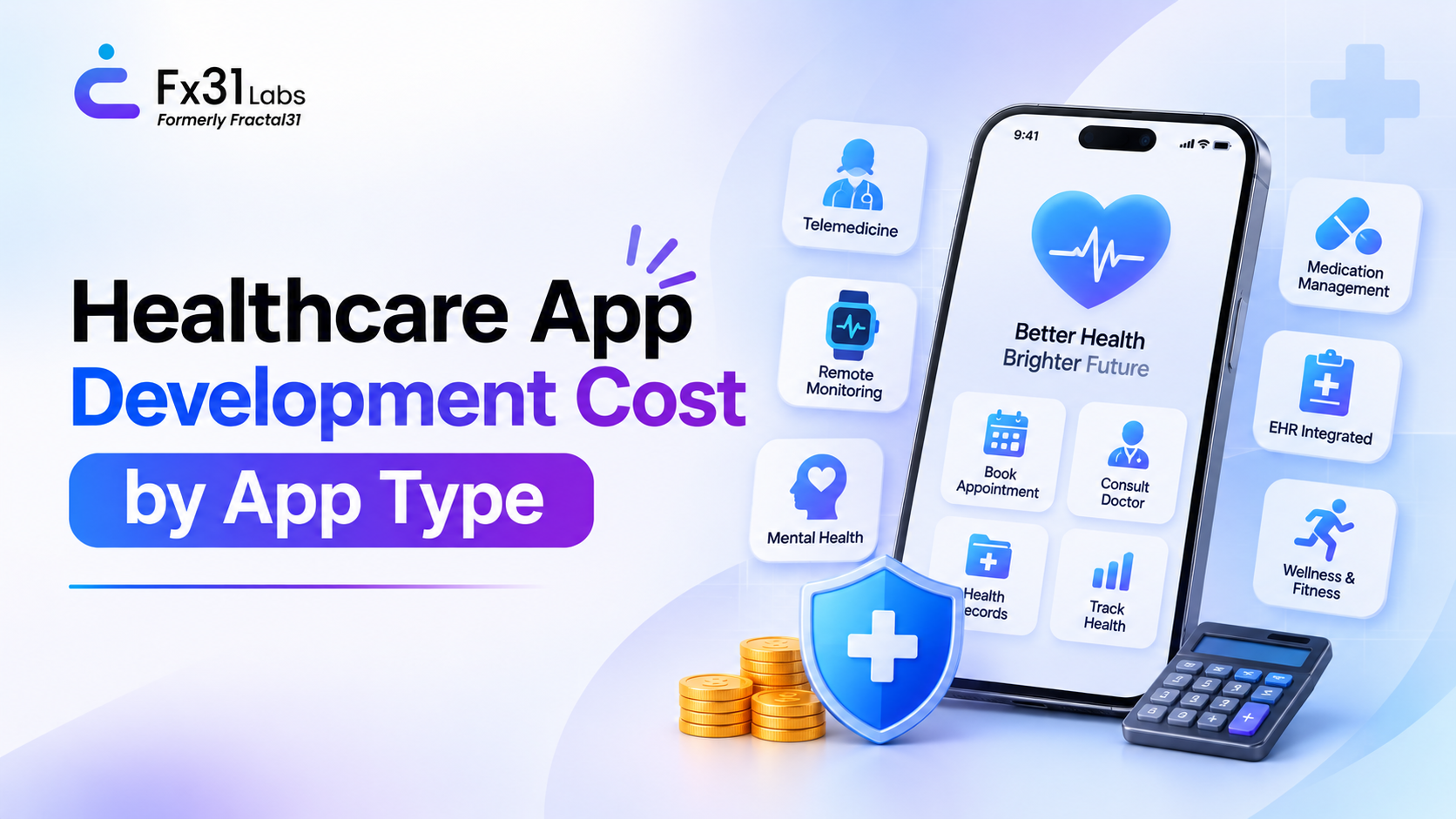
Your app type sets the starting budget. Features, integrations, and compliance requirements determine the final cost.
| App type | Core features | Market range | Typical timeline |
| Telemedicine and virtual care | Video calls, booking, chat, visit notes | $60,000 to $250,000+ | 4 to 9 months |
| Patient portal and appointment booking | Scheduling, test results, bills, secure messages | $40,000 to $150,000 | 3 to 6 months |
| Remote patient monitoring | Device sync, alerts, clinician dashboard | $80,000 to $300,000+ | 5 to 10 months |
| Mental health and teletherapy | Therapy sessions, mood tracking, crisis support | $60,000 to $200,000 | 4 to 8 months |
| Chronic care and medication management | Care plans, reminders, symptom logs | $50,000 to $180,000 | 4 to 8 months |
| EHR-integrated clinical app | Clinician workflows, EHR access, user roles | $100,000 to $400,000+ | 6 to 12 months |
| Wellness and fitness | Activity, sleep, nutrition, coaching | $40,000 to $120,000 | 3 to 6 months |
| AI health assistant and symptom checker | Symptom triage, patient Q&A, visit summaries | $80,000 to $350,000+ | 5 to 10 months |
These are market estimates, not fixed quotes. Integration complexity, user roles, and compliance requirements can create significant cost differences between apps in the same category.
1. Telemedicine and Virtual Care App
Telemedicine apps support video consultations, appointment booking, and patient communication. Costs range from $60,000 to $250,000+, depending on video quality, EHR integration, and e-prescribing.
- Must-have features: Booking, secure video, chat, visit notes, and payments.
- Biggest cost driver: Reliable video and clinical system integrations.
- Rules to plan for: HIPAA and BAAs in the US; UK GDPR and potentially DTAC in the UK.
2. Patient Portal and Appointment Booking App
Patient portals let users book appointments, view test results, pay bills, and contact care teams. Costs typically range from $40,000 to $150,000, with connected hospital, billing, and lab systems affecting the budget.
- Must-have features: Scheduling, results, bill payments, secure messages, and reminders.
- Biggest cost driver: Connecting scheduling, billing, and lab systems.
- Rules to plan for: HIPAA in the US and UK GDPR in the UK.
3. Remote Patient Monitoring App
These apps collect readings from devices such as glucose meters, blood pressure monitors, and wearables. Costs range from $80,000 to $300,000+, depending on device compatibility, alerts, and clinician dashboards.
- Must-have features: Device pairing, automatic readings, alerts, and trend reports.
- Biggest cost driver: Device integration and compatibility testing.
- Rules to plan for: HIPAA where applicable and medical device rules for regulated functions.
4. Mental Health and Teletherapy App
Mental health apps combine therapy sessions, mood tracking, journaling, and crisis support. Costs generally range from $60,000 to $200,000, depending on privacy controls and safety features.
- Must-have features: Session booking, video therapy, mood logs, and crisis support.
- Biggest cost driver: Risk alerts and escalation workflows.
- Rules to plan for: HIPAA where applicable, plus relevant FTC and state privacy laws.
5. Chronic Care and Medication Management App
These apps help patients manage long-term conditions with care plans, medication reminders, and symptom tracking. Costs typically range from $50,000 to $180,000, depending on integrations and caregiver access.
- Must-have features: Care plans, medication schedules, symptom logs, and caregiver access.
- Biggest cost driver: Long-term engagement features and care workflows.
- Rules to plan for: HIPAA where applicable and medical device rules for regulated functions.
6. EHR-Integrated Clinical App for Providers
Clinical apps connect with systems such as Epic or Oracle Health to support healthcare professionals. Costs range from $100,000 to $400,000+, depending on integration complexity, testing, and hospital security reviews.
- Must-have features: Single sign-on, SMART on FHIR, EHR access, and role-based views.
- Biggest cost driver: EHR integration, vendor approvals, and testing.
- Rules to plan for: HIPAA in the US; applicable DTAC, DSPT, and DCB0129 requirements for NHS projects.
7. Wellness and Fitness App
Wellness apps track activity, sleep, nutrition, and stress without diagnosing medical conditions. Costs usually range from $40,000 to $120,000, depending on wearable integrations, subscriptions, and coaching features.
- Must-have features: Activity tracking, goals, wearable sync, and coaching.
- Biggest cost driver: Wearable integrations and engaging content.
- Rules to plan for: Applicable US privacy laws, UK GDPR where relevant, and app store policies.
8. AI Health Assistant and Symptom Checker App
AI health assistants answer health questions, support symptom triage, or summarize visits. Costs range from $80,000 to $350,000+, depending on clinical safeguards, testing, integrations, and ongoing AI usage.
- Must-have features: Symptom triage, approved knowledge sources, human escalation, and audit logs.
- Biggest cost driver: Clinical evaluation, safety controls, and AI usage.
- Rules to plan for: HIPAA or UK GDPR where applicable, plus FDA or MHRA rules for regulated functions.
Need a project-specific estimate? Share your app type, target market, and integrations to get a scoped healthcare app estimate covering development, compliance, and running costs.
How Much Do Healthcare App Features Cost?
Individual features can add $1,600 to $72,000 to your healthcare app development cost, depending on development hours and team rates. The estimates below use $40/hr for offshore teams and $150/hr for US or UK teams.
| Feature | Typical hours | Offshore ($40/hr) | US or UK ($150/hr) |
| Sign-up, identity verification and consent | 60 to 120 | $2,400 to $4,800 | $9,000 to $18,000 |
| Appointment scheduling and calendar sync | 80 to 160 | $3,200 to $6,400 | $12,000 to $24,000 |
| Secure video consultations (via SDK) | 120 to 240 | $4,800 to $9,600 | $18,000 to $36,000 |
| Secure messaging and file sharing | 80 to 160 | $3,200 to $6,400 | $12,000 to $24,000 |
| EHR integration via FHIR (per system) | 200 to 480 | $8,000 to $19,200 | $30,000 to $72,000 |
| E-prescribing and pharmacy links | 160 to 320 | $6,400 to $12,800 | $24,000 to $48,000 |
| Wearable and device data sync | 120 to 240 | $4,800 to $9,600 | $18,000 to $36,000 |
| Payments, insurance and billing | 120 to 280 | $4,800 to $11,200 | $18,000 to $42,000 |
| Medication reminders and notifications | 40 to 80 | $1,600 to $3,200 | $6,000 to $12,000 |
| Audit logs, access control and consent records | 80 to 200 | $3,200 to $8,000 | $12,000 to $30,000 |
| Admin dashboard and reporting | 120 to 240 | $4,800 to $9,600 | $18,000 to $36,000 |
| Lab results and document upload | 60 to 120 | $2,400 to $4,800 | $9,000 to $18,000 |
| Multi-language support | 40 to 120 | $1,600 to $4,800 | $6,000 to $18,000 |
| Offline mode and data sync | 80 to 200 | $3,200 to $8,000 | $12,000 to $30,000 |
| AI symptom triage or virtual assistant | 200 to 480 | $8,000 to $19,200 | $30,000 to $72,000 |
These estimates cover development only. Discovery, UI/UX design, QA, security testing, and project management need separate budgets.
Features That Can Increase Costs
- EHR integration: Costs depend on the vendor, data access, read/write requirements, and hospital approval process. FHIR support can simplify data exchange, but each integration needs testing.
- E-prescribing: US apps may require certified networks such as Surescripts, with additional DEA security requirements for controlled substances. NHS apps may need to integrate with the Electronic Prescription Service.
- Secure video: A video SDK covered by a business associate agreement (BAA) can reduce development work. Custom video infrastructure typically requires more time and investment.
For a fuller feature checklist, see our guide to top healthcare mobile app features.
Also Read: Compliance-Ready Software Development: A Practical Guide for Enterprises
How Do HIPAA, UK GDPR and Medical Device Rules Affect the Cost?
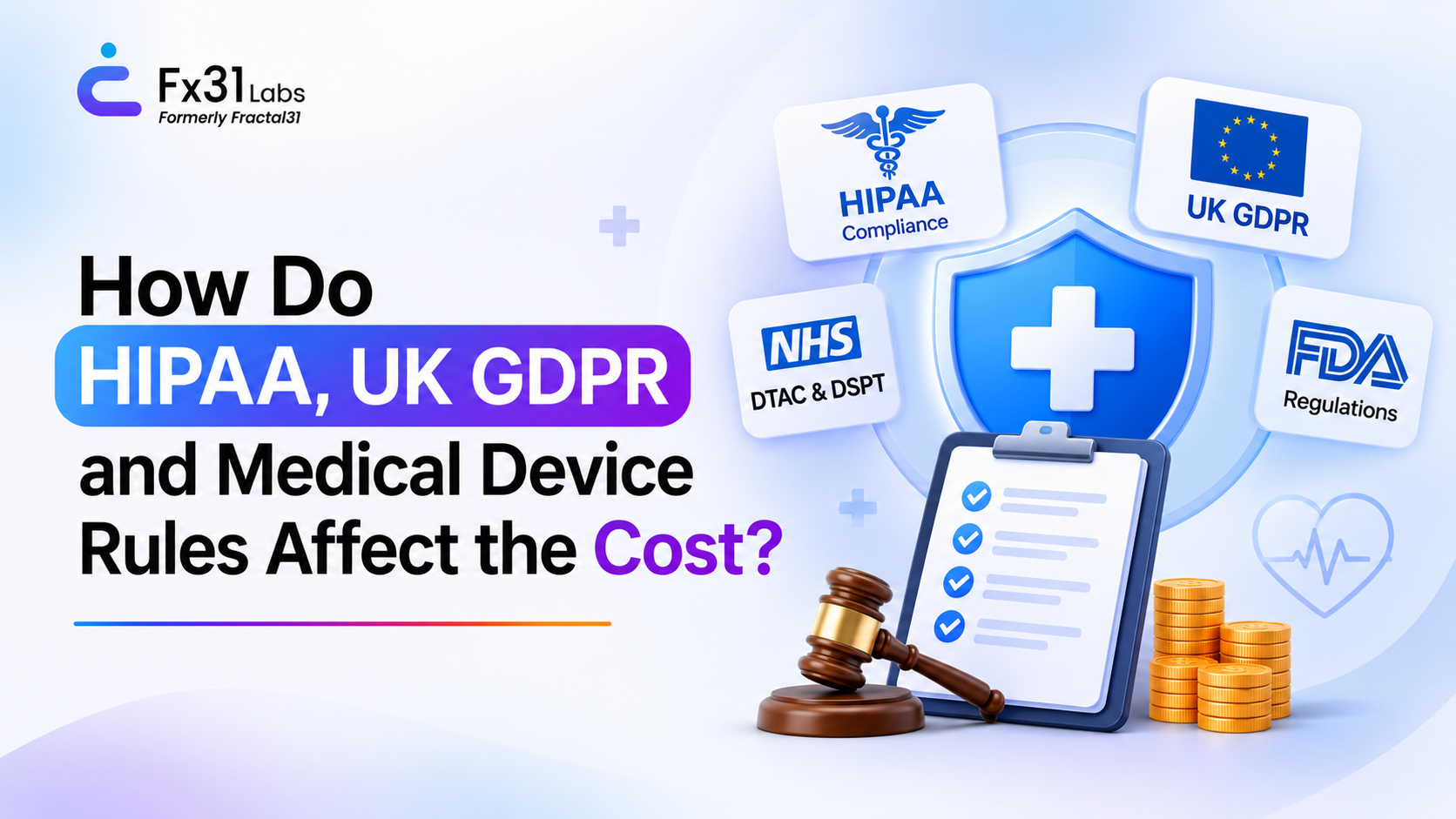
Compliance is a major part of healthcare app development cost, typically adding $15,000 to $50,000 per market. Launching in both the US and UK costs more, and medical device requirements can add $100,000 or more. Costs depend on your target market, the data you handle, and the app’s clinical role.
Plan compliance from the start, with security by design, to avoid expensive changes later. Keep compliance costs separate in your development budget.
1. Which Compliance Rules Apply to Your Healthcare App?
| Regulation or requirement | Typical cost |
| HIPAA (US) | $15,000 to $50,000 |
| FTC and state health privacy laws (US) | $5,000 to $20,000 |
| UK GDPR | $8,000 to $25,000 |
| NHS DTAC, DSPT and clinical safety requirements | $15,000 to $50,000 |
| FDA or MHRA medical device requirements | $100,000+ |
| Apple App Store and Google Play health policies | Low if planned early |
These are estimates, not fixed fees. Some requirements overlap, so one security control may support multiple regulations. Your final budget depends on the app’s features, data, and intended use.
2. What Does HIPAA Compliance Add to the Build?
HIPAA applies when an app handles protected health information (PHI) for a covered healthcare provider, health plan, or business associate. HIPAA-related development costs typically range from $15,000 to $50,000.
Key requirements include:
- Data encryption and secure storage
- Role-based access controls and multi-factor authentication
- Audit logs to track access to patient data
- Business associate agreements (BAAs) with relevant vendors
- Risk analysis, security testing, and documented policies
| HIPAA requirement | Estimated cost |
| Risk analysis | $3,000 to $10,000 |
| Penetration testing | $5,000 to $15,000 |
| Encryption and key management | $2,000 to $6,000 |
| Audit logs | $2,000 to $8,000 |
| Access controls and MFA | $2,000 to $6,000 |
| Policies, BAAs and documentation | $1,000 to $5,000 |
| Typical total | $15,000 to $50,000 |
Using a vendor that offers a BAA does not automatically make an app HIPAA-compliant. Your team must still configure the app correctly and meet its security obligations. Offshore development is possible, but the same safeguards and contractual requirements still apply.
HIPAA also requires covered entities to notify affected individuals of certain breaches without unreasonable delay and no later than 60 days after discovery.
3. Health Apps Outside HIPAA: FTC and State Health Privacy Laws
Consumer health apps may fall outside HIPAA but still face privacy requirements under FTC rules and state laws. Depending on the app, you may need clear consent, accurate privacy notices, secure data handling, and a breach response plan.
The FTC’s Health Breach Notification Rule can also require apps outside HIPAA to notify users and the FTC after a breach.
Laws such as Washington’s My Health My Data Act and privacy laws in states including Nevada and Connecticut may apply. Check the rules for every state where your app operates.
4. UK GDPR and Patient Data in the UK
UK GDPR treats health information as special category data. Apps handling it need a lawful basis, an applicable Article 9 condition, and appropriate security controls.
You may also need a Data Protection Impact Assessment (DPIA), processes for data access and deletion requests, and approved safeguards for international transfers, such as an International Data Transfer Agreement (IDTA) where applicable.
Serious violations can result in fines of up to £17.5 million or 4% of annual global turnover, whichever is higher. Include privacy documentation and legal review in your budget.
5. Selling to the NHS: DTAC, DSPT and Clinical Safety Standards
Apps intended for NHS use may need to meet the Digital Technology Assessment Criteria (DTAC), Data Security and Protection Toolkit (DSPT), and relevant clinical safety standards.
Budget for:
- Data protection and technical security checks
- Clinical safety documentation and a Clinical Safety Officer, where required
- Interoperability with NHS systems, including FHIR-based integrations
- Accessibility requirements, including WCAG
- NHS login and other required onboarding processes
These requirements can add development time, documentation work, and testing costs. Confirm which assessments apply before finalizing the project scope.
6. Is Your App a Medical Device? FDA and MHRA Rules
Apps that diagnose, treat, or support clinical decisions may fall under medical device regulations. This can add $100,000 or more for regulatory work, testing, documentation, and validation.
| App functionality | Likely regulatory position |
| Appointment booking, billing and messaging | Generally not a medical device |
| General wellness tracking | Often outside medical device regulation, depending on claims |
| Diagnosis or treatment support | May qualify as a medical device |
| Disease detection, dose calculations, or time-critical clinical alerts | May require medical device compliance |
In the US, requirements may include FDA 510(k), De Novo, or Premarket Approval (PMA), depending on the device. In the UK, requirements may involve MHRA rules and UKCA marking, where applicable.
Your app’s intended purpose and marketing claims matter. Confirm its regulatory status before development to avoid costly redesigns.
7. Apple App Store and Google Play Health App Policies
Both stores have health-related privacy and review requirements. You may need to disclose data collection, explain how health information is used, and provide regulatory documentation where applicable.
- Apple App Store: Follow privacy requirements for health data and HealthKit. Restrictions apply to advertising, data mining, and storing protected health information in iCloud.
- Google Play: Complete the relevant health app declarations and Data safety disclosures, and meet user data policies.
Build these requirements into design and testing rather than waiting until submission. This reduces the risk of rejection and launch delays.
Now that you’ve seen how compliance shapes the budget, let’s look at how long a healthcare app takes to build and what each phase costs.
Healthcare App Development Timeline and Cost by Phase
A healthcare MVP typically takes 3 to 5 months, while a production app takes 5 to 9 months. Each phase adds to the healthcare app development cost, so understanding the budget split helps you evaluate quotes.
1. Healthcare App Development Timeline by Phase
The table breaks down a $100,000 production build by phase. Some activities overlap, especially design, development, and testing.
| Phase | What happens | Share of budget | Cost on a $100,000 build | Duration |
| Discovery and compliance scoping | Workflows, user roles, requirements and integrations | 10% | $10,000 | 2 to 4 weeks |
| UX/UI and clinical workflow design | Wireframes, prototypes and user testing | 12% | $12,000 | 3 to 5 weeks |
| Development and integrations | Apps, backend, APIs, EHR and device connections | 45% | $45,000 | 12 to 20 weeks |
| Security, QA and compliance testing | Functional tests, penetration testing and accessibility | 18% | $18,000 | 3 to 6 weeks |
| App store release and launch | Store reviews, privacy declarations and monitoring | 5% | $5,000 | 1 to 3 weeks |
| Project management | Planning, reporting and stakeholder reviews | 10% | $10,000 | Throughout |
The full production timeline is around 5 to 9 months, although some phases run in parallel. Skipping security testing does not reduce the actual work. It shifts the risk and expense to after launch.
Adding developers can speed up coding, but clinical reviews, compliance checks, and app store approvals still take time. A production app rarely launches in less than five months.
For a focused MVP, a 16-week plan can look like this:
- Weeks 1 to 3: Discovery, compliance scoping, and feature approval.
- Weeks 4 to 6: UX design, prototype, and user testing.
- Weeks 7 to 13: App, backend, and core integration development.
- Weeks 14 to 15: QA, security testing, accessibility checks, and fixes.
- Week 16: App store submission, launch monitoring, and handover.
2. What Can Delay a Healthcare App Launch?
Delays often come from approvals, compliance decisions, and changing requirements rather than coding alone. These issues can increase the healthcare app development cost and push back launch.
- Late compliance decisions: Discovering HIPAA, DTAC, or medical device requirements mid-build can force redesign and retesting.
- EHR access approvals: Vendor reviews, sandbox access, and hospital IT approvals can take several weeks.
- Clinical sign-off: Clinicians need time to review workflows and safety documentation.
- App store review: Missing health declarations or privacy details can lead to rejection.
- Scope creep: Adding features after design can increase costs and delay testing.
Add a 15% to 20% contingency to the budget and timeline. Use it for approved scope changes, integration delays, or additional compliance work rather than treating it as automatic spending.
7 Cost Drivers That Move Your Healthcare App Development Cost
Seven factors influence your quote, from integrations and security to app architecture and AI features.
- Clinical workflows and user roles: Each role adds screens, permissions, and testing. Apps for doctors, nurses, patients, and admins need separate workflows and access rules.
- EHR, device, and third-party integrations: Connecting EHRs, labs, pharmacies, and wearables requires data mapping, error handling, and testing. FHIR APIs can simplify integration, but vendor approvals still affect timelines and costs.
- Native, cross-platform, or web: Separate native iOS and Android apps usually cost more. Flutter or React Native can reduce development effort through shared code. See our Flutter vs React Native comparison.
- Clinical UX and accessibility: Clear navigation, readable text, and accessible controls improve usability for patients and clinicians. WCAG testing also helps meet accessibility requirements for NHS-related projects.
- Security engineering and testing: Apps handling PHI need encryption, secure authentication, access controls, audit logs, and security testing. Cutting these safeguards can lead to costly fixes or data breaches.
- AI features and running costs: AI adds development costs plus ongoing expenses for model usage, hosting, monitoring, and evaluation. Clinical features also need safety checks and guardrails. See our guide to generative AI in healthcare.
- Data migration from existing systems: Moving legacy records requires data cleaning, mapping, validation, and testing. Test with anonymized data before launch to reduce errors and protect data quality.
Also Read: How to Choose the Perfect Mobile App Development Partner
What Does a Healthcare App Cost to Run After Launch?
Annual running costs can reach 40% to 60% of the initial build cost, including maintenance, hosting, security, and third-party services. Budget for these expenses before launch.
1. Yearly Running Costs After Launch
These ongoing expenses form a major part of the healthcare app development cost. Use the estimates below to plan your annual budget.
| Cost item | What it covers | Typical yearly cost |
| Maintenance and updates | OS updates, bug fixes, minor features | 15% to 20% of build cost |
| Cloud hosting | Secure hosting, backups, monitoring | $6,000 to $60,000 |
| Third-party services | Video, SMS, email, EHR APIs, device fees | $2,000 to $30,000 |
| Security and compliance | Penetration tests, risk reviews, audits | $10,000 to $40,000 |
| AI model usage (if used) | Inference fees, evaluation, monitoring | $6,000 to $60,000 |
| App store fees | Apple Developer Program and Google Play | $99/year for Apple, plus $25 once for Google Play |
Hosting and service fees increase with usage. Video minutes, SMS volume, stored files, and EHR API calls can raise costs as more patients use the app.
Other expenses to include in your budget:
- Clinical content review: Clinicians must review symptom information, care plans, and alerts before launch and after major changes.
- Legal and privacy work: Budget for privacy policies, terms, BAAs, and DPIAs.
- Cyber insurance: Healthcare partners may require proof of insurance before connecting their systems.
- Support and on-call: Plan for timely help with patient and clinician issues.
- Analytics setup: Use privacy-safe crash reporting and analytics tools that meet your data protection requirements.
For AI features, track model usage closely. Set per-user limits, cache common answers, and use smaller models for simpler queries to control monthly costs.
2. What Will a Healthcare App Cost Over Three Years?
Consider a telemedicine app with a $120,000 initial build cost. This example shows how maintenance, hosting, and compliance add to your total healthcare app development cost over three years.
| Cost item | Year 1 | Year 2 | Year 3 | 3-year total |
| Initial build | $120,000 | $0 | $0 | $120,000 |
| Maintenance and updates (18%) | $21,600 | $21,600 | $21,600 | $64,800 |
| Hosting, backups and monitoring | $15,000 | $15,000 | $15,000 | $45,000 |
| Third-party services | $9,000 | $9,000 | $9,000 | $27,000 |
| Security and compliance | $15,000 | $15,000 | $15,000 | $45,000 |
| App store fees | $124 | $99 | $99 | $322 |
| Total | $180,724 | $60,699 | $60,699 | $302,122 |
The three-year total is $302,122, around 2.5 times the initial build price. Running costs can exceed the original development spend by the end of year two, so confirm maintenance, support, hosting, and security fees before signing a contract.
Running costs pass the original build cost by the end of year two ($121,398 vs $120,000), so confirm maintenance, support, hosting, and security fees before signing a contract. A low build quote with weak support terms often costs more over the life of your app.
8 Ways to Reduce Healthcare App Development Cost Without Cutting Compliance
Reduce costs by narrowing scope, reusing proven tools, and planning compliance early. Never cut essential security safeguards to save money.
- Run paid discovery first: Spend 2 to 4 weeks mapping workflows, compliance needs, and integrations. Get a written scope, risk list, and itemized estimate before development starts.
- Launch an MVP around one workflow: Start with one core feature, such as appointment booking and video visits. Use MVP development to test demand before investing in additional features.
- Limit patient data in the MVP: Storing less protected health information (PHI) can reduce security controls, testing, and vendor requirements. Start with features that do not need patient data where practical, then expand as needed.
- Share one codebase across platforms: Flutter and React Native can support iOS and Android from a shared codebase, reducing development and maintenance effort. Choose native development when specific device features require it.
- Use BAA-ready cloud and communication services: Choose suitable HIPAA-eligible cloud, video, and messaging services from vendors that offer business associate agreements (BAAs). This avoids building complex infrastructure from scratch, but your app must still be configured securely.
- Use FHIR APIs for EHR integration: Start with standard FHIR APIs before paying for custom interfaces. In 2025, ASTP/ONC reported that 70% of non-federal acute care hospitals in the US enabled patient access through FHIR-based apps (ASTP/ONC, 2025). Approved UK suppliers can also use NHS England APIs such as GP Connect.
- Use white-label or low-code tools: Admin panels, intake forms, and internal dashboards may not need custom development. Choose platforms that meet your security and compliance requirements, and reserve custom code for features that differentiate your app.
- Add AI after validating demand: AI increases development, clinical review, and ongoing model costs. Launch the core app first, then add AI features when user data shows a clear benefit.
Also Read: How to Validate Your Startup Idea Before Building an MVP
Why Trust Fx31 Labs for Your Healthcare App Development?
Keeping healthcare app development costs under control takes the right mix of clinical workflows, security, and cost-effective engineering.
Fx31 Labs builds iOS, Android, and Flutter apps with India-based engineering and a US office in New Jersey. Its team supports projects from initial planning to app store launch, helping businesses build healthcare products around their needs and budget.
- Full-cycle mobile development: Design, iOS, Android, Flutter, backend development, QA, and app store release handled by one team.
- Faster MVP development: Fx31 Labs reports that its rapid MVP approach can reduce launch time by up to 40%, helping you validate a core clinical workflow sooner.
- Proven product delivery: Its UAE pet grooming super app delivered 3x operational efficiency and 2x faster bookings (read the use case).
- Flexible team models: Choose project-based development or a dedicated team that can scale as your product grows.
- Cost-effective engineering: India-based delivery and a US office support collaboration with US and UK businesses.
Planning a healthcare product? Book your free consultation with our experts to define your MVP scope, integrations, compliance needs, and development budget.
Conclusion: Plan Your Healthcare App Budget Before You Build
Your healthcare app development cost depends on the app type, compliance requirements, integrations, and development team. Define these early to avoid budget surprises and plan for three years of running costs.
We hope this guide helps you compare development estimates, understand compliance expenses, and budget for long-term maintenance.
Before development begins, shortlist your essential features, confirm the applicable regulations, and get a clear breakdown of build and running costs.
Have a healthcare app project in mind? Contact our experts to define your feature scope, compliance requirements, timeline, and budget before development begins.
Frequently Asked Questions
1. What Is the Average Cost to Build a Healthcare App?
Healthcare app development cost typically ranges from $40,000 to $200,000. MVPs cost $40,000 to $90,000, while enterprise platforms can exceed $500,000.
2. How Much Does a Telemedicine App Cost?
Telemedicine app development costs range from $60,000 to $250,000+. Video, chat, EHR integration, and e-prescribing affect the final price.
3. How Much Does HIPAA Compliance Cost?
HIPAA compliance typically adds $15,000 to $50,000 for encryption, access controls, audit logs, BAAs, and risk analysis. Ongoing security reviews cost extra.
4. Does Every Health App Need HIPAA Compliance?
No. HIPAA generally applies to apps handling PHI for covered entities or business associates. The FTC and state privacy laws may still apply to other health apps.
5. How Long Does Healthcare App Development Take?
Prototypes take 2 to 4 weeks, MVPs 3 to 5 months, and production apps 5 to 9 months. Enterprise platforms may take 9 to 18 months.
6. How Much Does EHR Integration Cost?
One FHIR-based EHR integration can cost $8,000 to $72,000. Custom interfaces, multiple systems, and hospital approvals can increase costs.
7. Does My Healthcare App Need FDA or MHRA Approval?
Apps that diagnose, treat, or support clinical decisions may qualify as medical devices. Regulatory work can add $100,000+ and extend timelines.
8. How Much Does Healthcare App Maintenance Cost?
Maintenance typically costs 15% to 20% of the initial build annually. Hosting, security, and third-party services can bring total yearly running costs to 40% to 60% of the build cost.