Top 15 Generative AI Integration Companies in 2026
Key Takeaways: Generative AI Integration Companies
- What a generative AI integration company does: Connect LLMs to business systems, data, and workflows.
- What matters: Production experience, security, and system compatibility.
- What it costs: Pilots start at $15,000, while complex rollouts can exceed $500,000.
- How to choose: Check real project results, data controls, and ongoing costs.
- Where to start: Test one high-value workflow with clear success metrics.
Choosing a generative AI integration company gets complicated when every provider promises smarter workflows, faster delivery, and better results. The real difference shows when AI needs to work with your existing CRM, ERP, business data, and security requirements.
Generative AI can help automate tasks and improve how teams use business data, but poor integration can lead to unreliable outputs, rising costs, and delays. Before investing in generative AI and LLM capabilities, you need to know which partner can support your systems and project requirements.
In this guide, you’ll learn:
- 15 generative AI integration companies and their core strengths
- The five common integration patterns and how they work
- How to choose the right generative AI integration company for your project
- Eight checks to review before signing a contract
- Integration costs, timelines, and ongoing expenses
- Which delivery model may fit your team and budgetFh
By the end of this guide, you’ll have a practical shortlist of companies to evaluate, a clearer understanding of potential costs, and the right questions to ask before choosing a partner.
What Does a Generative AI Integration Company Do?
A generative AI integration company connects large language models to your existing systems, data, and workflows. It manages data access, security, testing, and monitoring so the AI works reliably in production. See how AI integration services transform business operations.
1. What Are the 5 Most Common Generative AI Integration Patterns?
Most projects use one or more of these five patterns, depending on business needs and existing systems.
| Pattern | What it connects | Typical systems | Example use |
| RAG over company knowledge | LLMs with business documents and data | SharePoint, Confluence, Snowflake, BigQuery | Cited answers for support, sales, or legal teams |
| Copilot inside a business system | LLMs with existing business tools | Salesforce, Dynamics 365, ServiceNow, NetSuite | Drafting replies and summarizing accounts |
| Document and workflow automation | AI extraction with existing workflows | ERP, document management, email, Jira | Invoice, claims, and contract processing |
| AI agents with tool access | LLMs with approved APIs | ERP, CRM, ticketing, internal APIs | Order handling, triage, and research |
| Legacy system wrapper | APIs or MCP with older systems | Mainframes, on-premises databases, custom apps | Plain-language queries over legacy data |
AI agents can use approved tools to perform tasks, while the Model Context Protocol (MCP) standardizes how AI connects to tools and data. Learn more in our guide to MCP and the future of AI integrations.
2. Integration Partner, AI Development Company or AI Consultancy: Which Do You Need?
Choose an integration partner to connect AI with existing systems, an AI development company to build a new product, or an AI consultancy to define your strategy and use cases. Some providers offer all three, so check each generative AI integration company’s actual project experience before deciding.
| Factor | Integration partner | AI development company | AI consultancy |
| Main job | Connects AI to existing systems | Builds AI products or custom models | Defines strategy and governance |
| Typical output | Connectors, RAG pipelines, agents | Apps, fine-tuned models | Roadmaps, business cases, policies |
| Choose it when | AI must work with your CRM or ERP | You’re launching a new AI product | Use cases are not yet defined |
| Risk if mismatched | Wrong integration approach | Product may go unused | Plans without implementation |
Also Read: Top 21 LLM Development Company Options for US and UK Buyers
Top 15 Generative AI Integration Companies for US and UK Buyers
Compare 15 providers by strength, location, and best fit to shortlist the right generative AI integration company for your project.
| Company | Base and US/UK presence | Integration strength | Best for |
| Fx31 Labs | New Jersey, US, with India-based engineering | Generative AI and ERP integration, AI engineers on demand | Scoped first integrations for mid-market teams |
| RTS Labs | Glen Allen, Virginia, US | CRM, ERP, data warehouse integration, MCP servers | US-based delivery for finance, insurance, and logistics |
| Provectus | San Francisco, US, with a London hub | Amazon Bedrock, AI agents, and RAG | AWS-focused and regulated enterprises |
| Datatonic | London, UK | Gemini, AI agents, and GenOps on Google Cloud | Google Cloud enterprises |
| Scott Logic | Newcastle, UK | Integrating generative AI into existing software | UK regulated firms and public sector |
| STX Next | Poznań, Poland, with London and Texas offices | RAG and AI agents on AWS and Azure | Teams using AWS or Azure |
| Addepto | Warsaw, Poland, with US entities | LLMs integrated with ERP, data warehouses, and analytics | Data-heavy enterprises |
| BotsCrew | San Francisco, US, with delivery in Lviv | Claude-based agents connected to ERP and support systems | Operations and customer support teams |
| Vstorm | Wrocław, Poland | Production AI agents and RAG in product workflows | Product teams adding agents to live applications |
| 8th Light | Chicago, US, with a London office | Governed AI agents for regulated environments | Organizations needing US or UK delivery |
| Neurons Lab | London, UK | AWS-based AI agents for financial services | Banks, insurers, and wealth managers |
| 10Clouds | Warsaw, Poland | AI integration for core banking, CRM, and Dynamics 365 | Banks and insurers |
| Sphere | US-based, with delivery across the US, Europe, and LATAM | Access-controlled RAG across SharePoint, Salesforce, and SAP | Regulated firms with distributed business knowledge |
| Arionkoder | Uruguay, with US presence | Moving AI pilots into Jira, SharePoint, and Salesforce workflows | Teams moving stalled pilots toward production |
| Neoteric | Gdańsk, Poland, with London and New York listings | GPT-powered assistants integrated into existing apps | Startups and SMBs with smaller budgets |
Let’s look at each generative AI integration company in detail.
1. Fx31 Labs

Fx31 Labs is a generative AI integration company for mid-market businesses and AI-product founders. With a US office in Short Hills, New Jersey, and India-based engineering, it helps teams connect AI capabilities with existing business systems and workflows.
One example is a UAE retail demand-planning project that connected demand-planning software with Microsoft Dynamics 365. The integration automated sales, purchase, and inventory data flows, helping the client report 30% fewer stockouts, 25% less excess inventory, and a 95% faster planning process.
Beyond integrations, Fx31 Labs supports legacy modernization through Coderbotics AI, its platform of 40+ specialized agents for code modernization, cloud migration, and database migration. Its flexible delivery options let businesses start with a defined project or bring AI engineers into their existing teams.
Key Highlights:
- Integration Capabilities: LLM applications, retrieval-augmented generation (RAG), AI agents, and ERP integration.
- Retail Case Study: The demand-planning integration reported 30% fewer stockouts, 25% less excess inventory, and a 95% faster planning process.
- Legacy Modernization: Coderbotics AI uses 40+ specialized agents for code modernization, cloud migration, and database migration.
- Engagement Models: Project-based delivery, dedicated teams, and AI engineer augmentation.
- Pricing: No public rate card; costs are provided through a scoped estimate.
Best for: Mid-market companies and AI-product founders that need a clearly scoped AI integration, ERP connection, or legacy modernization project.
Planning a generative AI integration? Share the systems involved and the workflow you want to improve. You’ll get a scoped plan covering effort, timeline, and monthly run-rate cost. Get In Touch
2. RTS Labs
RTS Labs is a Virginia-based data and AI consultancy with a fully US-based delivery team. Its work connects AI with business systems and internal data, including a logistics copilot built for Landstar that uses retrieval-augmented generation (RAG) to retrieve procedures from SharePoint and shipment data through internal APIs.
Key Highlights:
- Landstar Case Study: Built an agentic RAG copilot inside the company’s existing agent portal using Azure OpenAI in a private network.
- MCP Servers: Develops MCP servers to help businesses connect AI models with tools and systems.
- Pricing: Lists a starting price of $40,000 for RAG chatbots on its website.
Best for: US businesses in logistics, finance, and insurance that need AI connected to sensitive operational data.
3. Provectus
Provectus is an AI consultancy that builds production-ready generative AI solutions, with a strong focus on AWS and Amazon Bedrock. Its work includes regulated-industry applications, from underwriting assistants to customer-service agents embedded in existing platforms.
Key Highlights:
- Insurance Case Study: Built a RAG-based underwriting assistant for Convex in its own AWS environment.
- Agent Development: Created a customer-service agent prototype for Mad Mobile inside Salesforce.
- Pricing: Clutch lists $50 to $99 per hour, with a $25,000+ minimum project size.
Best for: Insurance and financial services enterprises building governed AI solutions on AWS.
4. Datatonic
Datatonic is a Google Cloud-focused data and AI consultancy with practical experience building Gemini agents and strengthening AI operations. Its projects include customer-facing agents and GenOps platforms with built-in evaluation and security controls.
Key Highlights:
- Banking Case Study: Built a Gemini agent for Alpian that accesses account data through an MCP server.
- GenOps Case Study: Extended Vodafone’s MLOps platform with RAG templates, prompt-injection defenses, and continuous evaluation.
- Governance: Integrates guardrails, personally identifiable information (PII) masking, and evaluation into AI platforms.
Best for: Google Cloud enterprises connecting Gemini agents with business data in BigQuery.
5. Scott Logic
Scott Logic is a UK software consultancy focused on integrating generative AI into existing products and moving prototypes into production. Its projects emphasize testing and evaluation, including solutions for legal software and enterprise knowledge retrieval.
Key Highlights:
- Production RAG: Helped Hg move a chatbot using documentation and Jira tickets from prototype to production.
- Legal Technology: Built a GenAI service for Blinqx in its Azure environment, with outputs evaluated against lawyer-written references.
- Pricing: Clutch lists 100–149 per hour, with a $5,000+ minimum project size.
Best for: UK regulated organizations adding tested generative AI features to existing software.
6. STX Next
STX Next delivers AI and data engineering across AWS and Azure, helping businesses build secure knowledge systems and AI-powered workflows. Its work for industrial gases company Linde demonstrates how retrieval-augmented generation (RAG) can support multilingual access to internal knowledge.
Key Highlights:
- Linde Case Study: Built a secure, multilingual RAG platform in Linde’s Azure environment, with automated data synchronization and monitoring.
- RAG Evaluation: Uses multiple retrieval strategies and evaluation frameworks such as RAGAS.
- Pricing: Clutch lists $50 to $99 per hour, with a $50,000+ minimum project size.
Best for: Mid-market and enterprise teams building RAG applications and AI agents on AWS or Azure.
7. Addepto
Addepto is an AI and data consultancy specializing in connecting LLMs with enterprise data platforms, analytics, and ERP systems. Now part of KMS Technology, it combines AI engineering with tools for evaluating outputs and managing model costs.
Key Highlights:
- ERP Integration: Built a LangGraph agent for Meeting Tomorrow grounded in NetSuite inventory data.
- Natural-Language Analytics: Developed a solution for an automotive brand that converts questions into Snowflake queries using Amazon Bedrock.
- Cost Optimization: Uses evaluation tools, caching, and model routing to help manage LLM costs.
Best for: Data-heavy enterprises connecting AI with ERP systems, data warehouses, and analytics.
8. BotsCrew
BotsCrew specializes in conversational AI and agents that perform tasks inside business systems. Its work includes turning early prototypes into production-ready tools, including an agent for automotive parts manufacturer S&B Filters that connects Claude with NetSuite through MCP.
Key Highlights:
- S&B Filters Case Study: Built an agent that handles orders across Shopify, phone, and website channels.
- Integration Stack: Connects systems such as NetSuite, Salesforce, SAP, Zendesk, and Shopify.
- Pricing: Clutch lists $50 to $99 per hour, with a $10,000+ minimum project size.
Best for: Mid-market businesses connecting AI agents to ERP, CRM, and customer support workflows.
9. Vstorm
Vstorm is an AI engineering specialist focused on production-ready agents and RAG systems. For UK print company Mixam, it built a multi-agent order advisor connected to the product API and checkout flow, with the company reporting that checkout conversion roughly doubled after launch.
Key Highlights:
- Mixam Case Study: Connected an AI order advisor to live product and checkout systems.
- Agent Tooling: Works with Pydantic AI, LangChain, LangGraph, and LlamaIndex.
- Pricing: Clutch lists 100–149 per hour, with a $10,000+ minimum project size.
Best for: Product teams adding AI agents and RAG to live applications and customer workflows.
10. 8th Light
8th Light is a software consultancy with offices in Chicago and London, focused on governed AI agents for sensitive environments. Its work includes a HIPAA-compliant AI coach for Healing Track that connects to a certified electronic health record (EHR) through a credential proxy to protect patient identities.
Key Highlights:
- Healthcare Case Study: Built an AI coach using Claude with identity-protection controls.
- Governance: Uses evaluation, guardrails, and frameworks aligned with the EU AI Act and NIST.
- Pricing: Clutch lists a $250,000+ minimum project size; its hourly rate is undisclosed.
Best for: Regulated organizations that need tightly governed AI agents and stronger data controls.
11. Neurons Lab
Neurons Lab focuses exclusively on financial services, building AI solutions for banks, insurers, wealth managers, and private equity firms. Its projects include embedding an LLM content tool into Visa’s Campaign Atlas portal and developing multi-agent workflows using Amazon Bedrock AgentCore.
Key Highlights:
- Visa Case Study: Integrated an LLM-powered content tool into an existing AWS-hosted portal.
- Agent Development: Turns existing APIs into tools for multi-agent workflows.
- Partner Status: Listed as an AWS Advanced Tier Services Partner.
Best for: Financial institutions deploying governed AI agents and workflows on AWS.
12. 10Clouds
10Clouds builds AI solutions for financial services, with a focus on connecting generative AI to core banking and customer-management workflows. For a Polish commercial bank, it added a GenAI credit-assessment component to Microsoft Dynamics 365, using registry data to reduce manual analyst work.
Key Highlights:
- Banking Case Study: Integrated credit-assessment capabilities into a Dynamics 365 client card.
- AI Platform: Uses AIConsole for agent development and orchestration.
- Compliance Controls: Supports role-based access, audit trails, and frameworks including GDPR, DORA, and the EU AI Act.
Best for: Banks and insurers integrating AI agents into banking, credit-assessment, and CRM workflows.
13. Sphere
Sphere Partners helps organizations connect internal knowledge across scattered repositories without losing control over who can access sensitive information. For Navy Pier in Chicago, it built a contract Q&A system that retrieves answers from SharePoint agreements and provides clause-level citations, making contract review easier to trace and verify.
Key Highlights:
- Connectors: Supports Salesforce, Confluence, SAP, Slack, Teams, and SharePoint.
- AI Models: Works with Amazon Bedrock, Azure OpenAI, Claude, GPT, Gemini, Llama, and Mistral.
- Pricing: Clutch lists a $10,000+ minimum project size; hourly rates are undisclosed.
Best for: Regulated teams that need secure, traceable answers from internal documents.
14. Arionkoder
Arionkoder helps businesses move stalled AI pilots into production through embedded engineering teams and focused advisory work. Its projects include a healthcare triage agent inside Jira Service Management on Azure, using preprocessing designed to handle protected health information (PHI), and contract extraction for a pharmaceutical legal team using SharePoint and Databricks.
Key Highlights:
- Integration Stack: Jira Service Management, SharePoint, Azure, and Databricks.
- Delivery Model: Embedded AI squads and targeted support for stalled projects.
- Pricing: Clutch lists $50 to $99 per hour, with a $10,000+ minimum project size.
Best for: Teams that need hands-on engineering support to turn an AI pilot into a working product.
15. Neoteric
Neoteric helps startups and smaller businesses add GPT-powered features to products they already operate. For US fitness-tech company Spren, it optimized a GPT-4 chatbot connected to the app’s internal database, reducing response times from about 40 seconds to around 2 seconds. It has also built RAG assistants within existing platforms.
Key Highlights:
- Technology Stack: OpenAI, LangChain, Pinecone, AWS, and Azure.
- Performance Improvement: Reduced chatbot response time from roughly 40 seconds to 2 seconds for Spren.
- Pricing: Publishes proof-of-concept guidance starting at around $20,000. Clutch lists a $10,000+ minimum project size and $50 to $99 per hour.
Best for: Startups and SMBs adding responsive GPT assistants to existing applications.
Now that you’ve seen who does this work well, let’s look at how to evaluate a provider before signing.
How to Choose a Generative AI Integration Company
Choose a partner with proven production experience, strong data controls, and clear ownership terms. Use these eight checks to compare any generative AI integration company before signing a contract.
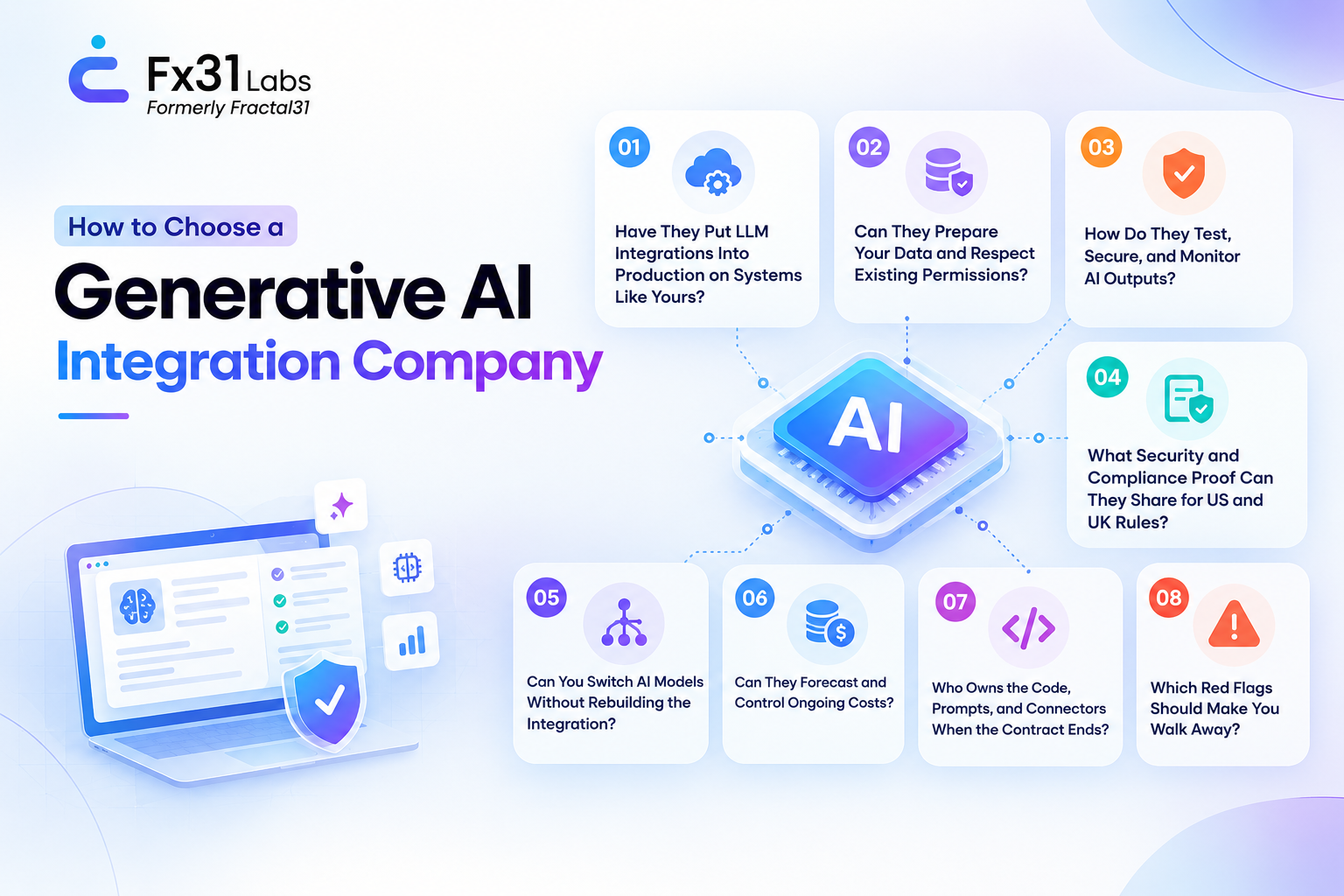
1. Have They Put LLM Integrations Into Production on Systems Like Yours?
Ask for two or three live integrations, including one with a system you use, such as Salesforce, SAP, or ServiceNow. Ask what failed after launch and how they fixed it. Real production experience matters more than polished demos.
2. Can They Prepare Your Data and Respect Existing Permissions?
Ask how the team checks data quality and keeps retrieval within each user’s existing access permissions. Poor data can undermine results and increase costs. Our guide to data readiness for AI explains what to audit before implementation.
3. How Do They Test, Secure, and Monitor AI Outputs?
Ask for a written evaluation plan using your own questions and agreed accuracy targets. Check how they detect hallucinations, block unsafe actions, and require human approval for high-impact tasks. Confirm who monitors performance and responds when output quality drops.
4. What Security and Compliance Proof Can They Share for US and UK Rules?
Request a current SOC 2 Type II report and ask how the vendor handles GDPR and UK GDPR requirements. For US health data, confirm that every vendor handling protected information has the required signed HIPAA business associate agreement. Review our guide to LLM security risks like prompt injection for key threats to test.
5. Can You Switch AI Models Without Rebuilding the Integration?
Model quality and prices change, so your architecture should not depend on one provider. Ask how prompts, retrieval, and tool connections are separated from the underlying model. Have the vendor explain how it would switch models and what that change would involve.
6. Can They Forecast and Control Ongoing Costs?
A reliable generative AI integration company should estimate monthly token, hosting, and monitoring costs using realistic usage assumptions. Ask how caching, smaller models, and better retrieval can reduce spending. Get both the implementation quote and the expected ongoing costs before signing.
7. Who Owns the Code, Prompts, and Connectors When the Contract Ends?
Confirm that your contract covers ownership of code, prompts, evaluation sets, connectors, and documentation. Require repository access from the first week, not just at handover. Agree on documentation and a transition plan, so another team can maintain the solution.
8. Which Red Flags Should Make You Walk Away?
A polished pitch cannot replace proof, clear controls, and transparent costs. Be cautious if a generative AI integration company shows only demos, cannot explain its data safeguards, or promises accuracy without a testing method. Watch for these specific warning signs:
- Demo-only proof: No examples running in production.
- Vague data plan: Unclear data quality checks, access permissions, or processing locations.
- No evaluation method: No measurable accuracy targets or testing process.
- Lock-in by design: You cannot access or transfer the code and connectors.
- Missing cost forecast: No estimate of ongoing model and hosting expenses.
Also Read: Private AI vs Public AI Models: Which Is Better for Enterprise Security?
Now that you know how to judge a partner, the next step is to understand the full cost of building and running an integration.
How Much Does Generative AI Integration Cost?
A pilot typically costs $15,000 to $60,000, while production integrations range from $60,000 to $180,000. Multi-system or agentic rollouts can reach $500,000+. Budget for ongoing costs before choosing a generative AI integration company.
1. What Does Generative AI Integration Cost by Scope?
Costs depend on the number of systems, data quality, security requirements, and workflow complexity. These indicative market ranges are based on published vendor pricing and industry benchmarks, not Fx31 Labs pricing.
| Scope | Typical work included | Timeline | Indicative build cost |
| Pilot on one workflow | One model, one data source, read-only access, basic evaluation | 4 to 8 weeks | $15,000 to $60,000 |
| Production integration | One or two systems, write-back, RAG, single sign-on, permissions, evaluation, and monitoring | 2 to 4 months | $60,000 to $180,000 |
| Multi-system or agentic rollout | Multiple systems, API or MCP tool access, governance, and audit trails | 4 to 9 months | $180,000 to $500,000+ |
Integration surprises can delay delivery. Deloitte’s 2026 State of AI in the Enterprise report found that three-month use cases can stretch to 18 months when integration complexity emerges. Map your systems and data before committing to a budget.
Two major cost drivers are connectors and data preparation. Our AI agent cost breakdown estimates that each enterprise connector, such as SAP or Salesforce, can add $15,000 to $60,000, while data preparation accounts for 20% to 30% of the budget. Compliance work for SOC 2, HIPAA, GDPR, or the EU AI Act can add $15,000 to $100,000+.
2. What Will It Cost to Run Each Month After Launch?
Monthly costs depend on usage, model choice, cloud infrastructure, and the amount of human review required. Use these indicative ranges to estimate the ongoing cost of a production workflow at moderate traffic.
| Line item | Indicative monthly range |
| LLM API usage | $500 to $15,000 |
| Vector database and retrieval | $50 to $5,000 |
| Cloud compute | $200 to $10,000 |
| Evaluation and observability tools | $200 to $5,000 |
| Human review and QA | $2,000 to $15,000 |
| Maintenance and improvements | 15% to 25% of build cost per year |
Year-one spending can reach 1.5 to 2 times the initial build cost once operating expenses are included. If token usage is rising quickly, our guide to managing AI token consumption and costs explains where you can reduce waste.
3. In-House, Outsourced Project, Dedicated Team, or Staff Augmentation: Which Model Fits?
The right delivery model depends on your roadmap, hiring capacity, and desired control. Compare how quickly each option can start and how closely your team needs to manage the work.
| Model | How it works | Speed to start | Your control | Best when |
| In-house team | Hire AI engineers directly | Slowest, often months of hiring | Highest | AI is core to your product, and you can recruit |
| Outsourced project | A partner delivers an agreed scope | Fast | Medium | One integration has a clear scope |
| Dedicated team | A partner team works on your roadmap | Fast | High | You have ongoing AI work without long hiring cycles |
| Staff augmentation | Vetted AI engineers join your existing team | Fastest | Highest day-to-day | You have leadership but lack LLM skills |
Rates vary by region. Typical blended market rates per hour are:
- US and Canada: $150 to $300
- Western Europe: $80 to $200
- Eastern Europe: $40 to $100
- Latin America: $50 to $90
- India: $25 to $60
If you already have AI leadership, a generative AI integration company can help you fill skills gaps without a lengthy hiring process by adding vetted AI engineers through staff augmentation.
Also Read: Build vs Buy AI Agents: What Enterprise Teams Should Decide First
Why Trust Fx31 Labs for Generative AI Integration?
Choosing a generative AI integration company is easier when its experience matches your systems, data, and delivery needs.
Fx31 Labs combines India-based engineering with a US office in New Jersey, led by founder Dr. Nilesh Modi, who holds a Ph.D. from the University of California and held R&D roles at Intel and IBM. Its work includes a GenAI-assisted in-house HRMS built in five weeks by a two-person team and ERP integration for retail.
The team connects generative AI, RAG, and AI agents with existing workflows, while Coderbotics AI supports legacy modernization, cloud migration, and database migration. Flexible delivery options help businesses start with a defined project and scale their engineering support as needed.
- Integration-first delivery: Scoping starts with your systems, data, and access rules, not just a model demo.
- Lean engineering: The HRMS case study shows how a two-person team built an in-house solution in five weeks.
- Legacy-ready tooling: Coderbotics AI supports cloud migration, monolith-to-microservices work, and database migration.
- Flexible engagement: Choose project-based delivery, dedicated teams, or AI engineers who join your team.
- Cost clarity: Scoped estimates cover expected monthly run-rate costs alongside build costs.
Ready to connect AI with your business systems? Book a free consultation with our experts to map your integration scope, timeline, and ongoing costs.
Conclusion: Choose the Partner That Can Prove the Integration
Choosing the right generative AI integration company comes down to proven production experience, secure data access, measurable results, and transparent costs. Look beyond demos and focus on how well a partner can connect AI with your existing systems.
Shortlist three providers and run the eight checks against each generative AI integration company. Start with a single workflow, define success metrics, and expand only when the results justify the investment.
We hope this guide helps you compare providers, understand integration costs, and choose the right approach for your business.
Looking for the right generative AI integration company? Get a scoped plan from Fx31 Labs covering your systems, timeline, and monthly run-rate costs.
Frequently Asked Questions
1. What does a generative AI integration company do?
It connects LLMs to systems like CRM, ERP, ticketing, and data warehouses. It also manages data access, retrieval, testing, monitoring, and documentation.
2. How much does it cost to integrate generative AI into existing systems?
A pilot typically costs $15,000 to $60,000, while production integration costs $60,000 to $180,000. Multi-system projects can reach $180,000 to $500,000+, plus monthly running costs.
3. How long does a generative AI integration project take?
A pilot usually takes 4 to 8 weeks, a production integration 2 to 4 months, and a multi-system rollout 4 to 9 months.
4. Can generative AI be integrated with legacy systems?
Yes. APIs, MCP, or retrieval layers can connect AI to older systems. Systems without usable interfaces may need modernization and extra testing.
5. Is it safe to connect an LLM to company data?
Yes, if the generative AI integration company uses the right safeguards, such as permission-aware retrieval, PII masking, audit logs, and suitable private deployment. For US health data, confirm that every relevant vendor signs a HIPAA business associate agreement.
6. Do we need RAG or fine-tuning for generative AI integration?
RAG is usually the starting point because it grounds answers in current business data. Fine-tuning helps with specific formats or behaviors. Use both when testing shows a clear need.
7. What is MCP, and does our AI integration need it?
The Model Context Protocol (MCP) standardizes how AI connects to tools and data. It is optional for simple RAG but can simplify connections when agents use multiple systems.
8. What should we prepare before hiring a generative AI integration company?
Choose one use case, define a measurable goal, and map the required systems and data. Assign an internal owner, set approval rules, and budget for both implementation and monthly costs.