
Ecommerce App Development Cost in 2026 (Complete Breakdown)
Quick Answer: Ecommerce App Development Cost at a Glance
- Typical cost: $20,000 for an MVP to $500,000+ for an enterprise platform.
- What affects the cost: Features, business model, integrations, platform, and team rates.
- Ongoing expenses: Hosting, maintenance, payment processing, and third-party services.
- Best next step: Define your must-have features and get a detailed, line-by-line estimate from development teams.
Ecommerce app development costs can range from $20,000 for a focused MVP to $500,000+ for an enterprise platform. Most growth-stage brands in the US and UK spend $60,000 to $150,000, depending on features, integrations, and the development approach.
The challenge is knowing what your budget actually covers. Different vendors can quote vastly different prices for similar requirements, so understanding the scope matters before choosing a mobile app development team.
Build costs are only part of the investment. Hosting, payment processing, app store fees, and ongoing maintenance also affect your total cost of ownership.
In this guide, you’ll learn:
- Ecommerce app costs by project tier and business model
- Native, cross-platform, and PWA development costs
- App builders vs. headless commerce vs. custom development
- Feature-wise costs, development phases, and team rates
- Pricing models, quote red flags, and ongoing expenses
- Practical ways to reduce costs without compromising quality
By the end of this guide, you’ll have a realistic budget range for your ecommerce app and know how to evaluate vendor quotes before committing.
How Much Does Ecommerce App Development Cost?
Ecommerce app development typically costs $20,000 for an MVP to $500,000+ for an enterprise platform. Your final budget depends on features, integrations, business complexity, and the development team you choose.
| App Tier | Key Features | Market Cost Range (USD) | Timeline | Best Fit |
| MVP Ecommerce App | Catalog, search, cart, checkout, payments, order tracking, basic admin | $20,000 to $60,000 | 3-4 months | New brands testing app demand |
| Growth-Stage App | Custom UI, wallet payments, loyalty, reviews, analytics, integrations | $60,000 to $150,000 | 4-7 months | Brands expanding beyond web sales |
| Advanced Ecommerce App | Personalization, subscriptions, multi-currency, complex promotions, ERP or OMS integration | $150,000 to $300,000 | 6-10 months | Retailers with complex operations |
| Enterprise Commerce Platform | Multi-region catalogs, multiple storefronts, omnichannel inventory, high-availability infrastructure | $300,000 to $500,000+ | 10-18 months | Large retailers and marketplaces |
These are market estimates for US, UK, and offshore development, not Fx31 Labs pricing. Offshore and nearshore teams may charge less than onshore teams for similar scopes, affecting your overall ecommerce mobile app development cost.
1. MVP Ecommerce App
An MVP covers the essential shopping journey: browsing, search, cart, checkout, payments, and order tracking. It may include push notifications and a basic admin panel to help new brands validate app demand before investing further.
2. Growth-Stage Ecommerce App
Growth-stage apps add loyalty programs, reviews, saved payment methods, and improved search to encourage repeat purchases. Analytics and email or shipping integrations help businesses understand customer behavior and streamline operations.
3. Advanced Ecommerce App
Advanced apps support personalized recommendations, subscriptions, multi-currency pricing, and ERP or order management integration. Higher costs typically come from backend complexity, integration testing, and custom business rules.
4. Enterprise Commerce Platform
Enterprise platforms connect multiple storefronts, regions, warehouses, and inventory systems while supporting high traffic and transaction volumes. Costs increase with system integrations, infrastructure requirements, and the need for reliable performance across operations.
For broader pricing benchmarks, explore our app development cost guide for startups.
Need a budget based on your features and business requirements? Get in touch with our team for a detailed estimate.
How Much Does Each Ecommerce Business Model Cost to Build?
Your business model directly affects ecommerce app development cost. Single-brand stores are generally simpler, while marketplaces and B2B apps need more complex workflows and integrations.
| Business Model | Cost-Heavy Parts | Market Cost Range (USD) |
| Single-Brand D2C App | Catalog, checkout, loyalty, personalization | $30,000 to $150,000 |
| B2B Ordering App | Account pricing, bulk orders, credit terms, ERP sync | $50,000 to $200,000 |
| Multi-Vendor Marketplace App | Seller onboarding, commissions, split payouts, disputes | $80,000 to $300,000+ |
| Subscription Commerce App | Plans, renewals, pauses, failed-payment recovery | $40,000 to $180,000 |
1. Single-Brand D2C App
A D2C app sells your products directly to customers through one catalog, inventory system, and checkout. Costs mainly depend on features such as wallet payments, saved carts, loyalty programs, and personalization.
2. B2B Ordering App
B2B apps need account-specific pricing, bulk ordering, minimum order quantities, credit terms, and approval workflows. ERP integration adds complexity because pricing and inventory often depend on existing business systems.
3. Multi-Vendor Marketplace App
A marketplace needs buyer features, seller management, and an admin system to handle onboarding, commissions, split payouts, and disputes. These workflows make development more complex than building a single-brand ecommerce app.
4. Subscription Commerce App
Subscription apps require recurring billing, plan changes, skips, pauses, renewal reminders, and failed-payment recovery. Reliable billing logic and thorough testing help prevent payment failures and lost recurring revenue.
Native vs Cross-Platform vs PWA: Which Costs Less?
A PWA costs the least, cross-platform apps fall in the middle, and two native apps cost the most. Your choice affects development time, maintenance, performance, and overall ecommerce app development cost.
| Criteria | Two Native Apps (Swift and Kotlin) | Cross-Platform (Flutter or React Native) | PWA |
| Build cost for iOS and Android | $30,000 to $350,000+ | $20,000 to $250,000+ | $10,000 to $50,000 |
| Time to market | Slowest, two separate builds | Faster, shared codebase | Fastest |
| Performance and animation | Best | Close to native for most shopping flows | Browser-dependent |
| Device features | Full access | Broad access through plugins | Limited |
| App store listing | Yes | Yes | No listing by default |
| Push notifications | Full support | Full support | On iPhone, requires Home Screen installation (iOS 16.4 or later) |
| Maintenance cost | Highest, two codebases | Lower, one codebase | Lowest |
| Best fit | Premium brands with AR or advanced native features | Most D2C and B2B apps | Web-first stores testing mobile demand |
For most ecommerce businesses, Flutter or React Native offers a practical balance between cost, performance, and maintenance. Our Flutter vs React Native comparison explains how to choose the right framework.
Choose native development for advanced features such as AR try-on or camera-heavy experiences. A PWA suits businesses testing mobile demand on a smaller budget, but iPhone push notifications require users to add it to their home screen, as explained by WebKit.
App Builder vs Headless vs Full Custom: Which Build Path Fits Your Budget?
Your build approach directly affects e-commerce app development cost. App builders are cheapest, headless apps reuse your existing backend, and full custom builds offer the most flexibility.
| Build Path | How It Works | Market Cost (USD) | Time to Launch | Best Fit |
| App Builder Subscription | Templates synced with Shopify or similar stores | About $100 to $1,000+ per month | Days to weeks | Standard catalogs and checkout |
| Custom App on Existing Backend (Headless) | Custom iOS and Android apps using existing platform APIs | $25,000 to $150,000 | 2 to 6 months | Brands wanting a distinct app without replacing the backend |
| Full Custom Commerce Build | Custom apps, backend, admin, and integrations | $60,000 to $500,000+ | 4 to 18 months | B2B pricing, marketplaces, and complex multi-region rules |
App builders work well for Shopify merchants with standard catalogs and checkout. Templates, product syncing, hosting, and OS updates simplify launches, but custom checkout logic and complex ERP integrations can exceed their limits.
Headless development keeps your existing commerce platform while adding custom iOS and Android apps through its APIs. It may add $15,000 to $40,000 upfront, but let’s use your existing backend support web, mobile, and future channels.
Full custom development makes sense when platform limitations restrict your business, such as account-specific B2B pricing, marketplace payouts, or multi-country catalogs. Otherwise, maintaining a custom backend may add unnecessary cost and complexity.
Also read: Hybrid App Development for Modern Businesses
How Much Do Ecommerce App Features Cost?
Individual ecommerce app features can cost from $2,000 to $90,000, depending on complexity and developer rates. The table estimates development effort at $40 per hour for offshore teams and $150 per hour for US or UK agencies.
| Feature | Typical Effort | At $40 an Hour | At $150 an Hour |
| User registration, login, and profiles | 80 to 150 hours | $3,200 to $6,000 | $12,000 to $22,500 |
| Product catalog, categories and variants | 150 to 300 hours | $6,000 to $12,000 | $22,500 to $45,000 |
| Search, filters and sorting | 100 to 250 hours | $4,000 to $10,000 | $15,000 to $37,500 |
| Cart and checkout | 120 to 250 hours | $4,800 to $10,000 | $18,000 to $37,500 |
| Payments (cards, Apple Pay, Google Pay, BNPL) | 80 to 200 hours | $3,200 to $8,000 | $12,000 to $30,000 |
| Order management and tracking | 120 to 300 hours | $4,800 to $12,000 | $18,000 to $45,000 |
| Push notifications and triggered messages | 50 to 120 hours | $2,000 to $4,800 | $7,500 to $18,000 |
| Wishlist, ratings and reviews | 60 to 150 hours | $2,400 to $6,000 | $9,000 to $22,500 |
| Coupons, loyalty and promotions engine | 100 to 250 hours | $4,000 to $10,000 | $15,000 to $37,500 |
| Multi-language and multi-currency | 80 to 200 hours | $3,200 to $8,000 | $12,000 to $30,000 |
| Admin panel and sales dashboard | 150 to 400 hours | $6,000 to $16,000 | $22,500 to $60,000 |
| ERP, CRM, or OMS sync | 150 to 400 hours | $6,000 to $16,000 | $22,500 to $60,000 |
| Seller management (marketplaces) | 200 to 500 hours | $8,000 to $20,000 | $30,000 to $75,000 |
| AI recommendations and smart search | 200 to 600 hours | $8,000 to $24,000 | $30,000 to $90,000 |
| AR try-on or 3D product view | 150 to 400 hours | $6,000 to $16,000 | $22,500 to $60,000 |
These are planning estimates for a cross-platform app with a shared backend, not fixed quotes. See our guide to must-have ecommerce mobile app features for more detail on what shoppers need.
Must-Have Features vs. Features That Can Wait
Start with the essentials: product browsing, search, cart, checkout, payments, order tracking, and guest checkout. Baymard Institute’s checkout research reports that 18% of shoppers abandon orders when forced to create an account.
Features such as AR try-on, AI recommendations, loyalty tiers, and multi-currency support can come later. Launch with the core shopping journey, review customer behavior, and invest in advanced features when your data shows they will deliver value
How Is an Ecommerce App Budget Split Across Development Phases?
Mobile and backend development account for 55% of a typical app budget. The remaining cost covers discovery, design, integrations, testing, and launch.
| Phase | What It Covers | Share of Budget | On a $100,000 Build | Typical Duration | Risk if You Cut It |
| Discovery and scoping | Requirements, user flows, integrations, tech choices | 8% | $8,000 | 2 to 4 weeks | Rework and scope disputes |
| UI/UX design | Wireframes, prototypes, design system, checkout flow | 12% | $12,000 | 3 to 6 weeks | Poor usability and lower conversions |
| Mobile app build (iOS and Android) | Screens, navigation, cart, checkout, accounts | 27% | $27,000 | 8 to 14 weeks | Slow or buggy shopping experience |
| Backend, APIs and admin panel | Catalog, inventory, orders, payment logic, admin tools | 28% | $28,000 | 8 to 14 weeks | Costly fixes and scaling issues |
| Integrations | Payments, shipping, tax, ERP, email, analytics | 10% | $10,000 | 2 to 6 weeks | Failed orders and manual work |
| QA and testing | Device, payment, performance, and security testing | 12% | $12,000 | Alongside the build | Bugs reaching customers |
| Launch and app store release | Store listings, submissions, production setup, monitoring | 3% | $3,000 | 1 to 2 weeks | Rejections and launch delays |
This estimate assumes one cross-platform codebase for iOS and Android. Two native apps can increase development costs, while skipping discovery or cutting testing below 10% can create expensive problems after launch.
Now that you have seen where each dollar goes, let’s take a look at the factors that push a quote up or down.
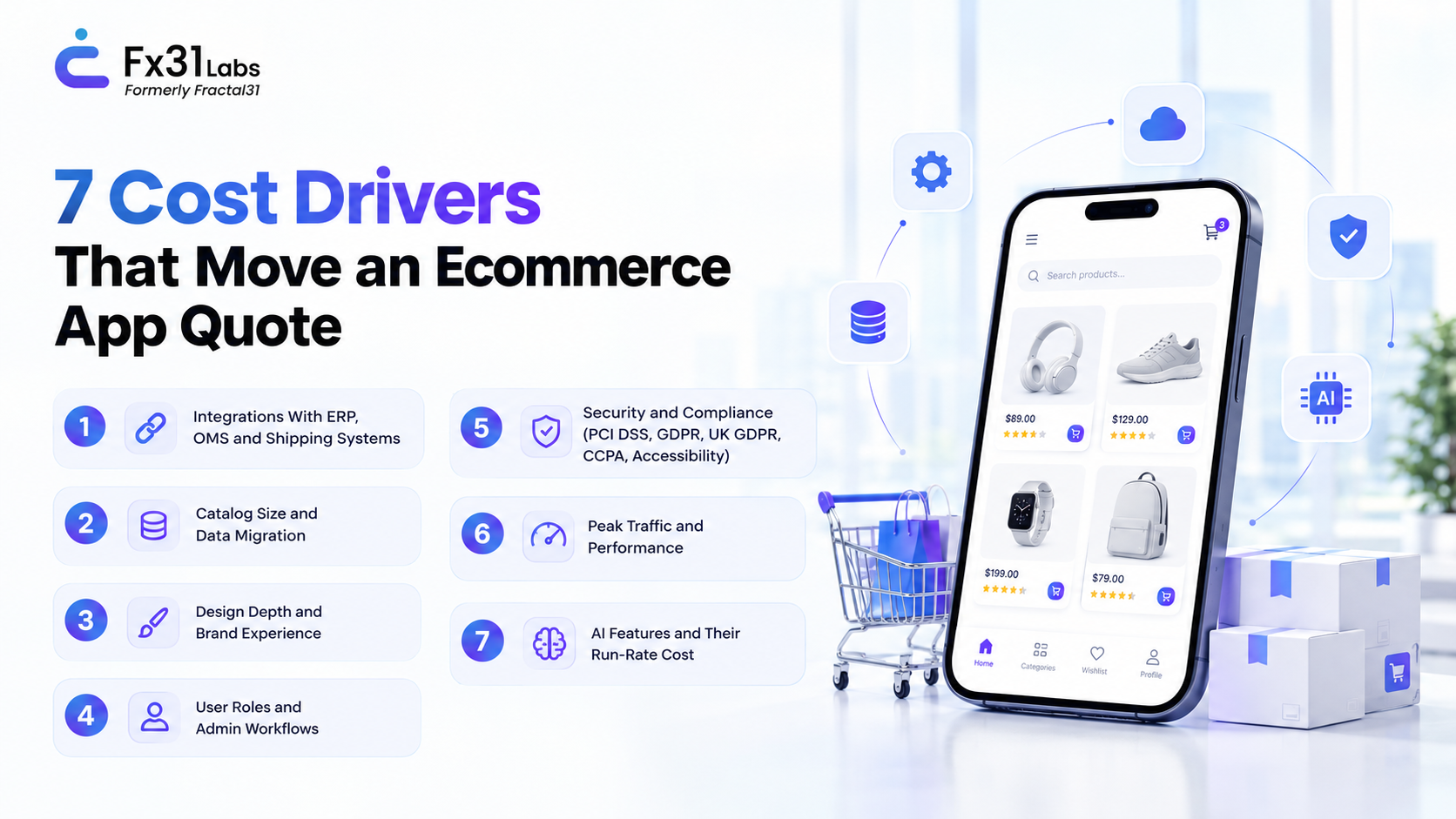
7 Cost Drivers That Move an Ecommerce App Quote
Seven factors explain why similar apps can receive very different quotes. Understanding them helps you estimate your ecommerce app development cost before development begins.
1. Integrations With ERP, OMS, and Shipping Systems
Each integration requires data mapping, authentication, error handling, and testing. Well-documented APIs usually cost less, while legacy systems may need custom middleware. List every required integration early to avoid unexpected expenses.
2. Catalog Size and Data Migration
A catalog of 200 products is much simpler to manage than 50,000 SKUs with multiple variants. Larger catalogs need data cleanup, image processing, search indexing, and migration from existing platforms. Budget for data preparation before development starts.
3. Design Depth and Brand Experience
Template-based interfaces can cost $3,000 to $8,000, while custom UI/UX design runs $10,000 to $30,000 or more. Prioritize checkout usability because Baymard Institute reports an average cart abandonment rate of 70.22%. Reducing checkout friction can make this investment worthwhile.
4. User Roles and Admin Workflows
Shoppers and admins need fewer workflows than sellers, warehouse staff, drivers, and B2B approvers. Each additional role requires specific screens, permissions, and testing. Define all user roles during discovery to control development and QA costs.
5. Security and Compliance (PCI DSS, GDPR, UK GDPR, CCPA, Accessibility)
Use a PCI DSS-compliant payment processor with tokenized card fields to keep card data off your servers. Plan for applicable privacy laws, WCAG accessibility, and Apple’s in-app account deletion rule. These safeguards matter when IBM’s Cost of a Data Breach Report puts the average breach cost at $4.99 million.
6. Peak Traffic and Performance
An app handling 200 orders daily needs to withstand sudden spikes during Black Friday and other sales. Load testing, caching, a content delivery network, and autoscaling add development and hosting costs. Plan for peak traffic, not average demand, to protect checkout performance.
7. AI Features and Their Run-Rate Cost
AI recommendations and smart search can add $8,000 to $90,000 to development, depending on complexity and team rates. Monthly expenses for model API calls, vector search, and monitoring can also rise with traffic. Ask vendors to estimate both build costs and ongoing costs at your expected order volume.
Also Read: Compliance-Ready Software Development Guide
Who Should Build Your App, and How Do You Compare Quotes?
Your ecommerce app development cost depends on project hours and the team’s hourly rate. A 1,500-hour build costs $60,000 at $40 an hour or $225,000 at $150 an hour.
Hourly Rates by Region
| Region | Typical agency rate (USD per hour) | Good fit when |
| United States | $100 to $200 | You need on-site workshops or same-time-zone delivery |
| United Kingdom | $70 to $150 | You sell to UK buyers with local procurement rules |
| Western Europe | $70 to $150 | You need EU-based delivery |
| Eastern Europe | $40 to $80 | You want strong engineering with EU time-zone overlap |
| Latin America | $35 to $75 | You want close overlap with US working hours |
| India | $25 to $55 | You want cost-effective delivery with planned overlap hours |
Hourly rates alone don’t tell the full story. A $40-an-hour team taking 2,500 hours costs $100,000, while a $60-an-hour team finishing in 1,500 hours costs $90,000. Ask vendors for phase-wise estimates to compare total project costs, not just rates.
In-House vs Freelancers vs Agency vs Dedicated Team
| Team model | Cost signal | Speed to start | Accountability | Best for |
| In-house team | Salaries, benefits, recruiting and retention | Slow, since hiring takes months | Full internal control | Commerce that is your core long-term product |
| Freelancers | $30 to $150 an hour, variable quality | Fast | Split across individuals | Small, well-defined tasks |
| Onshore agency | $100 to $200 an hour | Moderate | One accountable vendor | Large programs that need local presence |
| Offshore or nearshore dedicated team | $25 to $80 an hour, often billed monthly | Fast, since the team already exists | One accountable team | MVP through scale, with ongoing releases |
What the Lowest Quote Usually Leaves Out
A low quote may cover less than you expect. Before choosing an ecommerce app development company, check whether the proposal includes:
- Admin panel: Product, order, refund, and customer management.
- Payment testing: Failed payments, refunds, partial refunds, and wallet edge cases.
- App store submission: Store listings, review fixes, and rejection handling.
- Production setup: Hosting, staging, backups, and monitoring.
- Analytics events: Tracking where shoppers drop off.
- Post-launch warranty: A defined period for fixing bugs after release.
- Code ownership: Handover documents and full rights to your code and accounts.
Ask each vendor for phase-wise hours, pricing assumptions, and potential extra charges. Confirm who owns the code and cloud accounts from day one. Our guide to choosing a mobile app development partner explains what else to check before you choose.
Now that you’ve seen who should build your app, let’s take a look at what it costs to run after launch.
What Does an Ecommerce App Cost to Run After Launch?
Ecommerce app development costs continue after launch. Budget 15% to 20% of the build cost annually for maintenance, plus hosting, third-party services, and store fees. A 12-month budget may add roughly 30% to 60% to the initial build cost.
App Store, Google Play, and Payment Fees
| Fee | Amount | Official source |
| Apple Developer Program | $99 per membership year | Apple Developer |
| Google Play developer account | $25 one-time registration fee | Google Play Console Help |
| Store commission on physical goods | None, since physical goods must use payment methods outside in-app purchase | Apple App Review Guidelines 3.1.3(e), Google Play Payments policy |
| Card processing, US | 2.9% + 30¢ per successful domestic card charge (Stripe standard rate) | Stripe US pricing |
| Card processing, UK | 1.5% + 20p for standard UK cards (Stripe standard rate) | Stripe UK pricing |
App stores don’t automatically take 30% of every sale. Physical goods use your own payment provider, so card processing is the main transaction fee, just as it is for web sales.
Maintenance and Feature Iteration
Ecommerce app maintenance cost covers OS updates, security patches, bug fixes, dependency upgrades, and store policy changes. Budget 15% to 20% of the build annually for maintenance, and track new features separately. This keeps routine upkeep from consuming the budget for future development.
Worked Example: Total Cost of Ownership for the First 12 Months
This example estimates the cost to build and run a growth-stage, single-brand app for 12 months. It assumes one Flutter codebase and an initial build cost of $90,000.
| Cost line | Assumption | 12-month cost (USD) |
| App build | Growth-stage scope, one cross-platform codebase | $90,000 |
| Apple Developer Program | One membership | $99 |
| Google Play registration | One-time fee | $25 |
| Cloud hosting | $300 to $800 a month | $3,600 to $9,600 |
| Third-party services | $200 to $600 a month | $2,400 to $7,200 |
| Maintenance | 15% to 20% of the build | $13,500 to $18,000 |
| Budget buffer | 10% to 20% of the build | $9,000 to $18,000 |
| Total | Build plus 12 months of running costs | $118,624 to $142,924 |
Card processing is excluded because web sales incur these fees too. At Stripe’s US standard rate, $500,000 in app sales with an $80 average order would cost about $16,375 in card fees.
To estimate payback, multiply additional monthly orders by your contribution margin per order. For example, 500 extra orders a month at a $25 margin generate $150,000 over 12 months, enough to cover the estimated first-year budget.
Also Read: How to Validate Your Startup Idea Before Building an MVP
Why Choose Fx31 Labs for Ecommerce App Development?
Choosing the right development partner means finding a team that can deliver your app, integrate your systems, and support future growth.
Fx31 Labs builds iOS, Android, and cross-platform apps with India-based engineering and a US office in New Jersey. This setup gives US and UK businesses cost-effective delivery with planned overlap hours for reviews and releases.
Its project experience includes a chemical marketplace platform that reduced transaction time by 50% and accelerated onboarding by 70%, plus an AI/ML IoT self-checkout platform that achieved 99.8% item identification accuracy across deployments to 15+ retail clients.
Why choose us:
- Marketplace development: Build complex buying, selling, and onboarding workflows with proven marketplace experience.
- Retail and consumer apps: A pet grooming super app delivered 3x operational efficiency and 2x faster bookings.
- Faster first releases: Fx31 Labs reports that its rapid MVP approach can cut launch times by up to 40%.
- AI-powered shopping features: Add recommendations, smart search, and shopping assistants as part of the app build.
- Support for future growth: Start with a defined scope and expand features as your product and customer base grow.
Want a tailored estimate for your features, integrations, and launch goals?
Book a free consultation with our experts to discuss your project.
The Bottom Line: Budget Smart Before You Build
Your ecommerce app development cost depends on your features, business model, platform, and development team. Define your must-haves, list required integrations, and include 12 months of running costs before finalizing your budget.
We hope this guide helps you understand the costs, compare development options, and plan your app with confidence.
Ready to turn your idea into a realistic budget? Connect with our experts for a scoped, line-by-line estimate.
Frequently Asked Questions
1. Can I build an ecommerce app for under $30,000?
Yes. A lean MVP using Flutter or React Native, an existing commerce backend, and an offshore team can fit this budget. App builders are another low-cost option for standard Shopify stores.
2. How long does it take to build an ecommerce app?
An MVP takes 3 to 4 months, a growth-stage app 4 to 7 months, and an advanced app 6 to 10 months. Enterprise platforms can take 10 to 18 months.
3. How much does an Amazon-style marketplace app cost?
A marketplace with core buyer, seller, and admin features typically costs $80,000 to $300,000. Enterprise-scale, multi-region platforms can exceed $300,000.
4. Do I need a custom app if I already run a Shopify store?
Not always. App builders cost roughly $100 to $1,000+ per month. A headless app typically costs $25,000 to $150,000 when you need custom features or integrations.
5. Is Flutter or React Native cheaper for an ecommerce app?
Their costs are generally similar. Both use one codebase for iOS and Android, usually costing less than building two separate native apps.
6. Do Apple and Google take a commission on ecommerce app sales?
Physical goods sold through your app don’t incur store commissions. You still pay payment processing fees. Digital goods and subscriptions may be subject to store commissions.
7. How much does it cost to maintain an ecommerce app each year?
Budget 15% to 20% of the build cost annually. For a $90,000 app, that’s $13,500 to $18,000, excluding hosting, third-party services, and store fees.
8. Can I get a fixed-price quote for an ecommerce app?
Yes. Fixed pricing works best when features and integrations are clearly defined. For projects with changing requirements, time-and-materials pricing or a monthly retainer may be a better fit.