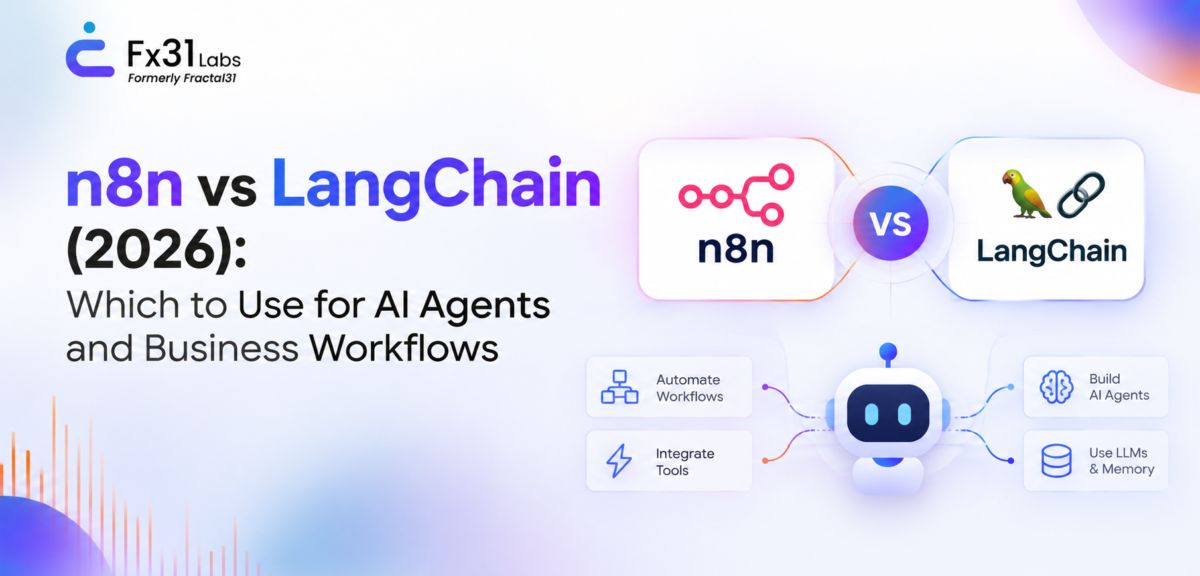
n8n vs LangChain (2026): Which to Use for AI Agents and Business Workflow
Quick Answer: n8n vs LangChain at a Glance
- Choose n8n: For business workflow automation, app integrations, and faster pilots.
- Choose LangChain: With LangGraph for complex reasoning, custom agents, and advanced evaluation.
- Choose both: When workflows need extensive integrations and advanced AI logic.
- Consider your team: n8n suits automation teams, while LangChain needs stronger development skills.
- Check long-term costs: Include hosting, AI usage, monitoring, maintenance, and licensing before deciding.
Two teams build AI agents for the same business problem, but one gets stuck connecting apps while the other struggles with complex reasoning. The difference often comes down to choosing the right tools.
That is why choosing between n8n vs LangChain takes more than comparing features. Your workflow needs, integration requirements, and level of control all affect which tool makes sense for your project.
With the right generative AI and LLM engineering approach, you can choose the right stack from the start instead of rebuilding it later.
In this guide, you’ll learn:
- The key differences between n8n and LangChain
- A 12-point comparison for buyers
- AI agents, integrations, security, and licensing
- Development costs and ongoing expenses
- When to combine both tools
- Which setup fits five real business scenarios
By the end of this guide, you’ll know which tool fits your use case, what to budget for, and how to make the right choice for your AI project.
What Is the Real Difference Between n8n and LangChain?
One AI project needs to connect apps and automate tasks. Another needs custom AI agents that can retrieve information, use tools, and handle complex decisions. Choosing the wrong approach can add unnecessary development work.
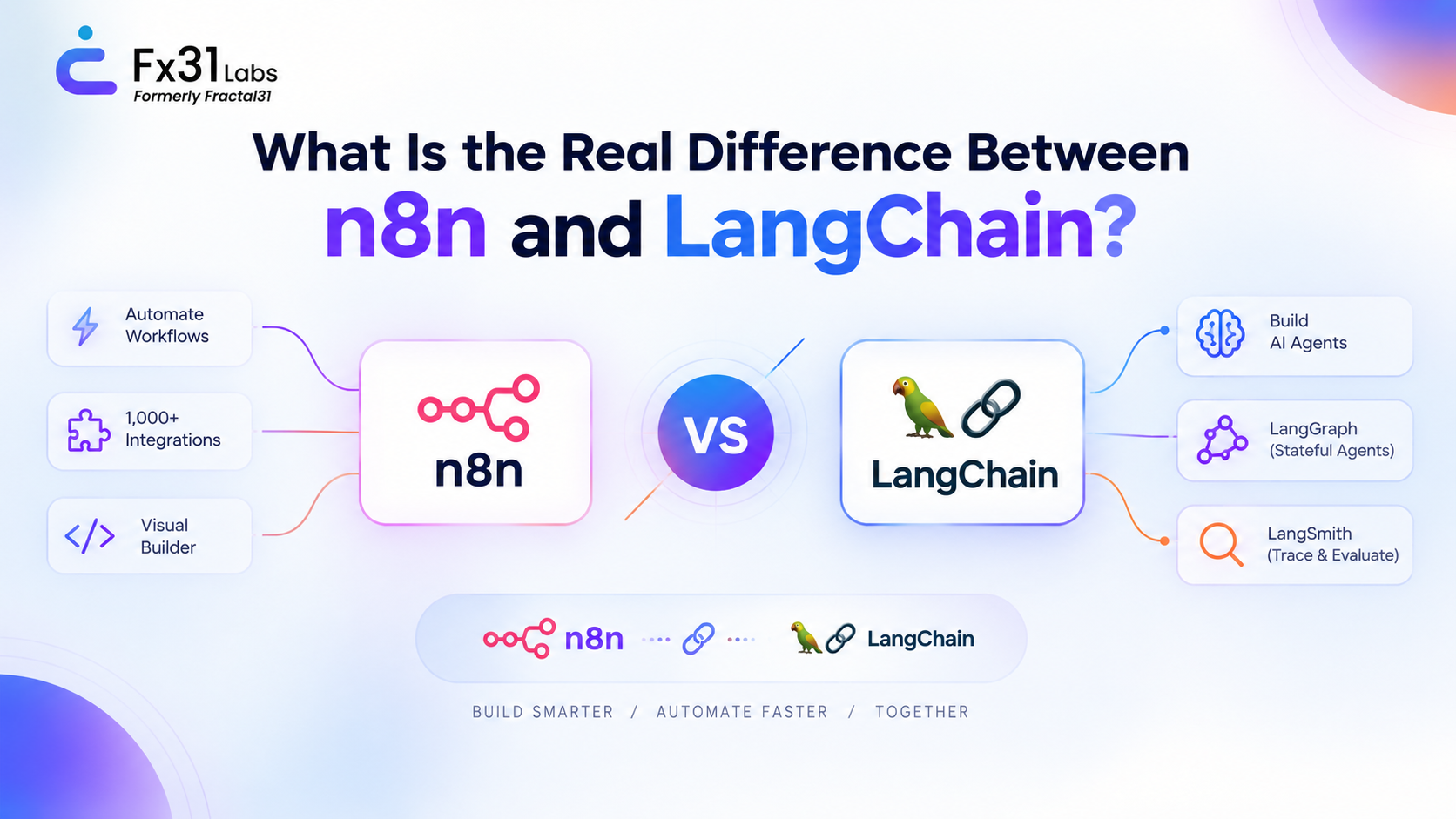
That’s where n8n vs LangChain matters. n8n connects business systems through visual workflows, while LangChain gives developers more control over AI application logic. Both can be used together.
What Is n8n?
n8n is a visual workflow automation platform with 1,000+ integrations, triggers, actions, and custom JavaScript or Python steps. You can use its Cloud plans or self-host the Community Edition.
Its AI nodes support agents, models, memory, and vector stores, making it useful for automating business processes across multiple apps.
What Is LangChain, and Where Do LangGraph and LangSmith Fit?
LangChain is an open-source framework for building AI applications and agents in Python or TypeScript. Its ecosystem includes:
- LangChain: Builds AI agents, tool calls, and retrieval workflows.
- LangGraph: Handles stateful, multi-step agents that need persistent state and human approval.
- LangSmith: Traces, tests, and evaluates AI applications.
LangSmith now also includes Fleet, a no-code builder for everyday agents, yet the ecosystem’s real depth still lives in code.
The frameworks themselves cost nothing to use. You pay for the engineers who build with them, the hosting they run on, and, if you choose it, LangSmith.
Where They Overlap: n8n’s AI Agents Use LangChain
An important detail in the n8n vs LangChain comparison is that n8n’s AI nodes use LangChain’s JavaScript ecosystem. This lets teams build agent-powered workflows visually without coding every component from scratch.
The real choice is between a workflow platform with built-in AI capabilities and a code-first framework that offers greater control over custom agent behavior. You can also combine both when a business workflow needs more advanced AI logic.
Also Read: AI Agents vs AI Assistants: What Enterprises Need to Know
n8n vs LangChain Comparison Table: 12 Criteria Buyers Should Weigh
This n8n vs LangChain comparison covers the 12 factors that affect development, cost, control, and production readiness. LangChain here includes LangGraph and LangSmith.
| Criteria | n8n | LangChain (with LangGraph and LangSmith) |
| Core role | Visual workflow automation with AI agent nodes | Code framework for LLM applications and agents |
| How you build | Visual canvas with JavaScript or Python nodes | Python or TypeScript code |
| Who builds and maintains it | Automation engineers and technical operations teams | Software and AI engineers |
| AI agent depth | Tool-calling agents, memory, sub-workflows, and human approval | Custom agents, middleware, stateful graphs, and durable execution |
| Integrations | 1,000+ prebuilt nodes plus HTTP Request for other APIs | Thousands of integrations for models, tools, and vector stores |
| State and long-running work | Execution-based state and Wait nodes; Cloud Run limits vary by plan | Checkpointed state that supports pausing and resuming workflows |
| Observability and evaluation | Execution logs, error workflows, and evaluations | LangSmith tracing, datasets, and online or offline evaluations |
| Data control and hosting | n8n Cloud or self-hosting; EU Cloud data hosted in Frankfurt | Deploy anywhere; LangSmith offers cloud and Enterprise self-hosting options |
| Governance | Admin roles, SSO, LDAP, and log streaming depend on plan | App-level access controls; Enterprise adds SSO and RBAC through LangSmith |
| Cost model | Cloud execution-based pricing or free self-hosting, plus model costs | Free frameworks, plus engineering, hosting, optional LangSmith, and model costs |
| License and lock-in | Sustainable Use License; workflows depend on n8n | MIT-licensed frameworks with code ownership and framework dependencies |
| Best fit | Business workflows connecting multiple apps and AI steps | AI products requiring customized reasoning and agent behavior |
The LangChain vs n8n decision comes down to speed versus control. n8n simplifies integrations and workflow building, while LangChain offers more flexibility for complex AI logic at the cost of greater engineering and maintenance effort.
n8n vs LangChain for AI Agents: Which Builds Better Agents?
n8n suits agents that automate defined workflows, while LangChain with LangGraph fits agents that need complex reasoning, custom logic, and persistent state.
1. How n8n Builds AI Agents
n8n connects an AI Agent node to a model, tools, and memory. Agents can use app integrations, APIs, MCP clients, or sub-workflows, with human approval for sensitive actions.
2. How LangChain and LangGraph Build AI Agents
LangChain lets developers customize agent behavior, tools, prompts, and middleware. LangGraph adds stateful workflows and checkpoints, allowing agents to pause and resume while preserving context.
3. Where Each One Hits Its Limit
In n8n vs LangChain, n8n becomes harder to manage when workflows involve complex branching and retries. The original draft lists Cloud execution limits of 5 minutes on Starter and 40 minutes on Pro.
LangChain handles complex agent logic better, but developers must manage integrations, retries, security, and monitoring. Choose n8n for defined business workflows and LangChain with LangGraph for agents that need greater control.
Need help choosing? Get In Touch to scope your AI pilot and estimate running costs.
n8n vs LangChain for Business Workflows: Which Connects to Your Stack Faster?
In n8n vs LangChain, n8n usually connects business apps faster, while LangChain gives developers more control over AI logic. For enterprise AI workflow automation across CRM, ERP, and support tools, n8n often gets workflows running sooner.
1. Integrations, Triggers and Error Handling
n8n includes app integrations, webhook and schedule triggers, credential management, retries, and error workflows. Teams can connect business systems without writing every integration from scratch.
LangChain provides integrations for models, embeddings, vector stores, and document loaders. However, connecting business apps and managing retries often requires additional code.
2. Speed to Production and Who Maintains It
Technical operations teams can often build and update n8n workflows visually, making it practical for automating routine business processes. Teams can inspect failed steps and fix workflows without changing a full application codebase.
LangChain requires a software development workflow for coding, testing, deployment, and monitoring. It takes more engineering effort upfront but offers greater control over complex AI applications and release processes.
Which Is Easier to Run, Secure, and Govern in Production?
In n8n vs LangChain, n8n offers more built-in workflow operations, while LangChain gives developers greater control but requires more engineering to run and secure.
1. Debugging, Observability and Evaluation
n8n shows execution inputs, outputs, and errors, with step re-runs and test evaluations. Metric-based evaluations are available from the Pro plan.
LangSmith traces prompts, tool calls, token usage, and latency, with datasets and online or offline evaluations. Base traces retain 14 days of history; extended traces retain 180 days for an additional fee.
2. Self-Hosting, Data Control and Scalability
n8n Cloud stores data in Frankfurt, Germany, while self-hosting gives teams control over infrastructure; queue mode and workers support scaling. Paid self-hosted plans require a license key that checks in with n8n’s license server daily, which matters for air-gapped environments.
LangChain agents run wherever you deploy the code, while LangSmith offers US and EU cloud regions and Enterprise hybrid or self-hosted options. LangSmith states that it does not train models on your data.
3. Governance and Compliance: GDPR, UK GDPR, HIPAA, SOC 2 and the EU AI Act
Neither tool guarantees compliance. Your setup must address data handling, access controls, retention, vendor agreements, and the requirements that apply to your use case.
- Access control: n8n offers admin roles on Pro, SSO and LDAP on Business, and log streaming and external secret stores on Enterprise. LangSmith Enterprise adds custom SSO and RBAC; application-level authorization remains your responsibility.
- GDPR and UK GDPR: Check data locations, processing agreements, and retention policies. Self-hosting can help keep data within your infrastructure.
- HIPAA: If protected health information is involved, verify that every relevant vendor and service has the required contractual safeguards, including a BAA where applicable.
- SOC 2: Review vendors’ current reports and document your own controls for credentials, logs, and change management.
- EU AI Act: Requirements depend on the system and its risk classification. Higher-risk uses may require risk management, logging, human oversight, and documentation.
For more on prompt injection and data leakage, read our guide to LLM security risks for enterprise AI.
Now let’s compare n8n vs LangChain pricing and the costs of building, hosting, and maintaining each setup.
How Much Do n8n and LangChain Cost to Build and Run?
The tools may be free or affordable, but development, hosting, and AI usage add to the bill. n8n vs LangChain pricing depends on your workflow complexity and total cost of ownership.
1. n8n Pricing: Cloud Plans vs Self-Hosted
n8n Cloud charges by workflow executions, while the Community Edition is free to self-host. n8n publishes Cloud prices in euros, although its comparison page also quotes Starter at €20 a month.
| Plan | Price (Billed Annually) | Executions per Month | Key Features |
| Community Edition | Free, self-hosted | No execution cap | Integrations and AI nodes; you manage the servers |
| Starter (Cloud) | €20 per month | 2,500 | Agents, MCP, AI nodes, 5 concurrent executions |
| Pro (Cloud) | €50 per month | 10,000 | Admin roles, workflow history, metric-based evaluations |
| Business (self-hosted) | €667 per month | 40,000 | SSO, LDAP, Git version control, multiple environments, queue mode |
| Enterprise | Custom | Custom | Log streaming, external secrets, extended retention, SLA support |
Business is self-hosted, so server and maintenance costs are additional. LLM usage is also extra, and Business overages cost €4,000 per extra 300,000 executions.
Companies with fewer than 20 employees can apply for n8n’s Start-up Plan, which offers 50% off the Business plan.
2. LangChain Pricing: Free Framework, Paid LangSmith
LangChain and LangGraph are free open-source libraries. Your costs come from engineering, hosting, model usage, and optional LangSmith plans
| LangSmith Plan | Price | Included Traces | Key Features |
| Developer | $0 for 1 seat | 5,000 base traces per month | Tracing, evaluations, prompt playground, community support |
| Plus | $39 per seat per month | 10,000 base traces per month | Unlimited seats, LangSmith Deployment with one free small deployment |
| Enterprise | Custom | Custom | Self-hosted or hybrid hosting, custom SSO and RBAC, support SLA |
Extra traces are billed pay-as-you-go, while managed deployments add compute and memory costs. For high-traffic agents, trace volume and model calls can quickly exceed the base plan cost.
3. Licensing: Can You Use n8n Inside a Commercial Product?
n8n’s Sustainable Use License generally allows internal business use, but embedding its interface or letting customers build workflows may require a commercial Embed agreement.
A silent backend setup may be permitted when only your backend communicates with n8n and end users never see or configure it. Confirm borderline architectures with n8n before launch.
LangChain’s MIT license allows commercial use, modification, and embedding, making it more flexible for products built around custom AI functionality.
4. Total Cost of Ownership by Scenario
These are indicative market ranges, not Fx31 Labs pricing. The n8n vs LangChain decision affects both the initial build and ongoing costs. See our AI agent development cost guide for more context.
| Scenario | Typical Stack | Indicative Build Cost | Indicative Monthly Run-Rate |
| Internal workflow with one or two AI steps | n8n | $1,000 to $20,000 | Plan or server cost, plus modest LLM usage |
| Single AI agent piloted on business systems | n8n, or LangChain for complex logic | $15,000 to $60,000 | $500 to $3,000 |
| Production-grade agent with evaluations and observability | LangChain and LangGraph, often triggered by n8n | $60,000 to $180,000 | $3,000 to $10,000 |
| Multi-agent or customer-facing AI platform | LangChain and LangGraph, plus n8n for integrations | $180,000 to $500,000+ | $10,000 to $100,000+ |
Budget for more than the initial build: first-year spending can reach 1.5 to 2 times the build cost, while annual maintenance may add 15% to 25%. LLM usage is another major variable, so model routing, caching, and spending limits help control costs.
Also Read: How to Control AI Token Consumption and Enterprise AI Costs
Team, Maintenance and Lock-In: What Are You Committing To?
n8n depends on the platform and the team running it. LangChain depends on your codebase and engineering team, so compare long-term maintenance and exit costs before choosing.
1. Skills You Need for Each Path
n8n needs API, JSON, webhook, and basic JavaScript skills, along with someone who understands the business process. An AI engineer can help with prompts and evaluation.
LangChain requires Python or TypeScript developers with retrieval, agent design, and evaluation experience. If you plan to hire LangChain developers, prioritize production experience over demo skills.
Our guide on hiring LLM developers without overpaying explains how to scope these roles. You can also use on-demand AI engineers to fill skill gaps without a lengthy hiring process.
2. Maintenance and Upgrade Burden
With n8n, you maintain workflows, monitor execution volumes, and upgrade the platform. Self-hosting also means managing servers, database backups, and credentials.
With LangChain, you maintain code, dependencies, model APIs, and prompts. Regression evaluations help catch issues after updates, while LangChain 1.0 committed to no breaking changes before version 2.0.
3. Vendor Lock-In and Exit Options
n8n workflows export as JSON, but they still depend on n8n to run. Moving elsewhere means rebuilding the logic, although readable workflows make the transition easier to plan.
LangChain uses the MIT license, but your code may still depend on its framework abstractions. Keep prompts, tools, and business rules in separate modules to make future changes easier.
Whichever path you choose, retain ownership of your prompts, workflow exports, evaluation datasets, and credentials from day one.
Can You Use n8n and LangChain Together?
Yes. In many cases, n8n vs LangChain isn’t an either-or choice. n8n manages integrations and approvals, while LangChain handles complex AI reasoning.
1. What Stays in n8n and What Moves to a LangChain Service
Keep triggers, schedules, CRM and ERP updates, approvals, notifications, and error handling in n8n. Move complex reasoning, custom retrieval, long-term memory, and advanced tool controls to LangChain.
Use shared credential policies, logging, and tracing to monitor the full request across both tools. This keeps responsibilities clear and makes production issues easier to investigate.
2. How the Two Connect: Webhooks, APIs and MCP
The simplest setup uses an API: n8n catches an event, sends it to your LangChain service, then routes the response to the right system.
MCP provides another option. n8n can expose workflows as tools for LangChain agents, or let its own agents use tools published by other systems. Our guide to the Model Context Protocol explains how it supports AI integrations.
For monitoring, self-hosted n8n can send AI runs to LangSmith, helping your team trace requests across both systems. This makes your AI agent orchestration platform easier to debug and maintain.
3. When a Hybrid Stack Is Overkill
Using both tools adds infrastructure, maintenance, and more potential failure points. If your AI only classifies, summarizes, or drafts within a business workflow, n8n alone may be enough.
If you’re building an AI feature with few external integrations, LangChain alone may be simpler. Add the second tool only when your use case needs it.
Now that you’ve seen how the two tools share one system, let’s take a look at five real scenarios and the setup that fits each.
Which One Fits Your Use Case? 5 Real Business Scenarios
The right choice depends on the workflow, integrations, and level of AI reasoning you need. These five scenarios show when to use n8n, LangChain, or both.
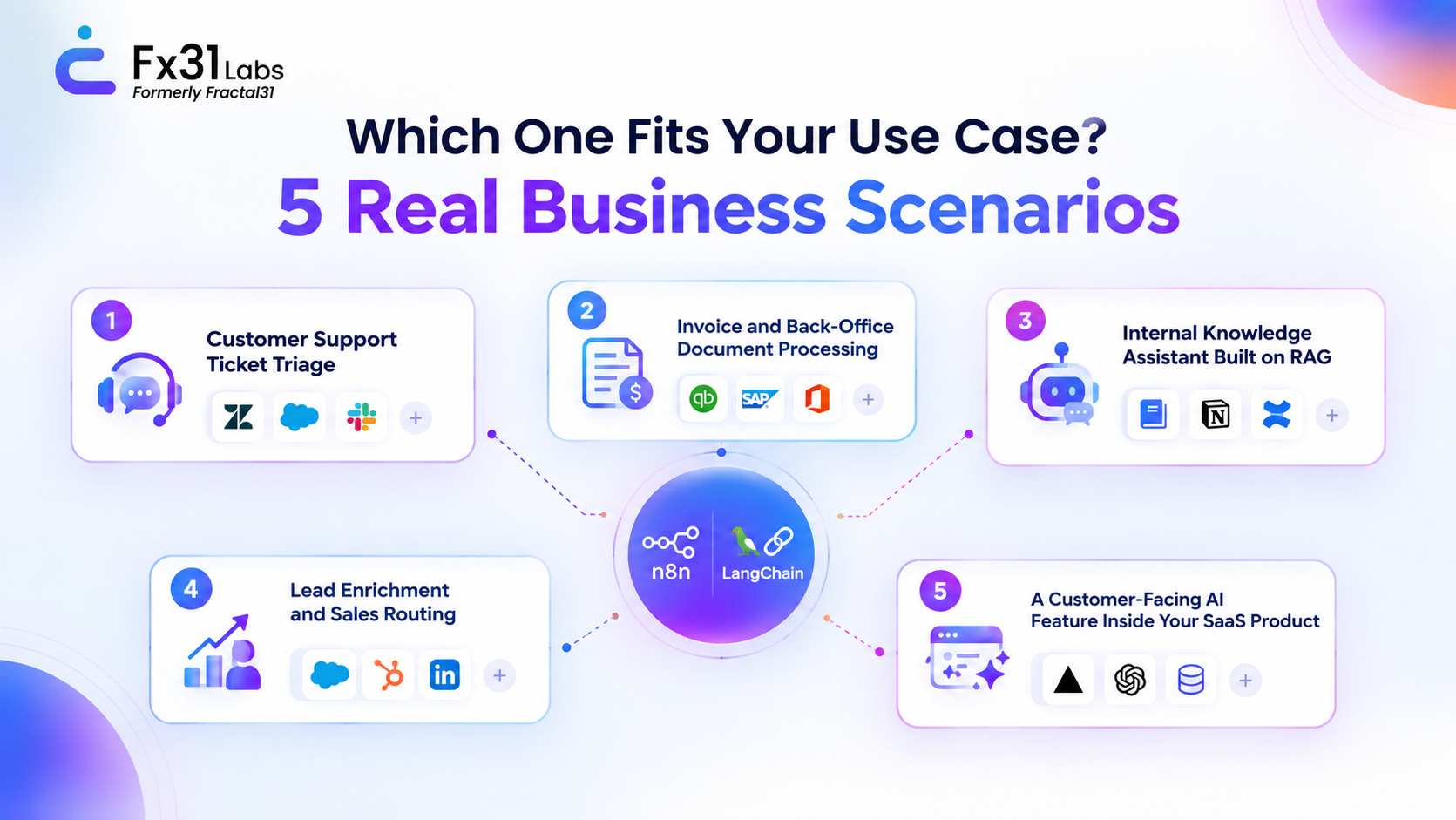
1. Customer Support Ticket Triage
Support teams need to categorize tickets, set priorities, and draft replies using help-center content. Since the workflow mainly connects business apps, n8n can handle it with a retrieval step and human approval before replies go out.
Best fit: n8n for helpdesk, CRM, and Slack integrations, with AI assistance for classification and draft replies.
2. Invoice and Back-Office Document Processing
Invoice processing involves extracting details, matching purchase orders, and updating the ERP. n8n handles predictable steps, while complex line-item matching and anomaly checks may need custom AI logic.
Best fit: Both. Use n8n for intake and ERP updates, and a LangChain service for matching and exceptions.
3. Internal Knowledge Assistant Built on RAG
An internal assistant must answer questions from policies, contracts, and wikis with reliable source citations. LangChain offers more control over retrieval, chunking, and evaluation, while n8n can help launch a quick pilot. Compare RAG vs fine-tuning for enterprise ROI to assess the right approach.
Best fit: LangChain with LangGraph for a production assistant; n8n for a simpler proof of concept.
4. Lead Enrichment and Sales Routing
When a lead enters the CRM, the workflow can enrich its details, score it against your ideal customer profile, assign a sales rep, and draft an email. These tasks rely more on integrations and routing than complex reasoning.
Best fit: n8n for CRM updates, lead routing, and AI-assisted outreach.
5. A Customer-Facing AI Feature Inside Your SaaS Product
A SaaS copilot needs low latency, tenant isolation, guardrails, and evaluations tied to each release. LangChain with LangGraph gives developers greater control over application logic, while customer-configurable n8n workflows may require a commercial Embed license.
Best fit: LangChain with LangGraph for a customer-facing AI feature that needs custom behavior and tighter application-level control.
Also Read: Data Readiness for AI: An Enterprise Guide
The Verdict: Who Should Choose n8n, LangChain or Both?
In n8n vs LangChain, choose n8n for integrations, LangChain for custom AI logic, or both when you need a mix of automation and advanced reasoning. If you’re still deciding whether to build, start with our guide to build vs buy decisions on AI agents.
Choose n8n If
- Your process is predictable: AI handles classification, summaries, or drafts within a defined workflow.
- Integrations drive the work: You need to connect SaaS apps, databases, and internal APIs.
- Your team isn’t developer-heavy: Automation engineers or technical operations staff will manage workflows.
- You need results quickly: You want to test a pilot in weeks, not months.
- You need self-hosting: The Community Edition or Business plan meets your infrastructure and compliance needs.
Choose LangChain If
LangChain fits when AI reasoning is central to your product and needs more control than a visual workflow can offer. It requires stronger engineering skills but supports custom agent logic and production testing.
- AI is your product: Customers depend on the quality of its answers, retrieval, or conversations.
- You need custom agents: Your use case requires complex planning, persistent state, or multi-agent coordination.
- Evaluation is essential: You need datasets, regression tests, and traces to check quality before releases.
- You have experienced engineers: Python or TypeScript developers can manage code, deployment, and support.
- You’re scaling a customer-facing product: You need control over tenant isolation, licensing, and releases.
Choose Both If
Choose both when business workflows need reliable integrations and advanced AI reasoning. In the LangChain vs n8n decision, a hybrid setup makes sense when neither tool can handle the full process efficiently.
It’s a strong fit for workflows that connect many apps, make complex decisions, and need a team capable of maintaining both tools.
10 Questions to Ask Before You Commit
- Can we map the process as a fixed sequence of steps?
- How many business systems must the AI access?
- Will customers configure workflows or connect their own accounts?
- Who will maintain the system after launch?
- What data will the AI access, and where must it stay?
- Do GDPR, UK GDPR, HIPAA, or other regulations apply?
- How will we measure accuracy after each change?
- What can we spend on models, hosting, and tracing?
- How long must each run last, and does it need human approval?
- How difficult would it be to migrate to another tool?
If most answers point to predictable steps and multiple integrations, start with n8n. If custom reasoning, rigorous evaluation, and customer-facing AI matter most, start with LangChain.
Why Choose Fx31 Labs for Your n8n or LangChain Build?
Choosing the right AI development partner means finding a team that understands your workflow, data, and production goals.
Fx31 Labs builds generative AI and LLM solutions for US and UK teams, with India-based engineering and a US office in New Jersey. We help businesses choose the right stack based on their needs, not a preferred tool.
- Tool-neutral assessment: We assess your business process, technical needs, and data before recommending a stack.
- Pilots built for production: We plan for evaluation, tracing, human approvals, and running costs from the start.
- Engineers for both stacks: Python, Node.js, and TypeScript engineers, backed by cloud and DevOps support, can help build and maintain your solution.
- Proven GenAI delivery: Our team delivered a functional in-house HRMS portal in 5 weeks with a two-person team using GenAI.
- Flexible engagement: Start with a scoped pilot, then expand with AI engineers or a dedicated team as your product grows.
Want an expert opinion before committing to a stack or budget?
Book a free consultation with our experts and talk about your AI project.
Conclusion: Make the Right Choice for Your AI Roadmap
n8n connects business systems and automates workflows, while LangChain gives developers more control over AI agents. The right choice depends on your integrations, reasoning needs, and team.
Start with one workflow and a clear success metric. Test it with a short pilot, then add the second tool only if your requirements demand it.
We hope this guide helps you compare n8n vs LangChain, understand their trade-offs, and choose a setup that fits your budget and long-term goals.
Ready to plan your AI project? Connect with our AI engineering experts to map your workflow, assess the right stack, and estimate running costs before development begins.
Frequently Asked Questions
1. Is n8n or LangChain better for building AI agents?
LangChain suits complex agents that need custom reasoning and evaluation. n8n is better for agents that automate defined business workflows.
2. Can n8n replace LangChain?
For simple agents, often yes. Complex retrieval, stateful agents, and custom guardrails may require LangChain.
3. Is n8n built on LangChain?
n8n’s core platform isn’t, but its AI features use LangChain’s JavaScript library for agent, chain, and memory capabilities.
4. What is the difference between n8n and LangGraph?
n8n automates visual workflows across apps. LangGraph builds stateful AI agents that need complex reasoning and checkpoints.
5. Can I use n8n in a commercial SaaS product?
Internal business use is generally allowed under n8n’s Sustainable Use License. Customer-facing workflow configuration or access may require a commercial Embed license.
6. How much does it cost to run n8n vs LangChain in production?
n8n Cloud starts at €20/month (billed annually). LangSmith Plus is $39 per seat/month. A production-grade agent usually costs $3,000-$10,000 a month to run, including model usage, hosting, and monitoring.
7. Can n8n and LangChain work together?
Yes. n8n handles integrations, triggers, and approvals, while LangChain manages complex AI logic. They can connect through APIs or MCP.
8. Which is more secure for enterprise data, n8n or LangChain?
Both can support secure deployments, but neither guarantees security by default. n8n offers built-in controls on paid plans, while LangChain gives developers more flexibility but requires them to implement and maintain security measures.