
AI Agents vs AI Assistants: What Enterprises Need to Know in 2026
Artificial intelligence has taken the world by storm and in 2026, enterprises and organisations are taking it up a notch by moving beyond AI assistants. Now, AI agents have emerged that can plan and schedule calendars, make decisions and complete daily tasks with minimal human involvement.
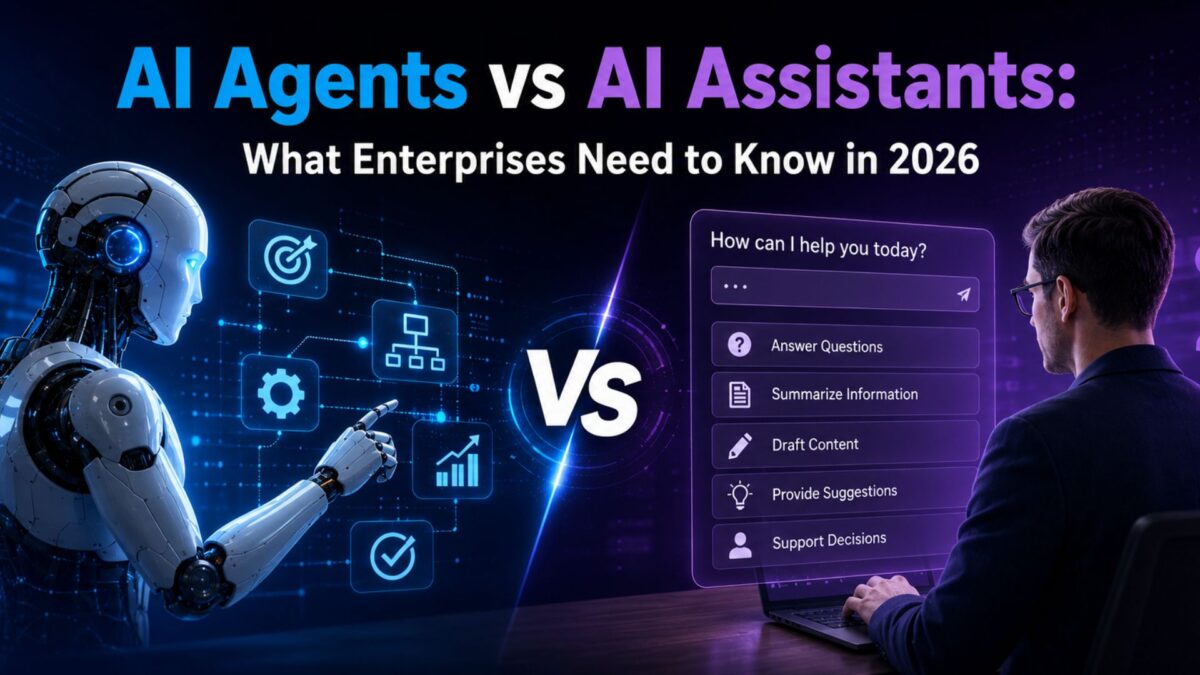
Where AI assistants are known to be well versed and efficient at answering questions and providing support to employees, on the other hand AI agents for enterprises are curated to automate complete workflow systems, collaborate with other systems and improve overall operations of the organisation.
In the initial years of adopting generative AI, businesses realised answering questions wasn’t enough. Organisations now want AI that can execute work operations, coordinate with other softwares and deliver measurable outcomes. This shift has given rise to agentic AI, one of the biggest enterprise technology trends of 2026.
AI agents for enterprises are autonomous software systems that understand simple goals and desires and after processing make decisions accordingly with the help of multiple tools, in simple words it can complete business tasks with little to no human intervention.
Unlike AI assistants whose primary response is fit for prompts, AI agents can actively execute workflows which makes them the preferred choice for businesses. They can work individually as well as alongside many departments for an enterprise such as AI automation, operations, finance, HR, consumer service and IT Management.
What Are AI Agents?
AI agents are intelligent systems capable of accepting data and their set objectives, planning and executing actions, interacting with other applications and finalising day to day tasks independently.
These AI agents do not require constant intervention, they automatically evaluate tasks at hand and decide what step to take next.
An AI agent resembles a highly capable digital employee, when provided with a set of Goals, it evaluates the necessary steps, takes help of available software tools, collects data, adapts when the situation arises, and delivers results.
Traditional automation software operates on a rigid structure, modern Autonomous AI agents keep learning from different contexts, evaluate different data sources, and make dynamic decisions through the whole process.
For enterprises, an AI agent reduces their manual work significantly and does faster execution of repetitive business activities.
What Are AI Assistants?
AI assistants on the other hand are systems which are more conversational in nature primarily to help users by answering questions, content generation, evaluating and summarizing given data and simplifying everyday tasks.
The majority of business employees today interact with AI assistants through a chatbox interface. These assistants are helpful in enhancing productivity by simplifying research, writing and brainstorming content, technical coding and overall communication.
However, AI assistants usually work on guided human access. They operate on given instructions before performing tasks.
In simple words, they assist people in their process rather than completely replacing it.
An AI assistant helps users in their tasks by evaluating prompts and then responding to it, while an AI agent has the ability to plan and execute tasks independently to achieve the defined goal. AI assistants aid employee productivity, whereas AI agents automate complete workflows for whole enterprises.
AI Agents vs AI Assistants: What’s the Difference?
Although both technologies are identical, their purpose is fundamentally different.
| AI Assistants | AI Agents |
| Prompt based response | Goal oriented response |
| Conversational in Nature | Action-oriented |
| Operates on continuous instructing | Operates and Plans independently |
| Main focus is productivity | Main focus is automation |
| Usually operate in one interface | Can operate with multiple business systems |
| Limited decision-making | Autonomous decision-making |
| Built for employee support | Built for executing workflows |
The difference becomes more clear while working inside enterprises.
For instance, a manager or sales team lead asks an AI assistant to prepare a client report. The assistant will generate reports after getting a clear set of instructions.
Now on the other hand, an AI agent will operate on this basis-
It checks whether the client has been in contact or not in recent times, retrieves CRM data, analyzes the purchase history of client, curates a well structured follow-up mail, plans or schedules a meeting, again updates the CRM and then notify the manager or sales team lead. All this without guidance on every step.
Why Are AI Agents Becoming Essential for Enterprises in 2026?
Modern day enterprises are in constant struggle of increasing their efficiency while reducing their operational costs.
Recruiting new employees for every department is not appropriate and traditional automation often lacks the competency to adapt to changing business conditions.
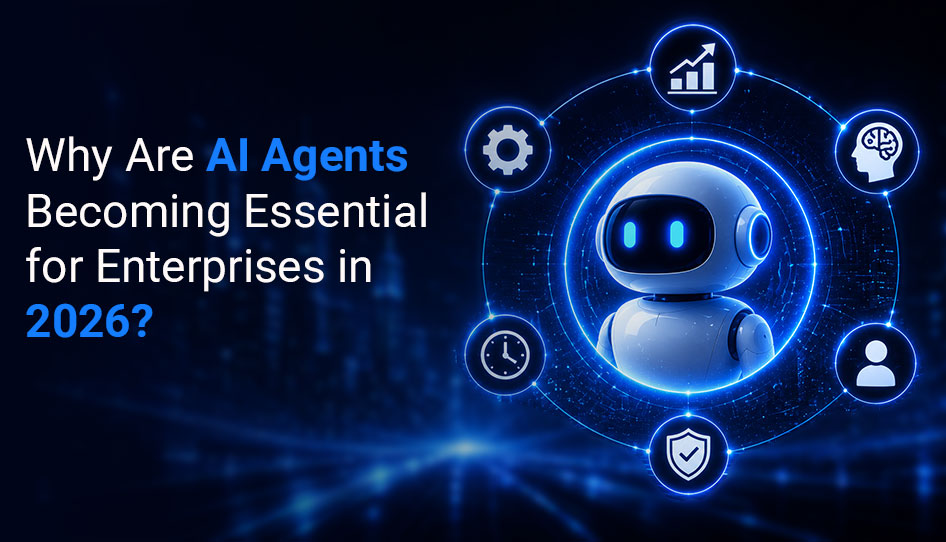
This is where AI agents for enterprises come in, instead of automating specific tasks or activities these agents can automate entire business workflows.
Organizations can allot them different departments to enhance their speed, reduce human errors and allow the workforce to focus on more creative and strategic work.
Major Factors behind enterprise adoption include:
- High Labor Cost
- Daily Operational Challenges
- Increasing demands of 24/7 customer Support
- Technological Advancements
- Efficient Decision-Making
- Measurable and Large Scale Automation
Newly introduced AI models are more competent and reliable, enterprises have shown increased trust in AI agents for mission driven operations.
What Is Agentic AI?
Agentic AI refers to technology systems that are capable of acting independently to attain desired results rather than simply instruction based responding.
Traditional AI operates on command.
Agentic AI curates plans, opt for preferred tools, evaluates progress, adapts to challenges and achieves results without any intervention. Instead of giving specific prompts to AI to perform individual actions, organizations define goals.
For example:
Traditional AI
“Write a Mail for the Customer”
Agentic AI
“Increase customer retention by 10%.”
The AI now first analyzes customer behavior, identifies risk markers, curates mail personalised for the customer, plans campaigns, tracks responses and optimises future mailing facilities automatically.
This aspect has revolutionised enterprise software across various industries.
How Do Autonomous AI Agents Work?
Autonomous AI agents combine several technologies into one intelligent system.
A simplified workflow looks like this:
- Accept a business objective/goal
- Understand the fundamentals
- Acquire relevant information
- Create a Plan
- Execute the action
- Evaluate outcomes
- Adjust strategies if required
- Execute action and achieve Result
Unlike traditional automation tools, these agents constantly track their executable actions and make adjustments during the whole process.
This level of adaptation helps dynamic business environments and fast paced work environments.
Where Are AI Agents Used in Enterprises?
AI agents have been deployed in various departments of businesses.
Customer Support
AI agents have the ability to resolve tickets, initiate refunds, update consumer data and transfer complex cases to human representatives. Support teams can handle significantly higher ticket volumes while maintaining service quality.
Human Resources
Recruitment agents screen portfolios and resumes, plan future interviews, answer questions, and generate submitted documents.
HR professionals spend less time on repetitive administrative work.
Sales
Sales agents acquire leads, update CRMs, generate proposals, send follow-ups, and identify upselling opportunities.
Sales teams gain more time to build customer relationships.
Finance
Finance agents process invoices, reconcile accounts, detect anomalies, monitor spending, and generate reports.
They reduce manual errors while improving compliance.
IT Operations
AI agents monitor infrastructure, detect issues, restart services, assign tickets, and even resolve routine technical problems automatically.
IT teams become more proactive instead of reactive.
Marketing
Marketing agents analyze campaign performance, create personalized content, optimize budgets, segment audiences, and recommend future strategies based on performance data.
What Are Multi-Agent Systems?
In 2026, many enterprises have adopted large-scale AI adoption, a single AI agent is not enough to manage complex tasks. Now, multi-agent systems help in scaling AI adoption.
A multi-agent system comprises a group of different AI agents, each carrying different responsibilities, working collectively towards a common business objective.
Instead of one AI trying to do everything, responsibilities are divided among specialized agents.
For example, an e-commerce company may use:
- A customer service agent to answer queries.
- An inventory agent to monitor stock.
- A pricing agent to adjust product prices.
- A logistics agent to coordinate shipping.
- A finance agent to process payments.
Each agent communicates with the others in real time, making the entire workflow faster and more efficient.
This collaborative approach is becoming the foundation of enterprise AI ecosystems in 2026.
Multi-agent systems are networks of specialized AI agents that collaborate to complete complex business workflows. Instead of relying on one AI model, enterprises assign different responsibilities to multiple autonomous agents, improving scalability, accuracy, and enterprise AI automation across departments.
AI Agents vs Chatbots: Are They the Same?
One of the major misconceptions businesses have about AI is that AI agents and chatbots are interchangeable and swappable. They both serve differently.
A chatbot operates on simulating a conversation. It answers questions, gives information and helps the user to navigate through simple processes. An AI agent, on the other hand, simply takes action.
This distinction is becoming increasingly important as organizations evaluate AI agents vs chatbots for business automation.
| Chatbots | AI Agents |
| Conversation Oriented | Execution Oriented |
| Limited workflow abilities | End-to-end workflow automation |
| Follow a defined script | Makes dynamic decisions |
| Need Human Intervention | Operates autonomously |
| Primarily customer-facing | Can work across any department |
For enterprises seeking operational efficiency, AI agents offer significantly greater value than traditional chatbots.
Why Are Enterprises Investing in AI Agents?
Organizations have moved on from targeted productivity gain.
Modern businesses want collective improvements in cost savings, consumer satisfaction and efficient decision-making.
This is the reason why industries are investing huge capital in AI agents for enterprises at a high-scale.
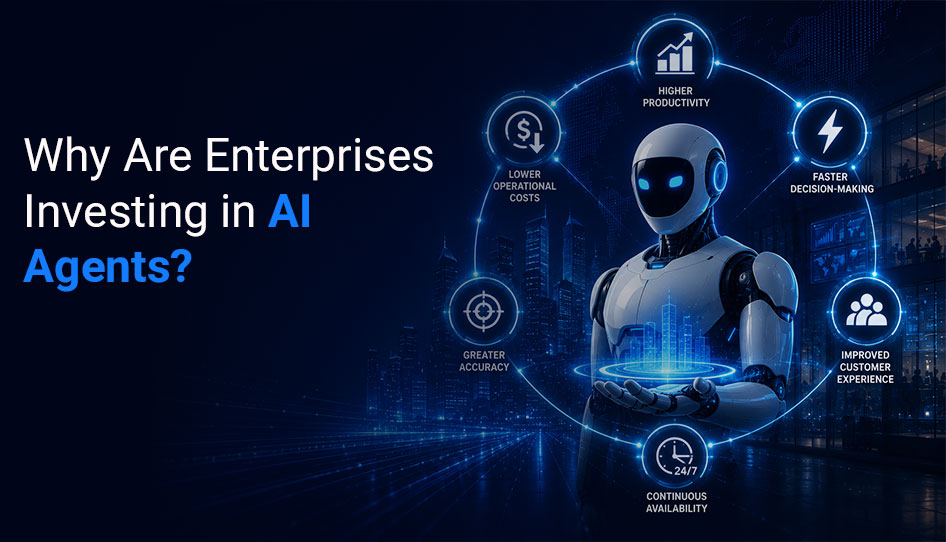
Some of the biggest benefits include:
Higher Productivity
Employees can spend much of their time in creative work and strategic problem solving for the company as they spend less time on daily repetitive activities.
AI agents can monitor and perform daily tasks routinely.
Lower Operational Costs
Automation of repetitive tasks and workflows reduces labor driven work while also reducing costly errors.
Organisations can increase their operations without a direct increase in staff.
Faster Decision-Making
AI agents can acquire large chunks of data and process it at a fast pace of a few seconds.
This allows team leads and senior individuals to make well-informed decisions much faster compared to a traditional reporting method.
Improved Customer Experience
Customers now receive more personalised and quick responses to any query and also get a faster issue resolution. This naturally leads to improved consumer satisfaction and customer loyalty.
Greater Accuracy
Unlike manual procedures, AI agents always validate information before completing tasks and follow the provided business rules thoroughly.
This reduces compliance risks and operational mistakes.
Continuous Availability
AI agents can operate 24/7 tirelessly with consistent performance.
This is of significant value for global organisations as they serve consumers across multiple time zones.
How Can Enterprises Successfully Implement AI Agents?
Adopting AI agents is not simply just buying new software.
Organizations should have a strict routine and a precise implementation strategy.
Step 1: Identify High-Impact Processes
Single out or isolate repetitive workflows that consume significant time of the employees and workforce.
Examples of such repetitive tasks include consumer support, management of documents, processing invoices and report generation.
Step 2: Define Clear Business Goals
Be decisive in your goal setting and have clarity on your process.
This may involve reducing response times, increasing productivity, lowering costs, or improving customer satisfaction.
Step 3: Select the Right AI Platform
Acquire the correct AI Solution which can integrate with existing software for enterprises such as CRM, ERP, HRMS and cloud applications as well.
Security and connectivity should be major concerns as well.
Step 4: Start with Pilot Projects
Do not initiate with automating your entire workflow system. Begin with one department and evaluate.
Track and monitor results over a period of time, collect employee feedback and refine worksystems before expanding to other domains.
Step 5: Train Employees
Adapting AI will excel at any organisation where employees understand and have clarity about AI agents, which they ultimately have to collaborate with.
Training provides the teams with confidence to use the technology effectively.
Step 6: Monitor and Optimize
AI agents need continuous monitoring to improve their performance, identify limitations and ensure compliance with the provided policies.
What Challenges Should Enterprises Consider?
Despite their advantages, AI agents are not without challenges.
Organizations must prepare for technical, operational, and ethical considerations.
Some common challenges include:
- Data privacy and security concerns.
- Integration with legacy enterprise systems.
- Governance and compliance requirements.
- AI bias in decision-making.
- Employee resistance to automation.
- Ongoing monitoring and maintenance.
Addressing these issues early helps organizations build trust in AI systems while maximizing long-term value.
Rather than replacing employees, successful enterprises position AI agents as collaborative tools that enhance human capabilities.
Which Industries Benefit Most from AI Agents?
Almost every industry can benefit from enterprise AI automation, but adoption is especially strong in:
- Banking and Financial Services
- Healthcare
- Insurance
- Manufacturing
- Retail and E-commerce
- Telecommunications
- Logistics and Supply Chain
- Information Technology
- Human Resources
- Legal Services
Each industry uses AI agents differently, but the goal remains the same: automate repetitive work, improve decision-making, and deliver better customer experiences.
What Is the Future of AI Agents for Enterprises?
The future of AI agents for enterprises is moving far beyond simple automation. In 2026 and beyond, organizations will increasingly rely on AI agents that can collaborate with humans, communicate with one another, and independently manage complex business operations.
Rather than replacing employees, AI agents will become digital teammates that handle repetitive, data-heavy tasks while people focus on creativity, strategy, and relationship-building.
Several trends are shaping the next generation of enterprise AI.
More Collaborative Multi-Agent Systems
Instead of deploying one powerful AI agent, businesses will use multi-agent systems where multiple specialized agents work together.
For example, a customer support request could involve:
- A customer service agent to understand the issue.
- A billing agent to verify payment history.
- A logistics agent to track shipments.
- A finance agent to process refunds.
- A reporting agent to update business dashboards.
This collaborative approach improves speed, accuracy, and scalability.
Better Decision-Making
Future AI agents will not simply automate tasks—they’ll recommend the best course of action based on business objectives.
By analyzing historical trends, customer behavior, and real-time business data, AI agents will help leaders make more informed decisions.
Deeper Enterprise Integration
Modern organizations use dozens of business applications every day.
The next generation of Autonomous AI agents will seamlessly integrate with CRMs, ERPs, HR platforms, accounting software, project management tools, and communication platforms.
This unified ecosystem will eliminate many manual handoffs between systems.
Stronger Governance and Security
As AI agents gain more responsibility, enterprises will invest heavily in governance.
Organizations will implement approval workflows, role-based permissions, audit trails, and human oversight to ensure AI actions remain transparent and compliant.
Conclusion
Artificial intelligence has entered a new phase. While AI assistants introduced businesses to conversational AI, AI agents for enterprises are transforming how work gets done by planning, acting, and adapting with minimal human intervention.
The difference between the two is more than technical—it represents a shift from assisting employees to automating end-to-end business processes. Powered by agentic AI, Autonomous AI agents, and multi-agent systems, enterprises can streamline operations, improve customer experiences, and unlock new levels of productivity.
However, successful adoption requires more than technology. Organizations must define clear objectives, choose the right use cases, establish governance, and ensure employees are equipped to work alongside AI.
Looking ahead, the most successful enterprises won’t be those that simply use AI. They’ll be the ones that combine human expertise with intelligent AI agents to create faster, smarter, and more resilient businesses.
FAQs
What are AI agents for enterprises?
AI agents for enterprises are intelligent software systems that can understand goals, make decisions, interact with business applications, and complete tasks with minimal human intervention. They automate entire workflows instead of simply responding to user prompts.
What is the difference between AI agents and AI assistants?
AI assistants help users by answering questions, generating content, and supporting everyday tasks. AI agents go further by planning, executing, and optimizing workflows independently, making them suitable for enterprise-wide automation.
What is agentic AI?
Agentic AI refers to AI systems that can act independently to achieve defined objectives. Instead of waiting for instructions at every step, they plan actions, use tools, adapt to changing conditions, and complete tasks autonomously.
How do autonomous AI agents improve enterprise productivity?
Autonomous AI agents reduce manual work by handling repetitive processes such as customer support, invoice processing, report generation, scheduling, and data management. This allows employees to focus on strategic and high-value activities.
What are multi-agent systems?
Multi-agent systems consist of multiple specialized AI agents working together to solve complex business problems. Each agent performs a specific role while communicating with others to complete larger workflows efficiently.
Are AI agents better than chatbots?
When comparing AI agents vs chatbots, AI agents offer significantly broader capabilities. Chatbots mainly provide conversational support, whereas AI agents can execute tasks, interact with enterprise software, make decisions, and automate complete workflows.
Which industries benefit the most from enterprise AI automation?
Industries such as banking, healthcare, manufacturing, retail, logistics, insurance, IT, and telecommunications benefit greatly from enterprise AI automation because they involve large volumes of repetitive processes and data-driven decision-making.
Can small and medium-sized businesses use AI agents?
Yes. While large enterprises often lead adoption, many cloud-based AI platforms now offer scalable solutions for small and medium-sized businesses. Companies can start by automating one workflow and gradually expand AI capabilities as their needs grow.