12 Best AI SaaS Development Companies in 2026
Quick Answer: AI SaaS Development Companies at a Glance
- What they do: Build SaaS products with AI features, integrations, security, and billing.
- Typical cost: $10,000 for discovery to $400,000 for production platforms, with enterprise builds exceeding $1,000,000.
- How to choose: Check production experience, data security, AI evaluation, running costs, and ownership terms.
- Best next step: Compare three suitable companies and validate your use case with a paid pilot.
Building an AI-powered SaaS product sounds exciting until you face the real challenges: choosing the right AI models, keeping development costs under control, and making sure your product works reliably at scale.
That’s why choosing the right AI SaaS development company matters. The right partner can help you turn your idea into a market-ready product without unnecessary delays or costly mistakes.
But with so many companies offering AI development services, which one should you choose?
In this guide, you’ll find:
- 12 AI SaaS development companies and their core strengths
- How to evaluate and shortlist the right development partner
- Questions to ask before signing a contract
- Development costs and ongoing expenses
By the end, you’ll have a practical shortlist and a clearer understanding of the capabilities, budget, and expertise needed to build a successful AI SaaS application.
What Is an AI SaaS Development Company?
An AI SaaS development company builds and maintains subscription-based software with AI features at its core. It combines SaaS engineering, AI integration, security, billing, and model-cost management in one system.
Unlike a general software agency that treats AI as an add-on, an AI SaaS development company plans for accuracy, data privacy, scalability, and profitability from the start.
| Area | General Software Agency | AI SaaS Development Company |
| Model Selection | Uses familiar LLM APIs | Selects models based on tasks, cost, and performance |
| Data Management | Connects data sources | Cleans, secures, and isolates customer data |
| Testing | Tests feature functionality | Measures accuracy, hallucinations, and model drift |
| Cost Planning | Focuses on development costs | Estimates AI costs per customer |
| Post-Launch Support | Fixes reported bugs | Monitors performance, quality, and ongoing costs |
What Does a Production-Ready AI SaaS Product Include?
A working demo proves an AI feature can function. A production-ready SaaS application must also handle security, reliability, and operating costs.
- Multi-Tenant Architecture: Manages accounts, roles, authentication, and customer data isolation.
- Data Pipelines: Prepare and transfer clean, permissioned data from business systems.
- AI Model Layer: Selects commercial LLM APIs or open-weight models based on the use case.
- RAG and AI Agents: Ground responses in business data and automate tasks within defined limits.
- Evaluation and Guardrails: Test accuracy and detect hallucinations before they affect users.
- Usage Metering and Billing: Track AI consumption per customer to protect subscription margins.
- Monitoring and Cost Controls: Track latency, output quality, and token spending.
- Security and Compliance: Apply encryption, audit logs, and relevant controls through an AI governance and compliance framework.
Why Work With an AI SaaS Development Company?
AI adoption is growing across SaaS businesses. According to SaaS Capital’s 2025 survey, more than 76% of surveyed private SaaS companies already use AI in their products.
Specialist AI SaaS development services can help businesses:
- Launch Faster: Use established patterns for authentication, billing, and RAG instead of building everything from scratch.
- Reduce Technical Risk: Test AI accuracy, security, and reliability before launch.
- Control Operating Costs: Estimate model usage per customer before setting subscription prices.
- Access Specialized Expertise: Work with engineers experienced in AI integration, model evaluation, and production deployment.
- Scale Efficiently: Adjust development resources as product requirements change without maintaining an unnecessarily large permanent team.
Working with a specialist makes sense when an AI pilot struggles to reach production, internal AI expertise is limited, or the business needs to launch an MVP quickly. If AI is your core intellectual property and you already have an experienced in-house team, building internally may be the better option.
| Planning an AI SaaS product but short on AI engineers? Our team scopes the build, the model strategy, and your monthly run-rate cost before you commit. Get In Touch for a scoped estimate built on your product, not a template. |
Also Read: SaaS Application Development: A Step-by-Step Guide to Success
12 Best AI SaaS Development Companies
Each company offers different AI and SaaS development capabilities. Use this comparison to shortlist providers based on their location, specialization, and engagement options.
| Company | Based in | Best for | Engagement models |
| Fx31 Labs | New Jersey, US; engineering in India | AI MVPs and production-ready GenAI | MVP development, dedicated teams, talent augmentation |
| STX Next | Poznań, Poland | Python-based AI and data-heavy applications | Fixed-price projects, embedded teams |
| Azumo | San Francisco, US; Latin American delivery | AI development aligned with US working hours | Projects, dedicated teams, staff augmentation |
| RTS Labs | Richmond, Virginia, US | Enterprise AI and regulated data projects | Proofs of concept, phased projects, consulting |
| Master of Code Global | Redwood City, California, US | Conversational AI and AI agents | AI pilots, MVPs, dedicated teams |
| Geniusee | Austin, US; engineering in Kyiv, Ukraine | AI applications for fintech and edtech | Dedicated teams, staff augmentation |
| Euristiq | Toronto, Canada; offices in Poland and Ukraine | Multi-agent AI and AWS-based solutions | MVP development, dedicated teams, outcome-based contracts |
| Netguru | Poznań, Poland | Cross-functional AI product development | AI teams, MVPs, staff augmentation |
| Uptech | Los Angeles, US; engineering in Kyiv, Ukraine | Generative AI MVPs for startups | Proofs of concept, MVPs, dedicated teams |
| Miquido | Kraków, Poland | AI SaaS with mobile applications | AI Kickstarter, team augmentation |
| Clockwise Software | Edinburgh, UK; engineering in Dnipro, Ukraine | LLM integration into existing SaaS | Full-cycle development, dedicated teams |
| Bitcot | San Diego, California, US | Healthcare AI and MCP integrations | Prototyping, phased development |
Let’s take a look at each one in detail.
1. Fx31 Labs

Fx31 Labs builds AI-powered SaaS applications, generative AI solutions, and custom AI features for startups and mid-market companies. With India-based engineering and a US office in Short Hills, New Jersey, it supports projects from initial MVP to production deployment.
Its experience includes an in-house HRMS built in 5 weeks using GenAI with a two-person team and an AI/ML-powered IoT self-checkout platform that achieved 99.8% item identification accuracy across 15+ retail clients.
Businesses can start with MVP development services or use Coderbotics AI, its code modernization platform, to support legacy code transformation and cloud migration.
Key Highlights:
- AI Development: Generative AI, custom ML, and AI-powered SaaS solutions for business applications.
- MVP Delivery: Its rapid MVP approach reports up to 40% faster launches.
- Code Modernization: Coderbotics AI uses 40+ specialized agents for code modernization and cloud migration.
- Retail AI Case Study: The AI/ML self-checkout platform demonstrates 99.8% item identification accuracy across 15+ retail clients.
- Engagement Models: Project-based development, MVP development, dedicated teams, and AI talent augmentation.
Best for: Startups and mid-market companies that need an AI MVP, production-ready GenAI features, or legacy system modernization without coordinating multiple vendors.
2. STX Next
STX Next specializes in Python development and builds AI solutions for data-heavy applications. Its expertise includes RAG, AI agents, document AI, and MLOps, using tools such as LangChain, LangGraph, and Amazon Bedrock.
Key Highlights:
- AI Search: Built an ML- and LLM-powered search system for a podcast and audiobook platform.
- MLOps: Supports model deployment and monitoring.
- AI Stack: Works with Python and modern AI frameworks.
Best for: Businesses building data-intensive SaaS applications with advanced search or AI-driven workflows.
3. Azumo

Azumo provides nearshore AI development with teams across Latin America working during US business hours. Its experience includes generative AI for a cultural intelligence SaaS platform and an LLM-powered quoting workflow for a health insurer.
Key Highlights:
- AI Product Experience: Develops and operates its own AI chatbot product.
- Security: Reports SOC 2 certification. Verify its current report before sharing production data.
- Delivery: Offers AI pods, dedicated teams, and virtual CTO support.
Best for: US-based companies that need AI engineers working in compatible time zones.
4. RTS Labs
RTS Labs builds enterprise AI solutions with a fully US-based team, making it relevant for businesses with strict data-handling requirements. Its work includes RAG, agentic AI, and an Azure-based copilot for logistics agents using internal documents and live data.
Key Highlights:
- AI Governance: Supports security reviews and AI risk management.
- Logistics AI: Builds copilots for internal workflows and operational data.
- MVP Hardening: Helps improve existing AI applications before production.
Best for: Regulated businesses that require US-based engineering and stronger data controls.
5. Master of Code Global
Master of Code Global specializes in conversational AI, helping SaaS businesses add chat assistants, voice interfaces, and AI agents. Its experience includes a multi-agent assistant integrated into a Shopify upsell application.
Key Highlights:
- AI Capabilities: Covers RAG, model fine-tuning, voice AI, and MLOps.
- Pilot Projects: Offers a 30-day, fixed-budget AI pilot.
- Post-Launch Support: Supports AI applications beyond initial development.
Best for: SaaS businesses adding conversational AI and automated assistants to existing platforms.
6. Geniusee
Geniusee develops AI features for existing software, with experience across AI customer support and recruitment tools. Its technical stack includes LangGraph, CrewAI, the OpenAI Agents SDK, and the Claude Agent SDK.
Key Highlights:
- Industry Experience: Focuses on fintech and edtech applications.
- Agent Frameworks: Works with multiple tools for building AI agents.
- Flexible Delivery: Supports proofs of concept and team augmentation.
Best for: Fintech and edtech companies integrating AI into established software.
7. Euristiq
Euristiq focuses on AWS-based AI development, including LLM applications, RAG pipelines, and multi-agent systems. Its experience includes a production-ready go-to-market SaaS platform built with Amazon Bedrock and Claude models.
Key Highlights:
- AWS Integration: Builds AI solutions around Amazon Bedrock.
- Commercial Flexibility: Offers outcome-based engagement options.
- Early Planning: Provides an AI workshop before development commitments.
Best for: Businesses building multi-agent SaaS applications within an AWS environment.
8. Netguru
Netguru combines AI engineering with product strategy and design. Its experience includes generative AI personalization for a proptech platform and a tool that accelerates teacher-guide creation for an edtech provider.
Key Highlights:
- Open-Source RAG: Develops Chatguru, its own RAG framework.
- Product Design: Combines engineering with product and design expertise.
- Cross-Industry Experience: Has delivered AI solutions for proptech and edtech.
Best for: Scale-ups that need coordinated AI engineering, product strategy, and design.
9. Uptech
Uptech helps startups validate AI ideas through rapid proofs of concept, typically lasting 3 to 8 weeks. Its projects include an AI marketing SaaS for prospect scoring and a medical-document system using self-hosted LLMs to keep patient data within the client’s environment.
Key Highlights:
- Private AI Deployment: Fine-tunes open models using LoRA and deploys them through SageMaker or Kubeflow.
- Rapid Validation: Supports early testing before a full-scale investment.
- Healthcare Experience: Builds AI systems for sensitive medical documents.
Best for: Startups that need to validate AI SaaS ideas quickly, especially in healthcare and fintech.
10. Miquido
Miquido combines mobile development with AI engineering for SaaS products that need strong web and mobile experiences. Its AI course-creation platform uses RAG and supports multiple models, including OpenAI, Mistral, Google, and Anthropic.
Key Highlights:
- Multi-Model Support: Integrates different LLM providers into one application.
- Mobile AI: Supports on-device AI and mobile-focused experiences.
- Flexible Start: Offers discovery workshops and an AI Kickstarter program.
Best for: Businesses building AI SaaS applications with polished mobile experiences.
11. Clockwise Software
Clockwise Software helps established SaaS businesses add LLM features without rebuilding their existing platforms. One public project involved an LLM-powered PR reporting SaaS that progressed from a one-month proof of concept to enterprise customers.
Key Highlights:
- SaaS Integration: Adds AI capabilities to existing software.
- Practical AI Scope: Focuses on LLM integration and light fine-tuning.
- Ongoing Support: Offers SLA-based maintenance after delivery.
Best for: SaaS founders who want to introduce LLM features into a product already in use.
12. Bitcot
Bitcot develops AI applications and integrations, with a focus on healthcare and data-driven workflows. Its work includes an MCP-based data pipeline that lets users query sales information from connected seller accounts through Claude.
Key Highlights:
- AI Stack: Works with RAG, LangChain, OpenAI models, and self-hosted models.
- MCP Integrations: Connects business data with AI assistants.
- Delivery Support: Offers a 90-day MVP-to-production track.
Best for: Healthcare businesses and companies that need AI features connected to existing data systems.
Now that you’ve compared all 12 companies, the next step is to understand how to choose the best AI SaaS development company.
Also Read: Top 21 LLM Development Companies for US and UK Buyers
How to Choose an AI SaaS Development Company
A polished demo doesn’t guarantee a reliable AI SaaS application. Use these questions to assess real-world experience, technical expertise, security, and long-term costs before choosing a development partner.
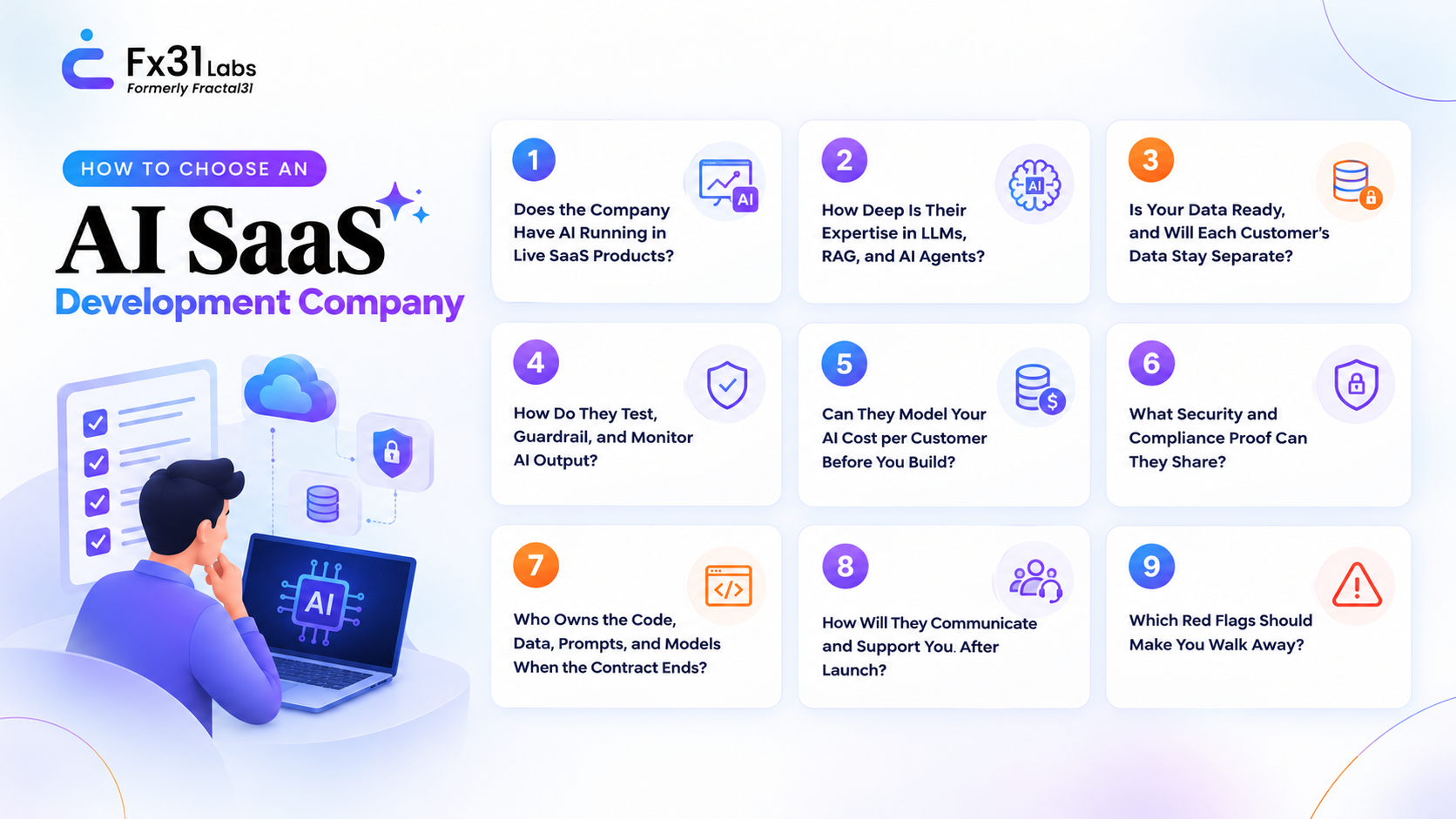
1. Does the Company Have AI Running in Live SaaS Products?
Ask for AI features used by paying customers, along with real results and post-launch challenges.
Ask: “Which AI features are live with paying users, and what problems did you fix after launch?”
2. How Deep Is Their Expertise in LLMs, RAG, and AI Agents?
A capable team knows when to use an LLM API, an open-weight model, or RAG versus fine-tuning.
Ask: “Which model strategy fits our use case, and why?”
3. Is Your Data Ready, and Will Each Customer’s Data Stay Separate?
Check data readiness for AI before development, including data quality, permissions, and tenant isolation.
Ask: “How will you prevent one customer’s data from appearing in another customer’s results?”
4. How Do They Test, Guardrail, and Monitor AI Output?
Look for evaluation datasets, hallucination checks, output monitoring, and clear processes for fixing accuracy problems.
Ask: “How will you measure accuracy before launch and detect quality drops afterward?”
5. Can They Model Your AI Cost per Customer Before You Build?
AI usage directly affects SaaS gross margins, so estimate token consumption and monthly costs before setting subscription prices.
Ask: “What will one active customer cost us in AI usage each month?”
6. What Security and Compliance Proof Can They Share?
Check their experience with SOC 2, GDPR, UK GDPR, HIPAA where applicable, and relevant AI governance and compliance requirements.
Ask: “What compliance work have you completed, and what evidence can you provide?”
7. Who Owns the Code, Data, Prompts, and Models When the Contract Ends?
Confirm ownership of source code, prompts, evaluation datasets, fine-tuned model weights, and data pipelines. Clear handover terms reduce the cost of switching software development vendors.
Ask: “What assets and documentation will we receive when the contract ends?”
8. How Will They Communicate and Support You After Launch?
Confirm time-zone overlap, communication schedules, account ownership, and post-launch support for model updates, costs, and performance.
Ask: “Who will manage our project, and what support is included after launch?”
9. Which Red Flags Should Make You Walk Away?
Watch for these seven warning signs before signing a contract:
- No live AI references: Only prototypes or internal demos.
- One model for everything: No task-specific model selection.
- No evaluation plan: No clear way to measure accuracy or detect hallucinations.
- Unclear running costs: No estimate of monthly AI usage.
- Vague ownership terms: Unclear rights to code, prompts, or data pipelines.
- Fixed pricing without discovery: A quote before reviewing your data and requirements.
- Unverified credentials: Certifications or partnerships without supporting evidence.
Start with paid discovery or a small pilot with clear success criteria. Tie payments to working milestones and keep your cloud and model accounts under your control.
Now that you know how to test a vendor, let’s look at what an AI SaaS build costs to launch and run.
How Much Does It Cost to Hire an AI SaaS Development Company?
AI SaaS development costs depend on product scope, data readiness, AI workflows, and integrations. A complete SaaS product also needs billing, tenant management, security, and admin features.
1. How Much Does an AI SaaS Build Cost at Each Stage?
Each development stage adds features, testing, and infrastructure. These are indicative market ranges, not Fx31 Labs pricing.
| Stage | What you get | Typical timeline | Market cost range |
| Discovery and proof of concept | Scope, data audit, and working AI prototype | 2 to 6 weeks | $10,000 to $30,000 |
| MVP | Core AI workflow, multi-tenant basics, billing, and first users | 3 to 6 months | $50,000 to $150,000 |
| Production platform | Integrations, evaluation, guardrails, SSO, admin, and monitoring | 6 to 12 months | $150,000 to $400,000 |
| Enterprise scale | Multi-agent workflows, advanced compliance, and high availability | 12 months or more | $400,000 to $1,000,000+ |
See our detailed AI SaaS development cost breakdown for more cost factors. Your final budget mainly depends on five things:
- Data readiness: Poor-quality or scattered data adds cleanup time.
- AI workflows: Each workflow needs prompts, evaluation, and guardrails.
- Integrations: CRM, ERP, and payment connections add development and testing.
- Compliance: SOC 2, HIPAA, and EU AI Act requirements can add controls and audits.
- Team location: Developer rates vary by region and delivery model.
2. What Will Your AI SaaS Product Cost to Run Each Month?
Development is only the initial expense. Model usage, hosting, monitoring, maintenance, and compliance affect monthly costs as customers grow.
| Cost line | Indicative market range | What drives it |
| Model and API usage | $500 to $15,000+ a month | Users, prompt size, model choice, and agent loops |
| Vector database and hosting | $50 to $5,000 a month | Data volume, tenants, and traffic |
| Evaluation and observability | $200 to $5,000 a month | Test volume, tracing, and monitoring tools |
| Maintenance and retraining | 15% to 20% of build cost a year | Model updates, drift, and new features |
| Security and compliance | Varies by framework | Audits, penetration tests, and HIPAA controls |
Model choice can change your bill significantly. Our guide to AI token consumption explains the main cost drivers. Check the latest rates on the OpenAI and Anthropic pricing pages before choosing a model.
Example: Monthly AI cost for 1,000 users
Assume each user makes 300 requests monthly, with 2,000 input tokens and 500 output tokens per request.
| Model tier at list price | AI cost per user per month | AI cost for 1,000 users |
| Low-cost model | About $0.135 | About $135 |
| Flagship model | About $13.50 | About $13,500 |
These are illustrative estimates before caching or batch discounts. On a $50-per-seat plan, the flagship model could consume more than a quarter of revenue. Actual costs depend on the model and current rates.
A good AI SaaS architecture controls spending from the start:
- Model routing: Use cheaper models for simple tasks and stronger models for complex reasoning.
- Prompt caching: Cached input can cost up to 90% less than standard input on eligible pricing tiers.
- Batch processing: Run non-urgent jobs through batch APIs at reduced rates.
- Tenant usage limits: Set usage caps or usage-based plans to protect margins.
- Cost dashboards: Track AI spending per customer and flag unusual usage.
AI inference costs also change quickly. The Stanford HAI AI Index 2025 reported that GPT-3.5-level inference costs fell more than 280-fold in under two years. Choose a partner that designs for model switching so your product can adopt more cost-effective options.
3. In-House, Outsourced, Dedicated Team or Staff Augmentation: Which Model Fits?
Your delivery model affects cost, control, and hiring speed. Compare these four options before committing to a development budget.
| Delivery model | How you pay | Control | Speed to start | Best fit |
| In-house team | Salaries, benefits, and recruiting fees | Full | Slowest | Long-term core AI development |
| Outsourced project | Fixed price or milestones | Shared | Fast | Well-defined MVP with clear scope |
| Dedicated team | Monthly fee per engineer | High | Fast | Evolving product roadmap |
| Staff augmentation | Hourly or monthly per specialist | High | Fastest | Filling specific AI skill gaps |
An in-house team offers full control and retains knowledge internally, but recruiting experienced AI engineers takes time.
An outsourced project suits a clearly defined scope. Fixed pricing or milestones help with budgeting, while scope changes may increase costs.
A dedicated team provides ongoing engineering support as your AI features, models, and prompts evolve after launch.
Staff augmentation adds specialists such as LLM engineers or MLOps experts to your existing team. It works best when you already have technical leadership.
Location also affects rates. The Accelerance 2026 rate guide lists senior engineer rates of $60 to $75 an hour in Latin America, $64 to $76 in Central and Eastern Europe, and $31 to $41 in Asia, including India.
For an evolving roadmap, AI talent augmentation or a dedicated team may offer more flexibility than a fixed-price project. Compare total cost of ownership, not just hourly rates.
Also Read: Dedicated Development Team vs In-House Hiring: What’s Right for Your Business?
Why Choose Fx31 Labs for AI SaaS Development?
Choosing an AI SaaS development company is easier when its experience matches your product, data, and delivery needs.
Fx31 Labs builds AI and software products with India-based engineering and a US office in New Jersey. Its published work includes commodity trading analytics at 99.99% uptime and demand planning with 30% fewer stockouts for a UAE retailer.
Its team supports the journey from AI prototyping to full-stack SaaS development, including generative AI, RAG, AI agents, and custom ML. Flexible engagement options help businesses start with an MVP and expand engineering support as their needs grow.
- Full AI SaaS development: Generative AI, ML, web and mobile development, cloud, and QA handled by one team.
- Flexible engagement: Project-based builds, dedicated teams, and AI talent augmentation to match your roadmap.
- Faster idea validation: The team prototyped 8 startup ideas and produced 9 pitch decks for a venture studio.
- Cost-effective delivery: India-based engineering with a US office in New Jersey.
Ready to build your AI SaaS product? Book a consultation with Fx31 Labs to discuss your requirements and development roadmap.
Conclusion: Make Your AI SaaS Investment Count
Choosing the right AI SaaS Development Company comes down to proven results, technical expertise, transparent costs, and a clear plan for scaling your product. Look beyond demos and focus on real-world experience.
Shortlist three companies that match your requirements. Ask each one about production experience, AI model selection, data security, and monthly running costs before making a decision.
Start with paid discovery or a small pilot with clear goals and measurable outcomes. This helps you validate the approach before committing to a larger investment.
We hope this guide helps you compare development partners, estimate costs, and choose the right approach for building a reliable AI SaaS product.
Ready to plan your MVP? Connect with our experts to discuss your requirements and development roadmap.
Frequently Asked Questions
1. What does an AI SaaS development company do?
It builds SaaS products with AI features such as LLMs, RAG, and AI agents, along with billing, security, monitoring, and ongoing maintenance.
2. How much does it cost to build an AI SaaS product?
Discovery costs $10,000 to $30,000, an MVP costs $50,000 to $150,000, and production platforms cost $150,000 to $400,000. Enterprise builds can exceed $1,000,000, excluding ongoing AI usage costs.
3. How long does it take to build an AI SaaS MVP?
Most MVPs take 3 to 6 months. Data readiness, integrations, and compliance requirements can affect the timeline.
4. Should I use an LLM API or an open-weight model?
LLM APIs are usually faster to launch with. Open-weight models may suit products with high usage or stricter data requirements. Some SaaS products combine both.
5. How do AI features affect SaaS pricing and profit margins?
AI usage adds ongoing costs that can reduce gross margins. Track usage per customer, set limits, and use cost-effective models for simpler tasks.
6. Is outsourcing AI SaaS development cheaper than hiring in-house?
Outsourcing can reduce recruitment time and upfront staffing costs for an MVP. In-house teams may be better for long-term AI capabilities you want to manage internally.
7. What compliance does an AI SaaS product need for US and UK customers?
Requirements depend on the product and data involved. Common considerations include SOC 2, GDPR, UK GDPR, and HIPAA for applicable US healthcare data.
8. How do I know if a company can take AI from prototype to production?
Ask for live AI product examples, an evaluation plan, estimated running costs, clear ownership terms, and a client reference.