Top 20 AI MVP Development Companies (2026): Best AI MVP Development Services Compared
Key Takeaways: AI MVP Development Services at a Glance
- What You’re Buying: The smallest working product that proves one AI workflow with real users.
- Top Companies: 20 AI MVP development services providers compared by strength, fit, and entry price.
- Budget and Timeline: Most focused AI MVPs cost $20,000 to $150,000 and take 6 to 16 weeks.
- Running Costs: Model usage, hosting, and upkeep continue after launch.
- How to Choose: Shortlist by budget and use case, then test data, evaluation, and code ownership.
Most AI startups don’t fail because the model is weak. They failed because nobody tested whether users needed them, and CB Insights’ 2026 review of 431 venture-backed shutdowns found that 43% cited poor product-market fit.
AI MVP development services exist to catch that risk early. The right partner proves one AI workflow with real users in 6 to 16 weeks, usually for $20,000 to $150,000, before you fund the full product.
Finding that partner is the hard part. Every agency now has an AI page, but only some know what to leave out, how to measure accuracy with proven generative AI engineering, and what the product will cost to run.
In this guide, you’ll learn:
- What AI MVP development services include
- 20 AI MVP companies and who each one suits
- Which company fits your budget and use case
- 10 checks to vet any AI MVP partner
- Red flags and first-call questions
- Build costs and timelines by project type
- Monthly running costs after launch
By the end of this guide, you’ll have a realistic shortlist and the questions to test every partner before you sign.
What Are AI MVP Development Services?
AI MVP development services turn an AI idea into the first version real users can rely on. They cover discovery, data review, model selection, design, engineering, testing, and a guided launch to a small user group.
The key word is “viable.” A demo chatbot becomes an MVP only when it handles messy inputs, admits uncertainty, and records what users do, so you can decide whether to invest, pivot, or stop.
What Does an AI MVP Include?
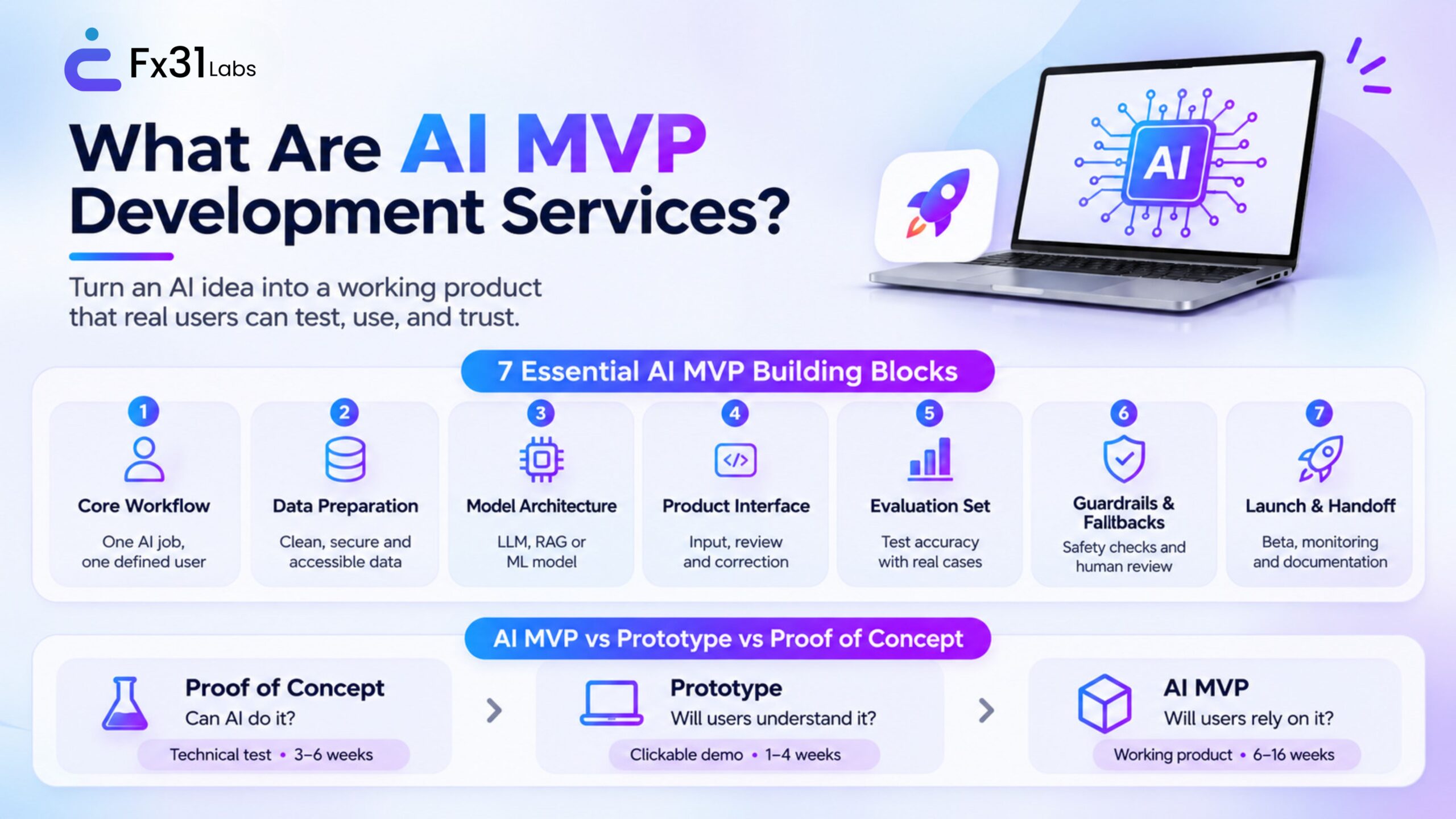
A well-scoped AI MVP has seven building blocks. Missing one usually means rework, a surprise invoice, or an AI feature nobody trusts.
- One Core Workflow: A single AI job for a defined user, such as triaging support tickets.
- Data Preparation: Documents and records checked for gaps, sensitivity, and access rights.
- Model and Architecture: An LLM API, open-weight model, or classic ML, chosen after weighing RAG against fine-tuning.
- Product Interface: Screens where users give input, review AI output, and correct it.
- Evaluation Set: Real test cases that score accuracy whenever prompts, data, or models change.
- Guardrails and Fallbacks: Rules that block unsafe output and route low-confidence answers to a person.
- Launch and Handoff: A beta release, monitoring, documentation, and a named owner.
AI MVP vs. Prototype vs. Proof of Concept: Which One Do You Need?
These three terms get mixed up in proposals, and that confusion costs money. Pick the stage that removes the risk you face next.
| Stage | Proof of concept | Prototype | AI MVP |
| Question it answers | Can AI do this task on our data? | Do users understand the flow? | Will real users rely on it? |
| What you get | A narrow technical test | Clickable screens or a rough demo | A working product with core features |
| Data used | Sample or historical data | Placeholder or mock data | Real user data with access controls |
| Typical timeline | 3 to 6 weeks | 1 to 4 weeks | 6 to 16 weeks |
| Best next step | Prototype or MVP | MVP if users respond well | Scale, pivot, or stop |
The AI MVP vs prototype decision comes down to risk. If you doubt AI can do the task, start with an AI proof of concept; if it works and users like the flow, build the MVP.
When Should You Hire an AI MVP Development Company?
Outside help makes sense when speed and AI depth matter more than building a team first. Watch for these signals.
- No AI Engineers In-House: Nobody on your team has shipped retrieval, evaluation, or agents to production.
- A Fixed Deadline: An investor meeting or pilot customer gives you weeks, not quarters.
- Sensitive Data: Health, financial, or personal data makes mistakes costly.
- A Stalled Pilot: An internal experiment looks good in demos but never reaches users.
- An AI-Built Prototype: A Lovable, Bolt, or Cursor build now needs proper architecture and security.
If you already have a strong technical lead and a validated idea, full AI MVP development services may be more than you need, and adding AI engineers to your team could be enough.
Also Read: How to Validate Your Startup Idea Before Building an MVP
Top 20 AI MVP Development Companies for US and UK Buyers
Here is the full shortlist of AI MVP development services providers at a glance. Most focus on AI MVP development for startups, though several also serve mid-market teams.
| Company | Base | AI MVP strength | Best for | Published entry point |
| Fx31 Labs | New Jersey, US; India engineering | GenAI MVPs and prototyping | MVP plus a team that stays | Fixed-price prototyping after scoping |
| RaftLabs | India and Ireland | Fixed-scope AI MVPs | One workflow, set budget | From $10,000 |
| Fourmeta | London, UK | Product, brand, and AI | Investor-ready UK founders | Not published |
| Emerline | Miami, US | KPI-led AI MVPs | Funded teams wanting rigor | Not published |
| DATAFOREST | Ukraine | Data engineering behind AI | Data-heavy MVPs | $10,000 to $100,000 |
| Topflight Apps | Irvine, California, US | Healthcare AI | Digital health founders | Not published |
| S-PRO | Zurich and Salt Lake City | AI agents for banks | Regulated finance | Pilot first, priced after discovery |
| Empat | San Francisco, New York, London, Kyiv | Fixed-scope MVPs and rescue | Scope discipline | Not published |
| thoughtbot | New York and London | MVP shaping sprints | Senior US and UK talent | $10,000+ minimum on Clutch |
| Boldare | Gliwice, Poland | AI opportunity sprints | Business case first | $25,000+ minimum on Clutch |
| 8allocate | Tallinn, Estonia | Integration-first MVPs in 4 to 6 weeks | AI on current systems | Not published |
| Inoxoft | Newark, Delaware, US | Pre-kickoff AI cost estimates | Budget approval | AI estimate on request |
| DBB Software | Kraków, Poland | Governed agents and copilots | Agents in business systems | Free AI scope document |
| Brocoders | Tallinn, Estonia | AI-native builds | AI SaaS MVPs | Not published |
| inVerita | Lviv, Kraków, San Francisco, Medellín | Full-product MVPs and AISD | Mobile and web with AI | AISD: $45,000 to $120,000 fixed price |
| 7Puentes | Buenos Aires, Argentina | ML and forecasting | Predictive products | Not published |
| Leanware | Bogotá, Colombia | Senior-only boutique | US Eastern-time overlap | Fixed-fee Sprint 0 |
| Imaginary Cloud | Lisbon and London | AI designed in from day one | Design-led UK and EU teams | Not published |
| Purrweb | Registered office in the UAE | Design-led MVPs | Lean consumer apps | AI PoC $3,000 to $15,000; MVP from $25,000 |
| Agicent | India and US | App MVPs with AI | Budget mobile founders | Itemized quote before the build |
Let’s look at each company in detail.
1. Fx31 Labs
Fx31 Labs builds AI MVPs and prototypes for founders who need a working product fast and the same team to keep building it. Its MVP development services cover discovery, IT strategy, design, development, cloud hosting, and maintenance, with launch times reported up to 40% faster.
For a VC studio, the team built prototypes for 8 startup ideas, along with 9 pitch decks. That gave each idea something concrete to test with users and show investors before a full build was funded.
It also delivered a functional HRMS portal in five weeks with a two-person team using GenAI. Once an MVP proves itself, founders can add AI engineers or a dedicated team that already knows the code.
Key Highlights:
- Generative AI MVPs: LLM features, AI assistants, and workflow automation built around one validated use case.
- Fixed-Price Prototyping: A scoped price agreed before the build, with no surprise invoices.
- Low-Code and Custom Builds: Bubble and no-code specialists for fast validation, plus custom engineering.
- Production-Grade AI: A self-checkout platform reached 99.8% item identification accuracy across 15+ retail clients.
- Engagement and Pricing: Projects, dedicated teams, or AI engineer augmentation, priced through a scoped estimate.
Best for: Founders who want a scoped AI MVP now and a dependable team for the next stage.
2. RaftLabs
RaftLabs frames every MVP around one expensive business question the product must answer. Scope and price are agreed before any code is written, and founders keep the same team from first call to launch. It also turns prototypes built with Lovable, Replit, Bolt, or v0 into production releases.
Key Highlights:
- Post-Launch Warranty: 60 days of fixes after release at no extra cost.
- Prototype Hardening: Production architecture, identity, and integrations for AI-built prototypes.
- Long-Term Clients: Most clients stay with the team for three years or more.
Best for: Founders with one clear use case who want a single accountable team.
3. Fourmeta
Fourmeta is an AI-native product agency whose AI MVP development services combine strategy, branding, design, engineering, and AI in one team. That mix helps when an MVP must impress investors as much as users. Its pre-launch audit checks whether AI-built code, tests, and security will hold up.
Key Highlights:
- AI Products and MVPs: LLM features and automation for web, mobile, and SaaS products.
- AI-Built Product Audit: A phased review of security, tests, and maintainability.
- Brand and UX for Launch: Identity and polished UI that look credible from day one.
Best for: Founders who want product, brand, and AI handled together before an investor round.
4. Emerline
Emerline builds AI MVPs around business hypotheses, with success metrics and decision gates agreed before the build. Its work covers RAG systems with hybrid search and hallucination guardrails, plus agents that run under human oversight. Emerline is part of the LeverX group and delivers under ISO 27001.
Key Highlights:
- Decision Gates: Checkpoints that tell you when to scale or stop.
- RAG and Agent Engineering: Grounded answers and agent workflows across CRM and ERP.
- Startup Delivery: 100+ startups supported, with 2 to 5 months to MVP.
Best for: Funded startups that want an enterprise-grade process around a first AI release.
5. DATAFOREST
DATAFOREST started as a data engineering company, and that background shapes its AI work. Before the model gets attention, the team reviews pipelines, data quality, and the infrastructure the AI will rely on. Its case studies include an LLM contract analysis system and a real-time AI voice agent.
Key Highlights:
- PoC to MVP Path: Feasibility first, then the MVP on the same foundation.
- AI-Ready Data Infrastructure: Pipelines that keep the AI working with clean data.
- LLM and Agent Builds: Document analysis, voice agents, and test automation.
Best for: Products where data is the hard problem, such as forecasting or document extraction.
6. Topflight Apps
Topflight Apps builds HIPAA-compliant apps and AI tools for clinicians, operators, and health tech founders. Its strategists, designers, developers, and former founders already know the compliance work generalists often learn on your budget. Projects follow HIPAA, FDA, HITECH, and IEC 62304 requirements where they apply.
Key Highlights:
- Healthcare AI MVPs: Clinical assistants, patient tools, and workflow automation.
- EHR Integration: Connections to Epic, Athena, and other care systems.
- Compliance-First Architecture: Medical software standards built in from the start.
Best for: Digital health founders whose AI MVP must pass a healthcare security review.
7. S-PRO
S-PRO builds AI agents and software for banks, starting each pilot with a 2 to 4 week design-thinking phase of workshops, prototyping, and user testing. A full pilot then runs for 2 to 3 months on its own agent platform. That makes the pilot the first step of production, not throwaway code.
Key Highlights:
- Bank-Grade AI Agents: Agents for AML monitoring and wealth management.
- Review-Ready Pilots: Evaluation sets, human review, and audit logs in every pilot.
- Regulatory Readiness: ISO 27001 and 27701 certified, with EU AI Act-ready agents.
Best for: Banks, wealth managers, and fintechs that must clear model-risk and compliance reviews.
8. Empat
Empat runs AI MVP development services with one strict rule: scope locks at the end of discovery. The team defines what the MVP must prove, sets acceptance criteria, and handles anything new through change requests. The same discipline drives Vibecode Rescue, its service for stabilizing fragile AI-built products.
Key Highlights:
- Full MVP Plan: Discovery, architecture, AI UX, build, QA, and launch in one plan.
- AI Product Rescue: Code and security audits with a realistic recovery path.
- AI Agent Workshop: A blueprint session that shapes agent use cases early.
Best for: Founders who want speed without scope creep, or need a shaky build stabilized.
9. thoughtbot
thoughtbot is a product design and development consultancy that has worked with more than 1,000 clients. Its MVP Shaping Sprint maps the riskiest assumptions, tests them with target users, and turns them into a roadmap. It also rebuilds AI-generated prototypes into scalable MVPs, with HIPAA and SOC 2 built in.
Key Highlights:
- Fast Discovery: Discovery sprints in as little as 2 weeks.
- AI Design Sprint: Tests feasibility and cost before you commit.
- Mobile and Web Builds: iOS, Android, and React Native apps with strong UX research.
Best for: Teams that value product strategy and senior talent.
10. Boldare
Boldare calls itself a human-first, AI-augmented product builder, with designers and developers working side by side. It has delivered more than 300 products, from first MVPs through product-market fit and scaling. Its AI opportunity sprint gives stakeholders a feasibility assessment and an in-product proof of concept.
Key Highlights:
- ROI Estimate: A business case leadership can review before funding.
- Design Built In: Design and engineering in one team from prototype to scale.
- MVP to Scale: Support through product-market fit and growth.
Best for: Product teams that need leadership buy-in before funding an AI build.
11. 8allocate
8allocate proves one high-value workflow by adding a lightweight AI layer to the tools you already use, rather than building a separate app. You see a thin-slice workflow running on your own data within 1 to 2 weeks. At handover, you get the code, evaluation results, and a cost-to-run estimate.
Key Highlights:
- Built-In Safeguards: Fallback paths, audit trails, and your existing access controls.
- Measured Outcomes: Success criteria, an evaluation summary, and early ROI signals.
- Compliance Alignment: GDPR, EU AI Act, and NIST AI RMF alignment.
Best for: Mid-market firms adding AI to the tools they already run.
12. Inoxoft
Inoxoft stands out for budget clarity before the first call. Its estimating tool uses data from 200+ past projects to break down development work, server and database costs, and third-party API fees. That matters because many AI quotes cover the build but ignore the monthly bill that follows.
Key Highlights:
- Full MVP Lifecycle: Market analysis, prototyping, development, and QA automation.
- AI Agents and Chatbots: Builds for healthcare, education, logistics, and fintech.
- Machine Learning: ML services alongside generative AI features.
Best for: Buyers who need a credible budget figure to secure internal approval.
13. DBB Software
DBB Software builds AI agents and copilots with governance designed in from the first sprint. Each agent gets scoped credentials, human approval for high-impact actions, and an immutable log with a one-click kill switch. Copilots are scored on accuracy, citations, and refusals against real user questions before launch.
Key Highlights:
- Agentic AI Development: Single and multi-agent systems, or a script when that’s enough.
- Cost Controls: Token limits, model routing, and caching keep bills steady.
- AI Copilot Development: In-product assistants that take only approved actions.
Best for: Teams building agents that will take real actions inside business systems.
14. Brocoders
Brocoders builds AI products for founders and adds AI to existing products with an AI-native team. It also runs its own AI products, Fieldera.ai and Bridge, so it knows firsthand what shipping AI really costs. Engagements range from a full product or single feature to a proof of concept.
Key Highlights:
- AI Agents and Automation: Agents with guardrails owned by senior architects.
- Chatbots and Copilots: Customer bots and assistants, including HIPAA-compliant options.
- Software Audit: An honest product review before you decide what to build.
Best for: SaaS founders who want a team that builds and runs its own AI products.
15. inVerita
inVerita builds full products where AI sits alongside mobile apps, web platforms, and complex backends. Its agent work covers multi-agent systems and private knowledge bases that keep data in your environment. For AI-only builds, its AISD brand offers an $8,000 discovery sprint credited to the build.
Key Highlights:
- Full-Product MVPs: AI plus app, design, QA, and DevOps from one team.
- Enterprise AI Agents: Agents connected to ERP, CRM, and legacy platforms.
- Dedicated Teams: Analysts, designers, developers, and testers after launch.
Best for: Products that need mobile, web, and AI shipped together by one team.
16. 7Puentes
7Puentes has worked in AI and machine learning for more than 15 years, long before generative AI crowded the field. Its MVP work starts with a fast proof of concept, then grows the product through agile sprints. Its strongest ground is demand forecasting, dynamic pricing, and predictive maintenance.
Key Highlights:
- PoC-Led Delivery: A quick feasibility test before scope expands.
- Industry Experience: Predictive models for retail, energy, and healthcare.
- AI Squads: A dedicated AI team for post-MVP work.
Best for: Data-rich businesses building a forecasting, pricing, or analytics MVP.
17. Leanware
Leanware is a small, AI-native boutique where the senior engineer you meet in discovery writes your code. After a 30-minute call, you get a Sprint 0 proposal with a fixed fee, a calendar window, and the MVP scope. If an MVP is the wrong next step, Leanware says so.
Key Highlights:
- Senior-Only Delivery: No handoff between sales and delivery teams.
- LLM Experience: LLM features are everyday work for every engineer.
- AI Readiness and Agents: Readiness assessments, AI integration, and agents.
Best for: Teams that want one senior engineer from the first call to the final release.
18. Imaginary Cloud
Imaginary Cloud has shipped more than 300 digital products for clients in Europe, the US, and the Middle East. Its design-first approach suits MVPs where user experience decides whether people adopt the product. ISO 27001 certification also helps when procurement teams ask security questions early.
Key Highlights:
- AI-Enabled Development: AI planned into architecture and UX from sprint one.
- Applied AI and ML: Models for automation, personalization, and decision support.
- One Delivery Team: Designers, product managers, and data scientists together.
Best for: Teams that want design quality and security assurance in a first release.
19. Purrweb
Purrweb publishes its prices, which makes early budgeting much easier. Each AI project opens with a 1 to 2 week feasibility phase led by a business analyst and an AI engineer. You receive a feasibility report, a data audit, and a clear go or no-go call before the build.
Key Highlights:
- Design-Led MVPs: Strong UI and UX for consumer and marketplace apps.
- Grounded Generative AI: LLM assistants with guardrails and task-level evaluation.
- Two-Week Sprints: A reviewable increment every sprint, plus handover support.
Best for: Consumer and marketplace founders who want strong design on a predictable budget.
20. Agicent
Agicent has built mobile app startups for more than 15 years and works as a product partner for early founders. One client, the fitness platform HASfit, has stayed with the team for seven years. Its AI work covers GPT, Claude, Gemini, and open-source models, plus RAG workflows.
Key Highlights:
- App MVPs With AI: iOS, Android, and web MVPs with AI assistants or recommendations.
- Eight-Step AI Process: Discovery, data audit, and model work in a fixed order.
- Reusable Libraries: Prebuilt components that keep early budgets lean.
Best for: Budget-conscious founders building a mobile-first product with AI features.
Also Read: 12 Best AI SaaS Development Companies
How to Choose an AI MVP Development Company: 10 Checks That Matter
A polished pitch tells you little about how a team behaves in week six, when model output still isn’t good enough. These ten checks show how any provider of AI MVP development services works under pressure.
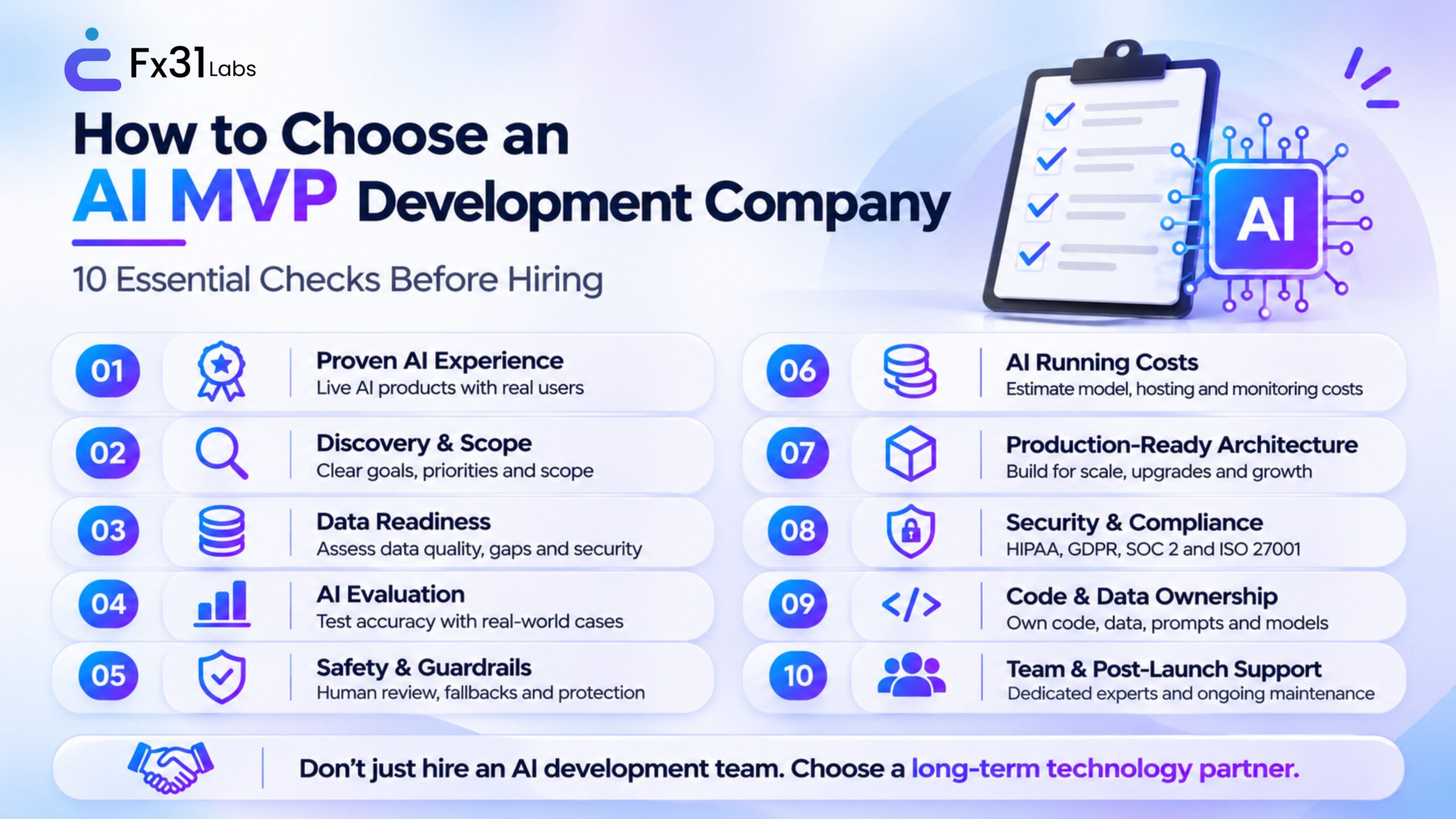
1. Have They Shipped AI Products That Real Users Rely On?
Ask for two or three AI products the team built that are live today, with real users and real data. A demo video doesn’t count here. Ask what broke after launch and how they fixed it, because that story tells you more than any feature list.
2. Do They Run Discovery and Cut Scope Before Writing Code?
A strong AI MVP development partner pushes back on your feature list, so ask which feature they’d drop first. If they accept everything, they’re selling hours. Good discovery names the riskiest assumption, one success metric, and a cut line.
3. Can They Assess Your Data Before Promising Results?
Your AI is only as good as the data behind it. Before quoting accuracy, the team should flag what’s missing, messy, or sensitive in your records. This guide to AI data readiness explains what that review covers.
4. How Will They Test the Accuracy of AI Output?
Ask to see their evaluation set, a fixed group of real test cases scored after every change. Without one, quality gets judged by feel during demos. A serious team shows how it tracks accuracy and decides when output is launch-ready.
5. What Guardrails, Human Review, and Fallbacks Will the MVP Have?
AI will get some answers wrong, so focus on what happens next. Look for rules that block unsafe output, route low-confidence answers to a person, and log every decision. Ask how they handle prompt injection, which our guide to LLM security risks covers.
6. Can They Estimate What the AI Will Cost to Run?
An MVP that costs too much per user is a problem you usually find after launch. Ask for a cost-to-run estimate covering model usage, hosting, and monitoring at your expected volume. Good teams explain how model choice, caching, and routing keep that bill in check.
7. Is the MVP Built to Grow Into a Production Product?
Speed matters, but throwaway code costs you twice. Ask how the architecture will scale beyond the MVP to more users, more data, and a model swap. Also ask who reviews AI-generated code, and expect senior engineers, not just a tool.
8. Can They Prove Security and Compliance for US and UK Users?
Ask for evidence, not a compliance page. US health data needs HIPAA knowledge, while UK and EU users need GDPR, UK GDPR, and EU AI Act experience. ISO 27001 or SOC 2 helps, so ask what each covers.
9. Will You Own the Code, Data, Prompts, and Models?
You should own the repository, cloud accounts, prompts, evaluation sets, and any trained models from day one. Get that in writing before work starts, not at handover. Also confirm you can switch AI providers later without the partner’s permission or a full rebuild.
10. Who Is on the Team, and What Happens After Launch?
Ask who will actually build your MVP and how many hours they’ll give it each week. Check time-zone overlap for daily decisions. Then ask about decisions. Then ask what support looks like in the three months after go-live, from bug fixes and monitoring to who owns improvements as feedback arrives.
Now that you know what a strong partner looks like, let’s take a look at the warning signs and questions that expose a weak partner.
Red Flags and First-Call Questions for AI MVP Vendors
Most warning signs show up in the first call. Spot them early, and you’ll save weeks of back-and-forth with a vendor who was never the right fit.
Red Flags That Rule a Vendor Out
These seven signals usually mean a vendor will cost you time, money, or both. One is reason to probe further, while two or more is reason to walk away.
- They Say Yes to Everything: No pushback on features means no real scoping.
- The Demo Only Works on Their Data: Accuracy stays unproven until they test your real examples.
- No Evaluation Plan: Problems surface after launch, in front of users.
- Full Autonomy for Sensitive Tasks: Agents without approvals, fallbacks, or logs signal serious risk.
- A Quote With No Assumptions: A price without stated scope will change once work begins.
- Vague Code Ownership: Anything short of owning the repository from day one becomes a negotiation.
- No Plan After Launch: A partner who hasn’t thought past go-live hands you an emergency later.
Questions That Separate Strong Vendors From Weak Ones
Ask every vendor these eight questions so you can compare answers side by side. A team that has done this many times answers them without checking notes.
- Scope: If you had to drop one feature, which would go and why?
- Success: What single metric will tell us the MVP worked?
- Data: What data do you need, and what if it’s incomplete?
- Quality: How will you measure accuracy, and can we see a sample report?
- Running Cost: What will this cost each month at 100, 1,000, and 10,000 users?
- Ownership: Who owns the code, accounts, prompts, and models on day one?
- People: Who will work on our MVP, and how senior are they?
- After Launch: What do the first 90 days after go-live include?
Pay attention to how quickly each vendor answers. A team that has done this many times answers most of these questions without checking notes.
How Much Do AI MVP Development Services Cost?
Most focused builds cost $20,000 to $150,000, depending on scope, data, integrations, and compliance. The AI MVP development services figures below are market ranges from published vendor pricing, not Fx31 Labs prices or quotes.
1. AI MVP Cost and Timeline by Project Type
Here’s how budgets typically break down by AI MVP type. Use these market ranges to sanity-check any quote.
| MVP type | What’s included | Typical timeline | Market cost range |
| Discovery or feasibility sprint | Scope, data audit, success metrics, go or no-go | 1 to 3 weeks | $3,000 to $15,000 |
| AI proof of concept | One hard assumption tested on sample data | 3 to 6 weeks | $5,000 to $30,000 |
| Single-workflow AI MVP | One LLM feature, RAG assistant, or copilot with evaluation | 6 to 10 weeks | $20,000 to $80,000 |
| AI agent MVP with integrations | Tool calls into CRM, ERP, or internal systems, with approvals | 8 to 14 weeks | $50,000 to $150,000 |
| Full-product AI MVP | Web or mobile app, backend, accounts, and payments, plus AI | 10 to 16 weeks | $60,000 to $200,000 |
| Regulated-industry AI MVP | Any of the above with HIPAA or financial controls and audits | 12 to 20 weeks | $100,000 to $300,000+ |
The AI MVP development cost moves most with these seven factors:
- Data Condition: Messy or sensitive data adds preparation work.
- Integrations: Each CRM, ERP, or legacy connection adds design and testing.
- Autonomy Level: Agents that take actions need approvals, logging, and more testing.
- Compliance Scope: HIPAA, financial rules, or EU AI Act duties add controls.
- Model Approach: APIs cost less to start than fine-tuning or self-hosting.
- Platforms: Web, iOS, and Android together cost more than one platform.
- Team Location and Seniority: Senior onshore teams cost more per hour but need fewer hours.
For agent-heavy MVPs, this breakdown of AI agent development cost goes deeper.
2. What Does an AI MVP Cost to Run After Launch?
The build is only part of the bill. Once users arrive, you pay monthly for model usage, infrastructure, and upkeep.
| Cost item | What drives it | Typical monthly range at beta stage |
| Model or API usage | Number of users, prompt length, and model choice | $100 to $3,000+ |
| Hosting, database, and vector search | Traffic, storage, and retrieval volume | $100 to $1,500 |
| Monitoring and evaluation tools | Tracing, scheduled evaluation runs, and alerts | $0 to $500 |
| Maintenance and iteration | Bug fixes, prompt updates, and model upgrades | $2,000 to $10,000 |
OpenAI and Anthropic price API usage per million tokens and change rates often. Check their pages before budgeting, and ask your partner to model costs at ten times launch volume.
3. AI MVP Development Rates by Region
Hourly rates vary by region. Lower rates work well when seniority, time-zone overlap, and communication hold up.
| Region | Typical hourly rate | What to weigh |
| United States | $100 to $200+ | Same time zone, highest cost |
| UK and Western Europe | $80 to $180 | Strong product skills and GDPR familiarity |
| Eastern Europe and the Baltics | $40 to $99 | Deep engineering talent and EU compliance knowledge |
| Latin America | $40 to $90 | Close US time zones at nearshore rates |
| India | $25 to $60 | Large AI talent pool with planned overlap hours |
4. Which Pricing and Delivery Model Fits Your MVP?
How you pay shapes how the project behaves. Match the model to how settled your scope is.
| Model | How you pay | Best fit | Watch for |
| Fixed-price MVP | One price for an agreed scope | A clear workflow and firm budget | Change requests outside scope |
| Discovery, then build | Paid scoping, then a build quote | Unclear data or requirements | Ownership of discovery outputs |
| Time and materials | Hourly or per sprint | Research-heavy AI with shifting scope | Budget drift without a ceiling |
| Dedicated team | Monthly retainer for a product pod | An MVP followed by a steady roadmap | Paying for unused capacity |
| Staff augmentation | Monthly rate per engineer | A tech lead who lacks AI skills | You carry delivery risk |
| In-house hiring | Salaries, benefits, and recruiting | Long-term ownership after validation | Slow hiring before proof |
Many founders run a fixed-price MVP first, then move to a dedicated team or in-house hires once usage proves the idea.
Also Read: AI Token Consumption: Why Enterprise AI Costs Are Rising and How to Optimize Them
Why Choose Fx31 Labs for AI MVP Development Services?
The best AI MVP development services answer one business question fast, then give you a clean path to production if the answer is yes.
At Fx31 Labs, we build generative AI MVPs for that path. Founder and CEO Dr. Nilesh Modi earned his Ph.D. at the University of California and previously worked in R&D at Intel and IBM. Delivery runs on India-based engineering, backed by a US office in New Jersey.
Why founders choose us:
- Cost Certainty: Fixed-price software prototyping, so the cost of your first build is clear upfront.
- Fast GenAI Delivery: A functional HRMS portal built in 5 weeks by a two-person team using GenAI.
- Investor-Ready Prototypes: For a VC studio, we built prototypes for 8 startup ideas, along with 9 pitch decks.
- Production-Grade AI: An AI/ML IoT self-checkout platform reached 99.8% item identification accuracy and rolled out to 15+ retail clients.
- Room to Grow: AI talent augmentation and dedicated teams after the MVP.
Ready to prove your AI idea? Book a free consultation with our team and share the workflow you want to test. We’ll send back a scoped plan, timeline, and running-cost picture.
Conclusion: Shortlist Three Partners, Then Test Them on Your Own Data
The best AI MVP development companies win on scope discipline, honest data checks, measured accuracy, and a clear plan after launch, not on demos.
Start with the fit table, shortlist three names, and run each through the ten checks. Compare AI MVP development services quotes for the same scope, including monthly running costs. Then pick one workflow to prove first and keep ownership of your code, data, and accounts from day one.
We hope this guide helps you understand what AI MVP development services include, what they cost, and how to choose a partner you can trust.
Want a partner that can scope it, build it, and stay for the next stage? Connect with our experts to map your AI MVP and see the scope, timeline, and cost before you commit a single dollar.
Frequently Asked Questions
1. What do AI MVP development services include?
AI MVP development services cover discovery, data review, model selection, design, engineering, evaluation, and a launch to early users. Strong providers also add guardrails, logging, and a cost-to-run estimate.
2. How much do AI MVP development services cost?
Most focused builds cost $20,000 to $150,000, and a discovery sprint runs about $3,000 to $15,000. Regulated or full-product builds can reach $300,000+, plus monthly running costs.
3. How long does an AI MVP take to build?
A single-workflow AI MVP usually takes 6 to 10 weeks, while agent MVPs take 8 to 14 weeks. Full-product or regulated builds can run 10 to 20 weeks.
4. Do I need a custom AI model for my MVP, or is an LLM API enough?
An LLM API is enough for most MVPs, usually paired with retrieval over your own data. Fine-tuning or a custom model makes sense later, when you need lower costs at scale.
5. Should I hire an AI MVP development company or build in-house?
Hire a partner for AI MVP development services when you need AI skills and speed now. Build in-house once real usage validates the idea.
6. Who owns the AI MVP’s code, data, and prompts after delivery?
You should own everything from day one, including code, cloud accounts, prompts, evaluation sets, and models. Get it in writing before work starts.
7. Can an AI MVP development company fix a prototype built with AI coding tools?
Yes. RaftLabs, Fourmeta, Empat, and thoughtbot all offer this, so ask what they’ll keep, rebuild, and how long hardening takes.
8. What should I have ready before I contact an AI MVP development company?
Prepare a brief covering the problem, users, workflow, and success metric. Add sample data, systems, compliance needs, budget, and deadline.