
AI Governance and Compliance: What Enterprises Need to Know in 2026
AI governance and compliance can be termed as the policies, processes, and oversight structures enterprises use to manage AI systems in a responsible and legal manner which covers most aspects from data handling to regulatory reporting to even bias testing. Modern markets operate as such that AI Governance and Compliance is now an operational necessity. As of 2026, the EU AI Act, several US state laws, and sector-specific rules have started taking effect.
What Is AI Governance and Compliance, and Why Does It Matter Now?
AI governance and compliance covers two related but distinct things: governance is the internal structure – who approves what, how risk gets assessed, how decisions get documented- and compliance is meeting the external legal and regulatory obligations that apply to your AI systems.
A few reasons this has become harder to treat as optional:
- The regulatory landscape is no longer theoretical. Multiple jurisdictions now have AI-specific laws with real enforcement mechanisms and penalties attached.
- AI decisions increasingly affect real outcomes – hiring, lending, healthcare, insurance- which tends to draw more legal scrutiny than lower-stakes uses.
- Enterprise customers are asking for it. It’s increasingly common for procurement processes to include AI governance questions before a deal closes, not after.
- The rules are still shifting. Several major frameworks changed meaningfully in just the past year, which makes governance a moving target rather than a one-time setup.
None of this means every company needs a fully built-out compliance department overnight. It does mean this deserves a real place on the roadmap, not something addressed only if a regulator or customer asks- a shift we’ve watched play out across the enterprise AI work we do, including the security side covered in our piece on AI-driven cloud security strategies.
What Does the 2026 AI Regulatory Landscape Actually Look Like?
This is genuinely a moving target, and it’s worth treating any specific date with some caution since frameworks have already shifted more than once. That said, here’s roughly where things stand as of mid-2026:
| Jurisdiction / Framework | Current Status |
| EU AI Act | Core transparency obligations and penalty powers for general-purpose AI models became enforceable in August 2026; obligations for high-risk systems were pushed back under a 2026 policy revision, though the underlying requirements still need to be met eventually |
| Colorado (US) | The state’s original AI law was replaced with a narrower automated decision-making law, with substantive obligations phasing in over 2027 |
| California (US) | Several targeted laws are already in force, covering AI transparency, training data disclosure, and frontier model reporting |
| Texas (US) | A broad AI law addressing prohibited uses (like social scoring) has been in force since early 2026 |
| Federal (US) | No single comprehensive federal AI law exists; oversight currently comes through a mix of executive actions and existing agency authority |
The practical takeaway is that there’s no singular standard as to what global business have to comply with yet, and companies who operate across multiple states or countries are often working against several overlapping and inconsistent sets of AI compliance requirements all at once.
Because this shifts often, it’s worth checking current guidance rather than treating any snapshot as permanent, including this one.
What Are the Core AI Compliance Requirements Enterprises Should Expect?
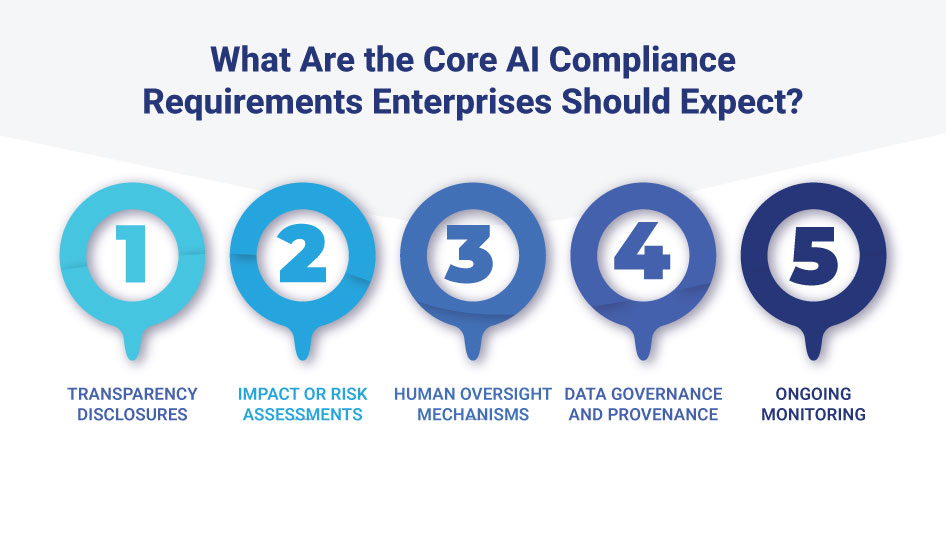
Despite the fragmentation, certain AI compliance requirements show up repeatedly across frameworks, which makes them a reasonable starting point regardless of which specific jurisdictions apply to you:
- Transparency disclosures – telling users when they’re interacting with AI, or when content has been AI-generated
- Impact or risk assessments – documenting how a system was evaluated for bias, safety, and unintended consequences before deployment
- Human oversight mechanisms – a documented path for a person to review, override, or appeal an AI-driven decision
- Data governance and provenance – knowing what data trained or informs a system, and being able to explain that if asked
- Ongoing monitoring – tracking system behavior after deployment, not just at launch
Building toward these baseline requirements now tends to put a company in a reasonable position no matter which specific law ends up applying to a given product or market.
How Is AI Regulatory Compliance Different From Traditional Data Compliance?
AI regulatory compliance overlaps with data privacy compliance, but it isn’t the same thing, and treating them as identical tends to leave gaps.
| Traditional Data Compliance | AI Regulatory Compliance | |
| Main focus | How data is collected, stored, and shared | How AI systems make decisions and what effects those decisions have |
| Typical requirement | Consent, data minimization, breach notification | Bias testing, explainability, human oversight, impact assessments |
| Who’s usually accountable | Privacy or legal teams | Often a mix of legal, engineering, and product, since decisions are embedded in the system itself |
| Audit focus | What data exists and how it’s protected | Why the system behaved the way it did in a specific case |
A team that’s fully GDPR-compliant, for example, can still fall short on AI-specific obligations like documenting bias testing or maintaining human review pathways – the two frameworks ask different questions, even when the underlying data is the same.
What Does AI Risk Management Involve in Practice?
AI risk management is the ongoing process of identifying, assessing, and reducing the risks a given AI system introduces -and it tends to look a bit different depending on how the system is used.
A reasonably practical structure tends to include:
- Classify the system by risk level – a customer service chatbot and a hiring decision tool carry very different stakes, and should be treated differently
- Assess for bias and fairness before deployment, and periodically afterward as data and usage patterns shift
- Document decision logic where feasible, especially for anything touching regulated outcomes like credit, employment, or healthcare
- Define escalation paths for when a system’s output needs human review
- Monitor for drift – a model that performed well at launch can behave differently months later as real-world data changes
This tends to work best as a continuous process rather than a single pre-launch checklist. A lot of the risk that actually causes problems shows up after deployment, not before.
What Do Responsible AI Practices Look Like Day to Day?
Responsible AI practices are less about a single policy document and more about how decisions actually get made across a team. In practice, that tends to include:
- Involving people with domain expertise – not just engineers – in reviewing high-stakes AI use cases
- Being willing to not deploy a system, or to delay deployment, if testing raises real concerns
- Documenting decisions and their reasoning as they’re made, rather than reconstructing them later
- Giving users a clear, accessible way to flag problems or request human review
- Treating vendor and third-party AI tools with the same scrutiny as internally built systems
We’ve seen this work best when responsible AI practices sit close to where decisions actually get made – in the product and engineering teams building the system — rather than living entirely in a separate compliance function that reviews things after the fact. It’s part of why we built our own AI governance framework for responsible enterprise AI around that kind of embedded ownership, which goes deeper into the specific governance structure than this overview does.
How Should Enterprises Structure an AI Governance and Compliance Program?
A workable governance and compliance program doesn’t need to be built all at once, but it does tend to need a few core pieces in place fairly early:
- A clear inventory of every AI system in use, including third-party tools, not just internally built ones
- Defined ownership – someone accountable for governance decisions, even if it’s a small cross-functional group rather than a dedicated department
- A risk classification process so effort gets focused on the systems that actually carry the most exposure
- Documentation standards that make audits and reviews faster instead of a scramble
- A review cadence, since both the systems and the regulations around them will keep changing
Enterprises already managing sensitive data through private or self-hosted AI deployments tend to have a head start here, since a lot of the underlying infrastructure and access controls overlap. Our comparison of private AI models versus public AI for enterprise security is a useful companion read if data handling is a big part of your compliance exposure.
What Are Common Mistakes in Enterprise AI Compliance?
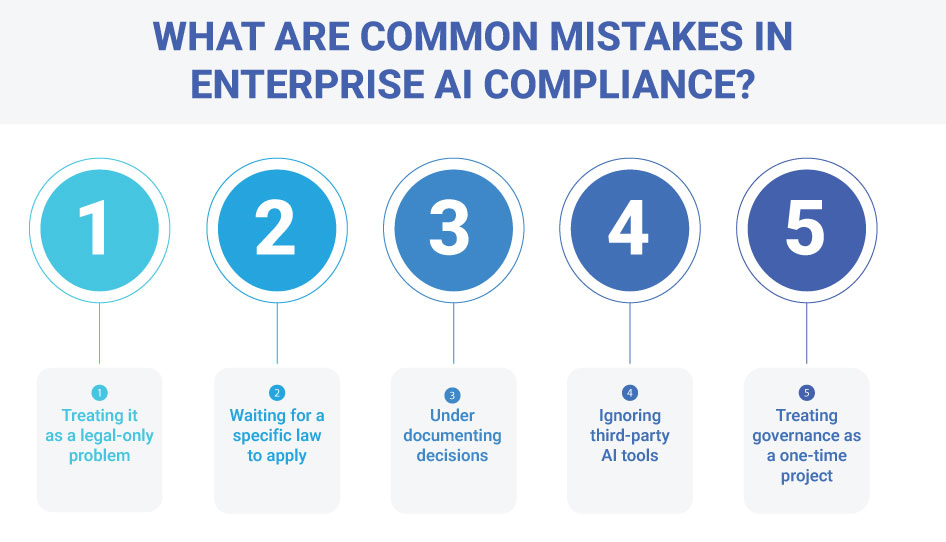
A handful of patterns show up repeatedly across enterprise AI compliance efforts that struggle:
- Treating it as a legal-only problem, without involving the engineering teams who actually build and maintain the systems
- Waiting for a specific law to apply before starting, rather than building toward the common requirements that show up across most frameworks
- Under-documenting decisions, which makes audits far harder than they need to be
- Ignoring third-party AI tools, which often carry just as much compliance exposure as internally built systems
- Treating governance as a one-time project instead of an ongoing practice that needs regular review
Most of these are avoidable with earlier planning and cross-functional ownership- the same kind of upfront thinking that tends to pay off in security work generally, not just AI-specific compliance.
Where to Start
This isn’t a box to check once and move on from – it’s closer to an ongoing discipline that has to keep pace with both your AI systems and a regulatory landscape that’s still actively changing. Starting with a basic system inventory, a risk classification process, and clear ownership tends to put most enterprises in a reasonable position, even before every applicable law is fully settled. If you’re rolling this out alongside broader AI adoption, our piece on AI agents and assistants for enterprises is a useful next read, and our engineering team can help you think through how governance fits into your specific AI systems.
Frequently Asked Questions
1. What is AI governance and compliance?
AI governance and compliance covers the internal policies and processes enterprises use to manage AI systems responsibly, along with meeting the external legal and regulatory requirements that apply to those systems.
2. What are the biggest AI compliance requirements enterprises face in 2026?
Common requirements across frameworks include transparency disclosures, risk or impact assessments, human oversight mechanisms, data provenance documentation, and ongoing monitoring after deployment.
3. Is there a single global AI regulation enterprises need to comply with?
No. As of 2026, the regulatory landscape is fragmented – the EU AI Act, various US state laws, and sector-specific rules all apply differently depending on where a company operates and what kind of AI systems it uses.
4. What’s the difference between AI risk management and traditional IT risk management?
AI risk management focuses specifically on how a model behaves, whether its outputs are fair and explainable, and how it’s monitored over time — rather than just system uptime, security, or data protection, which traditional IT risk management typically covers.
5. Do small and mid-sized companies need to worry about AI governance and compliance too?
Generally yes, though the scope can be smaller. Even without facing the largest regulatory frameworks directly, enterprise customers and partners increasingly expect some baseline responsible AI practices before signing a contract.