
Custom AI Development vs Off-the-Shelf AI Tools: Which Is Best for Enterprise AI ROI?
An AI demo can look finished long before an AI capability is ready. That is the mistake many enterprise teams are still making. A polished interface or a fast answer is not the same thing as a system that fits permissions, uses current data, handles exceptions, writes back to core systems, and gives people a safe way to review or override what it produces.
That distinction matters because the business rarely pays for the demo. It pays for the operating model. And that is where off-the-shelf AI tools, custom AI development, and hybrid architectures start to diverge in a very real way.
If you lead technology, this is not a philosophical choice. It is a decision about time-to-value, control, integration depth, data fit, and ultimately AI ROI. Buy the commodity layer when the workflow is standard and speed matters. Build when the value depends on proprietary data, deep integration, strict control, or a regulated environment. In many cases, the smartest answer is both.
The world before the decision
Enterprise AI projects do not start from a clean slate. They start from fragmentation.
Knowledge lives across ERP, CRM, ticketing systems, data warehouses, document stores, email, and legacy applications. Employees copy information between tools, search manually, write repetitive summaries, and wait for specialist teams. A packaged product may answer a generic question quickly, but it still may not understand your permissions, terminology, business rules, or exception paths.
Custom projects can fail in a different way. They can reproduce the same fragmentation in a new layer if data ownership, integration, evaluation, and workflow redesign are not solved first. And AI costs are not just subscription fees or model calls. They also include data preparation, connectors, identity and access control, testing, monitoring, security, human review, change management, support, and the cost of work delayed while the project is delivered.
So the enterprise can lose twice: by buying a tool nobody can use in the real workflow, or by building a bespoke system whose payback period is longer than the business can tolerate.
What custom AI development and off-the-shelf AI tools really mean
Here is the cleanest way to think about it.
A packaged AI product is a commercially maintained capability sold as software, a managed service, an API, or a feature inside a larger enterprise platform. The vendor usually owns the underlying model or service, release cycle, core reliability engineering, and much of the security and infrastructure. You configure it, assign users, connect available data sources, and pay through seats, usage, capacity, or an enterprise contract.
The upside is obvious: fast access, lower engineering burden, and vendor-funded updates. The constraint is just as real: the product’s workflow, data model, permissions, and user experience may not match the business.
Custom AI development is different. It is the design and delivery of an AI-enabled application or workflow for a specific organization’s data, rules, systems, users, and outcomes. That can include retrieval from approved knowledge sources, connectors to CRM or ERP, workflow orchestration, business rules, validation, human approval, evaluation datasets, monitoring, and continuous improvement.
That does not mean training a foundation model from scratch. For most enterprises, custom AI means building around an existing model or managed service. In other words, you are customizing the application layer, not necessarily the model itself.
A useful analogy: buying is like leasing a well-equipped vehicle for common roads. Building is like engineering a vehicle for a specialized route. The specialized one can outperform, but only if the route is important enough to justify the design, maintenance, and operating cost. A hybrid is the middle path: buy the powertrain, build the body and controls.
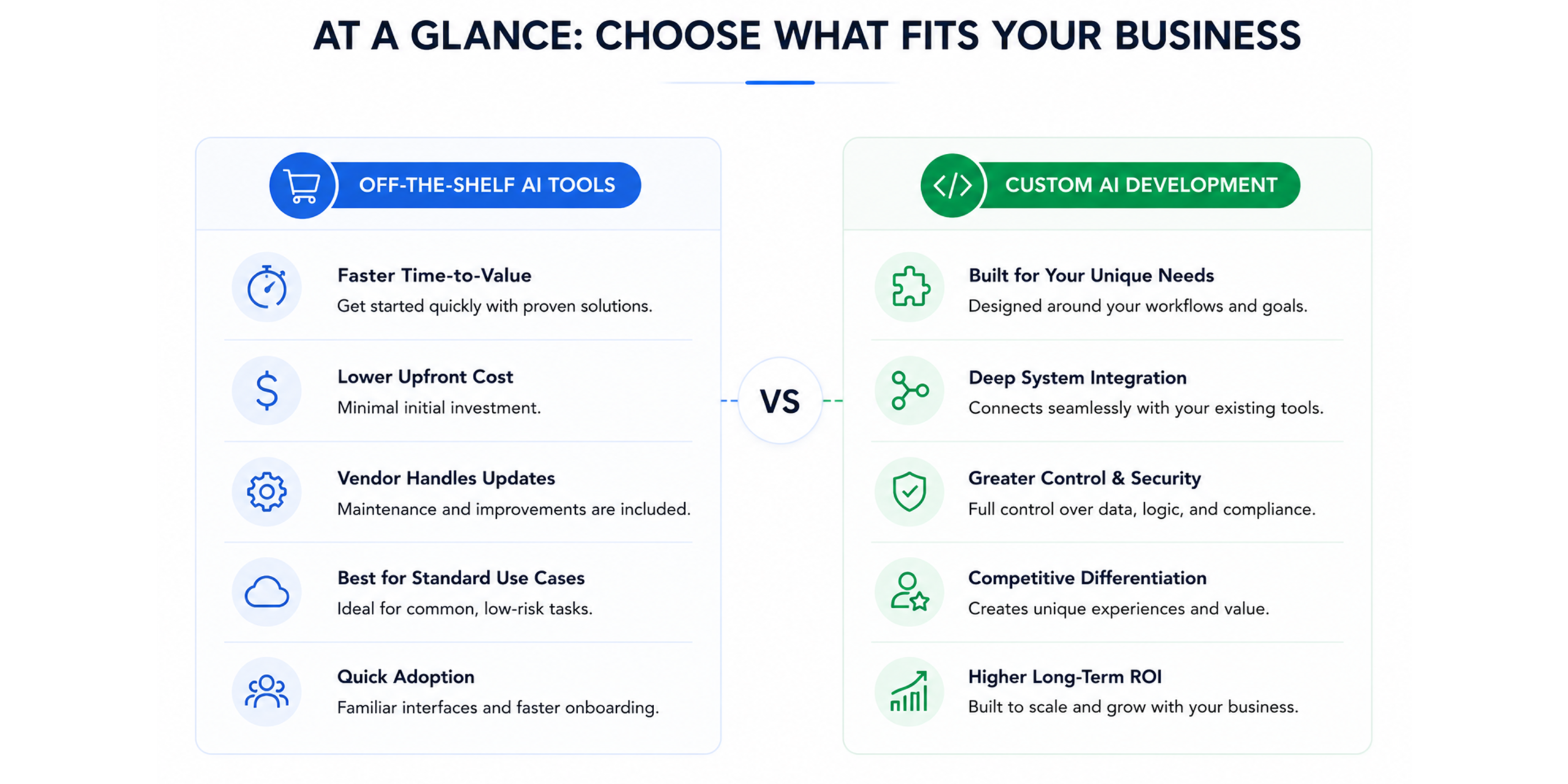
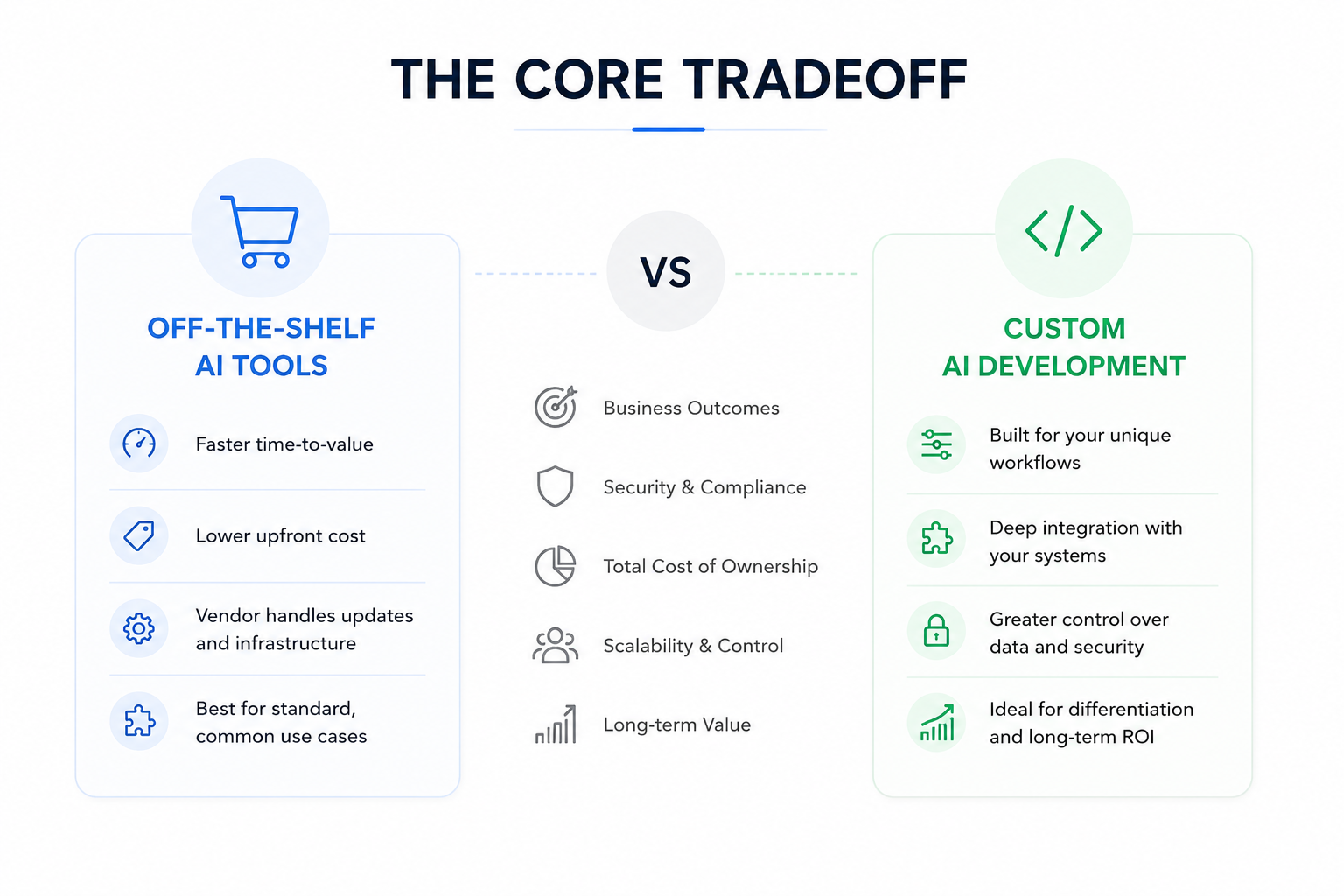
Off-the-shelf AI tools vs custom AI development: the core tradeoffs
| Dimension | Off-the-shelf AI tools | Custom AI development |
|---|---|---|
| First value | Usually fastest for a standard use case | Slower, because discovery, data, integration, and evaluation must be designed |
| Initial cash outlay | Usually lower and more predictable at small scale | Usually higher upfront |
| Ongoing cost | Subscription, usage, support, admin, change management, vendor price changes | Model/cloud usage plus monitoring, maintenance, security, support, and operations |
| Workflow fit | Best for standard processes | Can match exceptions, approvals, and system updates |
| Integration depth | Standard connectors may be enough | Can be designed around ERP, CRM, case systems, identity, and legacy interfaces |
| Data fit | Good for general or already-supported data | Better for proprietary, domain-specific, or regional data |
| Control | Less control over roadmap, pricing, and context limits | More control over orchestration, deployment, evaluation, and release cadence |
| Differentiation | Easy for competitors to buy too | Can create a unique product or operating advantage |
| Security and compliance | Baseline controls may exist, but you still must verify them | You can design controls, but you own more of the assurance burden |
| Scalability | The vendor handles much of the platform scale | You own capacity planning and operations |
| Exit and portability | Switching can be difficult | More control, but lock-in can still exist through cloud and model dependencies |
| Best fit | Common productivity, drafting, summarization, search, classification | Proprietary workflows, high-value decisions, strict control, customer-facing differentiation |
The important point is that neither option removes enterprise work. Off-the-shelf AI tools still require procurement, security review, permissions, data mapping, adoption, and governance. Custom AI development still depends on ongoing operations, monitoring, incident response, support, and cost control.
What the evidence says about AI ROI
The data supports urgency, but not magical thinking.
A 2025 global survey shows organizational AI use rising sharply, and regular generative AI use across at least one business function has spread quickly as well. Yet broad adoption is not the same as value capture. In that same survey, only a minority said they had fundamentally redesigned workflows, and fewer than one-fifth reported tracking KPIs for generative AI solutions.
That gap matters. Many teams are using AI. Far fewer are changing the process enough to turn it into measurable enterprise value.
Other evidence points in the same direction. One global enterprise report says most advanced initiatives often meet or exceed ROI expectations, but more than two-thirds still expect only a small share of experiments to be fully scaled in the next few months. Another preliminary 2025 report found that many organizations were getting zero return despite substantial enterprise GenAI investment. That finding should be treated as a warning, not a universal failure rate. The report itself notes limits around sample selection, self-reporting, geography, definitions, and a short observation window.
The practical read is simple: AI ROI is usually not blocked by the model alone. It is blocked by execution, adoption, workflow design, and operating discipline.
How to think about total cost of ownership
Do not compare a subscription price to a project invoice. That comparison is too shallow to be useful.
For off-the-shelf AI tools, the real cost includes:
- License, seat, capacity, or usage fees
- Setup, configuration, connectors, and integration
- Identity, permissions, security review, legal review, and procurement
- Data storage, retrieval, indexing, and observability
- Internal admin, support, training, and change management
- Human review, exception handling, and rework
- Vendor price changes, quotas, and required upgrades
- Exit costs, including data export and replacement integration
For custom AI development, the real cost includes:
- Discovery, process mapping, architecture, and user research
- Data inventory, cleaning, labeling, access controls, and connectors
- Application, orchestration, retrieval, evaluation, and interface engineering
- Cloud environments, compute, storage, model/API usage, and deployment
- Security testing, privacy review, compliance evidence, and audit logging
- Monitoring for quality, drift, latency, cost, and incidents
- Human-in-the-loop operations, support, model updates, and continuous evaluation
- Internal opportunity cost and partner management
- Handover and portability
The missed costs are often the dangerous ones. Poor data quality. A person correcting every output. Adoption works when the AI slows the process instead of improving it. Variable inference cost at production volume. Latency that makes users abandon the workflow. Rebuilding a pilot that was never designed for production security or observability.
That is why a serious AI ROI model should be risk-adjusted. Three proven strategies for optimizing AI costs and TCO can help quantify where to invest and where to economize when moving from pilot to production.
A practical version looks like this:
Risk-adjusted AI ROI = (annualized measurable benefits − annual operating cost − annualized implementation cost − adoption/change cost − expected risk loss) ÷ total investment
Benefits can include avoided operating cost, margin improvement, faster cycle time, fewer defects, lower service escalations, or released employee capacity, but only if that capacity is actually redeployed or the cost is avoided.
A decision framework for the technology leader
Start with the outcome, not the technology. That means saying the problem in business terms: reduce cost per case, shorten a claims cycle, improve proposal conversion, accelerate documentation, reduce downtime, or create a differentiated customer experience.
Then classify the workflow:
- Is it common or strategically differentiating?
- Is the output advisory, or can it affect financial, employment, safety, legal, or customer decisions?
- Does it need proprietary data or only general capability?
- Must it write back to multiple systems or follow complex approvals?
- Are exceptions the main source of value?
- Is the process stable enough for a package?
- Is the data clean, permissioned, and accessible?
- How much latency, auditability, and regional control is required?
- Do you have engineering capacity for production operations?
- Would a competitor buying the same product erase the advantage?
Use the least complex option that can meet the requirement:
| Signal | Starting recommendation | Why |
|---|---|---|
| Common task, low risk, low integration, urgent need | Buy | Avoid building commodity capability |
| Common capability but proprietary data or workflow | Buy plus configure/integrate | The value is often in access and process, not the model |
| High-value workflow with many systems, rules, approvals, or exceptions | Custom application or hybrid | Integration and orchestration are the product |
| Customer-facing or proprietary operating advantage | Custom or hybrid | Control and differentiation matter most |
| Regulated or sensitive use | Build or buy only after rigorous due diligence | Responsibility and evidence must be explicit |
| Unproven use case | Small, instrumented pilot | Validate before committing heavily |
| Need for a new foundation model | Usually reject as default | Treat as a separate, capital-intensive program |
A good pilot is production-shaped. It uses representative data, real permissions, edge cases, a named process owner, a baseline, a control or comparison, predefined acceptance criteria, logging, human review, and a scale-or-stop decision.
Where each approach tends to work best
Internal knowledge and documentation
A packaged assistant is fine for drafting, summarization, and broad search over low-risk content. But if you need permission-aware retrieval, freshness, auditability, escalation, and write-back to a document or case system, then custom AI development or a hybrid pattern is usually the better fit.
Customer support and service operations
Off-the-shelf AI tools can classify tickets, summarize interactions, and draft responses. A custom or hybrid system can go further by connecting customer history, entitlements, product configuration, returns or billing rules, translation, service-level commitments, and human escalation paths.
The business metrics are straightforward: resolution time, first-contact resolution, transfer rate, repeat contact, correction rate, customer satisfaction, cost per resolved case, and adoption.
Sales and account management
A packaged tool is often enough for general drafting, meeting summaries, and research support. But when the workflow needs account hierarchy, opportunity stage, pricing rules, product eligibility, contract terms, approved messaging, and CRM write-back, the case for a custom layer gets stronger.
That is where AI ROI gets tricky too. Better preparation time or faster response time is useful, but you should not claim revenue causation without a controlled comparison.
Operations, supply chain, and field service
Generic document extraction and summarization can help. But the value usually comes from live operational data, business constraints, exception handling, and human approval. If the AI is not acting on the workflow, it is just narrating it.
Legacy modernization
This is one of the clearest places where hybrid architecture makes sense. A packaged assistant may add a surface layer to a modern application, but the hard problem is often the legacy estate itself: inconsistent identifiers, missing APIs, batch data, and undocumented rules. A custom integration layer can create controlled access while the organization modernizes incrementally.
Finance, HR, healthcare, and other sensitive workflows
The lower the tolerance for a wrong answer or opaque decision, the less convincing a generic demo becomes. In these cases, documented data provenance, access control, human review, audit logs, incident handling, and a way to suspend the system are not optional details. They are part of the product.
Global deployment
Global scale does not remove local obligations. A centrally purchased service can still need region-specific data, permissions, language evaluation, human oversight, and regulatory review. In some regions, local workflow or data boundaries may make a custom or hybrid design more practical. The degree of regional variation is well-documented by industry analysts.
Governance, security, and procurement: where ROI is protected or lost
Whether you buy or build, use a life cycle approach.
Ask these questions:
- Who owns the business outcome, the system, the data, and incident response?
- Is the use case allowed, restricted, or prohibited?
- Who can approve changes or suspend the system?
- What data enters prompts, retrieval stores, logs, and evaluation sets?
- Are retention, deletion, residency, and training-use terms clear?
- Is access enforced at retrieval time, not just at the interface?
- Can you export data, prompts, evaluations, logs, and configuration if you change suppliers?
- What does a correct answer or action look like?
- Is there a representative evaluation set covering normal cases, edge cases, and stale data?
- Are outputs grounded, validated, and reviewed for high-impact actions?
- Are latency, uptime, rate limits, cost, and failure modes monitored?
- Are model, prompt, retrieval, and workflow changes versioned and tested?
- Can you explain the system to auditors, customers, and employees?
Vendor due diligence matters too. You need to know what happens to prompts and customer data, which models and sub-processors are involved, what controls exist, whether model updates can be constrained, and how portable the system really is.
There is also a regulatory layer. The European AI Act entered into force in 2024, with different obligations applying on different dates. The exact applicability depends on the system, role, sector, geography, and transition rules, so this is not legal advice. The practical point is that buyers must ask for evidence and builders must design evidence from the beginning.
FAQ
Is buying an AI tool always cheaper than custom AI development?
No. Buying usually lowers upfront engineering work, but recurring fees, integration, data work, support, and exit costs can dominate at scale. Compare fully loaded TCO over the same volume and time horizon.
How fast can off-the-shelf AI tools deliver ROI?
There is no universal timeline. A standard, low-risk task with ready data can show value quickly, but procurement, security, integration, adoption, and workflow redesign can still delay production impact.
Does custom AI development mean training our own model?
Usually not. It usually means building the application, data access, orchestration, controls, and workflow around an existing model or managed service.
When should an enterprise hire a development partner instead of buying a tool?
When value depends on proprietary data, deep integration, legacy modernization, complex approvals, customer-facing differentiation, regional controls, or specialized AI expertise the internal team does not have.
Can a packaged AI tool work with proprietary company data?
Often yes, but the real question is how it retrieves, authorizes, stores, refreshes, logs, and uses that data. If standard connectors and permissions are enough, buying may work. If not, custom integration or a hybrid architecture may be needed.
What is the biggest hidden cost in AI ROI?
Usually the work around the model: data preparation, integration, human review, adoption, monitoring, and exception handling. At production scale, variable inference and infrastructure costs can also become material.
How do we know whether the pilot is successful?
Define the baseline first. Track outcome, quality, adoption, technical operations, risk, and finance metrics. Use representative data and a control where possible. Scale only when the system meets quality and risk gates and users actually use it.
The strategic takeaway
Strategic maturity in AI is not about choosing build or buy as a slogan. It is about knowing what should be a commodity, what should be owned, and how to measure the difference.
That is why the best enterprise decisions are rarely pure. They buy the foundation where the capability is standard, then build the integration, retrieval, controls, and workflow where the business is differentiated. They do not confuse adoption with value. They do not treat a pilot as a transformation. And they measure AI ROI with the same discipline they would use for any other major technology investment.
For teams that choose the custom or hybrid path, that often means starting small, validating the workflow, and then engineering the parts that matter most. Fx31 Labs fits in that lane as an AI-focused software development and IT services partner for organizations that need generative AI MVPs, custom web and mobile applications, AI and machine learning integration, cloud-native delivery, and flexible technical augmentation when internal capacity is tight.
Need help with your AI-powered MVP?
Trusted partner in GenAI evolution
Share your email and we’ll reach out with tailored ideas.