
AI in Enterprise Software Development: Benefits, Risks & ROI
The landscape of enterprise software development is undergoing a fundamental and rapid transformation, driven by the ubiquitous integration of Artificial Intelligence (AI) & Machine Learning (ML). This shift is not merely an evolutionary step but a revolutionary one, promising unprecedented leaps in efficiency, code quality, and a dramatically faster time-to-market for mission-critical applications. For Chief Technology Officers (CTOs) & IT leadership, understanding deep-seated benefits, navigating inherent risks, and accurately calculating the strategic Return on Investment (ROI) of AI adoption is no longer optional—it is a core strategic imperative for maintaining competitive relevance in the digital age.
A Deep Dive into the Benefits of AI in Enterprise Development
AI’s most immediate and measurable impact comes from its capacity to automate the cognitive and mechanical burdens that have historically consumed development cycles, thereby freeing human developers to focus on architectural innovation and high-value problem-solving.
1. Accelerated Development and Velocity: Large Language Models (LLMs) and advanced code generation tools are fundamentally reshaping the day-to-day coding experience. These tools provide context-aware, intelligent autocomplete suggestions that go beyond simple syntax, suggesting complex functional implementations and boilerplate code. This significantly reduces keystrokes and context switching. Furthermore, AI tools automate tedious but crucial tasks like code refactoring, identifying optimal algorithmic structures, and most importantly, autonomously debugging common errors. This capability dramatically decreases the Mean Time to Resolution (MTTR), making the entire development pipeline more fluid and resilient.
2. Superior Code Quality and Security: AI acts as a tireless, proactive code reviewer, capable of scanning vast repositories for subtle flaws and inconsistencies that human reviewers often miss. Critically, AI is proving essential in the realm of secure software development by identifying potential zero-day vulnerabilities before deployment. By enforcing rigorous, uniform coding standards across increasingly distributed global development teams, AI simplifies long-term maintenance, reduces the accumulation of technical debt, and ensures architectural integrity.
3. Revolutionized Testing and Quality Assurance: Traditional testing is a common bottleneck, often consuming up to 40% of the development effort. AI tools are transforming this phase by automatically generating comprehensive, edge-case-aware test suites. Beyond generation, AI uses predictive regression testing to prioritize and execute only the most relevant tests following a code change, a critical function that accelerates the Continuous Integration/Continuous Deployment (CI/CD) pipeline. AI also tackles the persistent challenge of UI testing maintenance, automatically adapting test scripts to minor interface changes, saving significant manual labor.
4. Advanced Project Management and Knowledge Infrastructure: AI’s analytical power extends into project oversight. By analyzing commit histories, dependency graphs, and resource allocation data, AI can predict potential project risks, such as schedule delays and resource bottlenecks, allowing managers to intervene proactively. Crucially, AI automatically generates and maintains up-to-date technical documentation directly from the codebase. This dramatically improves knowledge management, accelerates the onboarding of new team members, and ensures that institutional knowledge is preserved and accessible.
Mitigating the Inherent Risks and Challenges of Adoption
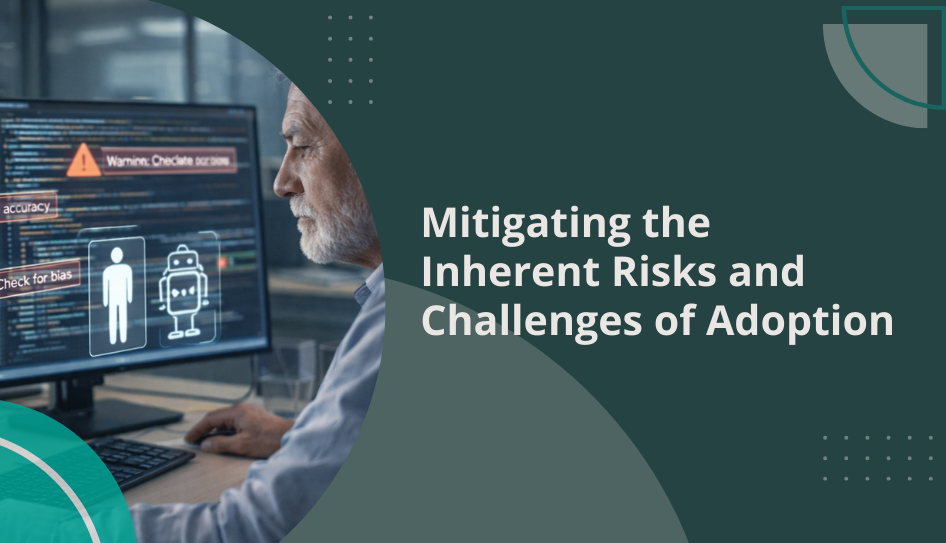
The path to AI integration, while rewarding, is fraught with significant risks that require robust, proactive mitigation strategies.
1. Data Security, Privacy, and Intellectual Property Exposure: Many powerful AI development tools are cloud-based, necessitating the transmission of proprietary source code to external servers. This creates a critical risk of Intellectual Property (IP) exposure. Strict Data Governance policies are non-negotiable. Organizations must implement secure on-premise or highly-controlled private cloud solutions, and absolutely must prevent the submission of code containing Personally Identifiable Information (PII) to public models. Compliance with global regulations like GDPR, CCPA, and HIPAA must be the bedrock of the AI strategy.
2. Code Integrity, Quality, and Technical Debt: AI-generated code, especially from non-fine-tuned models, can introduce subtle errors, inefficiencies, or “hallucinations”—functionally incorrect but syntactically plausible code. Over-reliance on AI can lead to a state of “black box” dependencies, where developers lose the deep understanding of the underlying logic, thereby increasing long-term technical debt and making future maintenance and debugging excessively difficult. Rigorous code review and developer validation remain essential safeguards.
3. Workforce Restructuring and Ethical Dilemmas: The developer role is evolving rapidly. The necessary skills are shifting from low-level coding to high-level prompt engineering and critical validation of AI output. This necessitates a massive organizational reskilling effort. Furthermore, AI models trained on flawed, biased, or non-inclusive data can perpetuate and amplify those biases in the software they generate, leading to fairness issues and potential reputational damage. Ethical guidelines must govern model selection and training data curation.
Calculating Strategic ROI: Beyond Cost Savings
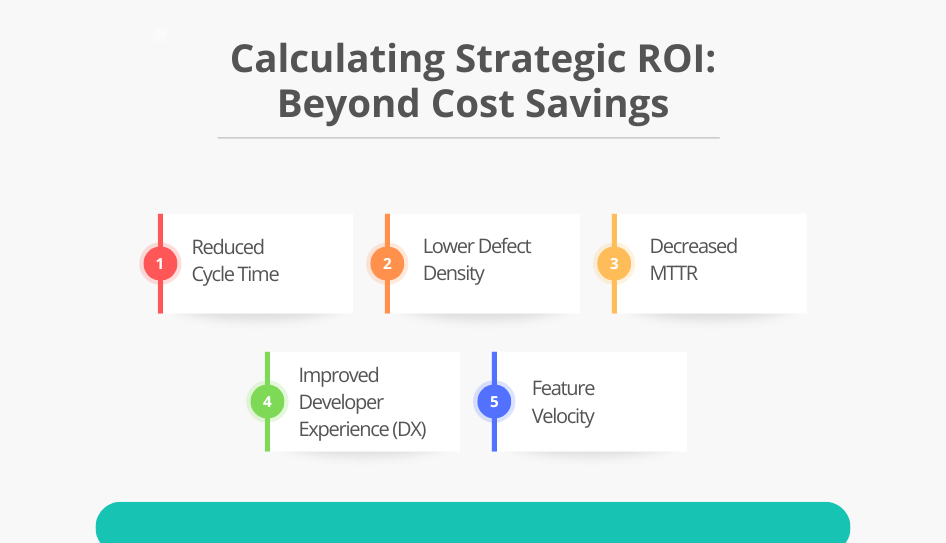
The Return on Investment for AI in development cannot be narrowly measured solely through headcount reduction or immediate cost savings. It is a strategic metric tied directly to business agility and competitive advantage. Key performance indicators (KPIs) that demonstrate AI’s value include:
- Reduced Cycle Time: The time from concept commit to deployment, accelerated by faster coding and testing.
- Lower Defect Density: Fewer bugs per thousand lines of code, driven by AI’s proactive quality checks.
- Decreased MTTR: Faster resolution of critical issues due to automated debugging and efficient root-cause analysis.
- Improved Developer Experience (DX): Higher job satisfaction and productivity by offloading drudgery.
- Feature Velocity: The speed at which new features are delivered to end-users, directly impacting market share.
The ultimate ROI is realized as a sustainable competitive edge achieved through rapid, continuous digital transformation, high-velocity innovation, and the mitigation of risk from costly security breaches.
Best Practices for Successful Adoption
Achieving success with AI requires a thoughtful, multi-faceted cultural and operational transformation:
1. Establish Robust Governance and Audit Trails: Implement clear governance frameworks that mandate code sanitization before submission to AI tools. Rigorous model vetting—including security audits like SOC 2 compliance—is crucial. Furthermore, mandatory human audit trails for all AI-generated code must be established to ensure accountability and maintain control over the codebase integrity.
2. Invest Heavily in Reskilling and Collaboration: The focus must shift to nurturing human-AI collaboration. Train developers not just in using the tools, but in the art of prompt engineering—the ability to articulate complex problems for the AI to solve—and the science of critical validation and refinement of the AI’s output.
3. Implement a Phased, Metric-Driven Rollout: Avoid a ‘big bang’ deployment. Begin with carefully controlled pilot projects within non-critical development streams. This allows the organization to measure quantifiable ROI against established KPIs and gather continuous, actionable feedback. This phased approach allows the refinement of the integration strategy, the adjustment of governance, and the continuous improvement of the Developer Experience before a full-scale enterprise rollout.
AI is an enterprise software development co-pilot, not a replacement. Humans set the vision; AI handles routine tasks. Strategic AI adoption is key to building superior, secure, and innovative software, achieving a competitive advantage, and driving digital transformation by balancing benefits and risks.
AI is moving rapidly into practice, transforming how large organizations design, build, test, and maintain critical applications, boosting efficiency, quality, and speed. IT leaders must understand the ROI, benefits, and risks of AI-driven development. This document details AI’s advantages in Enterprise Software Development.
FAQ’s
Q1: What is the primary benefit of integrating AI into enterprise software development?
The primary benefit is the accelerated development velocity and efficiency. AI automates tedious and cognitively demanding tasks, such as code generation, refactoring, and initial debugging, thereby freeing human developers to focus on higher-value architectural innovation and problem-solving, which significantly reduces the time-to-market.
Q2: What are the biggest risks associated with adopting AI development tools?
The two most significant risks are Intellectual Property (IP) exposure and the introduction of technical debt. Cloud-based AI tools require proprietary code transmission, raising IP concerns. Furthermore, over-reliance on AI-generated code without rigorous review can lead to subtle errors, inefficiencies, or “hallucinations,” resulting in long-term maintenance difficulties and black box dependencies.
Q3: How does AI improve code quality and security?
AI functions as a proactive, tireless code reviewer, capable of identifying subtle flaws, inconsistencies, and potential zero-day vulnerabilities before deployment. By enforcing uniform coding standards across distributed teams, AI helps reduce technical debt and is essential for secure software development practices.
Q4: How should organizations calculate the Return on Investment (ROI) for AI in development?
The ROI should be measured beyond simple cost savings. Key strategic metrics include Reduced Cycle Time (faster time from commit to deployment), Lower Defect Density (fewer bugs per code lines), Decreased Mean Time to Resolution (MTTR), and Improved Developer Experience (DX). The ultimate ROI is a sustainable competitive advantage gained through high-velocity innovation.
Q5: What is the recommended strategy for successful AI adoption in a development team?
Success requires a phased, multi-faceted approach centered on governance and reskilling. Organizations should:
- Establish Robust Governance to secure IP and audit AI-generated code.
- Invest Heavily in Reskilling developers in prompt engineering and critical validation of AI output.
- Implement a Phased Rollout starting with non-critical pilot projects to measure ROI against KPIs and continuously refine the integration strategy before full enterprise deployment.