
AI in Robotics: How Intelligent Automation Is Reshaping Manufacturing & Logistics in 2026
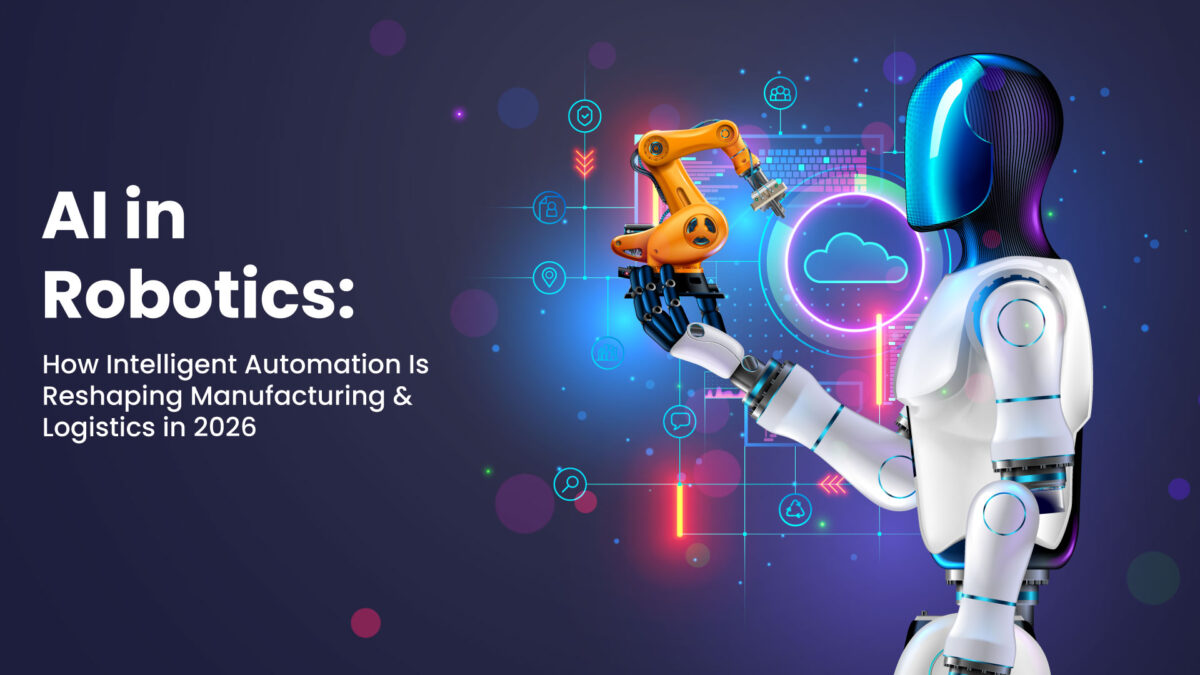
Artificial Intelligence in robotics can be defined as operating or powering warehouse or industrial robots through machine learning and large language models (LLM’s).
Desired results are to perceive, reason and act with low human input or interaction. In modern day industries, AI-driven systems are handling production lines and fulfillment centers in real time.
With the increasing introduction of LLMs in decision-making, LLM security risks have also become a large concern, from prompt injection to data leakage there are several challenges.
What Is AI in Robotics, and Why Does It Matter in 2026?
AI in robotics can be defined as a mix of standard industrial automation with machine learning, computer vision, and increasingly, LLMs that allows robots to understand natural-language instructions and adapt to unstructured environments.
Traditionally introduced robots majorly operated on pre-programmed and a fixed routine. They were fast-paced but sensitive, a misplaced pallet or a wrongly labeled box could stop the line. followed fixed, pre-programmed paths. They were fast but brittle — a shifted pallet or a mislabeled box could stop the line. The robots deployed across manufacturing and logistics in 2026 are different. They combine vision models for perception, reinforcement learning for motion planning, and LLM-based “reasoning layers” that let a floor supervisor type or speak an instruction like “reroute pallets from Line 3 to Line 5” and have the robot fleet actually do it.
That shift is what makes this moment different. Robots aren’t just executing scripts anymore, they’re interpreting intent. And any system that interprets natural-language intent inherits the same LLM security risks that have already shown up in chatbots and copilots, except now the output isn’t a paragraph of text. It’s a forklift moving, a robotic arm actuating, or a conveyor changing speed.
How Are LLMs Changing the Way Robots Work on the Factory Floor?
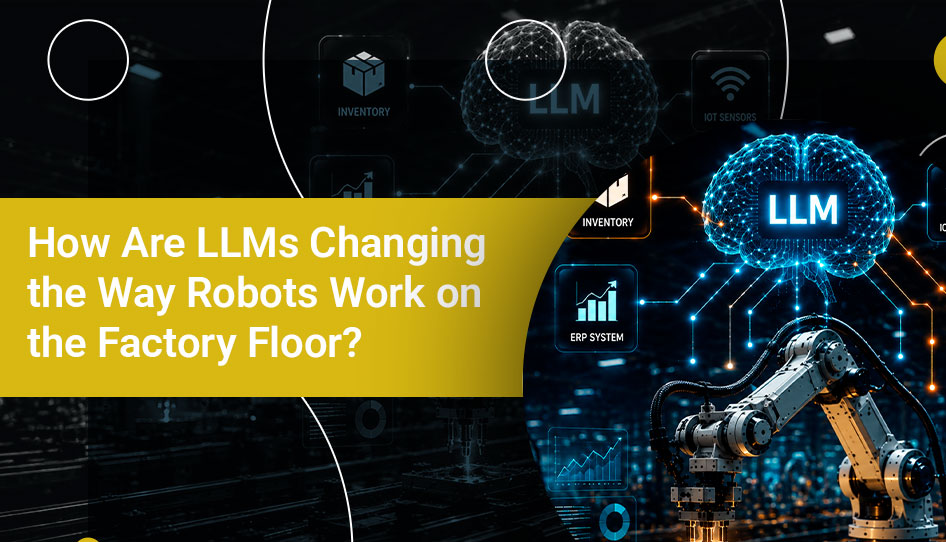
LLMs give robots three capabilities that traditional automation never had:
- Natural-language task assignment — operators issue instructions in plain English instead of writing new control logic for every exception.
- Contextual reasoning — the robot can weigh multiple sensor inputs and past outcomes before choosing an action, rather than following a single hardcoded rule.
- Cross-system coordination — an LLM-based orchestration layer can pull data from inventory systems, ERP platforms, and IoT sensors to make a single coordinated decision across a warehouse or plant.
This is powerful. It’s also exactly why LLM security risks in robotics deserve more attention than they’re currently getting. A model that can query your ERP and issue movement commands to physical machinery is a much higher-value target than a model that only writes marketing copy.
Why Does AI Data Privacy Matter More in Robotics Than in Typical Software?
Data privacy in a robotics deployment covers more ground than in a standard SaaS application. A single robotic system can be ingesting camera feeds, worker location data, proprietary process parameters, supplier pricing, and production volumes — often all at once, and often processed by a model hosted outside the company’s own infrastructure.
That combination raises the stakes considerably:
- Worker privacy — vision-based systems that track movement for safety or efficiency can inadvertently create surveillance datasets that fall under biometric privacy regulations.
- Trade secret exposure — production rates, process recipes, and yield data sent to a third-party model provider can leak competitive information if contracts and data-handling terms aren’t airtight.
- Regulatory scope creep — a robot deployed across multiple facilities in different jurisdictions may trigger different privacy obligations depending on where the data is processed, not just where it’s collected.
This is one of the reasons more manufacturers are evaluating private, on-premise, or VPC-hosted models for robotics workloads instead of routing every instruction through a public API — a tradeoff we broke down in our comparison of private AI models versus public AI for enterprise security.
What Does Secure AI Deployment Look Like for Manufacturing and Logistics?
Secure deployment for robotics isn’t a single control — it’s a layered approach that treats the LLM as a component that can fail or be manipulated, not an infallible decision-maker.
| Risk Area | Common Failure | Mitigation |
| Prompt injection attacks | Malicious content in scanned data or API responses | Input sanitization, instruction/data separation, allow-listed actions |
| AI data privacy | Sensitive data sent to third-party model endpoints | Data classification, private or VPC-hosted deployment where required |
| Unauthorized actuation | Model output triggers a physical action without checks | Human-in-the-loop approval for high-risk commands |
| Supply chain compromise | Unvetted third-party models or plugins | Vendor security review, model provenance tracking |
| Fleet-wide propagation | One compromised agent influences coordinated agents | Segmented networks, anomaly detection across the fleet |
Two principles cut across all of this. First, never let a model take a physical action that can’t be reversed without a validation step- especially early in deployment. Second, log everything: what instruction came in, what the model decided, and what action the robot took. Without that audit trail, diagnosing which of these LLM security risks actually caused an incident becomes guesswork.
Security teams that already have a governance model for LLMs in software can extend the same discipline to robotics- our AI governance framework for responsible enterprise AI covers the classification and approval process that a secure rollout depends on.
What Are the Biggest Security Risks in Industrial Robotics?
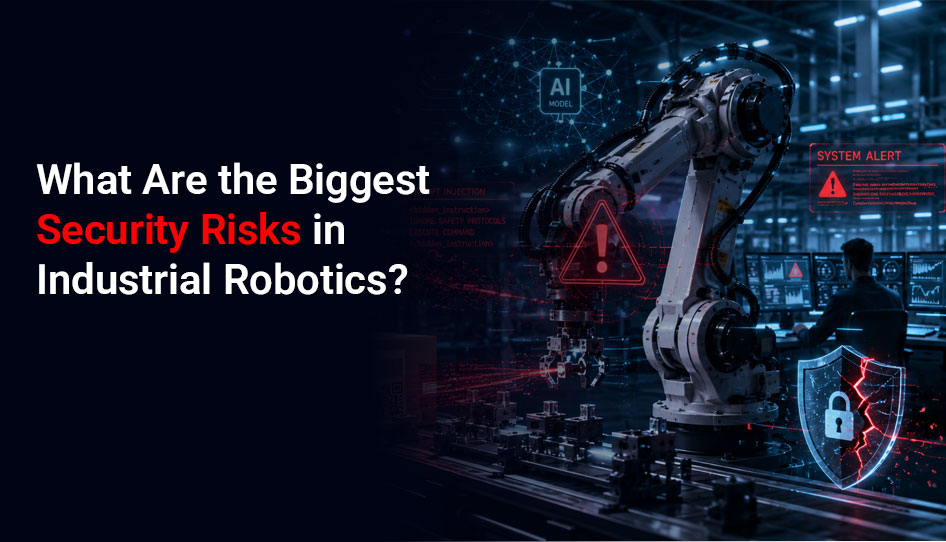
The security risks in a robotics context fall into a few clear categories, and they compound each other because the “output” of a compromised model isn’t just bad text — it’s a physical action.
- Prompt injection attacks — malicious instructions hidden in sensor data, scanned barcodes, uploaded documents, or third-party API responses that trick the model into executing unauthorized commands.
- Data leakage — proprietary production schedules, supplier contracts, or inventory data exposed through model logs, third-party API calls, or poorly scoped integrations.
- Model manipulation — adversarial inputs designed to make a vision-language model misclassify an object, a hazard, or a human presence on the floor.
- Supply chain compromise — a vulnerability introduced through a third-party model, plugin, or fine-tuning dataset that the robotics vendor didn’t build in-house.
- Unauthorized actuation — the most physical of all LLM security risks, where a manipulated instruction causes equipment to move, stop, or reroute in a way that damages goods or endangers workers.
None of these are hypothetical. Security researchers have already demonstrated prompt injection against LLM-connected robotic arms and autonomous agents in lab conditions, and the pattern of attack-hide an instruction inside content the model will read, then let the model act on it which translates directly to industrial settings.
How Do Prompt Injection Attacks Threaten Robotic Systems?
This attack technique works by smuggling instructions into content the AI model processes as if it were legitimate data — a product label, a support ticket, a scanned shipping manifest, or an API response from a connected vendor system.
In a chatbot, a successful injection might leak a conversation history. In a robotics pipeline, the same technique can:
- Trick a picking robot into selecting the wrong SKU by embedding conflicting instructions in a barcode’s associated metadata.
- Cause a coordination agent to reassign tasks across a fleet based on a spoofed status update from a compromised sensor.
- Override a safety constraint by disguising a command as a routine maintenance instruction.
The core problem is that most LLM-driven robotics stacks were built for speed and capability first, with prompt injection defenses added later. Any enterprise deploying LLMs to interpret unstructured input in a physical environment needs to treat this as one of the top LLM security risks in their entire automation program, not an edge case.
How Is AI Reshaping Manufacturing in 2026?
Manufacturing floors are seeing measurable change from AI-driven robotics:
- Predictive maintenance – vision and sensor models flag equipment wear before failure, cutting unplanned downtime.
- Adaptive quality control -computer vision inspects products at line speed, catching defects that manual inspection misses.
- Flexible production lines – LLM-coordinated robots can be reassigned between product variants without a full retooling cycle.
- Human-robot collaboration – collaborative robots (cobots) work alongside people, adjusting speed and force based on proximity sensing.
The common thread is flexibility. Plants that once needed weeks to reconfigure for a new product run are doing it in days, because the reasoning layer, not just the mechanical arm can adapt.
How Is AI Transforming Logistics and Warehousing?
Logistics operations are seeing similar gains, concentrated around speed and coordination:
- Autonomous mobile robots (AMRs) navigating warehouse floors dynamically instead of following fixed tracks.
- AI-driven demand forecasting feeding directly into robotic picking and restocking priorities.
- Natural-language fleet coordination, where a single instruction can reprioritize dozens of robots across a facility.
- Real-time route optimization for last-mile delivery, adjusting for traffic, weather, and order volume simultaneously.
As with manufacturing, the gains come with exposure. A logistics network coordinated by a single LLM-based orchestration layer is efficient,but it’s also a single point of failure if that layer is compromised, which is exactly why security has to be designed in from the start rather than retrofitted after a fleet is already live.
What Does Enterprise AI Security Require for Robotics Programs?
A mature security posture for robotics generally includes:
- A documented inventory of every model, agent, and integration touching the robotics stack.
- Defined approval tiers-low-risk actions the model can take autonomously, and high-risk actions that require human sign-off.
- Regular adversarial testing, including simulated injection attempts, against the actual production pipeline.
- Clear data-privacy rules covering what data can be sent to which models, and where that data is processed.
- Incident response procedures specific to physical systems, not just data breaches.
This overlaps significantly with how enterprises are already approaching AI agents in other parts of the business, robotics just raises the physical stakes of getting it wrong.
What’s Next for AI in Robotics Beyond 2026?
Expect three trends to accelerate: tighter integration between LLMs and robotics through open standards like Model Context Protocol, wider adoption of private or hybrid model deployment to contain privacy exposure, and growing regulatory attention on physical AI systems specifically — treating a compromised robot as a safety incident, not just a data incident. Enterprises that build secure deployment practices now will have a real head start.
Bringing AI Into Your Robotics Program, Securely
AI-powered robotics is delivering real efficiency gains in manufacturing and logistics in 2026, but the LLM security risks that come with it are not optional reading for later. Injection attacks, privacy gaps, and weak deployment practices turn a productivity win into an operational liability fast. Getting the architecture, governance, and testing right from day one is what separates a resilient robotics program from a headline. If you’re planning an AI-driven robotics rollout, our robotics development team can help you build it with strong security designed in from the start.
Frequently Asked Questions
1. What are LLM security risks in robotics?
LLM security risks in robotics include prompt injection attacks, data leakage, model manipulation, and unauthorized physical actions triggered by manipulated instructions. They’re distinct from typical software risks because a compromised model can cause a physical, not just digital, outcome.
2. Can prompt injection attacks actually control a physical robot?
Yes, under the right conditions. If a robot’s LLM layer reads unstructured input — like a scanned label or a sensor feed – without properly separating instructions from data, a hidden malicious instruction can influence the robot’s next action.
3. How is AI data privacy different in robotics compared to standard software?
Robotics systems often combine camera feeds, worker movement data, and proprietary production data in one pipeline. That creates broader privacy exposure than a typical application, and it can trigger biometric or worker-privacy regulations that standard software doesn’t.
4. What does secure AI deployment mean for a manufacturing robot fleet?
It means layered controls: input sanitization against prompt injection attacks, human approval for high-risk actions, private or VPC-hosted models where data sensitivity requires it, and complete logging of every instruction and action.
5. Is enterprise AI security different for robotics than for software AI?
The principles are the same — classification, access control, monitoring but robotics adds physical safety and actuation risk to the list, which raises the cost of getting it wrong.