
How PHP Web Development Empowers Fast and Flexible Web Solutions
PHP, as one of the most-used open-source scripting languages, is a major power behind the present-day web. It’s PHP Web Application Development, the programmers can create not only websites but also web applications that are dynamic and data-driven in a very short time. One of the reasons for the popularity of PHP is its simplicity, speed, and versatility, which make it a must-have technology for web development.
Content management systems, for instance, WordPress, are one of the cases that prove PHP Web Development’s flexibility; they manage not only blogs but also e-commerce sites. Besides that, PHP is a very powerful language; it is used on the server-side to execute all the heavy tasks, while on the front end, it integrates very well with HTML, CSS, and JavaScript. This server-side model permits the end users to get fully rendered pages very fast since PHP is performing tasks like processing, managing sessions, and querying the database behind the scenes.
This is what allows fast page loads and scalability at the same time: about 80% of websites have PHP as their backbone, and high-traffic sites such as Facebook and Wikipedia are trusting PHP to deliver content as a result of its capabilities.
Reasons for PHP Web Development: Being Fast and Efficient
PHP comes with a whole bunch of performance benefits. The modern versions (PHP 8+) come with a JIT (Just-In-Time) compiler and other optimization techniques so that PHP works faster for each request. Benchmarks indicate that PHP can outperform some of the slower languages like Python and Ruby; in fact, it can be as much as 382% faster than Python and 195% faster than Ruby in similar situations. The quicker execution speed is one of the factors that contribute to the very efficient running of PHP Web Development projects in the server area.
Most web hosting environments support PHP with built-in optimizations like OPcache, which stores precompiled PHP scripts in memory. This means repeated page loads use cached, compiled code, dramatically reducing processing time. As one guide notes, PHP delivers fast performance in handling web requests and high traffic. Together, these factors ensure that PHP pages load quickly for users even under heavy load, a key reason PHP is often chosen for performance-driven web development.
Flexibility through PHP Frameworks and Tools

A big reason PHP is flexible is its ecosystem of frameworks and tools. Many PHP frameworks for web development provide pre-built components and conventions. Frameworks such as Laravel, Symfony, and CodeIgniter handle common tasks (routing, database access, security) so developers can focus on unique features. For example, Laravel has built-in authentication and templating, speeding up development. Using frameworks like these makes it much faster to add new features and maintain code. In this way, choosing the right framework is often key to project success in PHP Web Development.
The PHP ecosystem also includes powerful development tools. Debugging extensions (e.g., Xdebug), automated testers (PHPUnit, Behat), security libraries (like HTML Purifier), and various utilities (image-processing libraries, profiling tools, etc.) all integrate with PHP. These tools work hand-in-hand with frameworks to boost agility. For example, automated tests catch errors early, and interactive debuggers help trace issues on the fly. Overall, these development tools and frameworks make PHP projects more efficient and maintainable.
PHP as a Robust Backend for Web Applications
PHP excels as a server-side (backend) language. In PHP backend development, the language handles all data processing and business logic. PHP scripts on the server can manage user logins, form submissions, and database operations, then send back HTML or JSON to the client. It works with nearly any database (MySQL, PostgreSQL, MongoDB, etc.) and web server (Apache, Nginx, IIS), making it versatile for backend tasks.
For example, an e-commerce site built with PHP can process payments and update inventory in real-time, all within server-side code. Many content management systems (like WordPress) and custom APIs rely on PHP to connect user interfaces with stored data. By centralizing operations on the server, PHP backend development ensures performance and security. This reliability is even noted in FX31 Labs services (they list Backend/Frontend development as a core expertise). All of these strengths mean PHP is well-suited for scalable backend systems, whether for a small business site or a large enterprise application.
Key Benefits of PHP Programming
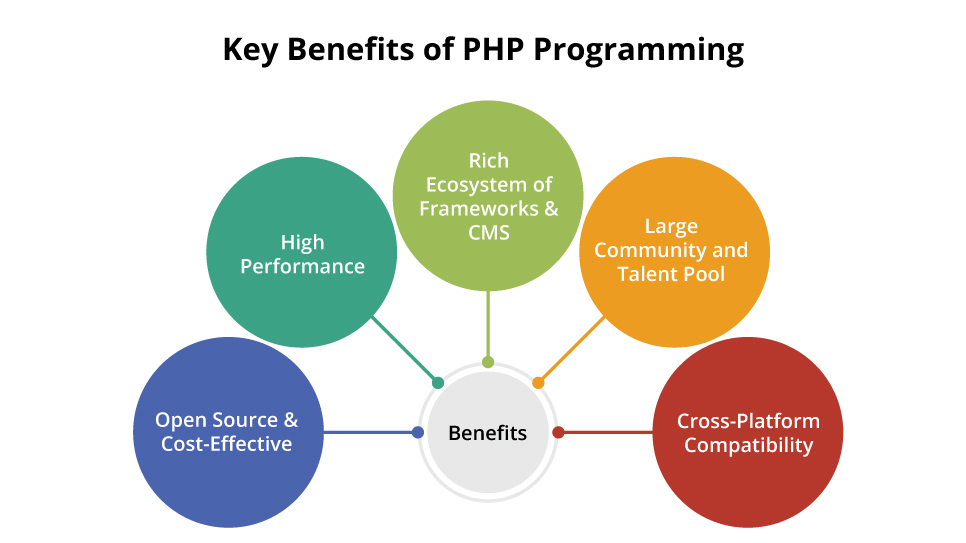
Understanding PHP programming benefits helps explain why many teams choose it. Some of the key advantages are:
- Open Source & Cost-Effective: PHP is free to use, with no licensing fees. A huge global community maintains it and contributes security patches and improvements. Almost all hosting providers support PHP out of the box, lowering deployment costs.
- High Performance: Modern PHP (especially PHP 8 and later) is very fast at runtime. It handles web requests efficiently and can scale to high traffic levels. These traits are evidenced by PHP’s use in major platforms and by benchmarks demonstrating its speed.
- Rich Ecosystem of Frameworks & CMS: PHP has mature frameworks (Laravel, Symfony, CodeIgniter) and content platforms (WordPress, Drupal, Magento). Developers can leverage these libraries and plugins to add complex features quickly, for example, using ready-made payment or data modules instead of writing them from scratch. This accelerates development.
- Large Community and Talent Pool: PHP’s longevity means there are abundant tutorials, libraries, and forums. It’s easy to find experienced PHP developers and plenty of documentation. As one source notes, PHP is “well-supported” and “easy to find developers”, which helps projects move faster from idea to deployment.
- Cross-Platform Compatibility: PHP runs on Windows, Linux, macOS, etc., without modification. This portability means a team can develop on one system and deploy on another. It also integrates smoothly with front-end languages, making full-stack PHP Web Development straightforward.
These combined PHP programming benefits make PHP a practical choice for many projects, especially when teams need to deliver fast, scalable web applications on a budget. In fact, PHP often “comes out ahead in both development time and the overall cost”, reinforcing its value for rapid web projects.
FAQ’s
1. What is PHP Web Development?
PHP Web Development refers to using PHP as the server-side language to build websites and web applications. Developers write PHP scripts that run on the web server to generate HTML or data dynamically, handle form submissions, and interact with databases. In other words, it’s using PHP to create and manage the backend of a website or web-based software.
2. What are the benefits of PHP programming?
The main benefits of PHP programming include fast execution, ease of learning, and broad ecosystem support. PHP’s syntax is relatively simple for new developers, and its large community offers libraries and frameworks to simplify tasks. It also runs on almost any server, so deployment is easy and cost-effective. Together, these factors mean faster development cycles and lower costs, which benefit any PHP Web Development project.
3. Which PHP frameworks for web development should I use?
Popular PHP frameworks for web development include Laravel, Symfony, CodeIgniter, and Yii. Laravel is known for its elegant, expressive syntax and rich features (authentication, ORM, queues, etc.). Symfony is very modular and favored in enterprise contexts. CodeIgniter and Slim are lighter-weight for smaller projects or microservices. The choice depends on your project’s scope and the team’s familiarity. Each framework handles common functions (routing, database interaction, security) so developers can focus on unique code. Using the right framework is a key decision in efficient PHP Web Development.
4. Is PHP backend development suitable for large applications?
Absolutely. PHP backend development is proven at scale. For instance, Facebook (using an optimized PHP engine) and Wikipedia have both relied on PHP to serve billions of users. With modern caching (OPcache, CDNs) and server architectures, PHP can handle very high traffic and complex operations. Its easy database integration and support for RESTful APIs make it fit for enterprise projects and large web platforms.
5. How does PHP support Web application development?
PHP provides the server-side foundation for web application development. It runs on the server to generate dynamic pages and handle application logic, while the frontend (HTML/CSS/JS) handles user interaction. By writing PHP code for backend tasks (like authentication, data validation, and API endpoints), developers can quickly implement features. For teams involved in Web application development with PHP, this built-in functionality and the rich ecosystem of tools mean web apps can be built efficiently and reliably with PHP.