
Enterprise Software Development in Ahmedabad: What Buyers Should Compare
Choosing an enterprise software partner is not really about buying code. It is about deciding who will help you extend an occupied system without breaking the parts your business already depends on.
That is why a cheap proposal can become the expensive one. The invoice may look small, but the real cost hides in integration work, migration effort, security reviews, release coordination, support, and the burden of owning what gets built. For a VP of Engineering, that is the actual question behind software development partner in Ahmedabad : can this firm deliver a maintainable capability inside your architecture, controls, and budget, while leaving your team able to own it afterward?
If the answer is vague, the price is irrelevant.
What enterprise software development actually means
Enterprise and custom software development is not the same as building a brochure site or a simple app. It usually means software shaped around an organization’s workflows, data, users, permissions, and operating rules. In practice, that can include authorization, multiple integrations, data migration, resilience, deployment controls, testing, and long-term ownership.
That is why buyers should compare firms differently. A good Ahmedabad enterprise software company is not the one with the broadest portfolio page. It is the one that can show how it thinks about the whole system, including the parts no one likes to discuss early:
- current state architecture
- dependencies on legacy systems
- security and access controls
- integration contracts
- cloud ownership
- test strategy
- recovery and rollback
- documentation and handoff
That is also why terms like custom enterprise application development and product engineering matter. They are not interchangeable labels. Product engineering often implies ongoing discovery and evolution, not just an initial build. Staff augmentation is different again. So is a dedicated team. Buyers should be clear about which accountability model they want before they compare suppliers.
The world before the solution: why these projects get hard
Most enterprise buying decisions start with one of a few familiar problems.
Your monolith is brittle, and the senior engineer who understood it is now the bottleneck, or gone entirely.
Your product team has promised a “simple” enterprise integration that turns out not to be simple once permissions, retries, data ownership, and failure handling are taken seriously.
Your roadmap is slipping because your best engineers are spending their time patching old systems instead of building new revenue work.
Or you have a customer requirement around security, reliability, or support that your internal team cannot absorb fast enough.
That is the context for any software development partner in Ahmedabad search. The partner is not there to magically remove complexity. The partner is there to help you manage complexity without losing control of architecture or operations.
What to compare before you ask for estimates
The most useful mistake a buyer can avoid is asking for price too early.
Before estimates, send every shortlisted firm the same brief. Include the business outcome, user roles, sensitive data, current applications, stack, cloud environment, integration inventory, transaction volume, known failure modes, launch window, operational owner, and any regulatory or customer-imposed requirements. Also note what is unknown.
Then ask for an initial dependency and assumption register.
That one step tells you a lot. A serious firm will ask about data authority, migration, failure recovery, and acceptance criteria. A weak one will rush to a preferred stack before it understands your environment.
For custom software development Ahmedabad buyers, this is the difference between a proposal and a plan.
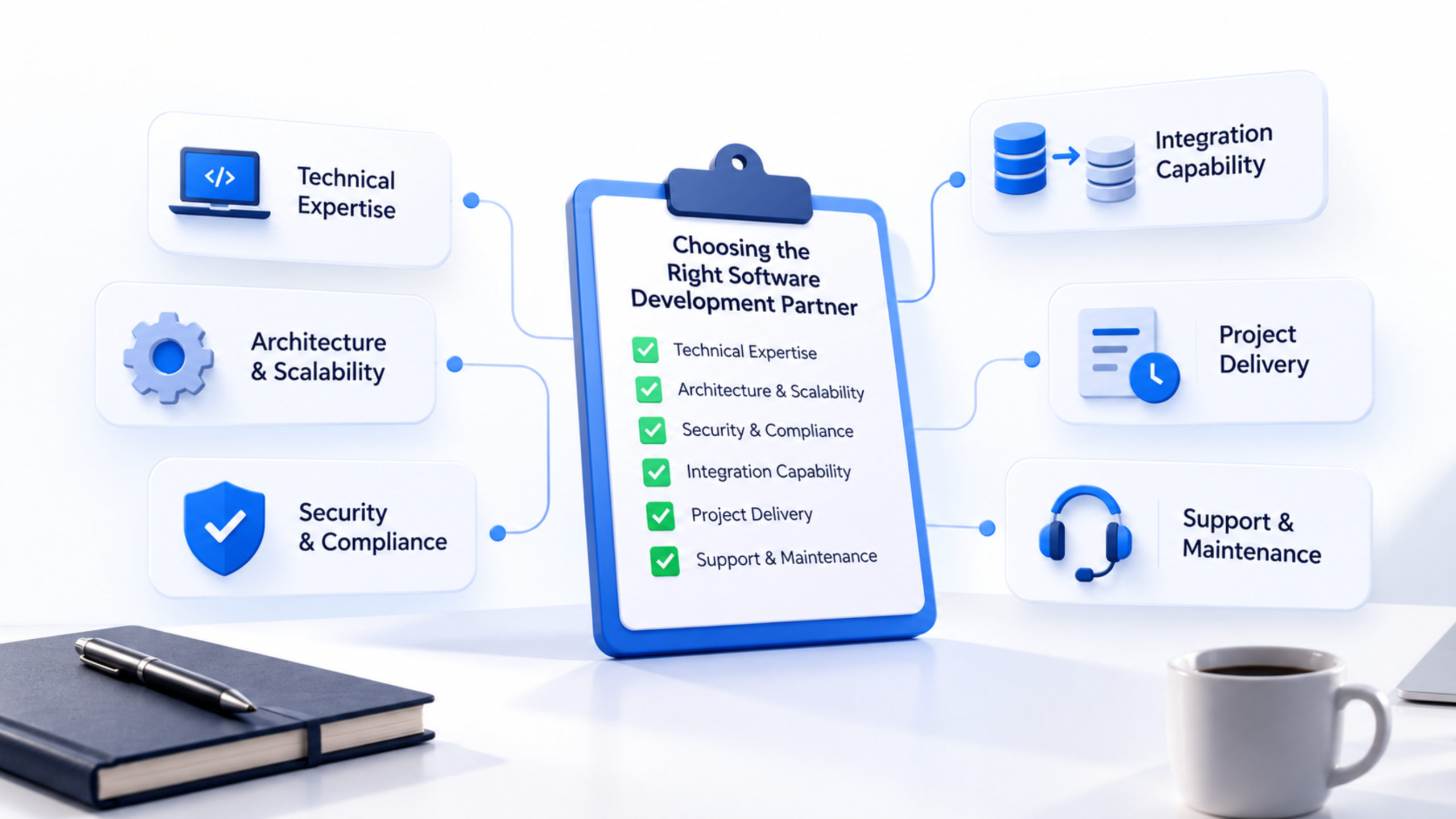
Compare technical expertise against your actual stack
Do not accept a logo wall as proof of fit. Ask the proposed architect and engineers to discuss a system they personally shipped and operated that resembles your environment.
If your stack is Python/Django, React, and AWS, that is the stack they should be able to talk about in detail. Ask for:
- a redacted architecture diagram
- one difficult integration example
- one production incident or migration lesson
- references who can discuss the work
- named roles for architecture, backend, frontend, QA, DevOps, product or business analysis, and delivery ownership
This matters because many firms can list technologies. Far fewer can explain the tradeoffs they made when they had to support them in production.
For a VP of Engineering, that is a core signal of whether an Ahmedabad software development company can work inside an existing engineering organization or only around it.
Compare architecture decisions, not architecture slogans
“Microservices” is not a strategy. “Cloud-native” is not a strategy. “Future-proof” is not a strategy.
Ask for a current-state diagram and a proposed target-state diagram. You want to see:
- component boundaries
- data ownership
- trust boundaries
- synchronous calls and events
- failure handling
- deployment units
- migration stages
A modular monolith may be the right answer. Microservices can create independently deployable boundaries, but they also add network, observability, data consistency, and operating demands. The supplier should explain why decomposition is warranted and how the old and new systems will coexist.
For legacy work, look for a reversible sequence: isolate one bounded capability, establish baseline tests and observability, place an interface around the legacy dependency, migrate the capability and its data safely, validate behavior, then retire the old path.
That is much more useful than hearing that everything will be rewritten.
Compare cloud, scale, and reliability together
Cloud is not just where the code runs. It is who owns the account, the configuration, the secrets, the monitoring, the backups, and the bills.
A serious proposal should include a deployment diagram, infrastructure changes under review, a load-test plan tied to your peak workload, and an actual restore exercise. It should also clarify who is responsible for cloud access and operational response.
Use the AWS Well-Architected categories as prompts even if you are not an AWS shop:
- operational excellence
- security
- reliability
- performance efficiency
- cost optimization
- sustainability
Those are useful review lenses. They are not proof of certification.
You should also define service-level indicators before you agree to an objective. Recovery time objective and recovery point objective mean different things, and neither has a universal number. The right values depend on the business.
A vendor should be able to explain what changes when the error budget is exhausted, not just say “high availability” and move on.
Compare integrations as a separate workstream
This is where many projects quietly fail.
Integrations are not small UI tasks. They are separate systems with their own ownership, schemas, auth methods, limits, and failure modes. Inventory every ERP, CRM, billing, identity, analytics, and legacy system you need to touch. For each one, ask for:
- owner
- API or export mechanism
- authentication method
- schema
- data direction
- expected volume
- sandbox access
- vendor limits
- error handling
- cutover dependency
Also ask for an interface contract and a test against an unavailable downstream system.
The right partner will treat the API like a contract, not a loose suggestion. They should discuss versioning, backward compatibility, idempotency, and safe retries. That matters because repeating a payment or order must not repeat the business action.
A diagram with arrows labeled “CRM integration” is not enough.
Compare security as evidence, not reassurance
Security should be concrete. Ask for a threat model, access-control design, code review and dependency practices, vulnerability triage ownership, incident escalation, and procedures for protecting source and build artifacts.
NIST’s Secure Software Development Framework is useful here because it gives you a common language: prepare the organization, protect the software, produce well-secured software, and respond to vulnerabilities.
If a supplier mentions OWASP ASVS, ask for the version they are using and the requirements they intend to test. If they mention SOC 2, ask for the actual report, the covered entity and services, the audit period, and any exceptions.
Do not let security become a vague promise. In enterprise buying, vague is expensive.
This is one of the clearest ways to judge whether a software development partner in Ahmedabad can support enterprise work without creating hidden risk.
Compare QA and DevOps with the release process, not the slide deck
Testing is not what happens at the end. Testing is part of how the system survives change.
Ask for the test strategy and examples of:
- unit tests
- integration tests
- end-to-end tests
- permission tests
- migration tests
- performance tests
- security tests
Then ask which tests run on each change, who approves a release, how staging resembles production, how a migration is rehearsed, and how a bad deployment is rolled back.
A good team should be able to demonstrate a change moving through your repository, review process, and CI/CD pipeline, with logs and an incident path.
You are not looking for perfection. You are looking for discipline. That is a different thing.
Compare delivery governance and communication
Good delivery is visible. You should see decisions, risks, and tradeoffs before they become surprises.
Compare suppliers on whether they provide:
- discovery deliverables
- a named technical lead
- access to engineers
- backlog ownership
- sprint demonstrations
- decision logs
- risk logs
- escalation contacts
- change request handling
If you are buying a dedicated team, ask about individual allocations, replacement procedures, continuity, and whether you can interview key people. If you are buying a fixed-scope project, ask about assumptions, acceptance tests, milestone dependencies, and how newly discovered integration work is handled.
Frequent status calls are not the same as good governance. Inspectable decisions are what matter.
Compare pricing as total cost, not hourly rate
Headline rates are useful only if the scope and risk are comparable. Compare the whole lifecycle instead:
- discovery
- architecture
- implementation
- integration
- migration
- testing
- security review
- cloud and third-party fees
- deployment
- documentation
- training
- warranty
- maintenance
- support
Also ask what happens if requirements change, whether specialist rates differ, whether there is a minimum commitment, and whether after-hours support is included or extra.
Published India-wide software development rates are broad context, not an Ahmedabad quotation. They do not tell you what your system will cost, and they do not tell you whether a bid includes the hard parts. A low bid that excludes integration, support, or handoff is not really low.
That is especially true in software development partner in Ahmedabad , where the real cost sits in operating the system after launch.
Compare ownership, documentation, and exit terms
This is the part many teams underweight until it is too late.
A maintainable engagement should specify:
- repository and cloud-account control
- deliverables
- third-party and open-source components
- confidentiality
- data handling
- acceptance
- defect correction
- support scope
- termination and transition process
You should also require architecture decisions, API contracts, deployment instructions, infrastructure configuration, runbooks, incident contacts, and a recorded handoff or paired walkthrough.
Make sure copyright and IP assignment terms are explicitly documented in the contract, including the work covered and the rights being transferred. If those are not specified, the default assumptions can work against you.
Paying the invoice is not the same as owning the result.
What a stronger proposal looks like in practice
Here is the practical difference.
A weak proposal says it will “build an API,” gives you a low developer rate, and promises to start quickly.
A stronger one starts by mapping authoritative customer records and permissions. It documents the API and version policy. It plans retries and duplicate-event handling. It tests an unavailable CRM and a peak import. It stages migration without interrupting existing customers. It assigns monitoring, rollback, and documentation owners.
That second approach is what you want from an Ahmedabad enterprise software company when the work touches real operational systems.
How FX31 Labs fits into this comparison
FX31 Labs publishes an Ahmedabad address and describes enterprise development, extended teams, product engineering, software architecture, cloud and DevOps consulting, and support for ERP, CRM, and supply-chain contexts.
That is useful context, not proof of fit.
If you compare FX31 Labs against other firms, ask for the same evidence you would ask from anyone else: the actual proposed team, architecture artifacts, security evidence, maintenance terms, and itemized pricing. The same rules should apply whether the supplier is local or remote, established or new.
The point is not to find a vendor with the most polished language. It is to find one that can work inside your operating model without turning your team into a support desk for someone else’s decisions.
Short comparison table
| Criterion | What to ask for | Strong response | Caution signal |
|---|---|---|---|
| Stack and team | Interviews with proposed people; delivered-system example | Explains tradeoffs in your stack | Generic portfolio and unnamed hires |
| Architecture and migration | Current and target diagrams; dependency map | Clear boundaries and rollback plan | “Move everything to microservices” |
| Cloud and scale | Account/control map; load and restore tests | Tied to real peaks and recovery needs | Scalability claimed without workload assumptions |
| Integrations | System inventory; contract; failure tests | Handles auth, compatibility, retries | Integration treated as a small task |
| Security | Threat model; checks; audit artifacts | Evidence matches the system | Unsupported certification claims |
| QA and DevOps | Test examples; pipeline demo; rollback procedure | Tests and release authority visible | Testing left until final acceptance |
| Delivery and communication | Named lead; demos; issue logs | Risks surfaced early | Only sales staff accessible |
| Price and support | Itemized proposal; support schedule | Assumptions and exclusions clear | Lowest rate hides dependencies |
| Ownership and exit | IP terms; repo access; runbooks | Internal team can support it | Supplier-owned black box |
Quick checklist before you shortlist anyone
- Have all suppliers received the same business, architecture, integration, and risk brief?
- Have we interviewed the actual architect, developers, QA, and delivery lead?
- Is there a defensible current-state and target-state design with staged migration?
- Are cloud ownership, load assumptions, observability, backup, and recovery agreed?
- Is each integration’s owner, contract, authentication, and failure behavior documented?
- Can we inspect threat modeling, security checks, and any claimed audit scope?
- Are tests, acceptance criteria, CI/CD authority, and rollback demonstrated?
- Do overlap hours, escalation, and after-hours responsibilities meet our needs?
- Are estimates itemized, with exclusions and change-control rules?
- Will we receive the code, necessary rights, configuration, runbooks, and knowledge transfer?
- Is maintenance priced and is the post-handoff owner named?
FAQ
Is the lowest hourly rate in Ahmedabad the lowest-cost choice?
Not necessarily. Compare discovery, integration, rework, infrastructure, support, and handoff costs for the same scope.
Should a modernization partner always replace our monolith with microservices?
No. A modular monolith or staged extraction can be the better fit if it reduces risk and keeps operations manageable.
What is the fastest way to spot a weak integration proposal?
Ask for the source-of-truth decision, API contract, auth approach, retry behavior, unavailable-system test, and production ownership.
Which security certification must an Ahmedabad firm have?
There is no universal answer. Start with your own contractual and data requirements, then inspect the controls and evidence that match them.
Fixed scope or dedicated team?
If the deliverable is stable, fixed scope may fit. If the work will evolve, a dedicated team may be better. In both cases, define accountability and change handling.
How do we avoid a vendor-built black box?
Keep control over repositories and environments, and require documentation, runbooks, API contracts, deployment instructions, and a real handoff.
What should happen after launch?
You should know who handles defects, support hours, severity rules, monitoring, security updates, backup and restore, and exit planning.
Conclusion
Selecting an enterprise partner is not just a procurement task. It is a governance decision.
The right firm increases your delivery capacity without moving architectural understanding and operating control out of your organization. That is the real advantage of disciplined vendor selection. It lets your team keep shipping while still owning the means to change, secure, and support what gets built.
That is what strategic maturity looks like in practice. Not a promise that one city or one firm will outperform every alternative, but the ability to compare custom enterprise application development options on evidence, keep control of the system, and choose a software development partner in Ahmedabad that strengthens the business instead of creating a black box.