
Enterprise Growth Strategies: Scaling Systems vs. Scaling Teams for Sustainable Growth
In today’s US market, it is not enough for Enterprise Growth Strategies to simply hire more staff or sell more products for the same reason. We are talking about a twofold approach of scaling both technology and people for sustainable growth. Growth is usually taken to mean increased business activity, whereas scaling captures its essence as being efficient, that is, dealing with more work without a corresponding rise in costs. The top American companies, without exception, are employing not only strong processes but also investing in cutting-edge technology and learning practices that are fast to adapt or even change in the course of execution, to enable growth along with their maturity. All these ways of strategies look at every enhancement as the planting of a seed that will grow into something much larger over time.
Investing in scalable systems and processes can even turn small improvements to the point of exponential returns. One of the instances of this is when a company automates its key operations (cloud infrastructure, DevOps pipelines, AI-driven analytics), then it would be able to cater to more customers or more data without needing to employ new staff or provide additional resources of the same amount as in the previous case. Every infrastructure upgrade compounds: as an insight from FX31 Labs states, adding specialized engineering capacity without aligned processes creates “hidden talent gaps” that slow growth and dilute culture.
On the other hand, a good system architecture keeps growing demand within reach. Studies indicate that companies with good people and systems strategies are qualitative winners; firms with strong people management are 1.4× more likely to get fast revenue growth. These features, in their entirety, improve the system an integral part of the Enterprise Growth Strategies that are effective.
Growth vs Scaling in Business
Understanding growth vs scaling in business is key for enterprise leaders. Simply “growing” means adding resources (staff, budget, etc.) to boost output. By contrast, scaling means increasing capacity without proportional cost. It focuses on efficiency, for instance, automating processes so growth doesn’t create bottlenecks. As Atlassian explains, companies today must adapt at “enterprise scale” to stay competitive, treating technology as a strategic enabler. Without this approach, hiring more people alone can create hidden bottlenecks.
Indeed, FX31 Labs warns that lacking specialized skills or structured hiring leads to hidden talent gaps and slow growth. In practice, growth means doing more, while scaling means doing more with less. Effective enterprise leaders balance both by building repeatable, efficient processes and augmenting talent where it truly matters.
Core Enterprise Growth Strategies
Successful Enterprise Growth Strategies combine multiple pillars. Key approaches include:
- Technology Modernization: Upgrading systems (cloud platforms, microservices, containerization) to boost efficiency. Scalable tech stacks let businesses handle surges without extra hardware. For example, adopting cloud infrastructure is often a core enterprise growth strategy; it provides elasticity so services can auto-scale on demand without heavy upfront costs.
- Talent & Team Expansion: Growing skilled teams via methods like staff augmentation or dedicated teams. FX31 Labs notes that forming dedicated external teams lets companies quickly add specialized expertise under their control. This provides flexibility and speed while keeping culture intact. Companies often mix new hiring, global talent centers, and rigorous training. After all, organizations with strong people development see faster growth.
- Agile Processes: Implementing agile scaling frameworks (SAFe, LeSS, etc.) to align cross-functional teams and accelerate delivery. Frameworks like these synchronize many teams on common goals, breaking down silos. They embed iterative planning and feedback into growth, keeping large projects coordinated. For instance, the Scaled Agile Framework (SAFe) is built around lean-agile principles and promotes alignment and collaboration across dozens of teams.
- Leadership & Culture: Investing in managers, organizational culture, and innovation capacity. Strong leadership development and a culture of continuous improvement are often overlooked “growth accelerators.” In fact, studies show companies that focus on leadership and employee development significantly outperform peers. Embedding clear values and incentives ensures that as teams expand, they stay productive and mission-focused.
Combining these elements ensures that systems and people grow together. This balanced approach prepares US companies to scale sustainably, avoid common pitfalls, and seize new opportunities.
Business Scaling Techniques
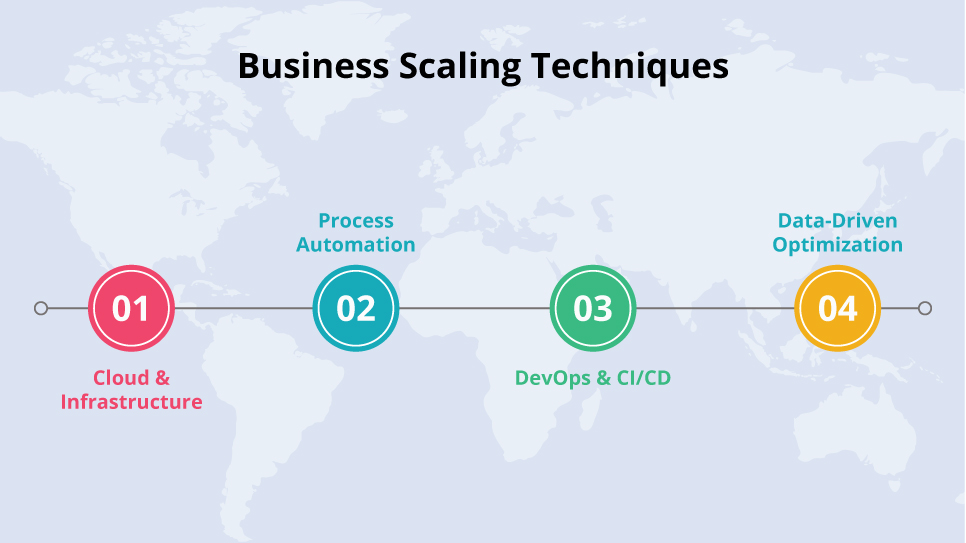
A key part of enterprise strategies is the set of business scaling techniques that strengthen systems and processes. Popular techniques include:
- Cloud & Infrastructure: Moving to cloud services (AWS, Azure, Google) that auto-scale on demand. This lets applications handle traffic spikes without extra servers, letting businesses grow usage without major capital investment.
- Process Automation: Applying AI, robotics (RPA), and analytics to streamline repetitive tasks. Automation frees up teams to focus on high-value work, and it can reduce costs even as output rises. For example, customer support chatbots or automated data pipelines let firms serve more clients without hiring at the same rate.
- DevOps & CI/CD: Automating development and deployment pipelines so new features roll out quickly and reliably. Continuous Integration/Continuous Delivery ensures the software platform scales in capability as teams grow, without manual bottlenecks.
- Data-Driven Optimization: Using big data, monitoring, and feedback loops to continuously improve products and processes. By closely tracking key metrics, an enterprise can adapt operations (servers, workflows, inventory) on the fly as demand grows.
These business scaling techniques allow enterprises to handle more customers or data with minimal extra cost. In essence, they build flexibility into the core operations. As a result, companies become more responsive: when demand doubles, well-designed systems can automatically expand usage rather than requiring manual intervention. Together, these practices form a scalable technical foundation that is central to any enterprise growth strategy.
Team Expansion Strategies
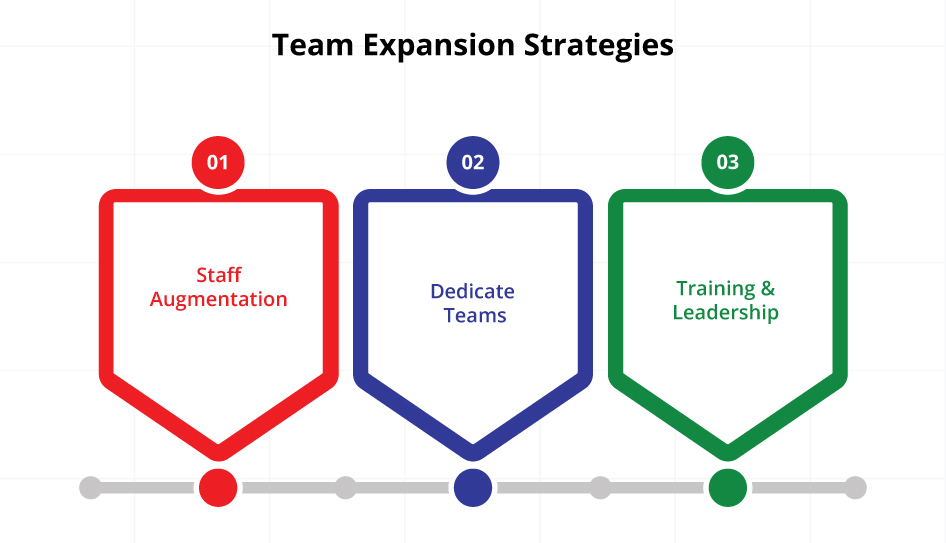
Effective scaling also requires strategic team growth. Enterprises use various team expansion strategies:
- Staff Augmentation: Hiring contractors or consultants to quickly plug skill gaps. This gives flexibility to adjust team size as projects change.
- Dedicated Teams: Forming long-term, focused teams of external professionals who integrate with the core staff. FX31 Labs notes that dedicated teams provide specialized expertise while you retain leadership and alignment.
- Training & Leadership: Investing in current employees through training programs, certifications, and leadership development. Upskilling staff and preparing managers to lead larger teams ensures that talent expansion doesn’t outpace capability.
Each new hire or partner must fit the company’s goals and culture. Without this alignment, “hidden talent gaps” can emerge, as FX31 Labs warns, missing engineering skills and weak hiring processes can stall growth. On the other hand, organizations that manage talent well see faster gains. By carefully balancing hiring, outsourcing, and learning, enterprises build high-performing teams. One study even found that companies with robust people-management strategies were significantly more likely to achieve higher growth. This underscores why smart team expansion (especially in fast-moving US companies) is a cornerstone of enterprise growth.
Agile Scaling Frameworks
Large organizations often adopt formal frameworks to scale agile across many teams. These agile scaling frameworks are essentially cultural transformations that align people, practices, and tools around strategic goals. Popular frameworks include:
- Scaled Agile Framework (SAFe): A comprehensive set of patterns for enterprise agile. SAFe is built on agile and lean principles and explicitly promotes alignment, collaboration, and delivery across dozens of teams.
- Large-Scale Scrum (LeSS): Extends Scrum to large-scale development. LeSS keeps practices simple – it essentially applies core Scrum rules to multiple teams with one product backlog, minimizing extra roles and artifacts.
- Spotify Model: A people-driven approach (using “squads” and “guilds”) popularized by Spotify. It emphasizes autonomy and culture networks so teams can self-organize effectively.
By choosing an agile scaling framework, enterprises embed agile values into their DNA. These frameworks provide proven recipes for coordinating planning, managing dependencies, and communicating across an organization. For instance, SAFe introduces roles (like Release Train Engineers) and ceremonies (PI Planning) that synchronize even large engineering groups. Adopting such frameworks helps large companies stay nimble: it increases transparency, breaks down communication silos, and speeds up time-to-market.
Enterprise Growth Strategies in Practice
- Well-defined Enterprise Growth Strategies differentiate sustainable scaling from random growth attempts.
- Effective Enterprise Growth Strategies unify technology, marketing, and HR goals under one plan.
- Enterprise Growth Strategies are often documented in leadership meeting agendas or strategic roadmaps.
- Every industry may have different Enterprise Growth Strategies, but the core principles (technology leverage, team building, continuous improvement) remain similar.
These examples illustrate how leading companies formalize and align their enterprise growth strategies as roadmaps for expansion.
Conclusion
In summary, effective enterprise growth strategies scale systems and teams in tandem. Leading US enterprises blend technology upgrades with talent investment. They leverage business scaling techniques (cloud, automation, DevOps) to create capacity, and apply team expansion strategies (outsourcing, training) to add expertise. Implementing agile scaling frameworks keeps these moving parts aligned and agile. The key is to treat growth as a systemic challenge: build repeatable processes, empower people, and foster adaptive leadership. By investing in scalable infrastructure and a skilled workforce, companies can grow revenue and market share without incurring matching increases in cost. This holistic approach keeps enterprises resilient and competitive as they expand.
FAQs
Q: What are enterprise growth strategies?
A: These are the overall plans and initiatives that a company uses to grow sustainably. They typically involve scaling systems, processes, and teams together. For example, focusing on long-term scalability (rather than short-term growth) differentiates an enterprise growth strategy from ad-hoc expansion tactics. A clear enterprise growth strategy aligns technology and talent with market opportunities.
Q: What is the difference between growth and scaling in business?
A: Growth means boosting output by adding resources (staff, budget, etc.), while scaling means increasing capacity without proportional cost. Scaling focuses on efficiency, such as automating processes or utilizing platforms, to prevent expansion from creating new bottlenecks. As Atlassian notes, companies today must adapt “at enterprise scale” by treating technology as a strategic enabler. Effective scaling ensures that even as volume increases, costs remain under control.
Q: What are agile scaling frameworks, and why use them?
A: These are structured methods to coordinate many agile teams across the company. Popular examples include SAFe, LeSS, and the Spotify model. Such frameworks provide guidelines (roles, events, tools) that help teams align on strategy and delivery. For instance, SAFe promotes alignment and collaboration across teams. By using these frameworks, enterprises increase transparency, better manage dependencies, and speed up time-to-market.
Q: What are common enterprise growth strategies in business?
A: Businesses pursue strategies like market penetration, product/service expansion, diversification, strategic partnerships, and mergers & acquisitions. Each approach aims to increase revenue but also adds complexity, which makes solid systems and automation essential.
Q: Why should U.S. enterprises focus on scaling systems as well as teams?
A: In the fast-changing US market, efficiency is key. System scaling, using technology, standard processes, and automation, allows a company to expand nationally or globally without proportionally raising costs. This preserves margins and competitiveness even as the business grows.