
Custom Software Development Strategies for Growing Businesses
In today’s fast-paced digital economy, off-the-shelf software solutions often fall short of meeting the unique, evolving needs of a growing business. As companies scale, their operational complexities increase, and the need for tailored tools that align perfectly with their processes becomes paramount. This is where Custom software development strategies become not just a luxury, but a strategic necessity.
The Strategic Imperative of Custom Software
For small and medium-sized enterprises (SMEs) and even larger corporations looking to gain a competitive edge, standard commercial software is a compromise. It forces the business to adapt its processes to the software’s limitations, which can stifle innovation and efficiency. Custom software development strategies offer a solution by creating applications specifically designed to solve internal challenges, automate proprietary workflows, and provide unique customer experiences.
The core difference lies in ownership and control. A custom solution is built for the business, incorporating its specific terminology, operational logic, and future growth trajectory from day one. This level of tailored integration is essential for businesses transitioning from initial rapid growth to sustainable, large-scale operations.
Key Pillars of Custom Software Development Strategies
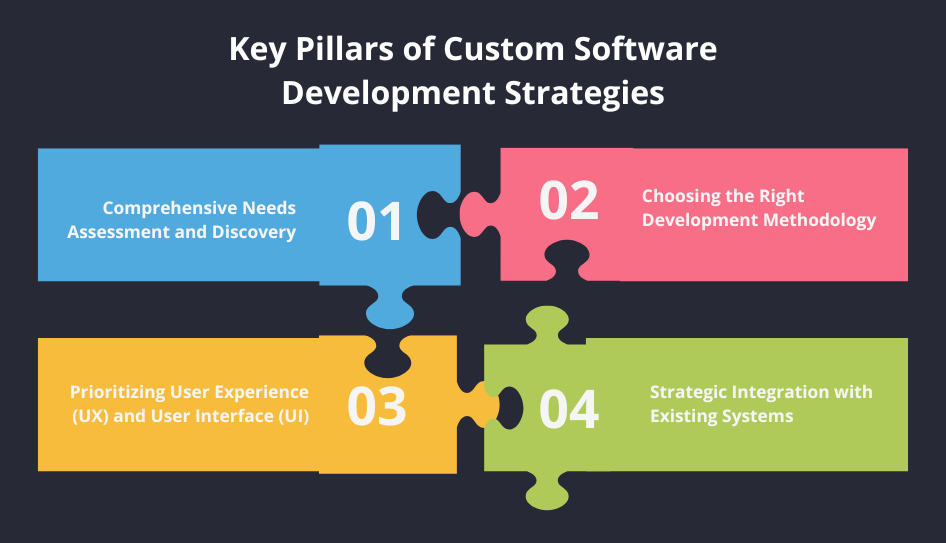
Implementing successful software development strategies requires more than just hiring a team of coders. It demands a structured, goal-oriented approach rooted in business strategy. The following pillars form the foundation of an effective custom development framework:
1. Comprehensive Needs Assessment and Discovery
Before a single line of code is written, the business must clearly define the problem the software is meant to solve. This phase involves deep dives into existing processes, identifying bottlenecks, and understanding the user journey (both employees and customers).
- Define Scope and Goals: What is the specific, measurable objective? Is it to reduce manual data entry by 50% or to integrate two disparate legacy systems?
- Stakeholder Alignment: Gather input from all departments that will interact with the software to ensure the final product meets everyone’s requirements.
- Future-Proofing: Design the architecture with scalability in mind. A growing business needs a system that can handle 10x the current load without a complete overhaul. This is critical for future Enterprise software solutions.
2. Choosing the Right Development Methodology
The approach to development significantly impacts time-to-market, cost, and flexibility.
- Agile Development: This iterative approach is almost universally preferred for custom software. It allows for continuous feedback and adaptation, ensuring the final product remains relevant even as market conditions or business needs change during the development cycle.
- DevOps Integration: Adopting a DevOps culture—integrating development and operations teams—speeds up deployment and ensures high reliability. Continuous Integration/Continuous Deployment (CI/CD) pipelines allow for rapid feature releases and immediate bug fixes.
3. Prioritizing User Experience (UX) and User Interface (UI)
Custom software often fails internally not because of technical flaws, but because of poor usability. If the software is cumbersome or difficult to navigate, employees will resist using it, negating the investment.
- Employee Efficiency: For internal tools, the UI/UX must streamline workflows, reduce cognitive load, and minimize the time required to complete essential tasks.
- Customer Engagement: For customer-facing applications, the interface should be intuitive, engaging, and reflective of the brand’s quality.
4. Strategic Integration with Existing Systems
A new custom solution should not exist in a silo. A vital part of Custom software development strategies is ensuring seamless data flow between the new application and existing tools (e.g., CRM, ERP, accounting software). Poor integration leads to data discrepancies, manual reconciliation, and frustrated users. Modern development relies on robust APIs (Application Programming Interfaces) to facilitate this seamless communication.
The Concrete Benefits of Custom Software Development
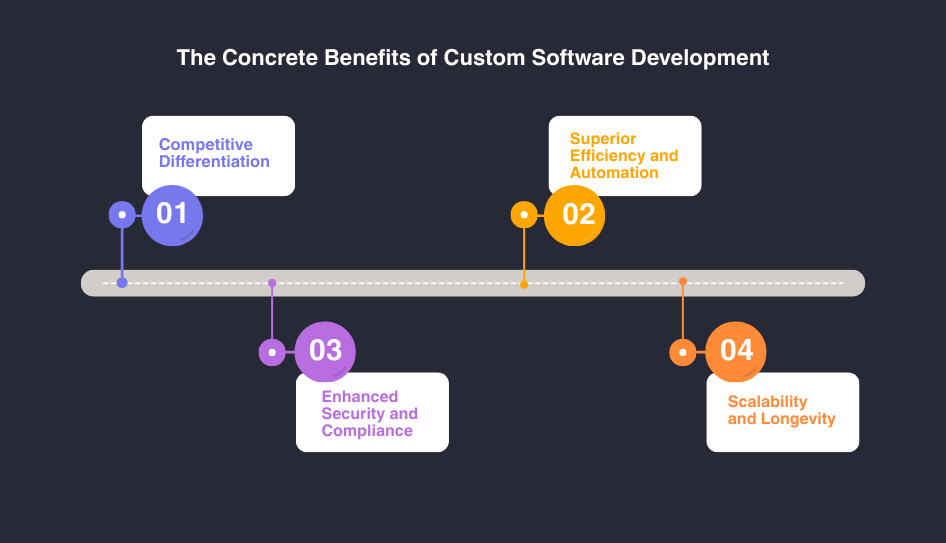
The investment in custom development yields multiple strategic advantages over generic alternatives:
1. Competitive Differentiation
Off-the-shelf software is available to competitors. A custom application, especially one that automates a proprietary process or offers a unique customer service feature, provides a distinct market advantage that cannot be easily replicated. This is often the genesis of true Enterprise software solutions.
2. Superior Efficiency and Automation
Custom software is built to mirror exact business processes, eliminating unnecessary steps and automating complex, repetitive tasks that generic software cannot handle. This leads to massive gains in operational efficiency and significant reductions in human error.
3. Enhanced Security and Compliance
Standard software can be a target for hackers due to its widespread use. Custom software offers the flexibility to embed specific, cutting-edge security protocols and comply rigorously with industry-specific regulations (e.g., GDPR, HIPAA, or financial compliance standards). Businesses have complete control over the data architecture and security layers.
4. Scalability and Longevity
One of the most compelling benefits of custom software development is its inherent scalability. As the business expands—adding new users, entering new markets, or launching new product lines—the custom solution can be adapted and expanded without the prohibitive licensing costs or functional limitations of commercial platforms. The business owns the source code and the roadmap for its evolution.
Transitioning to Enterprise Software Solutions
For rapidly growing businesses, custom software often matures into robust Enterprise software solutions. This transition marks a point where the bespoke system becomes the central nervous system of the organization, managing mission-critical functions like resource planning, supply chain, and complex data analytics.
Developing an enterprise-grade solution requires:
- Modular Architecture: Breaking the system into interchangeable components allows for phased development, easier maintenance, and less risk during updates.
- Robust Data Management: Implementing advanced data warehousing and analytics capabilities to turn operational data into strategic insights.
- High Availability: Designing the system for maximum uptime, recognizing that downtime in an enterprise environment can cost millions.
Conclusion: A Strategy for Sustainable Growth
For any growing business, the question is not if they need custom software, but when and how to build it strategically. By embracing well-defined Custom software development strategies, organizations can move beyond the limitations of generic tools and create digital assets that drive efficiency, ensure compliance, and most importantly, establish a decisive competitive edge. The decision to invest in custom solutions is a long-term strategy that transforms operational costs into business-critical intellectual property, paving the way for sustainable and exponential growth.
FAQs
Q1: What is the primary difference between custom software and off-the-shelf software for a growing business?
A: Off-the-shelf software is a compromise, forcing the business to adapt its processes to the software’s limitations, which can stifle efficiency. Custom software is built to align perfectly with a business’s unique, proprietary workflows, offering complete ownership and control, and incorporating specific operational logic and future growth trajectory from day one.
Q2: Why is a Comprehensive Needs Assessment critical before starting custom software development?
A: The Needs Assessment and Discovery phase is essential to clearly define the problem the software is meant to solve, identify bottlenecks in existing processes, and align requirements across all stakeholders. Crucially, it ensures the software is designed for future-proofing and scalability, preventing the need for a complete overhaul as the business grows.
Q3: Which development methodology is most preferred for custom software projects and why?
A: Agile Development is almost universally preferred. This iterative approach allows for continuous feedback and adaptation throughout the development cycle. It ensures the final product remains relevant even if market conditions or business needs change, and it facilitates quicker time-to-market compared to traditional methods.
Q4: How does custom software provide a competitive advantage?
A: Custom software provides a competitive differentiation because it automates proprietary processes or enables unique customer service features that are not available in standard, generic commercial software used by competitors. This creates a distinct market advantage that cannot be easily replicated, often leading to true Enterprise software solutions.
Q5: What is the significance of UX/UI design for custom internal tools?
A: For internal custom tools, good User Experience (UX) and User Interface (UI) design is paramount for employee efficiency. If the software is cumbersome, employees will resist using it. A well-designed UI/UX streamlines workflows, reduces cognitive load, and minimizes the time required to complete essential tasks, ensuring the investment provides a return.