Top 15 AI Product Development Companies in 2026
Quick Answer: AI Product Development at a Glance
- What they do: Build AI products, from MVPs to production-ready applications.
- Typical cost: $20,000 to $70,000 for an MVP and $60,000 to $180,000 for production, plus running costs.
- How to choose: Check production experience, security, evaluation, and IP ownership.
- Best next step: Compare three suitable vendors and validate your use case with a paid pilot.
AI can automate workflows, improve decisions, and power smarter products. But rising development costs, unreliable outputs, and deployment challenges can turn a promising AI idea into a costly failure.
That is why choosing the right AI product development company matters. The right partner can help you build reliable AI products using the right models, data, and infrastructure. However, MIT NANDA’s State of AI in Business research found that 95% of the organizations studied reported no return from their generative AI investments.
Not all AI development companies offer the same expertise. Some specialize in AI MVP development, while others focus on custom models, AI agents, or integrating AI into existing systems. Choosing the wrong fit can waste time and budget.
In this guide, you’ll learn:
- 15 AI product development companies and their core strengths
- How to evaluate vendors and choose the right partner
- AI product development cost, timelines, and ongoing expenses
- When to outsource AI development and what to check before signing a contract
By the end of this guide, you’ll have a practical shortlist and a clearer idea of which partner, approach, and budget fit your project.
What Is an AI Product Development Company?
An AI product development company turns an AI use case into working software your customers or employees can use. It manages the process from discovery and data preparation to model selection, development, testing, deployment, and ongoing support.
Unlike a consultancy that mainly provides strategy or a platform vendor that sells ready-made tools, it builds custom AI products your business can own and maintain.
What AI Product Development Services Include
Most AI product development services cover seven key areas:
- Discovery and use-case scoping: Identify valuable AI use cases and define measurable goals for the first release.
- Data readiness and engineering: Audit, clean, and connect the data required to power the product.
- Model and architecture selection: Compare API models, open-weight models, RAG, and fine-tuning based on cost, accuracy, and data control.
- Product development: Build the web or mobile application, backend, and integrations.
- Evaluation and guardrails: Test AI outputs and add safeguards for accuracy, privacy, safety, and cost.
- Deployment and LLMOps: Launch the product with logging, monitoring, version control, and rollback options.
- Post-launch support: Monitor performance, output quality, and running costs, then make improvements as needed.
AI Product Development Company vs. AI Consultancy vs. AI Platform Vendor
These options serve different needs. The right choice depends on whether you need a custom product, strategic guidance, or a ready-made tool.
| Factor | AI Product Development Company | AI Consultancy | AI Platform Vendor |
| What you get | Custom software, source code, and evaluation tools | Strategy, assessments, and roadmap | Ready-made AI software |
| How you pay | Milestones, sprints, or monthly team fees | Fixed fees or day rates | Subscription or usage-based fees |
| Who builds it | Development partner | Usually a separate team | Platform vendor |
| What you own | Custom code and agreed deliverables | Strategy documents | Your data, subject to platform terms |
| Time to value | Weeks to a working MVP, depending on scope | Weeks for a roadmap | Days for a basic setup |
| Best for | Building a custom AI product | Planning an AI initiative | Standard use cases |
AI product development company: Best when you need a team to design, build, test, and deploy custom software. Payment typically follows milestones, sprints, or a monthly engagement.
AI consultancy: Best when you need help identifying use cases, assessing readiness, or creating an AI roadmap. You may need a separate development team to execute the plan.
AI platform vendor: Best when an existing tool meets your needs. Setup is often faster, but customization and control depend on the platform.
For businesses that need both strategy and execution, working with one AI development partner can reduce handoffs between planning and development.
Also Read: Custom AI Development vs Off-the-Shelf AI Tools: Which Is Best for Enterprise AI ROI?
Why Work With an AI Product Development Company?
An external partner helps you move AI from an idea to production without the delays of hiring and building everything in-house. The right partner brings experienced engineers, a proven process, and a clear development plan.
1. A Faster Route From Pilot to Production
Experienced teams know how to handle common roadblocks, from poor data quality to unreliable AI outputs. This helps you launch a working product faster and get feedback from real users.
2. Senior AI Skills Without a Long Hiring Cycle
Hiring LLM, data, and MLOps engineers takes time and adds ongoing costs. An experienced partner gives you access to the skills you need without building a full in-house team.
3. Lower Delivery Risk Through a Proven Process
A structured process identifies weak use cases, data gaps, and performance issues early. This reduces costly rework and helps keep development aligned with business goals.
4. Staged, Predictable Spend
Split development into discovery, proof of concept, MVP, and production stages. Each stage has a defined scope, helping you manage spending and make decisions before committing more budget.
5. Evaluation, Security, and Compliance Built In
A reliable partner includes AI testing, guardrails, access controls, and audit logs in the development process. These practices help address security reviews and relevant requirements such as GDPR and HIPAA.
How We Vetted the Firms on This List
We reviewed firms featured across 11 AI development company ranking articles and narrowed the list to 15 based on seven criteria.
- Production Proof: Public case studies showing AI products used in real-world settings, not just demos or prototypes.
- Specialist Scale: Small expert firms to companies with a few hundred employees, excluding global consultancies and outsourcing giants.
- Clear AI Focus: Dedicated services in generative AI, AI agents, RAG, computer vision, or MLOps.
- US or UK Reach: Experience serving buyers in the US or UK through offices, teams, or an established client base.
- Transparent Engagement Models: Clear delivery and pricing approaches, including fixed-price projects, time and materials, or dedicated teams.
- Active and Independent: Firms checked for acquisition, merger, or signs of financial trouble.
- Verified Company Information: Locations, services, and claims checked against official company websites, with gaps noted where relevant.
Fx31 Labs publishes this guide, so we list ourselves first and use the same profile format applied to every other firm.
The remaining 14 firms are grouped by buyer needs rather than ranked order. Each profile ends with a ‘Best for’ line so you can see who fits your project.
Top 15 AI Product Development Companies at a Glance
Use this table to compare each company’s location, core strengths, ideal use cases, and engagement models. Review the profiles of the firms that best match your project requirements.
| Company | Where They Work | Standout Strength | Right Fit For | Engagement Models |
| Fx31 Labs | New Jersey, US, with India-based engineering | AI MVPs, AI agents, and code modernization | Startups and mid-market teams | MVP builds, product development, dedicated teams, talent augmentation |
| Upsilon | Remote team, office in Tallinn | Published, staged AI MVP pricing | Early-stage founders | Discovery, prototypes, MVP packages |
| Kodexo Labs | Austin, US, London, and Karachi | Agentic AI and published hourly rates | Budget-conscious startups and SMBs | Discovery sprints, PoCs, staff augmentation |
| Miquido | Kraków, Poland | Mobile-first and on-device AI | Consumer apps and UK brands | AI Kickstarter, product development |
| AscentCore | Herndon, Virginia, and Romania | LLM features for product teams | US software and media companies | Extended teams, AI PoC Accelerator |
| Scopic | Remote, Massachusetts mailing address | AI and software development teams | SMBs adding AI to existing software | Hourly projects, staff augmentation |
| Master of Code Global | Redwood City, California, and Winnipeg, Canada | Conversational AI and customer-facing agents | Customer support, sales, and CX teams | 30-day AI Pilot, project delivery |
| InData Labs | Nicosia, Vilnius, and Miami sales office | Data engineering and AI development | Data-heavy AI products | Fixed-price projects, time and materials, dedicated teams |
| Deepsense.ai | Warsaw, Poland, and Palo Alto, US | Machine learning, computer vision, and edge AI | Technically complex AI projects | AI advisory, R&D, development |
| DataRoot Labs | Kyiv, Ukraine, and Delaware, US | Deep-tech R&D and custom models | Products built around proprietary models | R&D projects with upfront IP terms |
| Neurons Lab | London, UK, and Singapore | Agentic AI for financial services | Banks, insurers, and wealth managers | Proof of concept, production development |
| ITRex Group | Sacramento, US, and Warsaw, Poland | AI for healthcare and supply chains | Healthcare and life sciences | Project-based, time and materials, dedicated teams |
| Markovate | Illinois, San Francisco, Toronto, and Gurugram | Generative AI pilots for industry | Manufacturing, construction, and insurance | Four to six-week pilots, product development |
| HatchWorks AI | Atlanta, US, with Latin American teams | Nearshore AI development in US time zones | US mid-market teams | Staff augmentation, dedicated teams, outcome-based projects |
| Azumo | San Francisco, US, with remote Latin American teams | SOC 2-focused nearshore delivery | US companies with security requirements | PoCs, production projects |
Let’s take a look at each one in detail.
1. Fx31 Labs

Fx31 Labs builds generative AI products, AI agents, RAG assistants, and custom ML systems for startups and mid-market companies. It combines India-based engineering with a US office in Short Hills, New Jersey.
Its services cover AI MVP development, AI talent augmentation, and Coderbotics AI, its code modernization platform. This lets businesses build AI products, add new features, and modernize legacy systems with one partner.
Engagements can start with a fixed-price prototype, an MVP, or dedicated AI engineers, allowing businesses to choose an approach that fits their budget and scale as needed.
Key Highlights:
- Where they work: 225 Hartshorn Drive, Short Hills, New Jersey, with India-based engineering teams and remote delivery.
- AI focus: Generative AI, RAG, custom ML, and data science, alongside Coderbotics AI with 40+ agents across 9+ languages.
- Engagement models: AI MVP development, full product builds, dedicated teams, and AI talent augmentation.
- HRMS case study: Built an in-house HRMS in 5 weeks using GenAI and a two-person team.
- Predictive analytics: Its commodity trading solution reports 99.99% uptime.
- Code modernization: Coderbotics AI supports cloud and database migration, monolith-to-microservices conversion, design documents, and codebase chat, with 70%+ accuracy in automated code transformations.
- Retail AI case study: Its UAE retail demand planning project reduced stockouts by 30%, excess inventory by 25%, and planning time by 95%.
Best for: Startups and mid-market companies that need an AI MVP, new AI features, or legacy code modernization without coordinating multiple vendors.
2. Upsilon
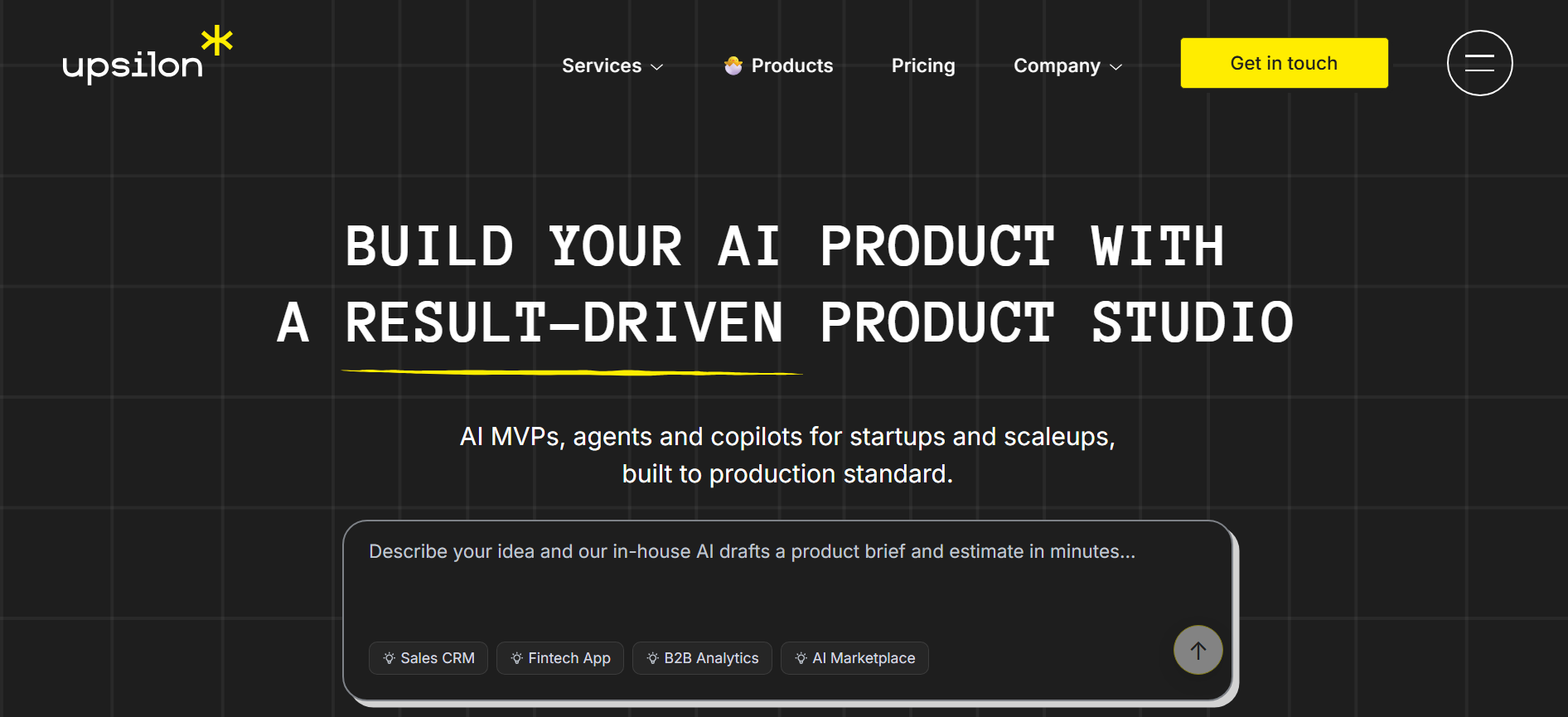
Upsilon focuses on startup product development, with a transparent, staged approach to AI MVPs. Its published pricing covers discovery from $6,000, prototyping from $10,000, and MVP development from $20,000, helping founders estimate costs before committing.
Key Highlights:
- Pricing transparency: Publishes stage-by-stage pricing, with most MVPs costing $20,000 to $65,000.
- Lower entry risk: Offers a money-back guarantee on the first sprint.
- Team setup: Remote-first team with an office in Tallinn, Estonia.
Best for: Pre-seed to Series A founders who need a clearly scoped AI MVP and predictable initial spending.
3. Kodexo Labs
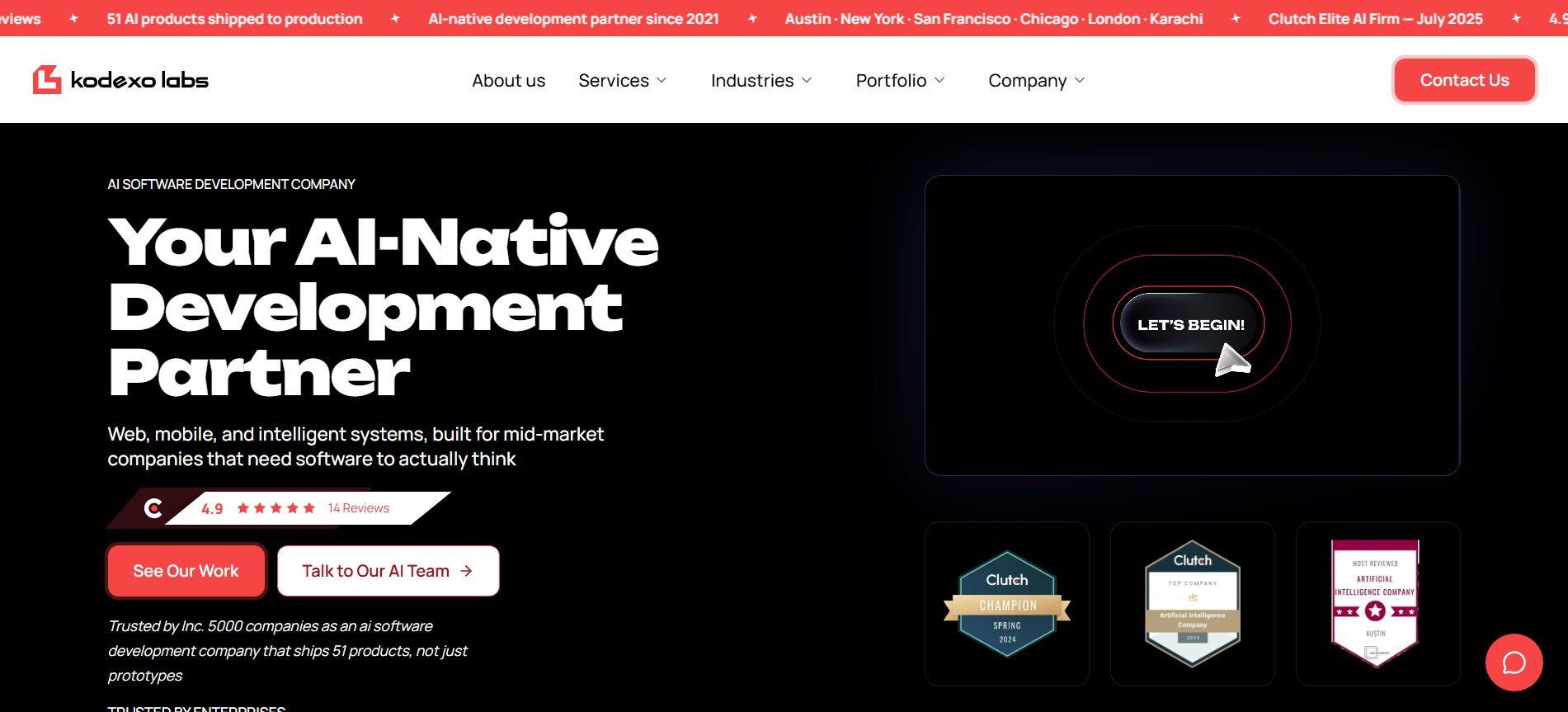
Kodexo Labs builds agentic AI products, including multi-agent systems, voice agents, and fine-tuned LLMs. Its use of frameworks such as LangGraph, CrewAI, and AutoGen supports complex workflows, while published rates help budget-conscious startups plan their projects.
Key Highlights:
- Published rates: AI development at $50-$99 per hour, with discovery sprints from $25,000.
- Technical depth: Covers RAG, computer vision, and LLM fine-tuning.
- Security checks: Ask for audit reports to confirm applicable certifications.
Best for: Startups and SMBs building agentic AI products with a US or UK point of contact.
4. Miquido
Miquido combines its mobile development expertise with on-device AI, generative AI features, and product design. Its AI Kickstarter gives businesses a structured way to test an idea before committing to a full mobile product.
Key Highlights:
- AI Kickstarter: Runs for three to five weeks, starting at $15,000.
- Mobile expertise: Integrates AI into polished iOS and Android experiences.
- Delivery planning: US clients should confirm working-hour overlap with its Poland-based team.
Best for: Consumer brands and product teams adding AI to mobile apps.
5. AscentCore
AscentCore works alongside product teams to develop AI agents, RAG applications, and LLM-powered features. Its AI PoC Accelerator helps businesses validate an idea through a working prototype before moving into full product development.
Key Highlights:
- PoC Accelerator: Begins with an NDA and targets a working prototype.
- Data platforms: Supports Snowflake and Databricks integrations.
- Project minimum: Clutch lists a $50,000 minimum project size.
Best for: US software and media companies taking AI features from prototype to production.
6. Scopic
Scopic combines AI engineering with broader software development, allowing businesses to add intelligent features to existing web and mobile products through one partner. Its remote delivery model also gives clients access to developers across multiple regions and time zones.
Key Highlights:
- AI capabilities: Covers GenAI, computer vision, NLP, and AI agents.
- Flexible staffing: Offers managed projects and part-time or full-time staff augmentation.
- Budget control: Set a clear scope and spending cap for hourly engagements.
Best for: SMBs and mid-market companies adding AI to existing software products.
7. Master of Code Global
Master of Code Global specializes in conversational AI, from chatbots to customer-facing agents for support and sales. Its focus on conversation design, natural interactions, and human handoffs helps businesses create AI experiences that serve customers without losing the human touch.
Key Highlights:
- 30-day AI Pilot: Tests an AI agent before a larger investment.
- Security: Holds ISO 27001 certification.
- Core expertise: Focuses on conversational AI rather than data-heavy ML or computer vision.
Best for: Support, sales, and CX teams deploying customer-facing AI agents.
8. InData Labs
InData Labs puts data engineering at the center of AI development, helping businesses build products around complex or inconsistent data sources. Its expertise spans NLP, computer vision, predictive analytics, and GenAI, supported by the data pipelines needed for reliable performance.
Key Highlights:
- Data engineering: Builds pipelines for complex, multi-source data.
- AI expertise: Combines NLP, computer vision, predictive analytics, and GenAI.
- Flexible delivery: Offers fixed-price projects, time and materials, and dedicated teams.
Best for: Businesses building AI products that depend on complex data and reliable pipelines.
9. Deepsense.ai
Deepsense.ai combines research expertise with production AI engineering, tackling complex problems where standard models fall short. Its work spans computer vision, AI agents, MLOps, and edge AI, while a six-week advisory engagement helps businesses assess feasibility before committing to extensive development.
Key Highlights:
- Project experience: Reports 200 delivered projects.
- Technical range: Covers edge AI, computer vision, and MLOps.
- Security checks: Ask about security controls and audit requirements for regulated projects.
Best for: Businesses tackling technically demanding AI problems where accuracy and latency matter.
10. DataRoot Labs
DataRoot Labs operates like a specialist AI R&D lab, focusing on custom model training and research-heavy prototypes rather than high-volume software delivery. It also addresses intellectual property ownership at the start, giving clients clarity over model and code rights before development begins.
Key Highlights:
- Custom R&D: Focuses on novel models and deep-tech prototypes.
- IP clarity: Agrees on model and code ownership before work starts.
- Team capacity: Its small team may need support from another vendor for large application builds.
Best for: Founders developing AI products where proprietary models are the main differentiator.
11. Neurons Lab
Neurons Lab develops AI for financial services, building agentic workflows for banks, insurers, and wealth managers. Its sector-specific approach helps teams account for compliance, risk, and operational controls while moving from proof of concept toward production.
Key Highlights:
- Rapid validation: Targets proof of concepts in around two weeks.
- Production timeline: Aims to move suitable solutions into production in about two months.
- Sector focus: Specializes in financial services rather than general-purpose AI projects.
Best for: Financial institutions that need AI built around regulated workflows.
12. ITRex Group
ITRex Group develops production AI for healthcare, life sciences, and supply chain operations, where reliability and governance are essential. Its combination of AI engineering and EU AI Act compliance support helps businesses address technical delivery and regulatory considerations within the same engagement.
Key Highlights:
- Compliance support: Offers EU AI Act-related services.
- Technical coverage: Combines GenAI, machine learning, computer vision, and data platforms.
- Project minimum: Clutch lists a $25,000 minimum project size.
Best for: Healthcare, life sciences, and logistics businesses that need governance considered from the start.
13. Markovate
Markovate helps operations-heavy industries test generative AI through focused pilots before expanding to production. Its work includes AI agents, computer vision, and machine learning for manufacturing, construction, and insurance, with ISO certifications supporting procurement reviews.
Key Highlights:
- Pilot delivery: Runs pilots over four to six weeks.
- Certifications: Holds ISO 9001 and ISO 27001 certifications.
- Project minimum: Clutch lists a $50,000 minimum project size.
Best for: Manufacturing, construction, and insurance teams validating AI for operational workflows.
14. HatchWorks AI
HatchWorks AI combines AI engineering with nearshore delivery, placing Latin American teams in US working hours. Its forward-deployed engineers work closely with business stakeholders to shape solutions around real processes rather than building demos disconnected from day-to-day operations.
Key Highlights:
- Nearshore collaboration: Supports real-time communication during US business hours.
- Engagement options: Offers staff augmentation, dedicated agile teams, and outcome-based projects.
- Security evidence: Publishes information about its SOC 2 Type 1 report; buyers should confirm the scope and current status.
Best for: US mid-market businesses that want close collaboration with dedicated AI engineers.
15. Azumo
Azumo offers AI engineering through remote Latin American teams working in US time zones, with published price ranges to help buyers plan budgets early. Its engagements span initial proof of concept through production development, backed by SOC 2 compliance for companies with security review requirements.
Key Highlights:
- Published estimates: Proofs of concept range from $10,000 to $50,000 over four to eight weeks.
- Production builds: Can cost up to $150,000 and take two to five months.
- Security posture: Maintains SOC 2 compliance; confirms the current report and scope during procurement.
Best for: US companies seeking nearshore AI development with clearer budgets and security documentation.
Now that you have seen the 15 companies side by side, let’s take a look at AI product development costs.
How Much Does AI Product Development Cost?
Most AI products cost $20,000 to $70,000 for an MVP and $60,000 to $180,000 for production. Monthly running costs typically range from $500 to $10,000.
Clutch’s AI development pricing data reports an average AI project cost of about $120,000, with a typical timeline of 10 months.
The following are market estimates, not Fx31 Labs pricing. Actual costs depend on scope, complexity, and delivery needs.
1. AI Product Development Cost by Stage
Each stage adds capabilities, cost, and development time. Use these market ranges to plan your budget before moving from discovery to production.
| Stage | What You Get | Build Cost (Market Range) | Typical Timeline | Monthly Run-Rate |
| Discovery and scoping | Use-case ranking, data audit, architecture, and estimate | $5,000 to $20,000 | 2 to 4 weeks | None |
| Proof of concept | One use case tested on real data with an evaluation score | $10,000 to $40,000 | 3 to 8 weeks | Minimal test usage |
| AI MVP or pilot | A usable product for a limited group of users | $20,000 to $70,000 | 8 to 14 weeks | $500 to $3,000 |
| Production AI product | Integrations, guardrails, and monitoring | $60,000 to $180,000 | 3 to 6 months | $3,000 to $10,000 |
| Enterprise-scale or multi-agent platform | Multiple workflows and agents under shared governance | $180,000 to $500,000+ | 6 to 12+ months | $10,000 to $100,000+ |
Budget 1.5 to 2 times the initial build cost for the first year, including running costs, support, and improvements. See our AI agent development cost breakdown for a similar cost model.
2. Hourly Rates by Delivery Region
Your AI product development company’s location affects hourly rates and time-zone overlap. Clutch reports typical AI developer rates of $25 to $49 per hour, while senior specialists in some regions charge much more.
| Delivery Region | Typical Hourly Rate (Market Range) | Overlap With US Hours | Overlap With UK Hours |
| United States and Canada | $150 to $300 | Full | Partial, UK afternoons |
| UK and Western Europe | $80 to $200 | Partial, US mornings | Full |
| Eastern Europe | $40 to $100 | Limited, US mornings | Strong |
| Latin America | $50 to $90 | Strong | Limited |
| India and South Asia | $25 to $60 | Planned overlap window | Half-day overlap |
Hourly rates don’t tell the whole story. A senior team charging $80 per hour may finish in 10 weeks, while a $35-per-hour team takes 25 weeks and costs more overall.
3. What It Costs to Run an AI Product After Launch
Running costs begin when users start using your product. Include these monthly expenses in your budget, as they can grow with usage and complexity.
| Run Cost Item | What It Covers | Typical Monthly Range |
| LLM API or model hosting | Token usage or GPU hosting | $500 to $15,000 |
| Vector database | Search across documents for RAG | $50 to $5,000 |
| Cloud compute and storage | App servers, pipelines, and backups | $200 to $10,000 |
| Monitoring and observability | Quality, latency, cost, and drift tracking | $200 to $5,000 |
| Human review | Experts checking flagged or high-risk outputs | $2,000 to $15,000 |
| Maintenance and improvements | Fixes, model updates, prompt changes, and new features | 15% to 25% of build cost annually (market estimate) |
Model prices change frequently, so check official provider pricing before setting your budget. Ask your AI development partner to estimate cost per user or task, not just the monthly total.
4. What Drives the Price Up or Down
Two similar AI projects can differ in cost by $100,000 or more. These seven factors explain why and help you control spending before development begins.
- Data readiness: Clean, connected data reduces effort. Scattered or unlabeled data can add an estimated 20% to 30% to project costs.
- Model approach: API models usually cost less to build than RAG, fine-tuning, or custom model training.
- Integrations: Connecting CRMs, ERPs, and legacy systems adds development, testing, and security work.
- Accuracy target: Higher accuracy requirements often need more data, testing, and evaluation.
- Compliance scope: HIPAA, GDPR, or EU AI Act requirements can add $15,000 to $100,000+ for a full compliance posture.
- Team location and seniority: Regional rates vary widely, but experienced teams may finish faster and reduce total costs.
- Scope discipline: A defined first phase with one use case is easier to budget than an open-ended brief.
Also Read: Data Readiness for AI: Why Most Enterprise AI Projects Fail Before They Start
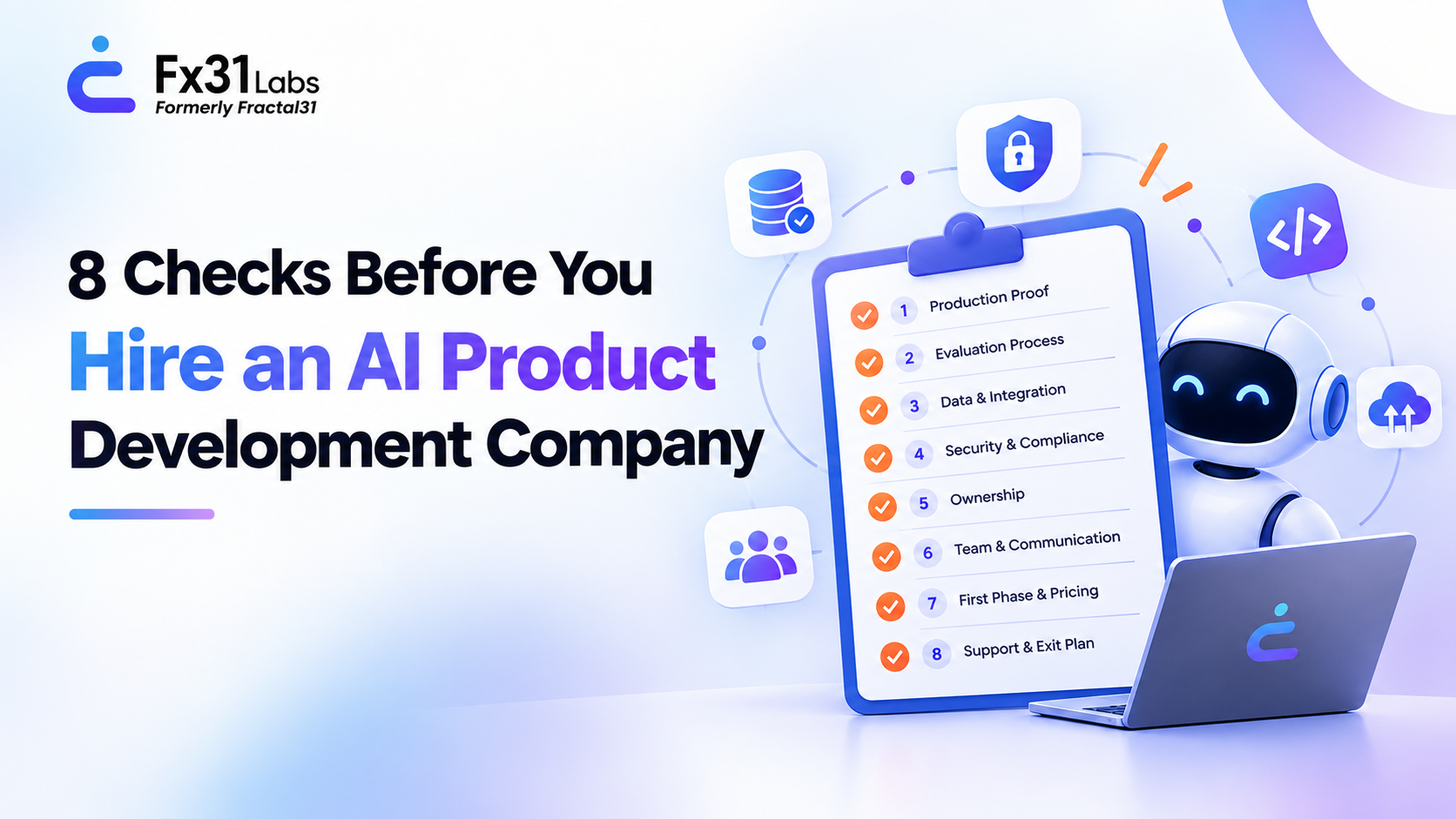
8 Checks Before You Hire an AI Product Development Company
Choose a partner that proves production results, tests AI quality, and protects your ownership. These eight checks help you assess vendors beyond polished demos.
1. Proof of AI Products Running in Production
Ask for two AI products used by real customers, not just demos. Check what failed after launch, how the team fixed it, and what results it achieved.
2. A Defined Discovery and Evaluation Process
Ask how the team tests AI outputs, measures accuracy, and sets release targets. Clear evaluation criteria help you judge product quality using evidence, not opinions.
3. Data Readiness and Integration Skills
Check how the team audits your data and connects systems such as CRMs and ERPs. Data quality, engineering, and access controls should be included from the start.
4. Security and Compliance Evidence for US and UK Rules
Ask for documented security controls, not general promises. UK GDPR transfers may require an IDTA or the UK Addendum, while HIPAA work may require a signed business associate agreement. Also review LLM security risks, including prompt injection and data leakage.
5. Clear Ownership of Code, Data, Prompts, and Models
Put ownership terms in the contract before work begins. Cover source code, prompts, evaluation sets, fine-tuned model weights, project data, and any vendor-owned components.
6. Team Seniority, Time-Zone Overlap, and Communication
Meet the engineers who will build your product and confirm their experience, working-hour overlap, and demo schedule. Ask how the team handles staff changes to maintain continuity.
7. A Scoped First Phase With a Fixed Price
Start with a paid discovery phase or proof of concept with clear deliverables and a fixed price. This lets you assess the team’s work before committing to a larger budget.
8. Post-Launch Support, Monitoring, and an Exit Plan
Confirm how the team monitors AI quality, performance, and running costs after launch. Agree on support SLAs, documentation, and handover terms, and review our guide to switching software development vendors.
Also Read: Build vs Buy AI Agents: What Enterprise Teams Should Decide First
Why Choose Fx31 Labs for AI Product Development?
Choosing the right development partner is easier when its experience, delivery approach, and technical capabilities match your product goals.
Fx31 Labs builds AI and software products for startups and mid-market teams, combining India-based engineering with a US office in Short Hills, New Jersey. Its work includes AI MVPs, production agents, and legacy code modernization.
The team supports businesses from early product development to production, with flexible engagement options that fit different roadmaps and budgets.
- Faster MVP launches: Fx31 Labs reports its rapid MVP approach can reduce launch time by up to 40%.
- Code modernization: Coderbotics AI uses 40+ specialized agents across 9+ languages to support code modernization and migration.
- Proven results: Its automated code refactoring platform achieved 70%+ precision and reduced refactoring time by 30% to 40%.
- Flexible engagement: Choose fixed-scope projects, dedicated teams, or AI engineers who work alongside your existing team.
Want to see how these capabilities fit your project?
Book a free consultation with our experts and discuss a practical roadmap for your next AI build.
Conclusion: Choose Your AI Partner With Confidence
Choosing the right AI partner comes down to proven results, clear costs, technical expertise, and ownership of the final product. Focus on what each team has delivered and how well its experience matches your business goals.
Start by shortlisting three suitable firms and comparing their approach, timelines, and AI product development cost. A paid discovery phase can help you validate the scope before committing to a larger build.
We hope this guide helps you compare AI development companies, understand their services, and choose a partner that fits your product needs and budget.
Ready to plan an AI MVP, add AI features, or modernize legacy code? Connect with our experts to scope your first phase and get a clear, staged estimate.
Frequently Asked Questions
1. How much does AI product development cost?
An MVP typically costs $20,000 to $70,000, while production builds range from $60,000 to $180,000. Monthly running costs can add $500 to $10,000.
2. How long does AI product development take?
Discovery takes 2-4 weeks, a proof of concept takes 3-8 weeks, and an MVP takes 8-14 weeks. Production builds usually take 3-6 months.
3. Who owns the code, data, prompts, and models?
Ownership depends on your contract. Clearly define your rights to source code, prompts, evaluation data, model weights, and project documentation.
4. Is fixed-price or time-and-materials development better?
Fixed pricing suits well-defined projects and MVPs. Time-and-materials or dedicated teams work better when requirements change frequently.
5. Is it safe to outsource AI development offshore?
Yes, with appropriate contracts, security controls, and access restrictions. GDPR and UK GDPR may require specific data-transfer safeguards, while HIPAA-regulated work may require a business associate agreement (BAA).
6. What should an AI proof of concept include?
It should test one use case using real data, measure results against agreed criteria, estimate running costs, and provide a clear go/no-go decision.
7. Which AI development companies work with startups?
Fx31 Labs, Upsilon, and Kodexo Labs support startup-focused AI MVP development. Miquido is another option for consumer apps. Compare pricing, expertise, and first-phase deliverables.
8. Can I change AI development partners mid-project?
Yes. Ensure your contract covers code, data, prompts, and documentation ownership, then plan a structured handover of access, open issues, and technical details.