
AI Coworker Development Cost Breakdown for Enterprise Teams
Most enterprises get it wrong the first time when it comes to AI-coworking. Their initial question is essentially “What does an AI-coworker cost?” instead of asking genuine questions like “What does it cost to run one at production scale, safely, and for a sustained period of time.”
AI coworker development cost typically forms $40,000 to $150,000 for a single-workflow AI coworker, and about $150,000 to $500,000+ for a multi-department, enterprise level deployment. Global costs when translated into INR comes to 1 Lakh Rupees to 6.5 Lakh Rupees for small scale agents, with mid-scale and enterprise level executions can range from anywhere around 12 Lakh Rupees to 1 Crore Indian Rupees. The final estimate comes down to depth of integration, readiness of data and security measures. It also depends on whether you build a custom, buy one off the shelf or use a hybrid approach.
The work range of an AI-coworker is vast. An AI coworker that drafts emails from a knowledge base is a different project than one that reads a claim, checks entitlements across three systems, and writes back to your core platform. Below, we progressively understand and breakdown enterprise teams and their needs before they start deciding their budget or hire a vendor.
What Is an AI Coworker, Exactly?
An AI coworker is not necessarily just a chatbot who operates limitedly on a website. It is a well-regulated system designed to complete a specific task or assigned piece of work. Tasks can be of different nature such as triaging tickets, reconciling invoices, drafting proposals, screening candidates etc. all this along with memory, tool access and permitting AI to act inside existing systems rather than just enquire about them.
That distinction is exactly why AI coworker development costs more than a simple chatbot integration. A chatbot answers. An AI coworker does work, which means it needs permissions, guardrails, monitoring, and a human-in-the-loop path for anything that matters.
What Factors Drive AI Coworker Development Cost?
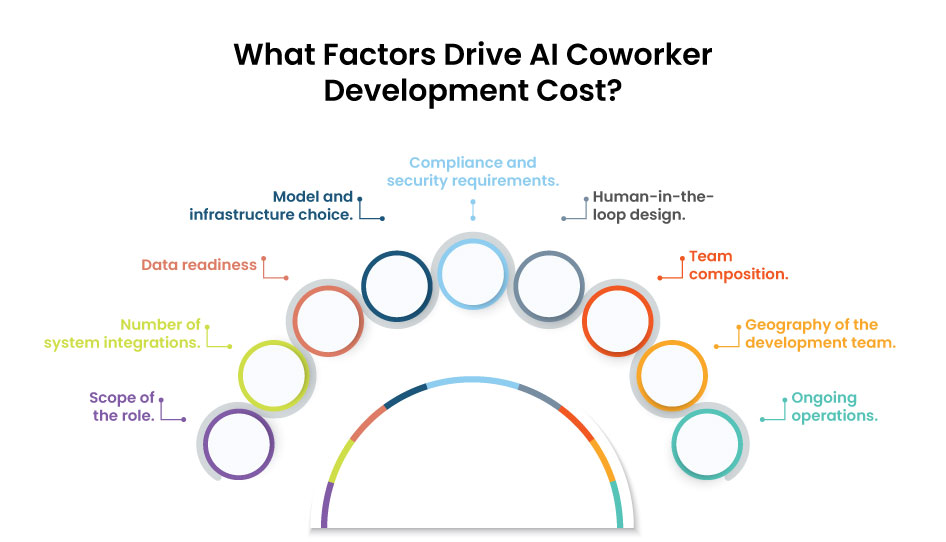
Before you can budget, you need to know what’s actually moving the number. Nine variables account for most of the variance enterprises see:
- Scope of the role. A single-task assistant vs. a coworker that owns an end-to-end process
- Number of system integrations. CRM, ERP, ticketing, identity, and legacy systems each add engineering time
- Data readiness. Clean, permissioned, well-labeled data costs far less to work with than fragmented data across five tools
- Model and infrastructure choice. A managed API vs. a fine-tuned or self-hosted model changes both build cost and ongoing spend
- Compliance and security requirements. Regulated industries (finance, healthcare, insurance) require audit logging, access controls, and evidence trails
- Human-in-the-loop design. Approval workflows and escalation paths add engineering but reduce risk
- Team composition. In-house team, freelancers, or a dedicated development partner all price differently
- Geography of the development team. Offshore and nearshore teams typically run 30–50% below onshore rates for comparable output
- Ongoing operations. Monitoring, retraining, and support are recurring, not one-time
AI Coworker Development Cost Breakdown by Project Tier
Here’s how enterprise budgets typically break down by project complexity.
| Project Tier | What It Looks Like | Typical Cost Range | Typical Timeline |
|---|---|---|---|
| Basic AI Coworker | Single workflow, one or two integrations, managed LLM API, minimal customization | $40,000 – $80,000 | 6–10 weeks |
| Mid-Complexity AI Coworker | Multi-step workflow, 3–5 system integrations, custom retrieval, human review step | $80,000 – $200,000 | 10–20 weeks |
| Enterprise-Grade AI Coworker | Cross-departmental workflow, deep ERP/CRM integration, compliance controls, custom orchestration | $200,000 – $500,000+ | 5–9 months |
| Multi-Agent Deployment | Several coworkers coordinating across functions with shared governance and monitoring | $500,000+ | 9+ months |
These figures reflect the AI agent development cost for the initial build. They don’t include the ongoing spend covered further down- and that’s where budgets most often get blindsided.
What’s Actually Included in the AI Employee Cost?
A number without a breakdown isn’t useful for a budget conversation. Here’s what a realistic AI employee cost is made up of.
| Cost Component | What It Covers | Rough Share of Budget |
| Discovery & process mapping | Workflow audit, requirements, success metrics, risk classification | 8–12% |
| Data preparation | Cleaning, labeling, access controls, connector setup | 12–18% |
| Application & orchestration engineering | Retrieval, tool use, workflow logic, interface design | 30–40% |
| Integration | CRM, ERP, ticketing, identity, legacy system connectors | 10–15% |
| Security, testing & compliance | Access review, audit logging, evaluation datasets, penetration testing | 8–12% |
| Deployment & change management | Rollout, training, documentation, adoption support | 5–8% |
| Model/API and cloud usage | Ongoing inference, hosting, and compute | Recurring, not one-time |
Notice that model or API usage, the thing most people assume dominates the bill is usually a smaller upfront line item. The real cost sits in the engineering around the model: data, integration, evaluation, and human review.
Build vs. Buy: How Much Does That Change the Number?
This is one of the biggest levers on enterprise AI coworker cost, and it’s worth deciding early rather than mid-project.
- Buying an off-the-shelf AI tool lowers upfront cost and speeds up time-to-value for standard, low-risk tasks. But subscription fees, integration work, and exit costs compound over time.
- Custom AI coworker development costs more upfront but fits your permissions, data, and exceptions; which matters most when the workflow is proprietary or the stakes are high.
- Hybrid approaches– buying the underlying model or platform and building the orchestration, integration, and controls around it are increasingly the default for enterprise teams, because they avoid paying full custom price for commodity capability.
We’ve broken down this decision in more depth in our guide on custom AI development versus off-the-shelf AI tools, including a framework for choosing between them by workflow risk and integration depth.
What Ongoing Costs Should Enterprises Budget For?
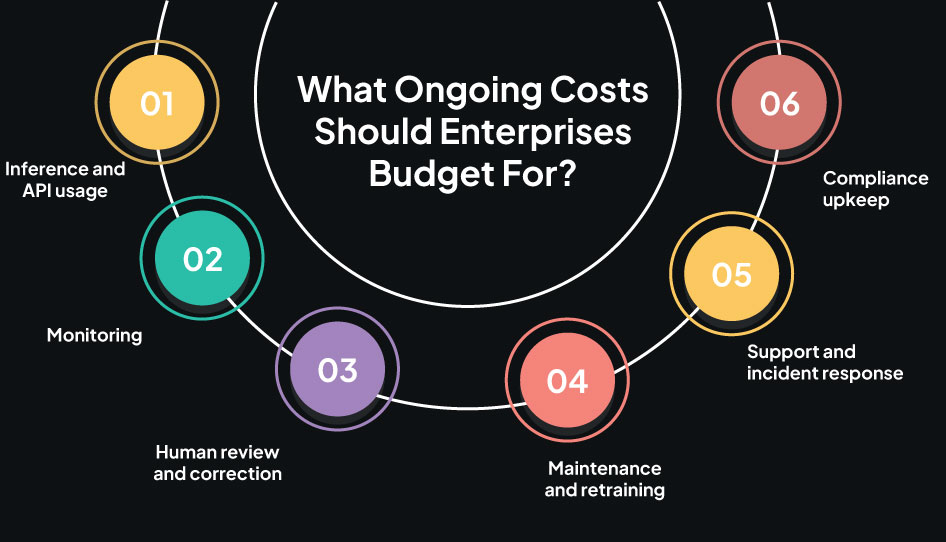
The build is a one-time cost. Running the coworker isn’t. This is the part of AI automation cost most budgets underestimate.
- Inference and API usage; costs scale with volume and can spike unexpectedly at production traffic
- Monitoring ; tracking quality, drift, latency, and cost in real time
- Human review and correction ; someone still needs to check outputs on judgment calls
- Maintenance and retraining ; models and business rules both change
- Support and incident response ; someone owns it when it breaks
- Compliance upkeep ; audit evidence and access reviews don’t stop after launch
A good rule of thumb: budget 15–25% of the initial build cost annually for operations and maintenance. For a deeper look at controlling the variable side of this, our piece on managing AI token consumption and inference costs walks through where usage costs quietly grow.
How Can Enterprises Control AI Coworker Development Cost Without Cutting Corners?
You don’t control cost by cutting scope randomly, you control it by sequencing the investment correctly.
- Start with one workflow, not five. A focused pilot proves value and de-risks the bigger build.
- Fix data problems before writing code. Data cleanup is cheaper before integration than after.
- Use a managed model instead of training your own. Custom orchestration on top of an existing model covers most enterprise needs.
- Design for human review from day one, not as an afterthought when something goes wrong.
- Choose a development partner with production experience, not just demo; experience the gap between the two is where most budgets blow up.
- Instrument the pilot so you have real usage and cost data before scaling company-wide.
If you’re weighing whether to build this internally or bring in outside expertise, our generative AI and machine learning services page outlines how a dedicated team typically slots into this kind of project, and our AI ROI framework is a useful next read for building the business case internally.
The Bottom Line
There’s no single number that answers “what does an AI coworker cost”, but there is a reliable way to estimate it: define the workflow tightly, price the real cost components (not just the model), and budget for operations as seriously as you budget for the build. Enterprises that treat AI coworker development cost as a one-time line item are the ones most likely to be surprised by year two.
If you’re scoping a pilot and want a realistic cost estimate for your specific workflow, Fx31 Labs can help map the requirements and give you a grounded number before you commit to a budget.
FAQ
Is AI coworker development cheaper than hiring a human employee?
It depends on the workload and the time horizon. Upfront development cost can exceed a year of salary for narrow use cases, but the ongoing operating cost; inference, monitoring, and maintenance is usually far lower than a full-time salary once the coworker is handling high volume, repetitive work at scale.
What’s the biggest hidden cost in AI coworker development?
Data preparation and integration, not the AI model itself. Enterprises often underestimate the work needed to connect clean, permissioned data to the coworker across CRM, ERP, and legacy systems.
Does AI agent development cost more than a simple chatbot?
Yes, generally. A chatbot answers questions. An AI coworker takes action inside your systems, which requires permissions, guardrails, testing, and human review all of which add engineering time and cost.
Can enterprises reduce AI automation cost after launch?
Yes. Optimizing model choice, caching repeated queries, right-sizing usage tiers, and reviewing which tasks actually need a large model versus a smaller one can meaningfully cut recurring inference costs.
How long does it take to see ROI on an AI coworker investment?
There’s no universal timeline. Narrow, well-scoped pilots with clean data can show measurable value in a few months. Enterprise-wide deployments with multiple integrations and compliance requirements typically take two to three quarters to show fully loaded ROI.