Top 15 AI Chatbot Development Companies in 2026
Key Takeaways: AI Chatbot Development Companies
- What they do: Build, integrate, and maintain AI chatbots for business needs.
- Top companies: 15 firms with different chatbot expertise and delivery models.
- Development cost: Ranges from $5,000 to $300,000+ based on complexity.
- What to compare: Experience, integrations, accuracy, security, and ongoing costs.
- Best approach: Start with a focused pilot before scaling.
Chatbots often look impressive in demos, but the real test begins when customers ask unexpected questions or need help with actual problems.
The right AI chatbot development company can turn a basic chatbot into a reliable business tool by connecting it to your data, CRM, and helpdesk.
With proper testing and generative AI and ML services, it can deliver accurate answers and handle real customer interactions.
The opportunity is growing fast. Gartner predicts that agentic AI will autonomously resolve 80% of common customer service issues by 2029. But the right results depend on the technology, integrations, and team behind the chatbot.
In this guide, you’ll learn:
- What an AI chatbot development company does
- 15 companies compared by expertise and capabilities
- Custom chatbots vs. ready-made platforms
- 8 key checks before hiring a development partner
- Chatbot development costs and ongoing expenses
By the end of this guide, you’ll have a practical shortlist, a clearer budget, and the right questions to ask before choosing an AI chatbot development company.
What Does an AI Chatbot Development Company Do?
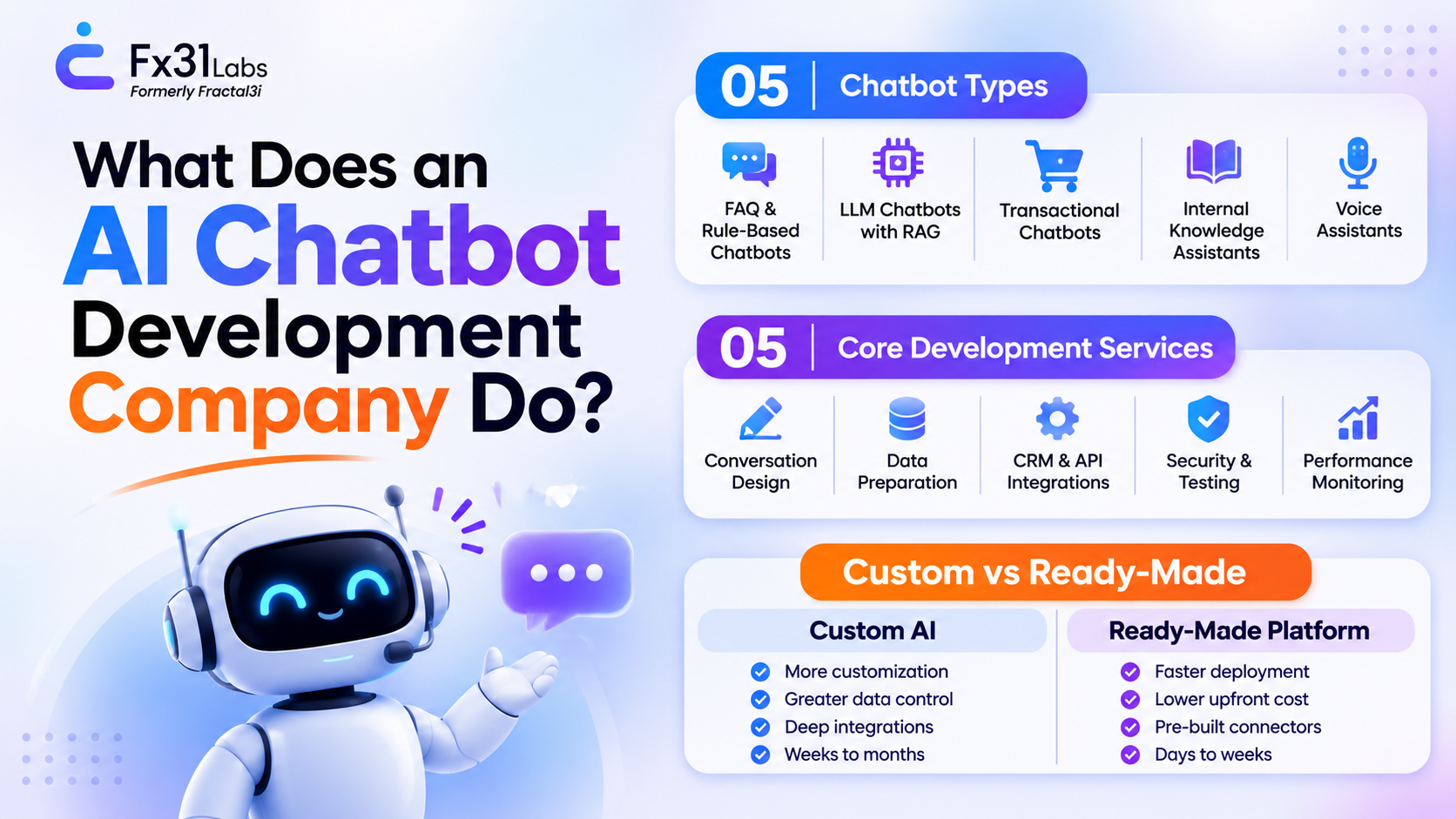
An AI chatbot development company builds and maintains chatbots for customers and employees. Fx31 Labs’ work includes conversation design, data and system integrations, testing, and ongoing improvements.
Good AI chatbot development services also cover data preparation, security, and performance monitoring. These areas determine whether AI chatbots for customer support deliver reliable answers. You may also see the term “conversational AI development company” for a similar service provider.
Which Types of AI Chatbots Can a Development Company Build?
Most chatbot projects fall into five categories, each serving a different business need. Understanding them helps you define requirements and compare any AI chatbot development company on your shortlist.
| Chatbot type | How it works | Common use |
| FAQ or rule-based bot | Follows scripted flows and keyword rules | Opening hours, order status, simple forms |
| LLM chatbot with RAG | Retrieves information from documents before generating answers | Customer support and product questions |
| Transactional chatbot | Reads and updates CRM, booking, or order systems | Returns, bookings, account updates |
| Internal knowledge assistant | Answers staff questions using policies and manuals | HR, IT help desk, operations |
| Voice assistant | Handles spoken conversations by phone or smart speaker | Call deflection and appointment lines |
Some chatbots can also complete tasks instead of only answering questions. Before planning one, understand how AI agents differ from AI chatbots.
Custom AI Chatbot or Ready-Made Platform: Which Do You Need?
You can build a chatbot around your business or configure an existing platform. Custom development offers more control, while ready-made platforms launch faster. Your choice depends on your workflows, budget, and integration needs.
| Factor | Custom AI chatbot | Ready-made platform |
| Best when | Workflows are unique, or accuracy is critical | The use case is standard and speed matters |
| Cost model | Higher upfront build, lower license fees | Lower upfront, ongoing subscription or per-message fees |
| Data and control | You own the code, prompts, and hosting choices | The vendor controls the roadmap and hosting options |
| Integration depth | Built around your systems | Limited to available connectors |
| Time to launch | Weeks to months | Days to weeks |
Custom AI chatbot development suits businesses that need specific workflows, private data access, or strict compliance. It costs more upfront but gives you greater control over features, integrations, and model choices.
Platforms such as Yellow.ai, Kore.ai, and Botpress can launch standard support bots faster. However, recurring fees and platform limitations may reduce long-term flexibility. This list focuses on development partners rather than ready-made platforms.
Some businesses combine both approaches, using a platform for the chat interface and custom integrations for business workflows. A good AI chatbot development company can help you decide which mix fits your workflows. Read custom AI development vs off-the-shelf AI for a closer comparison.
Also Read: Build vs Buy AI Agents: What Enterprise Teams Should Decide First
Top 15 AI Chatbot Development Companies for US and UK Buyers
Compare each AI chatbot development company by its location, chatbot expertise, and ideal project fit before exploring the detailed profiles.
| Company | Base and US/UK presence | Chatbot strength | Best for |
| Fx31 Labs | Short Hills, New Jersey, US, and Ahmedabad, India | LLM chatbots, knowledge assistants, on-demand AI engineers | Scoped chatbot projects for mid-market teams |
| Master of Code Global | Redwood City, US; Winnipeg and Toronto, Canada; teams in Poland and Ukraine | Chat, voice, and RCS messaging | Consumer brands across multiple channels |
| BotsCrew | San Francisco and Austin, US, with engineering in Lviv, Ukraine | Model-agnostic enterprise chatbots | Customer service automation |
| BlueLabel | New York, San Francisco, and Seattle, US | Agentic AI, RAG, and conversational AI | Consulting-led AI programs |
| LeewayHertz | US-based, part of The Hackett Group | Chatbots, multi-agent systems, and ZBrain | Enterprises needing AI platforms and services |
| Kodexo Labs | Austin, US, with a London presence | RAG chatbots and LLM applications | Funded startups and scale-ups |
| HatchWorks AI | Atlanta, Chicago, and Dallas, US, with Latin American teams | AI assistants built on enterprise data | Nearshore AI teams in US time zones |
| Markovate | Toronto, Canada | Support, transactional, and voice chatbots | Rapid proofs of concept |
| Biz4Group | Orlando, US | Generative AI chatbots and voice assistants | Healthcare and service businesses |
| STX Next | Poznań, Poland, with offices in London, Houston, and other locations | AI chatbots and enterprise system integrations | Complex system integration |
| Geniusee | Austin, US; Warsaw, Stockholm, and Kyiv | Chatbots for fintech and edtech products | Product-led chatbot development |
| Edvantis | Berlin, New York, Rzeszów, and Lviv | Chatbots and knowledge base tools | Additional engineering support and AI pilots |
| Merixstudio | Poznań, Poland, serving US clients | RAG knowledge assistants and AI copilots | Knowledge-based chatbots for digital products |
| AnyforSoft | Latvia, with a US sales office in Sarasota, Florida | Rule-based and NLP chatbots | Education and e-learning providers |
| Blackthorn Vision | Lviv, Ukraine, serving US and European clients | GPT-based chatbots using Azure and .NET | Microsoft technology stack projects |
Let’s look at each company in detail.
1. Fx31 Labs
Fx31 Labs builds LLM chatbots and internal knowledge assistants that help businesses get reliable answers from their own documents and systems. Its work focuses on practical AI solutions that fit existing workflows, from initial chatbot projects to dedicated AI engineering support.
One example is its plant assistant for a multi-site manufacturer. Factory employees can ask questions about equipment, safety, and operating procedures in plain language and get answers from company documentation. The published results include shorter training time and faster troubleshooting.
The team also built an in-house HRMS in five weeks using generative AI and a two-person team. Through Coderbotics AI, Fx31 Labs offers a platform of 40+ specialized agents, including a codebase chat agent. Businesses can engage the team through scoped projects, dedicated teams, or AI engineer augmentation.
Key Highlights:
- Chatbot Capabilities: LLM chatbots, RAG, internal knowledge assistants, and AI agents.
- Manufacturing Use Case: A plant assistant that helps employees find information on equipment, safety, and procedures.
- GenAI Development: An HRMS portal delivered in five weeks by a two-person team.
- AI Agent Platform: Coderbotics AI includes 40+ specialized agents and a codebase chat agent.
- Engagement and Pricing: Project-based delivery, dedicated teams, and AI engineer augmentation. Pricing is provided through a scoped estimate rather than a published rate card.
Best for: Mid-market businesses and AI-product founders planning a first chatbot, internal knowledge assistant, or custom AI solution.
2. Master of Code Global
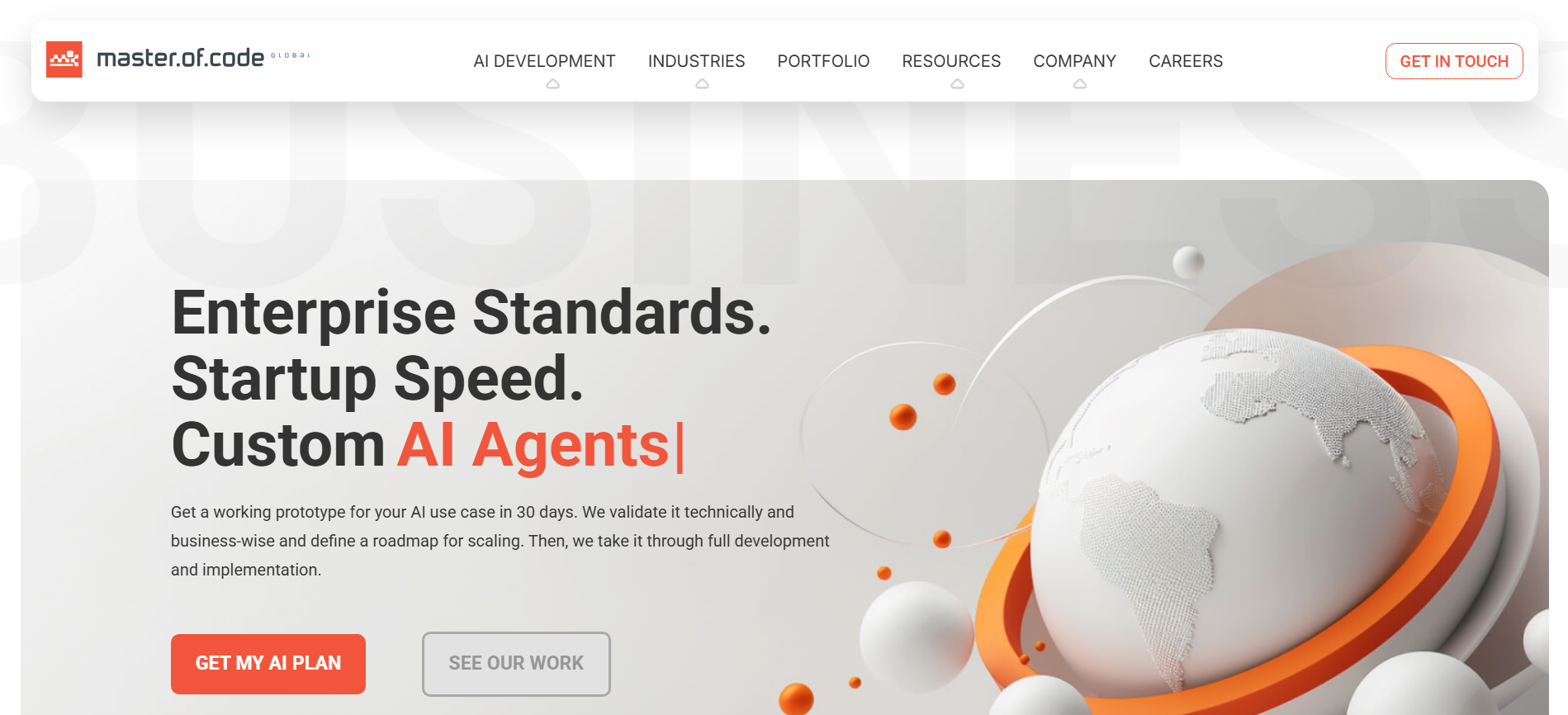
Master of Code Global brings 20 years of software experience, including a decade focused on conversational AI. Its team builds chatbots, voice assistants, and RCS messaging solutions, helping consumer brands create consistent conversations across customer touchpoints.
Key Highlights:
- Conversation Design: Treats dialogue design as a dedicated discipline alongside chatbot and voice engineering.
- 30-Day Pilot: Offers a fixed-budget, fixed-timeline pilot with a working proof of value.
- Security: Holds ISO 27001 certification and displays Google Cloud, AWS, and Salesforce partner badges.
Best for: Consumer brands looking to bring chat, voice, and messaging together through conversational AI.
3. BotsCrew
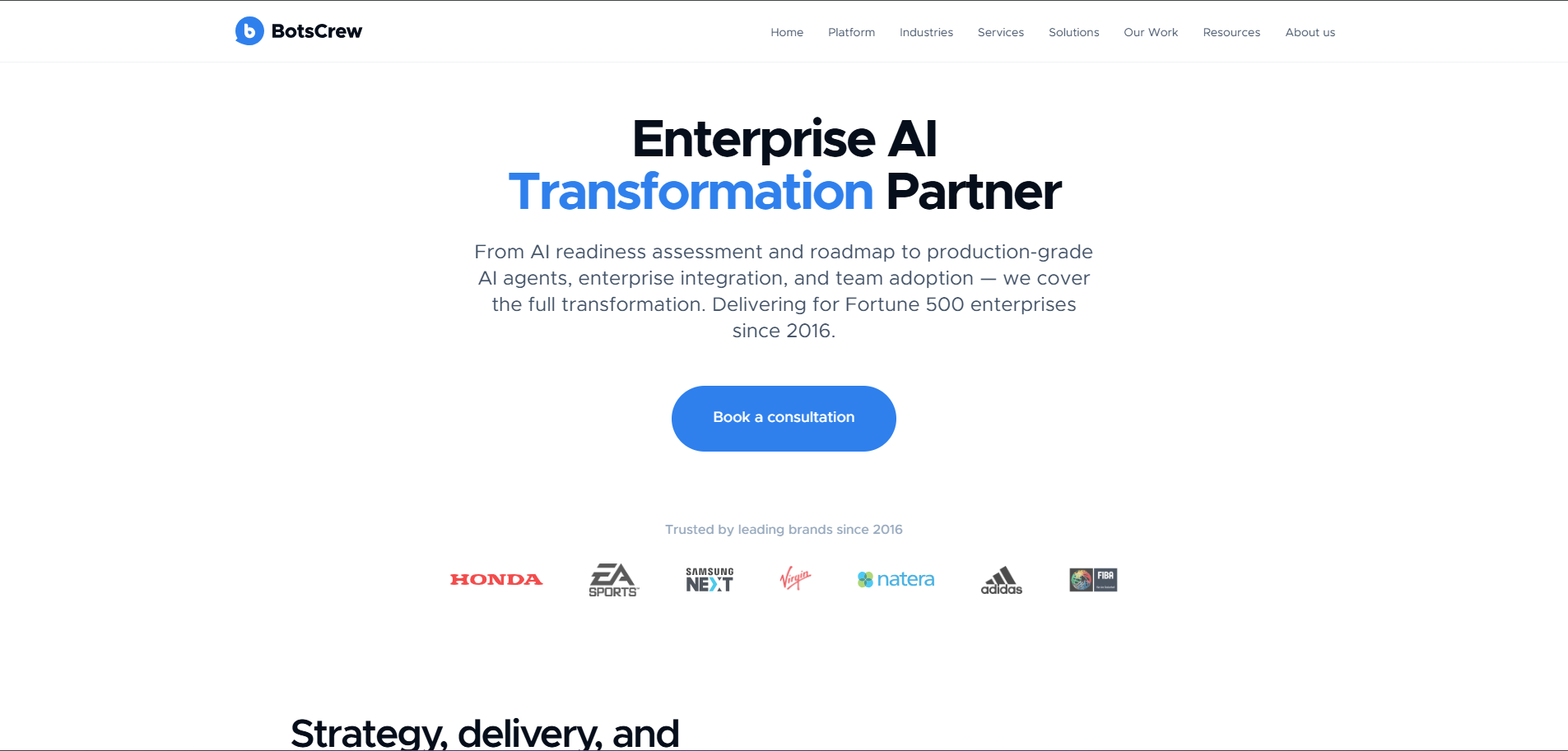
With more than a decade of chatbot experience, BotsCrew has a strong track record of building AI-powered customer interactions. Its teams work across leading and open-weight models, giving businesses flexibility when choosing the technology behind their chatbot. Published projects for brands such as Choose Chicago, Honda Australia, and S&B Filters add practical proof to its experience.
Key Highlights:
- Model Flexibility: Works with Claude, GPT, Llama, and open-weight models instead of relying on one provider.
- Client Experience: Published chatbot projects include Choose Chicago, Honda Australia, and S&B Filters.
- Compliance: Holds ISO 27001 certification and states that its delivery supports HIPAA and GDPR requirements.
Best for: Enterprises that need experienced chatbot development with flexibility over their underlying AI models.
4. BlueLabel
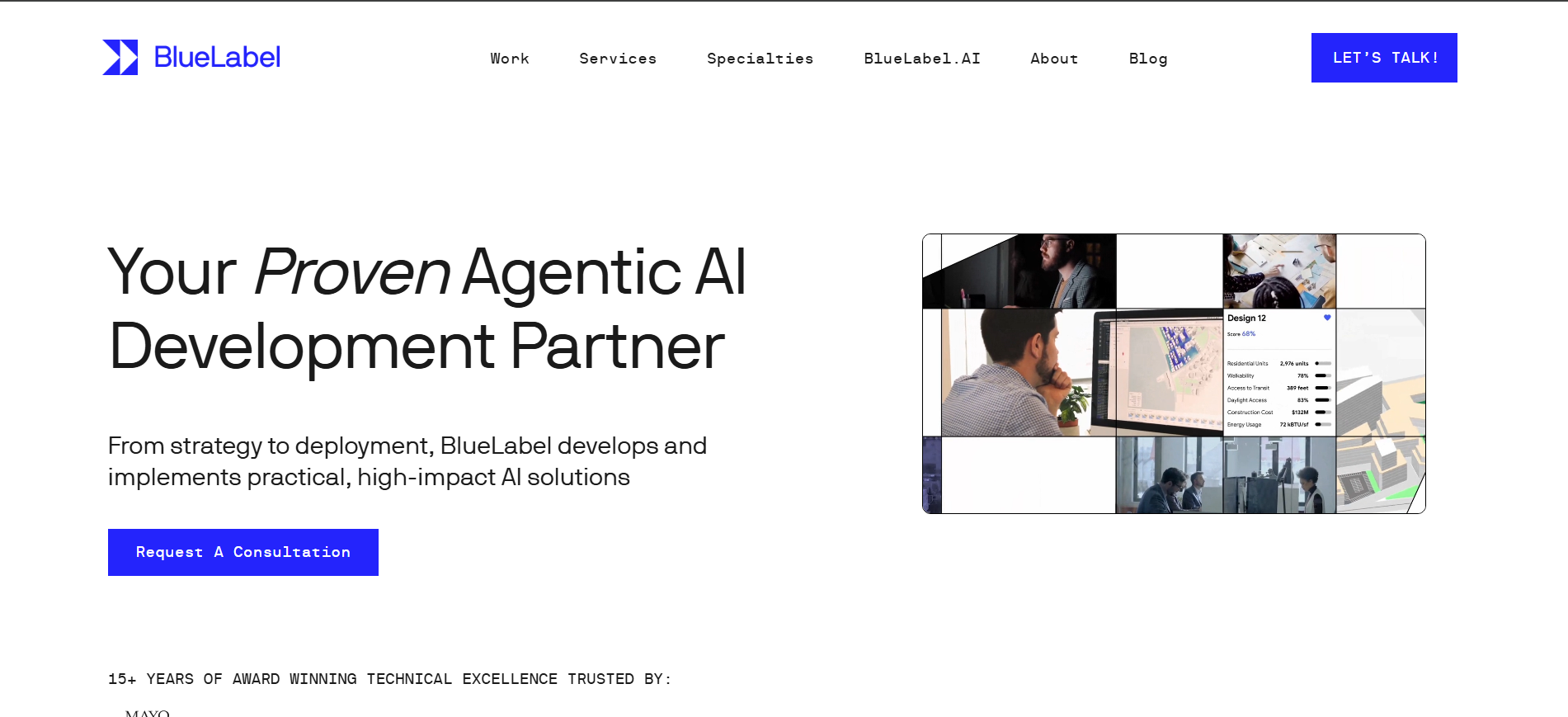
BlueLabel combines more than 15 years of product experience with a strategy-led approach to AI development. Its work includes projects for established organizations such as Mayo Clinic and Koch, giving buyers a view of its experience with larger business requirements. The agency focuses on shaping the right AI approach before moving into development.
Key Highlights:
- Delivery Record: Reports more than 300 solutions deployed by a team of 75+ people.
- Strategy First: Helps define AI opportunities and workflows before starting implementation.
- Agentic AI: Develops AI agent workflows and retrieval-based solutions for more advanced business needs.
Best for: Large organizations that need help defining an AI roadmap before committing to development.
5. LeewayHertz
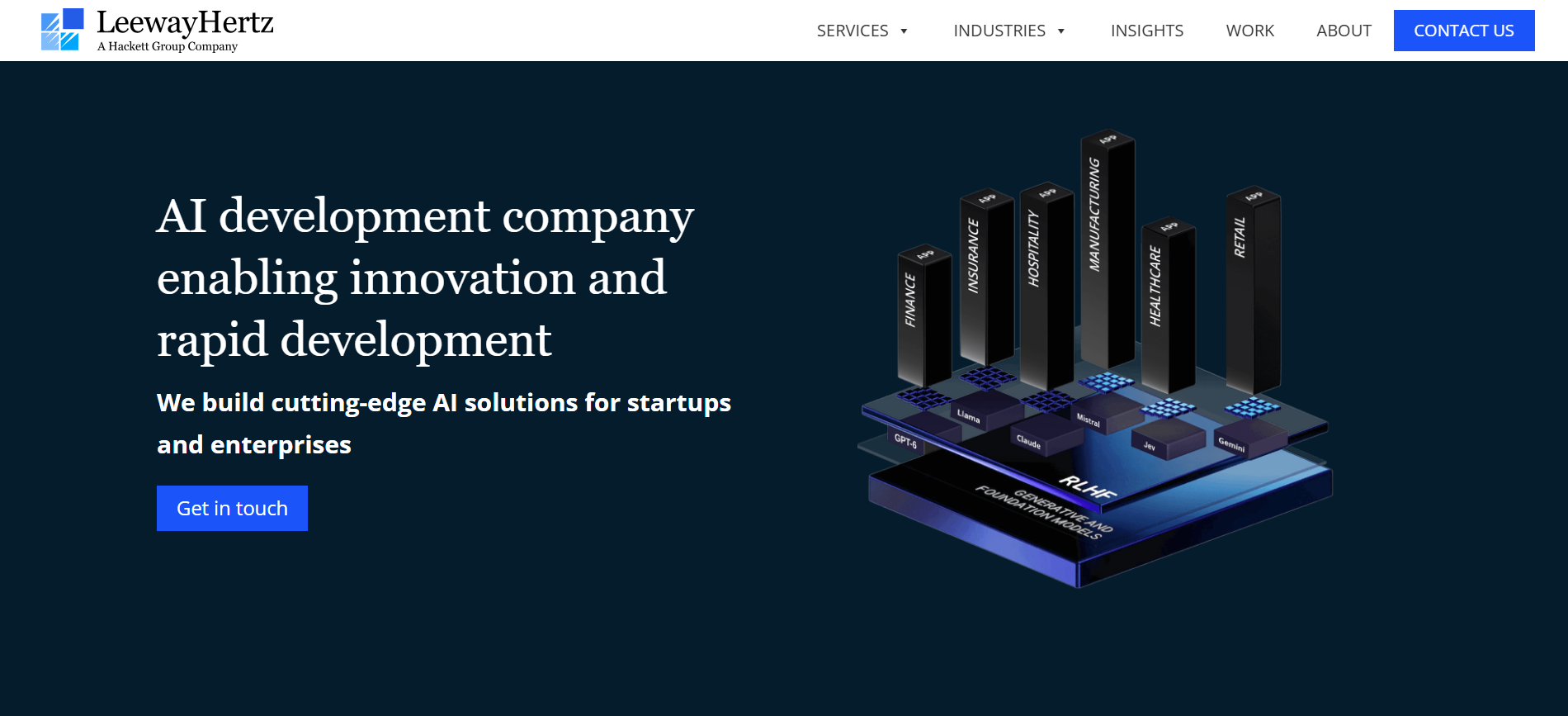
LeewayHertz brings enterprise consulting experience through its association with The Hackett Group. Alongside custom development, it offers ZBrain, a platform designed to help businesses build and manage AI-powered workflows. This gives organizations the option to start with a platform and extend it through tailored engineering.
Key Highlights:
- Agent Frameworks: Builds AI systems using frameworks such as CrewAI and AutoGen.
- Platform Flexibility: ZBrain supports Azure AI Foundry, AWS Bedrock, and Google Vertex AI.
- Client Project: Its portfolio includes an LLM-powered compliance application developed for Scrut.
Best for: Enterprises that want a combination of AI platform capabilities and custom engineering support.
6. Kodexo Labs
Kodexo Labs combines an AI-focused engineering team with experience across several leading model providers. Its work covers retrieval-based applications, document-driven answers, and custom AI products. Projects such as Teacher AI and a search solution for Diesel Laptops show how it applies these capabilities to practical business use cases.
Key Highlights:
- Technology Stack: Works with OpenAI, Anthropic, Gemini, and Llama models.
- Security Standards: Lists SOC 2, HIPAA, GDPR, and ISO 27001 among its deployment standards.
- Engagement Options: Offers project-based development, dedicated teams, and staff augmentation.
Best for: Startups and growing product companies that need flexible AI engineering with established security practices.
7. HatchWorks AI
HatchWorks AI has built its development approach around Generative-Driven Development, combining experienced engineers with AI-assisted workflows. Its work for Cox includes a chat assistant delivered as part of a broader AI program. The company also offers forward-deployed engineers and specialist teams for organizations moving from AI pilots to larger implementations.
Key Highlights:
- GenDD Method: Uses its Generative-Driven Development process, with senior practitioners guiding AI agents through quality checks.
- Enterprise Project: Built a chat assistant for Cox as part of a wider AI initiative.
- Security and Delivery: Has completed a SOC 2 examination and offers forward-deployed engineers and agentic AI pods.
Best for: Enterprises that want structured AI development with experienced engineers involved throughout delivery.
8. Markovate
Markovate offers chatbot development with a focus on connecting conversational experiences to business systems. Its projects include a legal research assistant for LegalAlly and workload automation for NVMS. The company also outlines a relatively short delivery cycle, with proofs of concept taking two to three weeks and typical builds taking six to twelve weeks.
Key Highlights:
- System Integrations: Connects chatbot solutions with CRM and ERP platforms.
- User Experience: Supports omnichannel and multilingual experiences for different customer needs.
- Published Projects: Its portfolio includes LegalAlly’s legal research assistant and workload automation for NVMS.
Best for: Businesses that want to validate a chatbot idea quickly and connect it with existing systems.
9. Biz4Group
Biz4Group brings a sizable AI team and a broad chatbot portfolio, covering generative AI, voice assistants, and multilingual experiences. Its healthcare projects include a veteran support assistant and CogniHelp, a dementia care app. It also publishes project pricing, giving businesses an early reference point when planning their budget.
Key Highlights:
- RAG Technology: Uses Pinecone, Weaviate, and FAISS to ground chatbot responses in business data.
- Healthcare Projects: Built solutions including a veteran support assistant and CogniHelp.
- Published Pricing: Lists custom chatbot projects from $20,000 to $200,000+.
Best for: Healthcare and service businesses that want clear pricing expectations before starting development.
10. STX Next
STX Next brings Python engineering experience to chatbot projects that depend on reliable business system connections. Its solutions can link conversations with platforms such as Salesforce and ServiceNow, while supporting workflows like order management. The focus is on making chatbots useful across existing operations, not just adding another chat window.
Key Highlights:
- Smart Escalation: Uses customer sentiment to route conversations to human agents.
- Security Credentials: Reports SOC 2 Type II compliance and AWS Advanced Tier partner status.
- Implementation Plan: Quotes a 9–12 week timeline with a phased rollout.
Best for: Enterprises that need chatbots to coordinate workflows across multiple business platforms.
11. Geniusee
Geniusee develops chatbots as part of broader digital products, particularly in fintech, edtech, retail, and real estate. Its team supports the full development cycle, from architecture and integration to testing and maintenance. This makes it a practical option when conversational AI needs to work as one feature within a larger application.
Key Highlights:
- Multi-Channel Deployment: Builds chatbot experiences for websites, social platforms, and mobile apps.
- End-to-End Support: Covers architecture, development, testing, integration, and maintenance.
- Flexible Engagement: Offers dedicated teams, time-and-material contracts, and outstaffing.
Best for: Product companies adding conversational features to an app or platform under development.
12. Edvantis
Edvantis combines software engineering with a dedicated AI practice that develops chatbots, summarization tools, and knowledge base solutions. Its published work includes a chatbot proof of concept for a Lithuanian public-sector client. The company also brings experience serving established technology businesses such as BigCommerce and Indeed.
Key Highlights:
- Quality Standards: Holds ISO 27001 and ISO 9001 certifications.
- Flexible Teams: Supports fixed-price projects, dedicated teams, and staff augmentation.
- Client Experience: Its software client list includes BigCommerce and Indeed.
Best for: Businesses that need additional engineering capacity alongside an AI proof of concept.
13. Merixstudio
Merixstudio brings more than 25 years of software development experience to AI-powered digital products. Its work focuses on RAG-based knowledge assistants, copilots, and enterprise search that help users find information across internal systems. The team can also add conversational AI to existing web and mobile products.
Key Highlights:
- Knowledge Retrieval: Builds assistants that answer questions using internal documents and data.
- Certified Processes: Holds ISO 27001 and ISO 9001 certifications audited by TÜV NORD.
- Product Integration: Adds AI capabilities to existing applications as well as new products.
Best for: Businesses that want a knowledge assistant embedded in an existing digital product.
14. AnyforSoft
AnyforSoft has more than 12 years of delivery experience, with a strong focus on education and e-learning. Its chatbot solutions support student and applicant interactions, from basic scripted conversations to multilingual NLP experiences. Published clients include High Pass Education and Delaware County Community College.
Key Highlights:
- Education Experience: Works with education providers such as High Pass Education and Delaware County Community College.
- Platform Connections: Integrates chatbots with websites, messaging apps, mobile apps, and e-commerce platforms.
- Delivery Timelines: Estimates two to four weeks for basic bots, with complex projects taking several months.
Best for: Education providers building chatbot support for students, applicants, and learning platforms.
15. Blackthorn Vision
Blackthorn Vision combines AI development with .NET engineering for businesses that need chatbots inside established software environments. Its work covers GPT-based assistants, retrieval-based answers, and omnichannel experiences. Client testimonials from Berkeley Lights and Sensia offer a glimpse into its enterprise project experience.
Key Highlights:
- Azure Experience: Reports completing 50 Azure projects.
- Client References: Features testimonials from Berkeley Lights and Sensia.
- Full-Cycle Delivery: Supports consulting, design, development, integration, and ongoing maintenance.
Best for: Businesses using .NET and Azure that need AI chatbots integrated into existing enterprise applications.
Also Read: Top 15 Generative AI Integration Companies for US and UK Buyers
Now that you’ve met the companies worth shortlisting, let’s look at how to choose the right AI chatbot development partner for your business.
How Do You Choose the Right AI Chatbot Development Company?
Use these eight checks to compare shortlisted vendors. Ask each AI chatbot development company the same questions so you can judge its experience, technical skills, and long-term support.
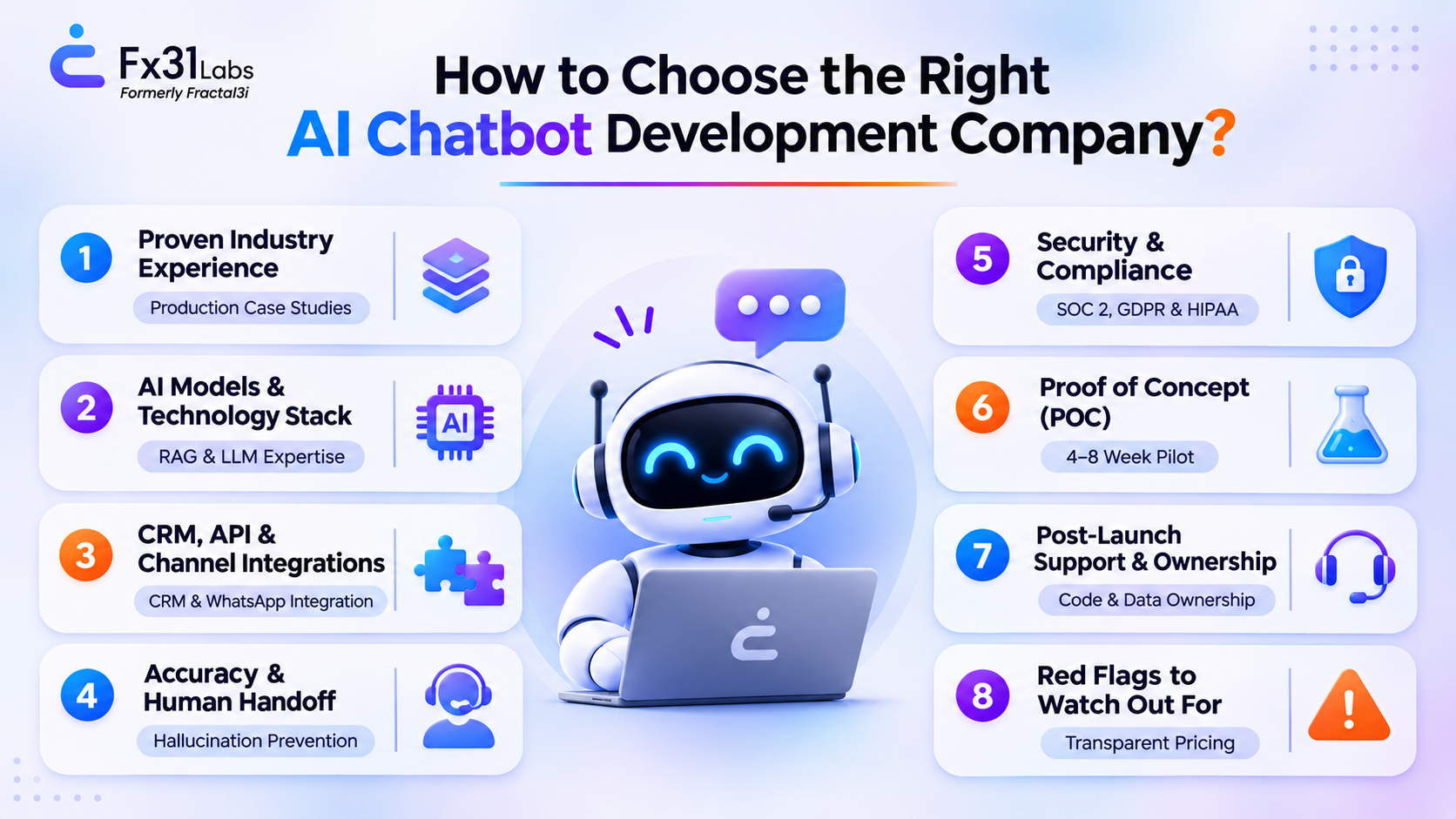
1. Have They Launched Chatbots Like Yours in Production?
Demos are easy to build, so ask each AI chatbot development company for chatbots that real customers use today. You want case studies from your industry that show the problem, the systems involved, and the measured result. Then ask to speak with one of those clients before you sign.
2. Which AI Models and Tech Stack Do They Build On?
Ask which models and frameworks they use, and how they ground answers in your business data. Understand when they recommend RAG over fine-tuning. Make sure you can switch models without rebuilding the chatbot.
3. Can They Integrate the Chatbot With Your CRM, Helpdesk, and Channels?
Check whether the team has connected chatbots to CRM, helpdesk, and order management systems like yours. Confirm support for the channels your customers use, including websites, WhatsApp, and voice. Strong chatbot integration services should fit your existing workflows.
4. How Do They Prevent Wrong Answers and Hand Off to a Human?
Ask how they test answers against real customer questions and prevent unsupported responses. Check their safeguards against LLM security risks such as prompt injection. The chatbot should also transfer complex conversations to staff with the full context.
5. What Security and Compliance Proof Can They Show?
Ask for a SOC 2 report, a GDPR and UK GDPR data processing agreement, and a business associate agreement if HIPAA applies. Also check how the vendor handles the EU AI Act’s transparency requirements, including telling users when they are interacting with AI.
6. Will They Start With a Proof of Concept or Pilot?
Start with one use case and agree on measurable success criteria before development. A four-to-eight-week pilot can test response quality, integrations, and business value. Scale only when the results support a larger rollout.
7. What Support Do You Get After Launch, and Who Owns the Chatbot?
Ask who monitors responses, updates knowledge sources, and improves prompts after launch. Confirm that your contract gives you ownership of the code, prompts, and conversation data. It should also include a clear handover process if you change vendors.
8. Which Red Flags Should Make You Walk Away?
Be cautious of guaranteed perfect accuracy, unclear development teams, or quotes given without reviewing your data and requirements. No testing plan, vague project scope, and hidden running costs are also warning signs. These gaps can lead to poor results and unexpected expenses.
Now that you know how to evaluate an AI chatbot development company, let’s look at the cost of building and running an AI chatbot.
What Does AI Chatbot Development Cost to Build and Run?
AI chatbot development cost typically ranges from $5,000 to $300,000+, depending on complexity, integrations, and scale. Here are the common build costs, timelines, and monthly expenses based on published market ranges, not Fx31 Labs pricing.
What Does an AI Chatbot Cost to Build by Type?
The more intelligence and integrations a chatbot needs, the higher the build cost. A basic FAQ bot costs less, while custom AI chatbot development with RAG, business integrations, and multiple channels requires a larger budget.
| Chatbot type | Typical build cost | Typical timeline | What you get |
| FAQ or rule-based bot | $5,000 to $15,000 | 2 to 4 weeks | Scripted answers and simple flows |
| LLM chatbot pilot or MVP | $15,000 to $40,000 | 4 to 8 weeks | Answers from your documents on one channel |
| Custom chatbot with integrations | $40,000 to $100,000 | 2 to 6 months | RAG, CRM or helpdesk actions, and analytics |
| Enterprise chatbot platform | $100,000 to $300,000+ | 6+ months | Several languages, channels, and security reviews |
Most mid-market businesses start with a $15,000 to $40,000 pilot or MVP. It tests the use case before you commit to a larger build, while the next investment depends on results and integration needs.
What Does It Cost to Run a Chatbot Each Month After Launch?
Development is only the upfront expense. Model usage, hosting, maintenance, and ongoing improvements add to the total cost, so ask every AI chatbot development company for a monthly estimate before signing.
| Cost line | Typical market range | What drives it |
| Model usage | Billed per token, so it scales with traffic | Conversations a month, answer length, and model tier |
| Hosting and infrastructure | $200 to $500 a month at low volume, $800 to $3,000 at high volume | Traffic, uptime needs, and private deployment |
| Maintenance and tuning | $7,500 to $10,000 a year on a $50,000 build | Content updates, prompt tuning, and bug fixes |
| Total run cost | About $200 to $10,000 a month | Volume and complexity |
Model usage can become a major expense as conversations grow. Use AI token consumption and cost control to understand what affects usage and how to keep spending predictable.
Which Factors Change the Price the Most?
Two vendors can quote very different prices for the same chatbot because scope, technology, and delivery rates vary. These five factors have the biggest impact on your final budget:
- Integrations: Connecting CRM, helpdesk, ERP, and other systems adds development and testing work.
- Channels and languages: A website chatbot costs less than a solution covering web, WhatsApp, and voice in multiple languages.
- Accuracy testing: High-risk use cases need more evaluation, validation, and ongoing monitoring.
- Compliance: HIPAA, GDPR, and SOC 2 requirements add security reviews and documentation.
- Team rates: Published hourly rates for firms in this market range from about $25 to $149.
Also Read: How Much Does It Cost to Build an AI Agent?
Why Consider Fx31 Labs for AI Chatbot Development?
A reliable chatbot needs more than a good model. It needs accurate business data, the right integrations, and a clear plan for launch and ongoing costs.
At Fx31Labs, we build custom AI chatbots tailored to your workflows, data, and business goals.
The team combines India-based engineering with a US office in New Jersey. Founder Dr. Nilesh Modi holds a Ph.D. from the University of California and has held R&D roles at Intel and IBM. Its work includes a GenAI-assisted HRMS built in five weeks by a two-person team.
Why choose us:
- Grounded AI Solutions: Starts with your documents, data quality, and access rules to build reliable chatbot responses.
- Faster MVP Development: Its rapid MVP approach reports launch times up to 40% faster.
- Clear Cost Estimates: Scopes the initial build alongside expected monthly usage and running costs.
- Flexible Engineering: Offers defined projects, dedicated teams, and AI engineer augmentation.
Ready to plan your chatbot?
Book a free consultation to discuss your requirements, integrations, expected costs, and delivery timeline.
Conclusion: Choose an AI Chatbot Development Company That Delivers
Choosing the right AI chatbot development company comes down to proven results, reliable integrations, answer accuracy, and clear costs. Look beyond polished demos and focus on what the team has delivered in production.
Shortlist two or three companies that match your use case. Ask each the same questions, verify client results, and compare quotes for the same scope, including monthly running costs.
Start with one focused pilot, set measurable goals, and keep ownership of your code, data, and accounts. This helps you test the chatbot before investing in a larger rollout.
We hope this guide helps you compare development partners, understand AI chatbot development costs, and choose the right fit for your business.
Have an AI chatbot use case in mind? Connect with our experts and discuss your requirements, integrations, budget, and timeline.
Frequently Asked Questions
1. Which AI chatbot development company is best for my business?
Choose a company with relevant case studies, strong integration skills, reliable testing, and clear pricing. Compare its experience against your use case and budget.
2. What budget do we need to hire an AI chatbot development company?
Basic FAQ bots cost $5,000 to $15,000, while custom LLM chatbots range from $15,000 to $100,000. Enterprise platforms can exceed $300,000, excluding ongoing usage and maintenance.
3. How long does a custom AI chatbot take to build?
A chatbot pilot usually takes 4 to 8 weeks. Custom integrations can take 2 to 6 months, while complex enterprise projects may take over 6 months.
4. Can an AI chatbot integrate with CRM, ERP, and helpdesk software?
Yes. Custom chatbots can connect to platforms such as Salesforce and ServiceNow through APIs. Existing connectors, custom development, and testing affect the cost and timeline.
5. What is the difference between an AI chatbot and an AI agent?
An AI chatbot answers questions and guides conversations. An AI agent can also perform multi-step tasks, such as updating records or processing refunds through connected systems.
6. Are AI chatbots secure enough for healthcare and financial services?
Yes, with proper safeguards such as encryption, access controls, audit logs, and compliance documentation. Healthcare projects may also require HIPAA agreements, while GDPR and UK GDPR rules apply to relevant data.
7. Why hire an AI chatbot development company instead of building in-house?
A specialist brings experience in chatbot design, integrations, testing, and security. In-house development may be better if you already have skilled AI engineers and plans for multiple AI products.
8. What should we prepare before hiring an AI chatbot development company?
Define the use case, expected questions, success metrics, required integrations, and security needs. Prepare relevant documents and system access so vendors can estimate the same project scope.