
Forward Deployed Engineer: What the Role Is and When Your AI Project Needs One
Key Takeaways: Forward Deployed Engineers at a Glance
- What they do: Build and deploy solutions inside real business systems, taking AI projects beyond demos.
- Why they matter: They connect AI with business data, existing tools, and everyday workflows.
- When you need one: When pilots stall, integrations get complex, or security and compliance slow production.
- How to source one: Hire in-house, use a vendor team, work with a development partner, or choose staff augmentation or a dedicated AI team.
- How to start: Run a 4- to 8-week pilot with one workflow, clear success metrics, agreed access, and a defined handoff.
Most enterprise AI projects don’t fail at the demo. They stall when the model has to work with real data, existing systems, and everyday business workflows.
A forward deployed engineer (FDE) works alongside business and engineering teams to close that gap and move AI projects from pilot to production, including generative AI that delivers measurable results.
This gap remains common across organizations. According to McKinsey’s 2026 State of AI survey, only 44% of respondents said AI is scaling across their enterprise. Many businesses are still experimenting or running pilots that haven’t reached production.
So, when does an AI project actually need a forward deployed engineer? It depends on how closely the solution must work with your existing systems, data, and business processes.
Understanding that distinction can help you decide whether to hire one, bring in an external team, or use a different approach.
In this guide, you’ll learn:
- What a forward deployed engineer does and how the role differs from other engineering positions
- 10 signs your AI project may need an FDE
- 5 ways to source one, including costs and trade-offs
- The essential skills, responsibilities, and risks to consider
- How to start with a focused AI pilot and measure its results
By the end of this guide, you’ll be able to assess whether this role fits your AI roadmap, choose a suitable sourcing model, and plan a practical path to production.
What Is a Forward Deployed Engineer?
A forward deployed engineer (FDE) works directly with a customer’s team to build and implement software within its existing systems. Unlike advisors who recommend solutions, an FDE helps make them work in production.
The term comes from military language, where forward-deployed teams operate close to the action. In software, it means working alongside the people who use the technology, accessing their systems, joining team meetings, and solving real operational problems.
The role gained recognition through Palantir, which still hires for its Forward Deployed Software Engineer position. It is also known as a forward deployed software engineer (FDSE), forward deployment engineer, forward deploy engineer, or forward deployed AI engineer.
Generative AI has renewed demand for this role as businesses need engineers who can move AI beyond pilots and into real workflows. OpenAI lists forward deployed engineer openings, while Anthropic hires FDEs for applied AI work.
Why Do AI Projects Need Forward Deployed Engineers Now? 6 Reasons
AI demos are easy to build. Making them work with real data, business systems, and daily workflows is harder. Here are six reasons embedded engineering matters for successful AI deployment:
1. Demos Hide the Hardest Part of the Work
An LLM pilot can look ready in weeks, but production brings legacy data, access rules, and reliability issues. A forward deployed engineer works inside your environment to solve these problems and make the AI solution usable. Without that hands-on work, a promising demo can remain stuck in testing.
2. Off-the-Shelf AI Rarely Fits Your Workflow
Ready-made AI tools rarely understand your approval steps, business rules, or team handoffs. They need custom AI integration to fit the way your business operates. Otherwise, employees get another tool that doesn’t solve their actual problems.
3. Your Data Lives in Scattered and Legacy Systems
Business data often sits across ERPs, CRMs, shared drives, and older databases. An FDE connects these sources while maintaining permissions and data access controls. This helps AI use current, approved information instead of relying on limited demo data.
4. AI Adds Risks Your Reviewers Must Sign Off
AI introduces risks such as data leakage, inaccurate answers, and weak access controls. Teams need guardrails, evaluation results, and audit trails before approving production deployment. These controls must work inside your actual environment, not just in a project document.
5. Value Appears Only When People Change How They Work
Even accurate AI delivers little value if employees don’t trust or use it. McKinsey’s research on the FDE role highlights the importance of the human side of implementation. Embedded engineers can identify adoption problems early, improve workflows, and help teams use the solution effectively.
6. AI Vendors Now Ship Engineers With Their Software
AI providers are increasingly pairing their platforms with hands-on engineering support. AWS backed its forward deployed engineering organization with a $1 billion investment (Amazon, 2026). Microsoft Frontier Company also announced plans to embed 6,000 industry and engineering experts with customers (Microsoft, 2026). These programs mainly target large enterprises, so mid-sized businesses often turn to partners instead, but businesses should check whether the support is tied to one vendor’s platform.
What Does a Forward Deployed Engineer Do on an AI Project?
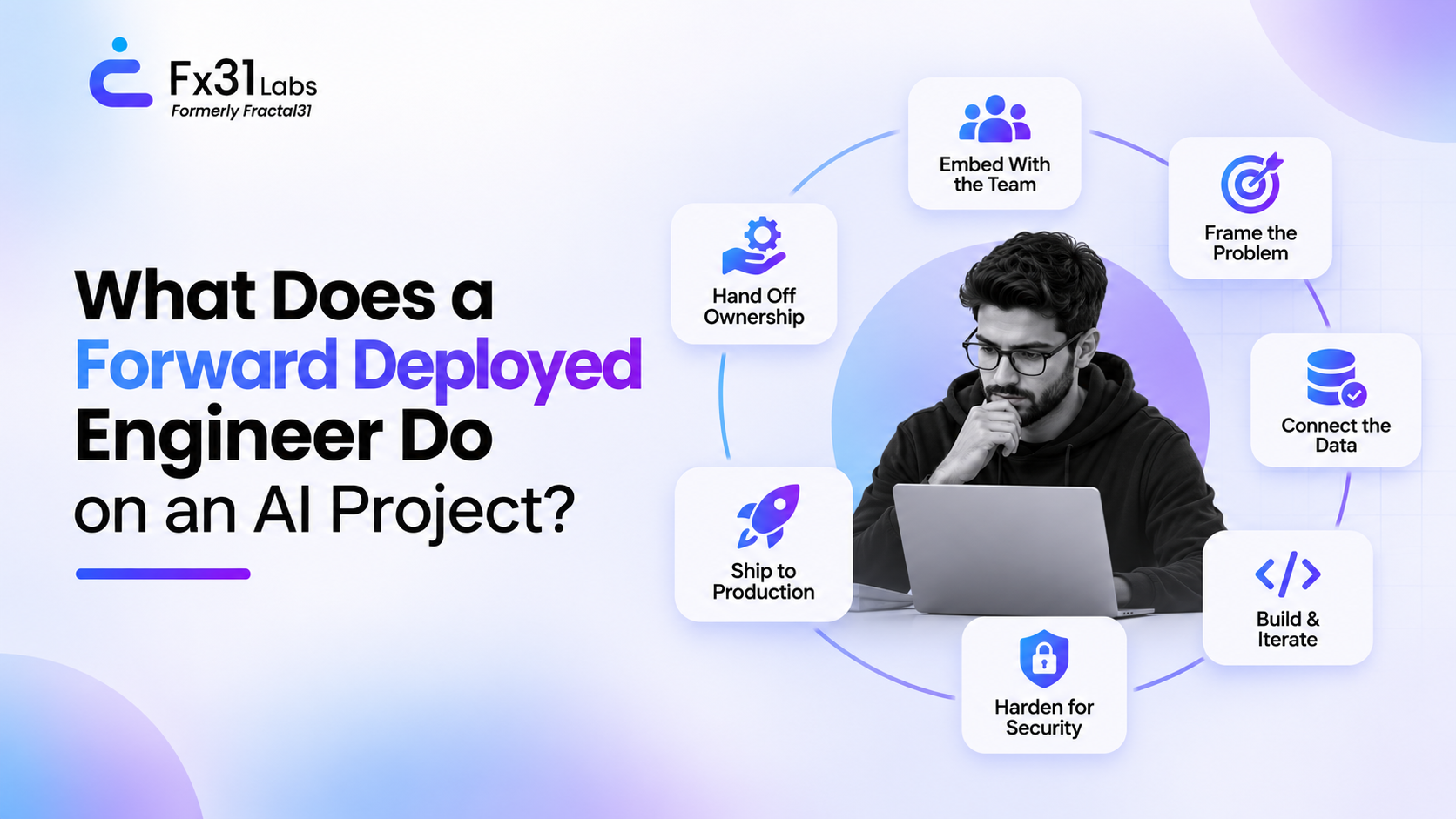
An FDE takes an AI project from a business problem to a working production system. The work covers everything from understanding workflows and connecting data to testing, deployment, and handoff.
1. Embed With the Team and Map the Real Workflow
The first step is understanding how people actually work. The FDE observes daily tasks, talks to users, and identifies delays, manual work, and existing process gaps.
This matters because documented workflows often differ from real ones. Mapping actual processes helps build AI solutions that fit the team’s needs instead of forcing employees to change how they work.
2. Frame the Problem and Agree on a Success Metric
Once the workflow is clear, the FDE identifies one business problem to solve first. They agree on measurable targets with the business owner, such as lower handling time, better answer accuracy, or hours saved each week.
These metrics keep the project focused and show whether the AI implementation is delivering value. They also prevent the scope from expanding into unnecessary features.
3. Connect the Data and Systems the AI Depends On
The next step is connecting the data the solution needs, often spread across ERPs, CRMs, document stores, and legacy databases. This includes setting up secure access, authentication, and data pipelines so AI can retrieve current, approved information.
Data quality can slow down this stage. Plan the data readiness work for enterprise AI early, especially when information is scattered, incomplete, or poorly labeled.
4. Build, Evaluate and Iterate With Real Users
With the data connected, the FDE builds a working solution using technologies such as large language models (LLMs), retrieval-augmented generation (RAG), tool calls, or AI agents. They also create evaluation tests using real business cases to measure accuracy and reliability.
The solution is then tested with actual users. Regular feedback helps the engineer fix errors, improve responses, and refine the workflow before wider deployment.
5. Harden the System for Security, Guardrails and Scale
Before production, the system needs proper security and reliability controls. These include role-based access, single sign-on, audit logs, and guardrails against unsafe or irrelevant outputs.
The FDE also works with security and compliance teams, while monitoring cost, latency, and accuracy under real workloads. This helps catch issues before they affect more users.
6. Ship to Production and Drive Adoption
Deployment brings the solution to real users and business workloads. The FDE supports the rollout, resolves early issues, and trains employees to use the system and handle situations where human review is needed.
Adoption matters as much as technical performance. If employees return to manual processes or old spreadsheets, the solution isn’t delivering its intended business value.
7. Hand Off Ownership and Feed Lessons Back to the Product
Before the engagement ends, the FDE documents the architecture, decisions, runbooks, and evaluation tests. They also work with your internal engineers so the team can maintain and improve the system independently.
For software vendors, lessons from customer deployments can also improve the core product. A solution built for one customer’s needs can become a useful feature for others.
Also Read: Top 15 Generative AI Integration Companies
Forward Deployed Engineer vs Software Engineer, Solutions Architect and Other Roles
The main difference is ownership. A forward deployed engineer builds and deploys solutions inside one customer’s environment, while other roles focus on shared products, technical design, sales, or strategy.
| Role | Main goal | Write production code? | Customer involvement | Owns the live outcome? |
| Forward deployed engineer | Make one customer’s workflow work | Yes, in the customer’s environment | High, weeks or months | Shares ownership with your team |
| Software engineer | Build features for all users | Yes, in the product codebase | Low | Owns product quality |
| AI engineer | Build models and AI features | Yes, usually on a central team | Low to medium | Owns model and feature quality |
| Solutions architect | Design the technical solution | Rarely, mostly designs and proofs of concept | Medium, during evaluation | No |
| Sales engineer | Demonstrate product fit | Demo code only | Medium, during sales | No |
| Consultant | Recommend strategy and process changes | Rarely | High, mainly advisory | Owns recommendations |
1. FDE vs Software Engineer
A software engineer builds product features for a wider user base, following the product roadmap and shared codebase. Their work focuses on improving the core product rather than adapting it for one customer’s environment.
An FDE starts with that customer’s specific problems, systems, and workflows. They build and adapt solutions directly, often working with unfamiliar codebases and changing requirements.
2. FDE vs AI Engineer
An AI engineer focuses on models, retrieval pipelines, fine-tuning, and evaluation systems. Their work usually improves AI capabilities that multiple teams or customers can use.
An FDE applies those capabilities to one business environment. They handle data access, system integration, workflow changes, and user adoption alongside AI development.
3. FDE vs Solutions Architect
A solutions architect designs how technology should fit a customer’s requirements. They create technical plans, reference architectures, and proofs of concept, often during the evaluation or planning stage.
An FDE takes that design into implementation and production. They work inside the customer’s systems, resolve technical issues, and stay involved until the solution works reliably.
4. FDE vs Sales Engineer
A sales engineer demonstrates product capabilities, answers technical questions, and builds tailored demos to help win a deal. Their involvement is usually strongest before the customer signs the contract.
An FDE typically joins during implementation, when real data, integrations, and workflow challenges appear. They focus on making the product work in the customer’s environment, not just proving its potential.
5. FDE vs Consultant
A consultant studies business problems and recommends improvements through strategies, roadmaps, or process changes. The actual implementation is often left to the client’s internal team or another vendor.
An FDE combines that problem-solving approach with hands-on software development and deployment. Instead of delivering only recommendations, they help build a working solution that the business can operate.
What Skills Should a Forward Deployed Engineer Have?
A strong forward deployed engineer combines software engineering, AI expertise, and practical problem-solving. They must build reliable systems, work with business teams, and take solutions into production.
| Skill | Why it matters on an AI project | How to test it |
| Production software engineering | Code must handle real users, traffic, and production issues. | Review a system they built and supported after launch. |
| LLM, RAG and agent engineering | AI workflows often combine language models, retrieval, and tool calls. | Ask how they would fix a RAG system returning outdated information. |
| Evaluation and guardrails | AI accuracy and safety must be tested against real business cases. | Ask them to design an evaluation set for your workflow. |
| Data engineering and integration | AI needs secure access to data across legacy systems, ERPs, and CRMs. | Review an integration they have built for a business system. |
| Cloud, security and compliance | Production AI needs access controls, audit logs, and data protection. | Ask how they implemented least-privilege access on a past project. |
| Discovery and problem framing | Business requirements must become clear problems with measurable outcomes. | Give them a broad business problem and assess the questions they ask. |
| Stakeholder communication | They must explain technical decisions to leaders and guide everyday users. | Ask them to explain a technical trade-off in simple terms. |
| Teaching and handoff | Your internal team must be able to manage the system independently. | Ask what documentation, training, and knowledge transfer they provided. |
One warning sign to watch for: candidates who discuss models and frameworks but overlook users, data access, security, and handoff. Strong technical skills alone won’t ensure successful AI deployment.
Planning to hire for these skills? Our guide on hiring LLM developers without overpaying explains how to evaluate candidates and plan your hiring budget.
Where Do Forward Deployed Engineers Add the Most Value?
Embedded engineering adds the most value when AI must work with complex data, strict regulations, or business processes that are difficult to automate.
| Industry | Typical AI workflow | What the FDE solves |
| Financial services and fintech | KYC reviews, fraud detection, credit memo drafting | Sensitive data access, audit trails, model risk reviews |
| Healthcare operations | Patient intake, prior authorization, claims processing | HIPAA-compliant data access, accuracy, staff adoption |
| Manufacturing and industrial | Maintenance assistants, quality checks, production planning | Legacy plant data, shop-floor workflows, uptime |
| Retail and commerce | Demand planning, product content, customer support | Catalog and inventory data, peak-season scaling |
| Logistics and supply chain | Load planning, exception handling, carrier communication | Real-time data across systems, operator trust |
| Insurance and legal | Document intake, claims review, contract analysis | Unstructured documents, compliance, human review |
| Public sector and government | Case handling, records search, citizen service assistants | Strict data controls, security requirements, on-site work |
The industry matters less than the workflow itself. If your AI solution depends on restricted data, undocumented processes, or approval from compliance and operations teams, embedded AI engineering can help move it into production.
Is your AI pilot struggling to move beyond testing? Get In Touch with our AI engineering team to discuss your workflow and what production deployment would require.
When Does Your AI Project Need a Forward Deployed Engineer?
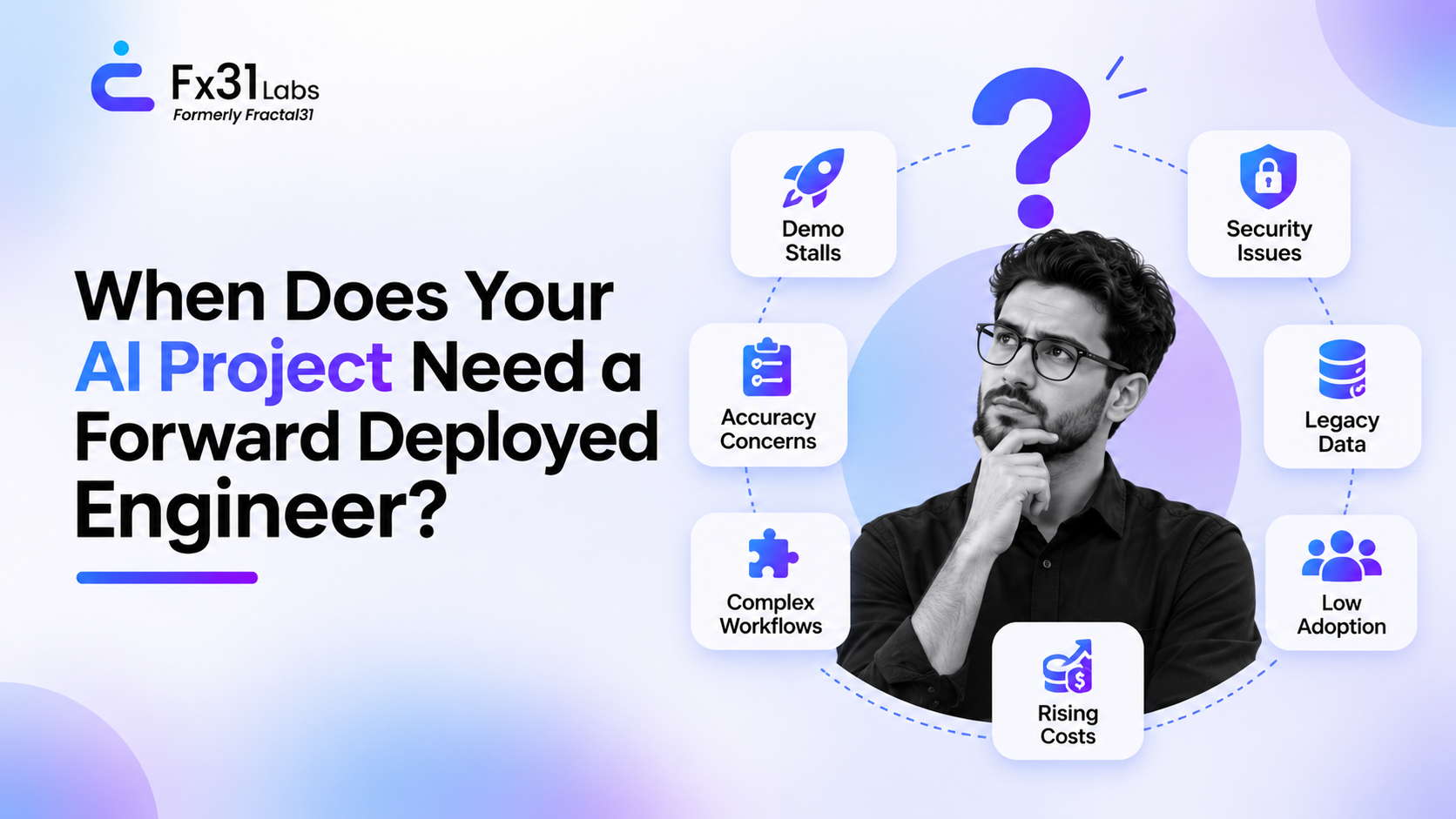
Your AI project may need an FDE when moving from a working demo to reliable production becomes difficult. These 10 signs can help you decide.
1. Your AI Pilot Works in a Demo but Stalls Before Production
Your AI demo impressed leadership, but it still runs in a sandbox. Integration, data access, or production issues may be holding it back. You need someone who can work inside your systems and get it live.
2. The Workflow Lives in People’s Heads, Not in Documents
Your process documents may not match how employees actually work. Missing steps and manual workarounds can make AI solutions ineffective. Embedded engineering helps map real workflows before implementation.
3. Critical Data Sits in Legacy Systems
Your AI may need information from old ERPs, CRMs, mainframes, and shared files. Connecting these sources requires secure integrations and permission controls. Without reliable data access, even a capable model will struggle.
4. Accuracy Depends on Domain-Specific Evaluation
Generic benchmarks cannot measure accuracy across your contracts, claims, or product data. You need evaluation sets based on real business cases. This helps identify errors and improve reliability before deployment.
5. Security or Compliance Reviews Keep Blocking Go-Live
Security, legal, and risk reviews can delay production deployment. Standards such as HIPAA, GDPR, UK GDPR, and SOC 2 require clear data controls and audit trails. An embedded engineer can work directly with reviewers to address these requirements.
6. Your Team Has Not Shipped LLM, RAG, or Agent Systems Before
Your developers may know application development but lack hands-on LLM, RAG, or agent engineering experience. Learning these technologies through production trial and error can be risky. Experienced AI engineers can implement proven patterns and transfer knowledge to your team.
7. AI Agents Need to Take Actions in Live Systems
AI agents that update records, send emails, or trigger payments need stronger controls than systems that only retrieve information. You need permissions, human approvals, and rollback plans. Embedded AI engineering helps build these safeguards into live workflows.
8. Users Are Not Adopting the AI Tool You Rolled Out
Employees may stop using an AI tool if it doesn’t fit their daily work. Low adoption often points to workflow or usability problems. An FDE can identify these gaps and improve the experience around actual user needs.
9. Run-Rate Costs Are Rising Without Business Results
Token, hosting, and monitoring costs can rise without improving business outcomes. Reviewing prompts, caching, and model selection can help control spending. Our guide to AI token consumption and cost control explains where enterprise AI costs add up.
10. A Fixed Launch Date Leaves No Room for Handoffs
Regulatory deadlines, board commitments, or peak seasons can leave little room for delays. Multiple handoffs between teams can slow implementation and production fixes. An embedded engineer works directly with stakeholders to keep delivery moving.
When Should You Skip a Forward Deployed Engineer?
Not every AI project needs embedded engineering. Skip this role when your team needs extra capacity, basic configuration, or more planning rather than hands-on implementation.
- Your gap is headcount, not expertise: If your team already knows how to build the solution but lacks time, staff augmentation or direct hiring may be a better fit.
- The product works out of the box: If an AI tool needs only basic configuration and employee training, bringing in an embedded engineer may add unnecessary cost.
- You have no clear use case yet: Without a defined workflow or business problem, an engineer has little to build. Start with AI discovery and planning before moving into implementation.
- No one owns the outcome internally: Without a business owner to make decisions, approve access, and coordinate teams, implementation can quickly get delayed.
- Data access is months away: If legal or security approvals are still pending, resolve those access issues first. Otherwise, the engineer may spend weeks waiting instead of building.
Now that you’ve seen when a forward deployed engineer fits, let’s take a look at the practical ways to bring one in.
How Do You Get a Forward Deployed Engineer? 5 Sourcing Models Compared
You can source a forward deployed engineer through five models, from an in-house hire to an external AI team. The right choice depends on your timeline, budget, and who owns the final solution.
| Model | Who owns the outcome | Speed to start | How you pay | Lock-in risk | Best fit |
| In-house FDE hire | You | Slow, often months to hire | Salary, equity, benefits and hiring costs | Low | Ongoing AI programs with steady demand |
| AI vendor’s FDE team | Shared, tied to the vendor’s platform | Fast when included in your contract | Bundled into platform spend or billed as services | High | Deep commitment to one platform |
| Development partner | The partner, up to an agreed outcome | Fast, usually within weeks | Fixed scope or monthly engagement | Low to medium | One workflow to production, then handoff |
| Staff augmentation | You, with engineers under your direction | Fast | Hourly or monthly rates | Low | Teams that know what to build but lack AI skills |
| Dedicated AI team | Shared across a longer roadmap | Usually within weeks | Monthly team cost | Low to medium | Several AI workflows over many months |
1. Hire a Forward Deployed Engineer In-House
Hiring in-house gives you long-term AI engineering capability and keeps project knowledge within your company. However, senior engineers with software, AI, and client-facing skills can take months to find. This model works best when you have a steady pipeline of AI projects.
2. Use Your AI Vendor’s Forward Deployed Team
Major AI and cloud vendors can provide engineers who already understand their platforms, helping you move faster. However, their work may tie your solution closely to that vendor. Read our build vs buy guide for AI agents before making that commitment.
3. Embed Engineers From a Development Partner
A development partner can provide engineers for a defined outcome, such as a support agent or document workflow. You get hands-on AI implementation without hiring a permanent team. Agree on code ownership, documentation, and handoff terms before work begins.
4. Add AI Engineers Through Staff Augmentation
Staff augmentation adds skilled engineers to your existing team without changing how you manage the project. It works well when you know what to build but need skills such as RAG, AI evaluation, or integration. When you augment your team with AI engineers, your leads retain control of priorities and code.
5. Set Up a Dedicated AI Team
A dedicated AI team suits businesses with several workflows planned over the next few months. It can include AI engineers, QA specialists, and a delivery lead who become familiar with your systems. You get continuity across projects, but need a longer-term budget and roadmap.
Many companies combine these models over time. They may start with a vendor or development partner for the first workflow, then build internal capability through hiring or staff augmentation. A forward deployed engineer can help establish the first production workflow and make the later handoff easier.
Also Read: Dedicated Development Team vs In-House Hiring: What’s Right for Your Business?
How Much Does an FDE Cost?
Hiring an FDE in the US can mean a six-figure salary, while external teams charge based on scope, duration, and experience. Your budget should also cover the costs of running and maintaining the solution after launch.
For a salary benchmark, Levels.fyi reports a US median total compensation of $220,000 for forward deployed engineers (Levels.fyi, 2026). This includes base salary, stock, and bonuses. Benefits, payroll taxes, and recruiting fees can increase the actual hiring cost.
| Cost factor | In-house FDE | Vendor FDE team | Partner or augmented engineers |
| How you pay | Salary, equity, and benefits | Bundled into platform spend or billed as services | Fixed scope, monthly, or hourly engagement |
| Time before work starts | Months of recruiting | Days to weeks | Usually weeks |
| Hidden costs | Recruiting, ramp-up, and retention | Platform lock-in and possible migration | Onboarding and knowledge transfer |
| Run-rate after go-live | Model usage, hosting, and monitoring | Often tied to vendor pricing | Model usage, hosting, and monitoring |
| Exit cost | Low | Can be high | Low when handoff is included in the contract |
The initial quote rarely covers everything. Account for these five costs before setting your budget:
- Ramp-up time: Engineers need time to learn your systems, data, and workflows before reaching full productivity.
- Security and access setup: VPN access, background checks, accounts, and security reviews require internal time and effort.
- Evaluation and monitoring: Test sets, dashboards, and performance checks need ongoing maintenance after launch.
- Run-rate costs: Model tokens, vector storage, hosting, and logging add recurring monthly expenses.
- Handoff and training: Documentation and knowledge transfer help your team maintain the solution without paying for the same work twice.
For external engagements, the biggest price factors are engineer seniority, on-site travel, compliance requirements, and the number of systems involved. These are market patterns, not fixed quotes.
Start by budgeting for one workflow. Once it goes live, use its actual operating costs to estimate the budget for your next AI implementation.
Also Read: How Much Does It Cost to Build an AI Agent?
What Are the Risks of Forward Deployed Engineering, and How Do You Control Them?
Embedded engineering can create risks around knowledge transfer, security, vendor lock-in, code quality, and ownership. Set clear controls before work begins to avoid problems later.
1. Knowledge Leaves When the Engineer Does
If one engineer holds all the project knowledge, your team may struggle after they leave. Require architecture notes, runbooks, and regular knowledge-sharing sessions from the first sprint. Before handoff, make sure your internal team can operate and maintain the system independently.
2. Vendor Lock-In When the Engineer Works for the Platform
A vendor’s engineer may rely heavily on its models, tools, and services. This can limit your options if you later want to switch platforms. Keep your data, prompts, and evaluation sets portable, and agree on an exit plan before implementation.
3. Security Exposure From Repo and Data Access
Engineers need access to your systems, but unrestricted access creates security risks. Use least-privilege accounts, separate production credentials, and log access to sensitive data. Our guide to LLM security risks covers the threats to consider.
4. One-Off Custom Code That Becomes Technical Debt
Quick fixes can become difficult to maintain when they lack proper documentation and testing. Set coding standards, require code reviews, and test custom components before deployment. Ask the engineer to identify reusable components that can reduce effort on future workflows.
5. Unclear IP Ownership and Compliance Gaps
Your contract should clearly state who owns the code, prompts, and evaluation data after the engagement ends. Include data processing terms for GDPR or UK GDPR, and a business associate agreement when HIPAA applies. Our AI governance and compliance guide explains the controls businesses should consider.
Now that you’ve seen the risks and how to keep each one in check, let’s take a look at a pilot-first path for getting started.
How Do You Start With an FDE? A Pilot-First Path
Start with one workflow, one clear success metric, and a time-boxed pilot. This keeps the scope manageable and shows whether the solution is ready for production.
1. Pick One Workflow and Define Success
Choose a workflow that is repetitive, time-consuming, and easy to measure, such as support ticket triage, document review, or internal knowledge search. Set one success metric and record its current baseline before development begins. Without that baseline, you cannot prove whether the pilot improved the process.
2. Choose the Sourcing Model and Vet the Engineer
Choose a sourcing model based on your timeline, budget, and who will own the final solution. Interview the engineers who will work on your project, not just the sales or account team. Ask about their production experience, handoff process, platform dependencies, security practices, and how they measure results.
3. Clear Access, Security and Ownership Before Day One
Delays in VPN access, approvals, or data permissions can waste the first weeks of a project. Settle these requirements before the start date so the team can focus on implementation. Use this checklist to confirm your project is ready.
| Readiness item | What ready looks like |
| Business owner | A named person who makes decisions and clears blockers |
| Success metric | One agreed metric with a measured baseline |
| Data access | Approved access to the systems the workflow needs |
| Code and tool access | Repository, CI/CD, and environment access with least-privilege rights |
| Security and compliance | Reviewers briefed, with a DPA or BAA signed where needed |
| Internal counterpart | An engineer who pairs with the FDE and owns the handoff |
| Contract terms | IP ownership, exit terms, and documentation duties agreed |
| Run-rate budget | Approved spend for model usage, hosting, and monitoring |
4. Run a Time-Boxed Pilot With Weekly Demos
Keep the first build focused and set a clear deadline. A scoped AI pilot often takes 4 to 8 weeks, depending on data access, integrations, and workflow complexity. Hold weekly demos with real users and data to review progress against the agreed success metric, not just completed features.
5. Measure Results, Then Scale, Adjust or Stop
At the end of the pilot, compare the results with your original baseline. Review business impact, system quality, user adoption, and ongoing costs before deciding what comes next. Use these measures to make the decision.
| Measure | What it tells you |
| Time to production | How quickly the workflow reached real users |
| Business metric movement | Whether the target improved against the baseline |
| Evaluation accuracy | Whether results meet your test-set accuracy requirements |
| Adoption rate | How many intended users rely on the system |
| Run-rate cost per task | What each completed task costs in model and hosting spend |
| Override rate | How often users correct or bypass the system |
| Handoff readiness | Whether your team can operate and update the solution |
If the pilot succeeds, move to the next workflow with the same team or consider a longer engagement, such as a dedicated AI team. If results fall short, adjust the approach or stop before committing more budget. Either way, you get evidence to guide your next AI implementation decision.
Why Choose Fx31 Labs for Embedded AI Engineering?
Building AI for real business workflows takes more than a working demo. You need engineers who can handle AI integration, production deployment, and the handoff to your internal team.
Fx31 Labs builds AI and software products with India-based engineering and a US office in New Jersey. In one project, a two-person team used GenAI to deliver a working in-house HRMS in 5 weeks. The team also delivered predictive analytics at 99.99% uptime for a commodity trading platform.
Why choose us:
- Embedded AI engineering: Engineers work with your team to take AI workflows from pilot to production, then hand over the solution.
- Platform-neutral development: Solutions work with your existing AWS, Azure, or Google Cloud setup, keeping your technology choices flexible.
- Flexible engagement: Start with one workflow, then add AI staff augmentation or a dedicated team as your roadmap grows.
- Production-focused delivery: The team builds and integrates generative AI, RAG, AI agents, and custom ML for real business use cases.
- AI MVP development: Founders can validate ideas with working products before committing to a full in-house engineering team.
Have an AI workflow ready for production? Book your free consultation with our experts and get a scoped estimate based on your requirements.
Conclusion: Does Your AI Project Need Embedded Engineering?
An FDE makes sense when your AI project is stuck between a working demo and production. If the challenge is messy data, complex integrations, security reviews, or user adoption, embedded engineering can help close that gap.
If your main problem is limited team capacity or an unclear use case, hiring, staff augmentation, or AI discovery may be a better starting point. Choose the model that fits your actual needs, budget, and long-term plans.
We hope this guide helps you understand the role, compare sourcing models, estimate costs, and decide whether your AI project needs hands-on engineering support. Start with one workflow, define a clear success metric, and expand only when the results justify it.
Ready to move your stalled AI workflow into production? Connect with our experts to scope a pilot that gets your stuck AI workflow into production with Fx31 Labs.
Frequently Asked Questions
1. What Does FDE Stand For?
FDE stands for forward deployed engineer. The role combines software development, customer collaboration, and production implementation.
2. How Much Do FDEs Earn in the US?
Levels.fyi reports a US median total compensation of $220,000, including salary, stock, and bonuses. Actual pay varies by experience, company, and location.
3. How Long Does an FDE Engagement Last?
A focused pilot usually takes 4 to 8 weeks. Larger projects can last 3 to 12 months, including handoff and team training.
4. Do FDEs Work On-Site or Remotely?
Both. Regulated, government, and factory projects may need on-site support, while many AI integrations can be handled remotely.
5. Will an FDE Replace Our Internal Team?
No. An FDE works alongside your developers, handles complex implementation, and transfers knowledge so your team can manage the solution.
6. Does an AI Startup Need Its Own FDEs?
It can help when enterprise customers need custom integrations, security reviews, and workflow support. Founders or senior developers can initially handle this work.
7. Can Our Developers Become FDEs?
Yes. Developers with production integration experience, strong communication skills, and the ability to solve changing business needs can grow into the role.
8. Is the FDE Role Here to Stay?
The title may change, but the need will remain. Businesses still need engineers who can connect AI systems with real data, workflows, and users.