
AI Cost Optimization: How Enterprises Can Reduce LLM Expenses Without Sacrificing Performance

AI cost optimization is the practice of reducing the operational expense of running AI and LLM systems through smarter model selection, infrastructure design, and usage patterns without degrading output quality or user experience. Most enterprises are overpaying for AI not because the technology is inherently expensive, but because nobody architected the system with cost as a design constraint from day one.
Why Are Enterprise AI Costs Spiraling in 2026?
Because most enterprises scaled their AI usage before they ever stopped to design for cost.
It’s an understandable pattern. A team builds a proof of concept, it works, leadership gets excited, and the feature ships. Usage grows. More features get added. More teams plug into the same models. And six months later, finance is asking why the LLM bill looks like a regional data center’s power consumption.
The uncomfortable reality is that token-based pricing scales linearly with usage in the best case, and far worse than linearly when inefficient architecture is involved. A poorly designed prompt that’s three times longer than it needs to be doesn’t just cost three times more it also increases latency, which often triggers retries, which compounds the cost again.
Add to this the fact that most teams default to the most capable (and most expensive) model available for every task, regardless of whether the task actually requires that level of capability. Using a frontier model to do simple text classification is like hiring a surgeon to put on a Band-Aid technically capable, wildly inefficient.
This is the core problem AI cost optimization solves. It’s not about doing less with AI. It’s about being deliberate about where your spend is going and whether it’s buying you proportional value. Enterprises that get this right aren’t cutting corners they’re applying the same financial discipline to AI that they’d apply to any other significant operating expense.
Where Does Enterprise AI Spend Actually Go?

Before you can optimize costs, you need to understand where the money is actually going. Most finance teams see one number the monthly API or infrastructure bill without visibility into what’s driving it.
Model inference costs. This is usually the largest and most visible line item the per-token or per-call cost of querying an LLM. It scales with usage volume, prompt length, response length, and which model tier you’re using.
Infrastructure and hosting. For enterprises running self-hosted or fine-tuned models, GPU compute, storage, and networking costs add up fast. AI infrastructure cost often gets underestimated during planning because teams budget for the model but not the surrounding compute ecosystem.
Data preparation and pipeline costs. Vector databases, embedding generation, data labeling, and ETL pipelines that feed AI systems all carry ongoing operational costs that are easy to overlook when budgeting focuses solely on model usage.
Engineering and maintenance overhead. AI systems aren’t “set and forget.” Prompt engineering, model evaluation, monitoring, retraining, and incident response all require ongoing engineering time — and engineering time is one of the most expensive resources in any technology budget.
Redundancy and waste. This is the category most enterprises don’t even know exists until they audit it: duplicate API calls, unnecessarily long context windows, repeated queries that could have been cached, and AI features that get built but never adopted at meaningful scale.
Understanding this breakdown is the first real step toward an enterprise AI budget that reflects reality instead of guesswork. You can’t optimize what you haven’t measured.
How Do You Reduce LLM Costs Without Hurting Performance?
This is the question every enterprise AI leader is asking right now, and the answer is reassuring: in most cases, you can reduce costs significantly often by 40 to 70% without any meaningful loss in output quality. The key is knowing which levers actually move the needle.
Match the model to the task.
Not every task needs a frontier model. Use smaller, faster, cheaper models for tasks like classification, simple extraction, summarization of short text, and routing decisions. Reserve your most capable (and expensive) models for tasks that genuinely require deep reasoning, complex generation, or nuanced judgment.
A practical pattern many enterprises adopt: a lightweight model handles initial triage and routing, and only escalates to a more powerful model when the task complexity justifies it. This single change alone often produces some of the largest savings in any LLM cost reduction initiative.
Optimize your prompts for token efficiency.
Every unnecessary word in a prompt costs money at scale. Verbose system prompts, redundant instructions, and overly long few-shot examples all add up. A well-optimized prompt that achieves the same output quality with 30% fewer tokens translates directly into a 30% cost reduction on every single call multiplied across millions of requests.
Trim your context windows deliberately.
Larger context windows are expensive, and the temptation to “just include everything” leads to bloated, costly calls. Be deliberate about what context the model actually needs to perform the task well. Retrieval systems should return the most relevant chunks, not the most comprehensive ones.
Use streaming and early termination where appropriate.
For some use cases, you don’t need the model to generate a complete response before you can act on it. Streaming responses and terminating generation early once you have what you need can meaningfully reduce output token costs, particularly for longer-form generation tasks.
Right-size your fine-tuning investments.
Fine-tuning a smaller, cheaper base model can sometimes outperform a larger general-purpose model on a narrow task at a fraction of the per-inference cost. If you have a well-defined, high-volume use case, this tradeoff is worth evaluating seriously rather than defaulting to the biggest available model.
Negotiate enterprise pricing and commit-based discounts.
Most major model providers offer volume discounts, committed-use pricing, and enterprise agreements that aren’t reflected in public pricing pages. If your usage is significant and predictable, this is a straightforward conversation that can meaningfully lower your effective per-token cost without changing anything about your architecture.
What AI Infrastructure Decisions Drive the Biggest Cost Savings?
Beyond the model and prompt layer, infrastructure architecture decisions have an outsized effect on long-term AI infrastructure cost. Get these right early, and the savings compound for years.
API-based vs. self-hosted models.
For most enterprises, using a managed API is more cost-effective than self-hosting at least until usage reaches a scale where dedicated infrastructure pays for itself. Self-hosting requires GPU provisioning, scaling infrastructure, model serving optimization, and a team that can maintain all of it. Unless your usage volume is genuinely massive and predictable, the operational overhead of self-hosting often exceeds the savings.
Multi-model routing architecture.
Building infrastructure that can route requests to different models based on task complexity rather than hardcoding a single model for every use case is one of the highest-leverage infrastructure investments an enterprise can make. It requires more engineering effort upfront but pays for itself quickly at scale.
Edge and regional deployment.
For latency-sensitive applications, deploying inference closer to users can reduce both latency and certain categories of infrastructure cost, depending on your provider’s pricing structure. This matters more for self-hosted deployments than for API-based usage, but it’s worth evaluating as part of a broader cost and performance strategy.
Auto-scaling and idle resource management.
For self-hosted AI infrastructure, idle GPU capacity is one of the most common sources of waste. Auto-scaling infrastructure that spins resources up and down based on actual demand rather than provisioning for peak capacity at all times can produce substantial savings, particularly for workloads with variable or predictable traffic patterns.
Observability and cost attribution.
You can’t manage what you can’t see. Building proper observability into your AI systems tracking cost, latency, and quality metrics per feature, per team, and per use case turns cost optimization from a guessing game into a data-driven discipline. This is a core part of what end-to-end AI integration services should be designing for from the very first architecture decision, not retrofitting after the bill arrives.
How Should Enterprises Set and Manage Their AI Budget?
Setting an effective enterprise AI budget requires moving past the instinct to treat AI spend as an unpredictable, unmanageable line item. It can be planned and governed like any other significant technology investment.
Tie budget to business value, not usage volume.
The most mature enterprises don’t budget for AI based on projected API calls. They budget based on the business outcomes AI is expected to drive and they measure whether spend is producing proportional value. If a feature costs $50,000 a month to run and generates $40,000 in measurable value, that’s a problem regardless of how “normal” the spend looks compared to industry benchmarks.
Set per-feature and per-team cost ceilings.
Without budget guardrails, individual teams will reasonably optimize for their own feature’s performance without visibility into aggregate enterprise spend. Setting clear cost ceilings per feature or team with alerts when usage trends toward exceeding them prevents cost surprises before they happen rather than after the invoice arrives.
Build a quarterly AI cost review into your governance cadence.
AI usage patterns change as features mature, user adoption grows, and new use cases get added. A quarterly review examining which features are cost-efficient, which are underperforming relative to spend, and which need architectural intervention keeps cost discipline embedded in how the organization operates, rather than treating it as a one-time initiative.
Involve finance early, not after the bill arrives.
Many enterprises only loop finance into AI conversations once costs become a visible problem. Involving finance from the planning stage with clear cost projections, usage assumptions, and ROI models produces far better outcomes and avoids the awkward conversation where engineering has to explain why the bill is five times the original estimate.
This kind of budget discipline is increasingly a core component of AI strategy for CTOs and CEOs not a back-office finance exercise, but a leadership-level conversation about how AI investment maps to business outcomes.
Caching, Batching, and Other Technical Levers for Cost Reduction
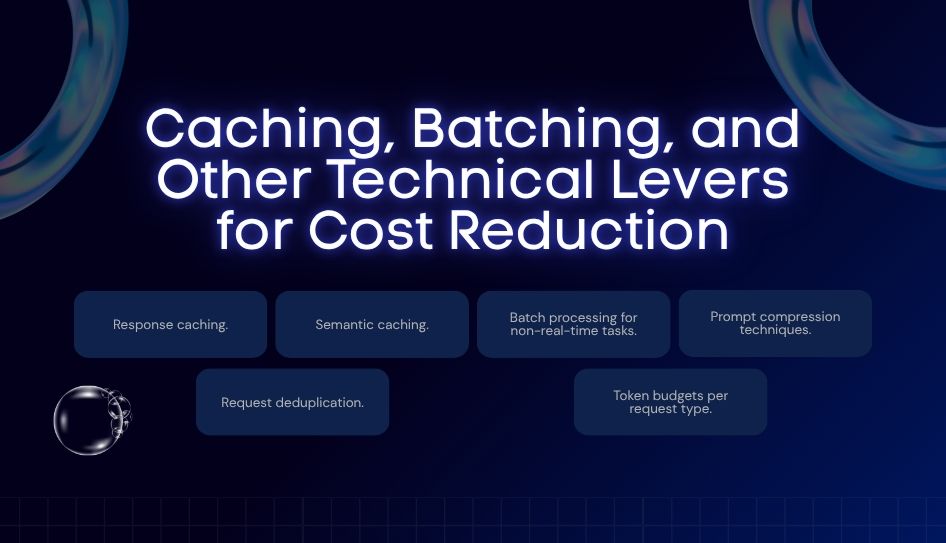
Beyond strategic architecture decisions, there are tactical, implementation-level techniques that meaningfully reduce costs often with relatively low engineering effort.
Response caching. If users frequently ask similar or identical questions, caching responses (or caching retrieved context in RAG systems) avoids paying for the same inference repeatedly. This is one of the simplest and highest-ROI optimizations available, particularly for FAQ-style or support-oriented AI applications.
Semantic caching. A more sophisticated version of response caching, semantic caching identifies when a new query is similar enough in meaning to a previously answered query even if the wording is different and serves a cached or lightly adapted response instead of triggering a fresh model call.
Batch processing for non-real-time tasks. Many AI workloads don’t need real-time responses. Document summarization, data enrichment, and bulk classification tasks can often be processed in batches during off-peak periods, which many providers price at a discount compared to real-time API calls.
Prompt compression techniques. Beyond simply writing shorter prompts, there are systematic techniques for compressing context summarizing retrieved documents before injecting them, removing redundant information, and using structured formats that convey the same information in fewer tokens.
Request deduplication. In systems with multiple components or microservices, it’s surprisingly common for the same underlying query to trigger multiple redundant model calls due to architectural inefficiencies. Auditing for and eliminating this duplication is often an easy win once identified.
Token budgets per request type. Setting explicit maximum token limits for different categories of requests rather than letting every call use however many tokens it wants creates a forcing function that often improves both cost and response quality, since it pushes prompt engineering toward precision rather than verbosity.
These technical levers connect directly to broader conversations about how AI automation is reducing operational costs across the enterprise the same discipline that makes automation cost-effective applies directly to the AI systems powering that automation.
How Do You Measure Generative AI ROI Properly?
Generative AI ROI is notoriously difficult to measure well, and a lot of enterprises get it wrong in predictable ways either overestimating value by counting vanity metrics, or underestimating it by failing to account for costs avoided rather than just revenue generated.
Here’s a more rigorous framework:
Define the baseline before deployment. What did this process cost, how long did it take, and what was the error rate before AI was introduced? Without a clear baseline, any ROI calculation is built on assumption rather than evidence.
Count both hard and soft value. Hard value includes direct cost savings, revenue generated, and time saved that translates into measurable labor cost reduction. Soft value includes things like improved customer satisfaction, faster response times, and reduced employee burnout from repetitive tasks real value, but harder to quantify directly.
Include the full cost picture, not just the API bill. ROI calculations that only account for inference costs while ignoring engineering time, infrastructure, data preparation, and ongoing maintenance will always overstate ROI. Include the full cost of ownership.
Measure quality, not just volume. A system that processes more requests at lower quality isn’t necessarily delivering more value. Track quality metrics accuracy, user satisfaction, error rates, escalation rates alongside cost and volume metrics so you’re measuring genuine improvement, not just throughput.
Reassess ROI periodically, not just at launch. AI ROI isn’t static. Model prices change, usage patterns evolve, and the business value of a feature can shift over time. A feature that delivered strong ROI at launch might quietly become inefficient as usage scales or as cheaper alternative models become available.
When done properly, this measurement discipline turns generative AI ROI from a marketing talking point into a genuine, defensible business metric one that justifies continued investment and identifies where investment needs to be reallocated.
Common Mistakes That Quietly Inflate AI Deployment Costs
Defaulting to the most powerful model for everything. This is the single most common and most expensive mistake. Teams reach for the flagship model because it’s the safest technical choice, without evaluating whether a cheaper model would deliver equivalent results for the specific task at hand.
Letting context windows grow unchecked. As features evolve, it’s common for context windows to quietly expand more retrieved documents, longer conversation histories, more system instructions without anyone revisiting whether all of that context is still necessary. This kind of creep is one of the most common drivers of unexpected AI deployment cost increases.
No cost attribution by feature or team. When AI spend is a single aggregated number on the finance dashboard, nobody can identify which features are cost-efficient and which are quietly burning budget. Cost visibility has to be granular to be actionable.
Treating cost optimization as a one-time project. Enterprises sometimes run a cost optimization sprint, see good results, and then stop paying attention. But model pricing changes, usage patterns shift, and new inefficiencies creep in over time. Cost optimization needs to be an ongoing discipline, not a quarterly fire drill.
Ignoring the security and reliability tradeoffs of cost-cutting. Aggressive cost optimization that compromises security monitoring, data validation, or system reliability isn’t optimization it’s risk transfer. This is particularly relevant when AI systems touch sensitive data, where AI-driven cloud security strategies need to remain a non-negotiable part of the architecture regardless of cost pressure.
Failing to sunset underperforming AI features. Not every AI feature that gets built turns out to deliver value proportional to its cost. Enterprises that are honest about this and willing to retire features that aren’t earning their keep free up budget for initiatives that actually move the needle.
Frequently Asked Questions
What is AI cost optimization?
AI cost optimization is the process of reducing the operational expense of running AI systems including LLM inference, infrastructure, and engineering overhead while maintaining or improving output quality and performance. It involves model selection, prompt engineering, infrastructure architecture, and ongoing monitoring rather than simply cutting usage.
How much can enterprises typically save through LLM cost reduction?
Results vary by starting point and architecture, but enterprises that systematically apply cost optimization techniques model right-sizing, prompt efficiency, caching, and infrastructure tuning commonly achieve savings in the range of 40 to 70% without any meaningful loss in output quality. The largest gains usually come from matching model capability to task complexity rather than defaulting to the most powerful available model.
Does reducing AI costs mean sacrificing quality?
Not necessarily. Many cost optimization techniques better prompt engineering, smarter model routing, caching, and reduced context bloat actually improve consistency and reliability while reducing cost. The mistakes that genuinely hurt quality are usually the result of poorly planned cost-cutting, like switching to a weaker model without proper evaluation, rather than cost optimization done with rigor.
What’s the difference between AI infrastructure cost and LLM inference cost?
LLM inference cost refers specifically to the per-call or per-token expense of querying a language model, typically through an API. AI infrastructure cost is broader it includes compute, storage, networking, data pipelines, vector databases, and the engineering resources needed to build and maintain the systems around the model. Enterprises that only track inference cost often significantly underestimate their total AI spend.
How do you calculate generative AI ROI?
Calculate generative AI ROI by comparing the full cost of an AI system including inference, infrastructure, engineering, and maintenance against the measurable value it generates, including direct cost savings, revenue impact, and time saved. A proper calculation requires a clear pre-AI baseline for comparison and should be reassessed periodically rather than measured only at launch.
Should enterprises self-host their own AI models to save money?
It depends on usage scale and predictability. Self-hosting can be more cost-effective at very high, consistent usage volumes, but it requires significant infrastructure investment, GPU provisioning, and a team capable of maintaining model serving infrastructure. For most enterprises, especially those still scaling their AI usage, managed APIs remain more cost-effective once engineering overhead is factored in.
What is the biggest mistake enterprises make with AI deployment costs?
The most common and costly mistake is using the most powerful, most expensive model available for every task regardless of whether the task actually requires that level of capability. Right-sizing model selection to task complexity is consistently one of the highest-leverage cost optimization strategies available to enterprises.