
How Claude Automation Is Reducing Operational Costs Without Slowing Growth

Claude Automation helps businesses reduce operational costs by automating repetitive tasks, improving workflow efficiency, and supporting faster decision-making through AI-driven processes. By integrating AI workflow automation into daily operations, companies can scale productivity, reduce manual workload, and maintain business growth without increasing operational complexity.
Key Takeaways
- Claude Automation helps businesses reduce operational costs through intelligent automation.
- Companies can automate workflows such as support, analytics, documentation, and internal processes.
- AI automation tools for business reduce human errors and speed up operations.
- AI productivity tools allow teams to focus on strategic work instead of repetitive tasks.
- Businesses using AI workflow automation scale operations without proportionally increasing costs.
Why Are Businesses Looking for AI Automation Today?
Operational costs are rising across industries. Hiring more staff or increasing operational layers often slows companies down rather than helping them scale.
This is why AI automation for companies has become a strategic investment rather than a technical experiment.
Businesses are adopting automation to:
- Reduce manual work
- Improve decision speed
- Scale customer support
- Automate internal documentation
- Improve data analysis and reporting
Among the emerging tools, Claude Automation stands out for its ability to integrate natural language understanding with business workflows.
What Is Claude Automation?
Claude Automation refers to the use of the Claude AI model to automate business tasks, workflows, and decision-making processes.
Instead of relying on rigid rule-based automation, Claude can understand context, interpret instructions, and generate intelligent outputs.
This enables companies to automate tasks like:
- Customer communication
- Data processing
- Workflow management
- Documentation
- Knowledge retrieval
In short, Claude Automation transforms AI from a chatbot into an operational system.
How Does Claude Automation Reduce Operational Costs?
Businesses often assume automation requires large investments. However, AI automation tools for business frequently reduce costs by eliminating inefficiencies.
Here’s how.
| Cost Driver | Traditional Process | With Claude Automation |
| Customer support | Large support teams | AI handles first-level queries |
| Documentation | Manual writing & updates | Automated document generation |
| Data analysis | Analysts processing reports | AI summarises insights instantly |
| Workflow coordination | Multiple managers | AI workflow automation handles tasks |
| Internal communication | Repetitive meetings | AI summarises and organizes information |
The result: lower operational costs without sacrificing productivity.
What Are Real Claude AI Use Cases for Businesses?
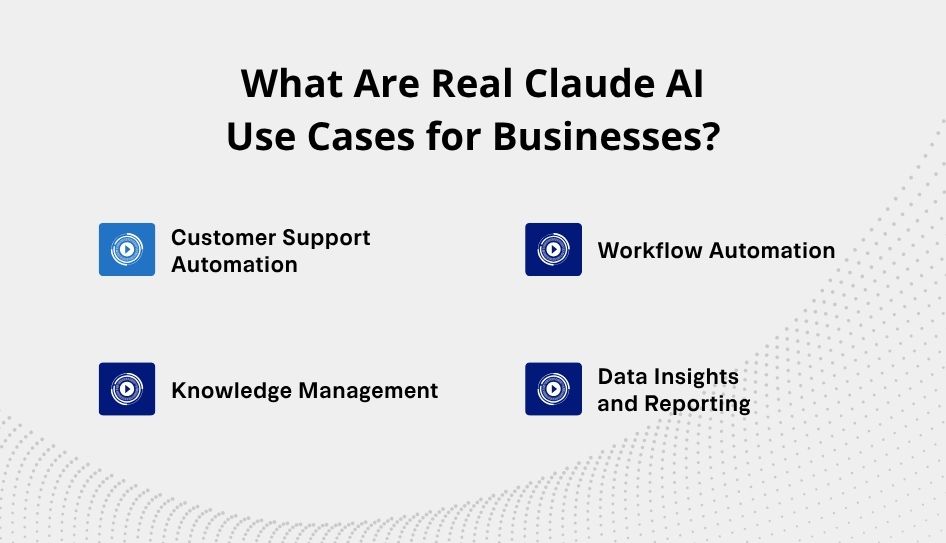
Understanding Claude AI use cases helps businesses see where automation delivers real value.
1. Customer Support Automation
Claude can automatically answer common questions, classify support tickets, and assist agents.
Benefits:
- Faster response times
- Lower support costs
- Better customer experience
2. Workflow Automation
Businesses use AI workflow automation to streamline repetitive processes like approvals, task assignments, and reporting.
Example workflows Claude can automate:
- Marketing campaign approvals
- HR onboarding processes
- Product documentation updates
- Sales reporting
3. Knowledge Management
Large organizations struggle with scattered information across systems.
Claude can:
- Search internal documents
- Generate summaries
- Provide contextual answers to employees
This dramatically improves organizational productivity.
4. Data Insights and Reporting
Many businesses spend hours preparing reports.
With AI productivity tools, Claude can:
- Summarize dashboards
- Explain trends
- Highlight anomalies
- Generate executive reports
This turns data into insights faster.
How Claude Automation Supports Growth Instead of Replacing Teams
One of the biggest misconceptions about automation is that it replaces people.
In reality, AI automation for companies enhances human productivity.
Instead of replacing teams, it removes repetitive tasks.
Employees can focus on:
- Strategy
- Innovation
- Customer relationships
- Product development
Companies that implement automation often see higher output without increasing headcount.
Why Claude Automation Is Different From Traditional Automation
Traditional automation relies on predefined rules.
Claude introduces context-aware automation.
| Feature | Traditional Automation | Claude Automation |
| Flexibility | Limited rules | Contextual understanding |
| Workflow complexity | Hard to scale | Easily adaptable |
| Data interpretation | Structured only | Works with unstructured data |
| Human-like reasoning | Not possible | Built into the model |
This is why businesses see Claude as part of a new generation of AI automation tools for business.
How Companies Are Implementing Claude Automation
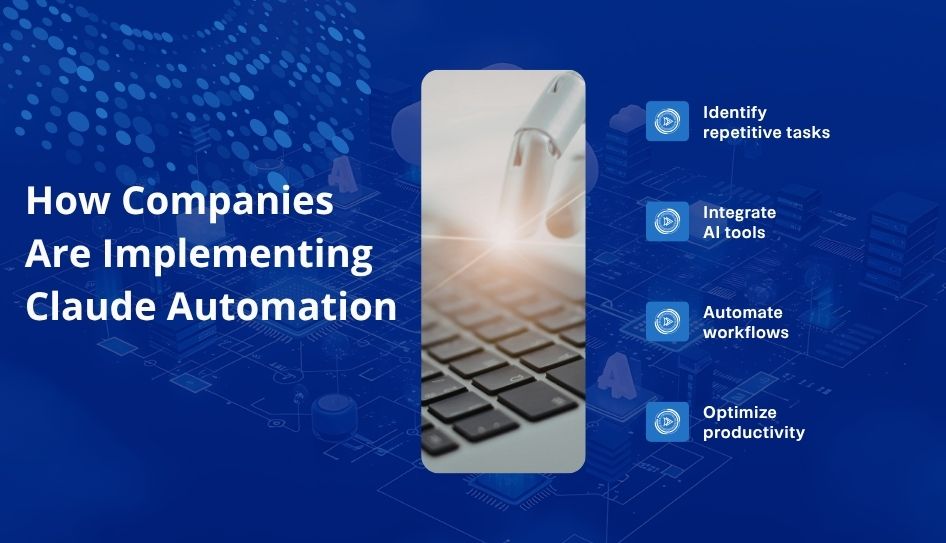
Most organizations adopt Claude automation in stages.
Step 1: Identify repetitive tasks
Look for processes involving documentation, communication, or data summarization.
Step 2: Integrate AI tools
Connect Claude with internal tools like Slack, CRM, or dashboards.
Step 3: Automate workflows
Start with small processes and expand gradually.
Step 4: Optimize productivity
Use insights from automation to improve operations.
This phased approach ensures that AI workflow automation improves efficiency without disrupting existing systems.
Challenges Businesses Should Consider
While automation brings major advantages, companies should plan implementation carefully.
Common challenges include:
- Data security considerations
- Integration with existing systems
- Change management for teams
- Workflow design
When implemented strategically, however, Claude Automation becomes a long-term operational advantage.
The Future of AI Workflow Automation
AI is moving from experimental tools to core operational infrastructure.
Future trends include:
- AI-driven decision support
- autonomous workflows
- predictive business operations
- AI-native organizations
As these technologies evolve, Claude Automation will likely become a central component of intelligent business operations.
Conclusion
Businesses today are under constant pressure to grow faster while controlling costs.
Claude Automation provides a practical solution.
By combining intelligent language understanding with workflow automation, companies can:
- reduce operational costs
- increase productivity
- scale operations
- empower teams to focus on strategic work
For organizations exploring AI automation tools for business, Claude represents a powerful step toward building smarter, more efficient operations.
FAQs
What is Claude Automation?
Claude Automation refers to using the Claude AI model to automate business workflows, communication tasks, and operational processes.
How does Claude Automation reduce operational costs?
It reduces costs by automating repetitive tasks, minimizing manual work, improving workflow efficiency, and increasing employee productivity.
What are common Claude AI use cases?
Common Claude AI use cases include customer support automation, knowledge management, workflow automation, document generation, and reporting.
Is Claude Automation suitable for small businesses?
Yes. Many AI automation tools for business are scalable and can automate processes even for small teams.
Does Claude Automation replace employees?
No. It primarily enhances productivity by removing repetitive work, allowing teams to focus on strategic tasks.