
Why Python Continues to Dominate Modern Software Development

Python software development continues to dominate because it combines simplicity, scalability, speed, and flexibility. Businesses prefer Python for building web applications, AI solutions, automation systems, and enterprise software because it reduces development time, lowers costs, and supports scalable architectures that adapt to evolving business needs.
Technology evolves rapidly, but some programming languages consistently stay ahead of the curve. Python is one of them.
For more than two decades, Python has remained one of the most trusted languages for developers, startups, and enterprises. From artificial intelligence and machine learning to cloud-native platforms and enterprise automation, Python software development has become the backbone of modern digital transformation.
But why does Python continue to lead when so many programming languages compete for relevance?
The answer lies in its unmatched balance of simplicity, performance, scalability, and innovation.
What Makes Python Software Development So Popular?
The popularity of Python software development comes down to one simple fact: it solves real business problems faster.
Unlike complex programming languages that require longer development cycles, Python allows businesses to build, test, and deploy applications quickly.
Key reasons Python stands out:
- Clean and readable syntax
- Faster development cycles
- Massive developer community
- Extensive libraries and frameworks
- Cross-platform compatibility
- Excellent scalability
- Strong support for AI and automation
For organizations exploring Python programming for business, these advantages translate directly into faster product launches and reduced engineering costs.
Python vs Traditional Development Languages
| Feature | Python | Java | C++ |
| Learning Curve | Easy | Moderate | Complex |
| Development Speed | Fast | Moderate | Slow |
| Scalability | High | High | High |
| AI/ML Support | Excellent | Limited | Limited |
| Maintenance Cost | Lower | Moderate | Higher |
This flexibility is one reason Python software development continues gaining traction across industries.
Why Do Businesses Prefer Python Programming for Business Applications?

Modern businesses need software that adapts quickly.
Whether launching a SaaS platform, automating operations, or integrating AI-driven workflows, Python programming for business offers practical advantages.
Business benefits include:
Faster Time-to-Market
Python enables rapid prototyping.
Businesses can validate ideas quickly before investing heavily in infrastructure.
This is particularly useful for startups building MVPs.
Lower Development Costs
Because Python is easier to write and maintain, development teams spend less time solving syntax-heavy issues.
That means lower engineering costs.
Easier Integration
Python integrates seamlessly with:
- APIs
- Cloud platforms
- Data tools
- Machine learning systems
- Enterprise databases
Better Collaboration
Python’s readability improves collaboration between developers, data scientists, and business stakeholders.
This is one of the strongest Python development benefits for large-scale organizations.
How Does Python Support Scalable Applications?
Scalability is no longer optional.
Businesses need applications that grow with demand.
This is where Python for scalable applications becomes especially valuable.
Python supports scalable architecture through robust frameworks like:
- Django
- Flask
- FastAPI
- Tornado
These frameworks allow developers to create applications capable of handling increasing traffic and complex workflows.
Why Python scales effectively
Asynchronous processing
Python supports concurrent task execution for better performance.
Microservices architecture
Businesses can break large systems into smaller services.
Cloud-native compatibility
Python works seamlessly with AWS, Azure, and Google Cloud.
Database flexibility
It supports relational and NoSQL databases.
This makes Python software development ideal for enterprise-grade applications.
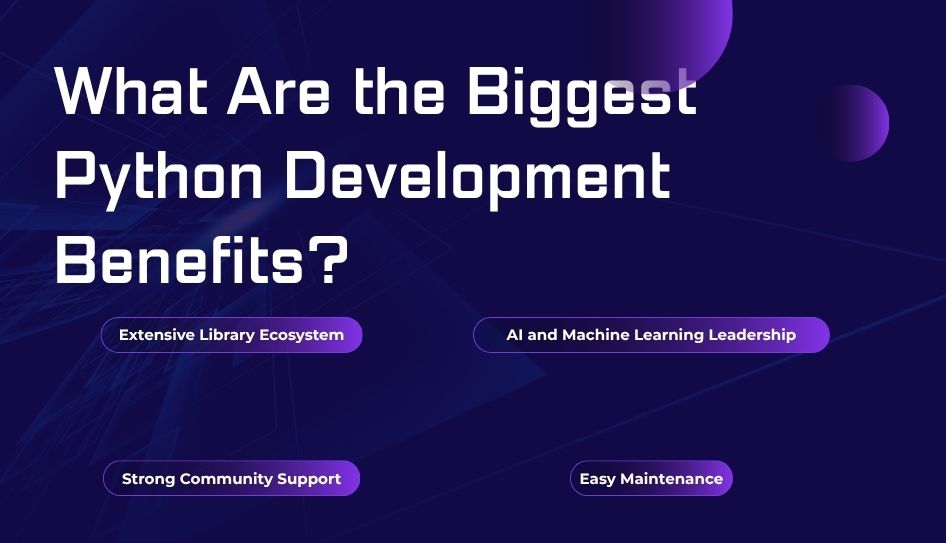
What Are the Biggest Python Development Benefits?
The continued dominance of Python isn’t accidental.
Its ecosystem delivers measurable technical and business value.
Here are the most impactful Python development benefits:
1. Extensive Library Ecosystem
Python offers powerful libraries for nearly every use case.
Examples include:
| Use Case | Python Libraries |
| Web Development | Django, Flask |
| Data Analysis | Pandas, NumPy |
| Machine Learning | TensorFlow, Scikit-learn |
| Automation | Selenium, PyAutoGUI |
| APIs | FastAPI |
This accelerates Python software development significantly.
- AI and Machine Learning Leadership
Python dominates AI development.
Its frameworks make advanced model development accessible.
Businesses leveraging AI often choose Python software development because it shortens experimentation cycles.
- Strong Community Support
Python has one of the largest open-source communities globally.
This ensures:
- Frequent updates
- Better security patches
- Faster troubleshooting
- Rich documentation
- Easy Maintenance
Readable code reduces technical debt.
This lowers long-term operational costs.
Is Python Still Relevant in 2026 and Beyond?
Absolutely.
If anything, Python is becoming more important.
Emerging Python development trends show increasing adoption across advanced technologies.
Top Python development trends shaping the future
AI-Powered Application Development
Python remains central to AI engineering.
Businesses building intelligent systems rely heavily on Python software development.
Cloud-Native Development
Python is increasingly used for serverless and cloud-first applications.
This aligns perfectly with modern digital infrastructure.
Automation at Scale
Organizations continue automating repetitive workflows using Python.
This improves operational efficiency.
Cybersecurity Applications
Python is becoming essential for:
- Threat detection
- Security automation
- Penetration testing
These evolving Python development trends ensure long-term relevance.
Which Industries Benefit Most from Python Software Development?
Python’s versatility makes it useful across industries.
Industries actively adopting Python
FinTech
For fraud detection, analytics, and secure transaction systems.
Healthcare
For predictive analytics and patient data systems.
E-commerce
For recommendation engines and automation.
EdTech
For scalable learning platforms.
Logistics
For route optimization and predictive operations.
This broad applicability reinforces why Python software development remains dominant.
How Does Python Compare for Startup Innovation?
Startups need speed.
Python delivers it.
For early-stage businesses, Python programming for business provides:
- Faster MVP launches
- Reduced engineering complexity
- Easier iteration cycles
- Affordable scaling options
This makes Python software development one of the smartest choices for innovation-driven companies.
Should Businesses Invest in Python for Future Growth?
Yes.
Python is no longer just a programming language.
It is a strategic technology enabler.
Organizations investing in Python software development gain:
✓ Faster innovation cycles
✓ Lower development costs
✓ Easier scalability
✓ Better AI integration
✓ Future-ready infrastructure
These are powerful Python development benefits that directly support long-term growth.
Final Thoughts
The continued rise of Python software development is rooted in its ability to solve modern business challenges efficiently.
It simplifies development, accelerates deployment, supports intelligent automation, and scales effortlessly.
As digital transformation accelerates, businesses need technologies that balance flexibility with performance.
Python does exactly that.
From startups building disruptive products to enterprises modernizing infrastructure, Python remains a foundational technology for innovation.
Its evolving ecosystem, strong community, and alignment with emerging Python development trends ensure that Python will continue dominating modern software development for years to come.
FAQs
Why is Python software development so popular?
Python software development is popular because it is simple, scalable, cost-effective, and supports modern technologies like AI, automation, and cloud computing.
What are the key Python development benefits?
The main Python development benefits include faster development, lower maintenance costs, scalability, extensive libraries, and strong community support.
Is Python good for scalable applications?
Yes. Python for scalable applications is highly effective due to frameworks like Django and FastAPI, cloud compatibility, and microservices support.
Why is Python programming for business important?
Python programming for business helps organizations build faster, automate workflows, reduce operational costs, and innovate efficiently.
What are the latest Python development trends?
Current Python development trends include AI engineering, cloud-native applications, cybersecurity automation, and large-scale workflow automation.