
How to Validate Your Startup Idea Before Building an MVP
Building an MVP for startups should never begin with code. The smartest founders first validate whether a real market exists, whether users genuinely care, and whether the problem is painful enough to solve. Strong validation reduces waste, sharpens your product vision, and creates a far more effective path for the MVP development process.
Launching a startup is exciting. You have an idea that feels promising, maybe even revolutionary. The temptation is to jump straight into development and start building features immediately. But experienced founders know that successful products are rarely built on assumptions.
At companies like FX31 Labs, the emphasis on strategic product discovery, technical assessment, and iterative delivery reflects a practical, data-first approach to startup execution. Their tone is consultative, solution-oriented, and focused on measurable outcomes—making it clear that validation is a critical first step before development begins.
That same principle applies to every founder: validate first, build second.
If you’re planning an MVP for startups, this guide will walk you through exactly how to test your idea before investing heavily in product development.
What Does It Mean to Validate a Startup Idea?
Startup validation is the process of proving that your idea solves a genuine problem for a specific audience.
It helps answer critical questions like:
- Is this a real problem?
- Are enough people experiencing it?
- Will they pay for a solution?
- Does your idea solve it better than existing alternatives?
This stage is the foundation of startup product validation.
Without it, your MVP for startups becomes an expensive experiment with unclear direction.
Quick Validation Checklist
| Validation Question | Why It Matters |
| Does the problem exist? | Confirms market need |
| Is the pain urgent? | Determines buying intent |
| Are users actively seeking solutions? | Indicates demand |
| Can your solution stand out? | Builds competitive edge |
| Will customers pay? | Validates monetization |
Why Should Founders Validate Before Building?
Many startups fail not because of poor technology, but because they build something nobody needs.
Skipping validation often leads to:
- Overbuilt products
- Wasted development budgets
- Delayed launches
- Poor product-market fit
- Founder burnout
A thoughtful minimum viable product strategy helps founders focus only on solving the most critical problem.
Instead of building ten features, validation helps identify the one feature users truly need.
That’s the difference between random development and a successful MVP for startups.
How Do You Identify the Real Problem?
Before validating solutions, validate the problem itself.
Ask yourself:
What pain point am I solving?
Be brutally specific.
Weak problem statement:
“Businesses need better software.”
Strong problem statement:
“Small eCommerce brands lose repeat customers because they lack personalized retention automation.”
Specificity makes startup product validation easier.
Ways to Identify Real Problems
1. Observe User Frustrations
Look for complaints on:
- Reddit communities
- Product review platforms
- LinkedIn discussions
- Industry forums
- Customer support threads
Patterns reveal unmet needs.
2. Interview Potential Users
Speak directly with your target audience.
Ask:
- What’s your biggest challenge in this area?
- How do you currently solve it?
- What frustrates you most?
- What would an ideal solution look like?
The goal isn’t to pitch your idea.
It’s to validate startup idea assumptions.
How Can You Test Demand Without Building Anything?
This is one of the most effective ways to validate an MVP for startups.
You do not need a fully built product to test interest.
Create a Landing Page
A simple landing page can measure real demand.
Include:
- Problem statement
- Proposed solution
- Key benefits
- Waitlist signup
- CTA button
Track:
- Conversion rate
- Signups
- Bounce rate
- Time on page
If users willingly sign up, that’s an early validation signal.
Run Paid Ads
Use:
- Google Ads
- LinkedIn Ads
- Meta Ads
Send traffic to your landing page.
This helps measure:
- Real market interest
- Cost per lead
- Audience response
A strong minimum viable product strategy often begins here.
Build a Concierge MVP
Instead of building software, manually deliver the service.
Example:
If you’re building an AI scheduling tool, manually schedule meetings for users first.
This validates whether people value the outcome.
It also improves your MVP development process by clarifying which features matter most.
How Do You Analyze Competitors?
Competition is validation.
If similar products exist, that means demand already exists.
Study:
| Area | Questions to Ask |
| Features | What do users love or hate? |
| Pricing | What are people willing to pay? |
| Reviews | Where are gaps? |
| Positioning | How do they communicate value? |
Look for underserved segments.
A successful MVP for startups often wins by focusing narrowly.
Not by trying to beat large competitors at everything.
What Metrics Indicate Strong Validation?
Validation should be measurable.
Track these indicators:
Positive Signals
- High interview engagement
- Waitlist signups
- Repeat interest
- Users asking for launch updates
- Willingness to pre-pay
- Strong ad conversion rates
Warning Signs
- Vague feedback
- Low signup rates
- Users saying “interesting” but not acting
- No urgency
Real validation creates action.
That’s the essence of startup product validation.
How Much Should You Build Initially?
This is where many founders make mistakes.
A proper minimum viable product strategy means building the smallest version capable of testing your core assumption.
Ask:
What is the smallest product that delivers value?
For example:
| Startup Idea | First MVP Feature |
|---|---|
| Expense tracking app | Receipt upload + categorization |
| Hiring platform | Candidate matching only |
| AI writing assistant | Single content generation workflow |
Your MVP for startups should test one key hypothesis.
Nothing more.
What Should Be Included in the MVP Development Process?
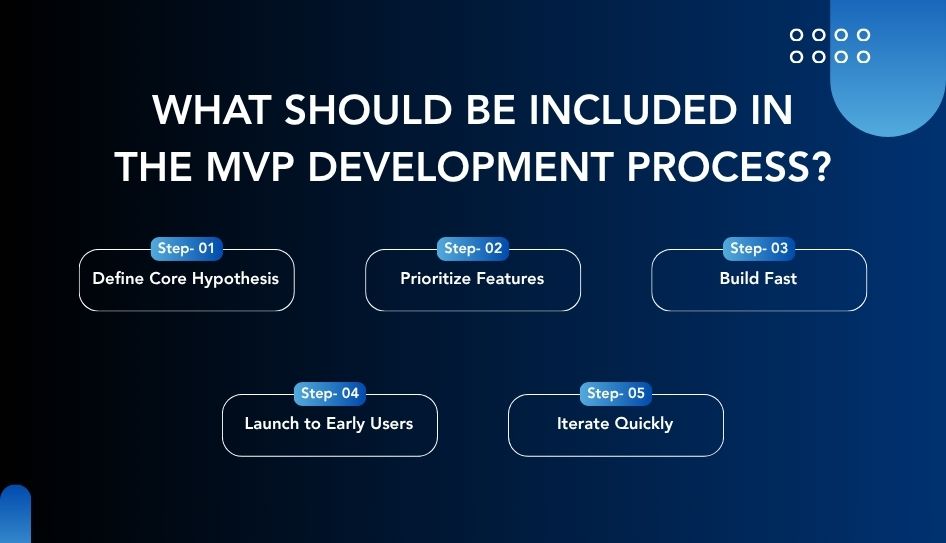
Once validation is strong, move into structured execution.
Step 1: Define Core Hypothesis
Example:
“Freelancers will pay monthly for automated tax tracking.”
Step 2: Prioritize Features
Use MoSCoW prioritization:
Must Have
Should Have
Could Have
Won’t Have
Step 3: Build Fast
Focus on speed and learning.
Not perfection.
Step 4: Launch to Early Users
Keep launch small.
Collect direct feedback.
Step 5: Iterate Quickly
The MVP development process is continuous refinement.
Every release should answer a learning question.
Common Startup Validation Mistakes
Avoid these costly errors.
Building Based on Personal Assumptions
Just because you need it doesn’t mean others do.
Asking Leading Questions
Bad:
“Wouldn’t this app be useful?”
Good:
“How do you solve this today?”
Ignoring Negative Feedback
Critical feedback improves your MVP for startups.
Listen carefully.
Validating Features Instead of Problems
People care about outcomes.
Not features.
When Is Your Idea Ready for MVP Development?
You’re ready when:
- Users clearly acknowledge the problem
- Multiple people express need
- Demand signals are measurable
- Your solution resonates
- Core use case is defined
At this stage, your MVP for startups becomes a strategic test rather than a blind gamble.
Final Thoughts
Building an MVP without validation is like writing code in the dark.
Validation gives direction.
It strengthens your minimum viable product strategy, sharpens startup product validation, improves the MVP development process, and helps you confidently validate startup idea assumptions before investing serious resources.
The best founders don’t build first.
They learn first.
Then they build with purpose.
And that’s exactly how great startups begin.
FAQs
What is the purpose of an MVP for startups?
An MVP for startups helps test market demand with minimal investment while collecting real user feedback.
How long does startup validation usually take?
Typically 2–8 weeks depending on audience access and testing methods.
What is startup product validation?
It is the process of confirming market demand before building a full product.
What is a minimum viable product strategy?
A minimum viable product strategy focuses on launching only essential functionality to test assumptions quickly.
Can I validate my startup idea without coding?
Yes. Landing pages, surveys, interviews, and concierge MVPs are excellent ways to validate startup idea concepts before development.