
Claude Automation in Enterprises: From Prompts to Scalable AI Systems
Introduction: The Shift from Prompts to Systems
Enterprises are rapidly moving beyond simple AI experiments, as seen in the rise of large language model adoption among them. What started as prompt-based interactions is now evolving into full-scale AI automation systems that power real business workflows.
Claude automation is at the centre of this shift.
In 2026, organisations are no longer asking, “How do we use AI?”
They are asking:
“How do we build scalable, reliable, and cost-efficient AI systems?”
This transition is a key step from isolated prompts to enterprise-grade automation frameworks that are deeply integrated into operations.
Why Prompt-Based AI Is No Longer Enough
Early adoption of generative AI focused heavily on prompts. Teams used tools like Claude for:
- Content generation
- Basic customer responses
- Internal knowledge queries
While useful, this approach has limitations.
Prompt-based usage is:
- Manual
- Inconsistent
- Difficult to scale
- Hard to integrate with business systems
As organisations grow, these limitations become operational bottlenecks.
This is why enterprises are shifting toward AI-powered workflow automation systems that remove dependency on manual prompting.
What is Claude Automation in Enterprises?
‘Claude automation’ refers to the use of Claude AI in structured workflows that automate tasks, decisions, and processes across the organisation.
Instead of isolated usage, Claude becomes part of a larger system architecture, connected to:
- APIs
- Databases
- Internal tools
- Business logic layers
This capability enables organisations to build intelligent, automated workflows that operate continuously without human intervention.
From Prompts to AI Systems: The Transformation
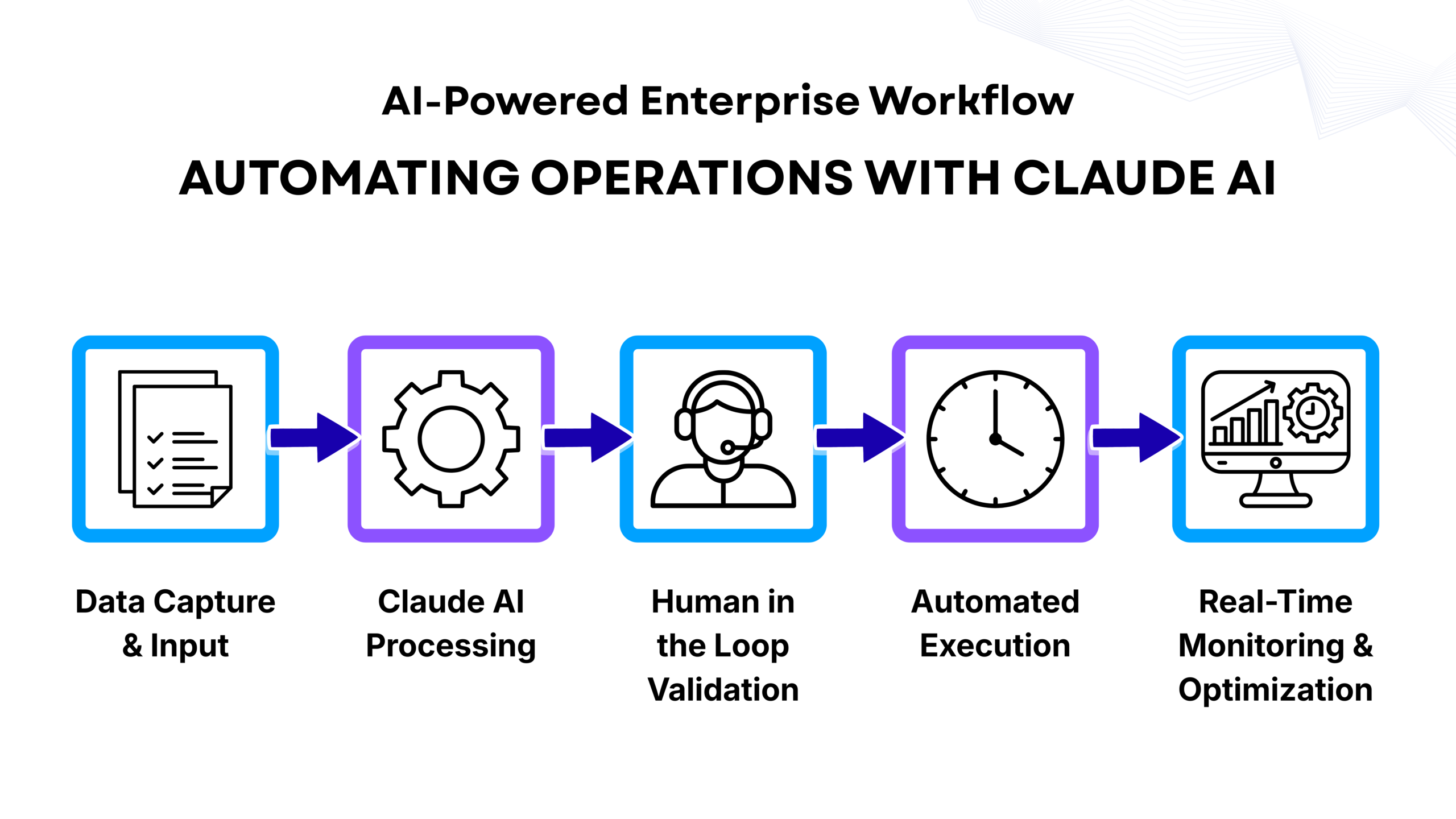
The real transformation happens when companies move through these stages:
1. Prompt-Based Usage
Teams interact with AI manually for specific tasks.
2. Workflow Automation
AI is integrated into workflows (e.g., customer support, document processing).
3. System-Level Integration
AI connects with enterprise systems (CRMs, ERPs, and HR platforms).
4. Autonomous AI Systems
AI agents operate workflows with minimal human input.
This evolution defines the future of enterprise automation.
Key Use Cases of Claude Automation
Claude automation is not theoretical. It is already being applied across industries.
1. Customer Support Automation
AI handles queries, escalations, and responses with contextual understanding.
2. Document Processing
Contracts, reports, and compliance documents are analysed and generated automatically.
3. Internal Knowledge Systems
AI-powered assistants help employees access company knowledge instantly.
4. Workflow Orchestration
Multi-step business processes are automated end-to-end.
5. Compliance and Reporting
AI ensures regulatory alignment and generates audit-ready reports.
The Rise of AI Agents and Workflow Systems
One of the biggest trends is the rise of AI agents, with companies exploring autonomous AI systems and agent-based workflows.
Unlike traditional automation tools, AI agents can:
- Make decisions
- Adapt to context
- Handle complex workflows
Claude is increasingly being used as the intelligence layer behind these agents.
This shift is moving enterprises toward autonomous business operations.
Why Enterprises Are Investing in Claude Automation
1. Operational Efficiency
AI reduces manual effort across workflows.
2. Cost Optimization
Automation lowers operational costs without reducing output.
3. Scalability
Systems can handle increasing workloads without hiring more teams.
4. Consistency
AI-driven processes eliminate human variability.
5. Speed
Tasks that took hours now take seconds.
This combination makes Claude automation a strategic investment, not just a technical upgrade.
Challenges in Scaling Claude Automation
Despite its advantages, many companies struggle to scale AI systems.
Common Challenges:
- Lack of system architecture
- Poor integration with existing tools
- Data inconsistency
- Governance and compliance issues
- Over-reliance on prompts
Most failures happen not because of AI but because of poor system design.
The Role of Enterprise AI Architecture
To scale Claude automation, companies need structured systems.
This includes:
- Workflow orchestration layers
- API integrations
- Data pipelines
- Monitoring systems
- Governance frameworks
This situation is where AI-powered enterprise systems become critical.
Organisations that invest in proper architecture can transform AI from a tool into a core business capability.
How FX31 Labs Enables Claude Automation at Scale
At FX31 Labs, we help enterprises move from experimentation to execution.
We design and implement systems for enterprise AI automation that integrate Claude into real business workflows.
Our approach focuses on:
- Building scalable AI architectures
- Automating complex workflows
- Ensuring compliance and governance
- Optimizing cost and performance
- Enabling AI-driven decision systems
To explore how organisations are implementing these systems, check out enterprise AI use cases.
The Future: Autonomous Enterprise Systems
The next phase of AI is not about better prompts.
It is about autonomous systems.
Enterprises are moving toward:
- Self-operating workflows
- AI-driven decision-making
- Real-time system intelligence
Claude automation is a key enabler of this transformation.
Early adoption of these systems will provide businesses a big competitive edge.
Final Thought
The shift from prompts to systems is not optional.
It is inevitable.
Enterprises that continue relying on manual AI usage will struggle to scale.
Those that invest in structured AI automation systems will lead.
Claude automation is not just a tool; it is the foundation of the next generation of enterprise systems.
FAQs
1. What is Claude automation in enterprises?
‘Claude automation’ refers to the integration of Claude AI into business workflows to automate tasks, decision-making, and processes at scale across enterprise systems.
2. How is Claude different from traditional automation tools?
Unlike rule-based automation tools, Claude uses advanced AI to understand context, generate responses, and handle complex workflows, making it more flexible and intelligent.
3. What are common use cases of Claude automation?
Claude automation is used for customer support, document processing, workflow automation, internal knowledge systems, and compliance reporting.
4. Can Claude automation replace manual workflows completely?
It can significantly reduce manual work, but most enterprises use it alongside human oversight for critical decisions and governance.
5. What are the challenges in implementing Claude automation?
Common challenges include system integration, data consistency, governance, and designing scalable AI architectures.
6. How can enterprises scale Claude automation effectively?
By building structured AI systems with proper architecture, integrating APIs, and using enterprise-level automation frameworks.