
Python for AI and ML: Why It’s Widely Used in Modern Product Development
Python has increasingly become the principal technology for artificial intelligence (AI), machine learning (ML), and modern software product development. A simple scripting language that was introduced in the early 1990s is now the first choice for AI and ML projects, amplifying everything from small start-up prototypes to sophisticated systems at tech giants. The blog takes a look at the journey of Python – from its history and evolution to its real-world business applications in 2026 – and how its unique strengths make it ideal for AI, ML, and innovation in product development. We will also talk about how FX31 Labs is using Python to put forward state-of-the-art solutions, followed by a quick FAQ section for common queries.
History of Python in AI, ML, and Software Development
Python was the programming language that was the brainchild of Guido van Rossum and was first offered to the public in 1991 as a general-purpose programming language that prioritized simplicity and readability. In the initial few years of its life, Python was mainly used in software development for purposes such as automation and web scripting, owing to its easy syntax and quick learning curve. Python’s popularity among the Developer community increased gradually and continuously by the late 1990s and early 2000s. The language was often evaluated against Perl in the scripting area and Java and C++ in the domain of large applications.
- Early Beginnings (1991–2000s)
Python was born in 1991, which is the year when it was developed by Guido van Rossum as a general-purpose language with simplicity and readability as its main characteristics. At the beginning, developers preferred using Python for scripting, automation, and building very small web applications. The user-friendly syntax and easy learning curve attracted programmers from both the academic and industry sides. - Adoption in Data Science
Python’s breakthrough came when the scientific community began adopting it in the 2000s. Libraries like NumPy and SciPy made Python a powerful tool for numerical computing. As data grew central to research and business, Python programming for data science surged. Tools like Pandas and Matplotlib made data cleaning and visualization simple, creating a foundation for ML adoption. - Rise of Machine Learning with Python
The late 2000s saw a growing interest in machine learning. Python responded with scikit-learn, a user-friendly library for classical ML algorithms like regression and classification. This marked a turning point. Python became a go-to for ML research and experimentation due to its balance of simplicity and capability. Developers could implement models quickly, with minimal code. - Open Source and Community Growth
Python’s growth was driven by its open-source model. Thousands of developers contributed to its ecosystem through PyPI. When deep learning rose to prominence, new Python libraries emerged: Theano, Keras, and later PyTorch and TensorFlow, all with Python-first APIs. This ensured Python remained central to every new development in AI and ML. - Python in Product Development
Python also gained traction in real-world applications. Reddit moved its backend from Lisp to Python in 2005. Django (released the same year) made Python a serious choice for web development. Google used Python extensively for internal tools. Python in software development wasn’t limited to prototypes; it powered scalable, production-ready systems. - From Teaching Tool to Tech Backbone
By the 2010s, Python was no longer just a beginner’s language. It became a core tool for startups, enterprises, and researchers. Its flexibility, vast library ecosystem, and community support helped cement Python for AI and ML as the industry standard and a trusted language for modern product development.
Evolution of Python & Modern Use in AI/ML (2026)
Fast-forward to 2026, and Python’s role in AI/ML and product development has only strengthened. The 2010s and early 2020s saw an explosion of AI capabilities, from advanced machine learning models to today’s era of generative AI, and Python has been at the heart of this evolution. Let’s look at Python’s modern use and why it remains the go-to language for AI and ML, even as technology continuously evolves:
Deep Learning Changed the Game
The rise of deep learning in the 2010s made Python essential. Tools like TensorFlow and PyTorch launched with Python-first APIs, forcing anyone working in AI to use them. This created a feedback loop; more developers used Python for AI and ML, which led to better libraries, stronger community support, and even wider adoption. Today, Python is standard for building everything from basic classifiers to advanced generative AI systems.
An End-to-End AI Toolset
Python offers robust tools for every stage of AI development:
- Data Handling: Pandas and NumPy help prepare and clean data efficiently—critical for AI success.
- Model Building: scikit-learn, XGBoost, Hugging Face Transformers, and others provide everything from traditional ML to cutting-edge NLP.
- Visualization: Tools like Matplotlib and Plotly simplify interpreting model results and building dashboards.
- Deployment: With FastAPI, Flask, ONNX, and TensorRT, Python models are now production-ready and scalable. Python also works well with cloud platforms, DevOps tools, and container systems.
Python has evolved from a scripting tool into a full-stack language for AI and ML development, with flexibility that supports everything from research to deployment at scale.
Performance, Talent, and Community: Why Python Still Leads in 2026
- Modern Python Is Fast Enough
While Python isn’t the fastest language, that rarely matters in AI. Core operations (like matrix computations) happen in optimized C/C++ or CUDA under the hood. Python acts as a high-level interface, simple and powerful. Python 3.11 and newer versions bring 10–30% speed boosts, and upcoming no-GIL projects may close the performance gap even further. Tools like Cython and JIT compilers offer more speed where needed. For most AI/ML tasks, Python’s balance of speed and flexibility beats lower-level languages in productivity and time-to-market. - The Default Language for AI Talent
Python dominates in education. Most AI courses, bootcamps, and university programs teach Python first. As a result, teams today, from junior developers to senior data scientists, are fluent in it. This lowers onboarding costs and ensures your product team shares a common toolset. Other languages (R, Julia, etc.) have niche appeal but lack Python’s talent pipeline. - Massive Community = Low Risk
Python’s open-source community is unmatched. New AI breakthroughs are often shared with Python libraries within days. Developers worldwide contribute tutorials, tools, and real-world solutions. This gives startups and product teams an edge: faster problem-solving, faster adoption of trends, and reduced reliance on internal expertise. It also means fewer blockers during development; there’s almost always an existing answer or working example.
Why It Matters for Product Teams
In 2026, Python’s evolution makes it more than a scripting tool; it’s a robust platform powering real-time AI systems, SaaS products, and large-scale data pipelines. Its speed, talent pool, and ecosystem give founders and product managers the confidence to build fast, iterate quickly, and scale with confidence.
Whether you’re building recommendation engines, automating workflows, or experimenting with generative AI, Python remains the most practical, future-ready choice.
Business Applications of Python in AI and Product Development
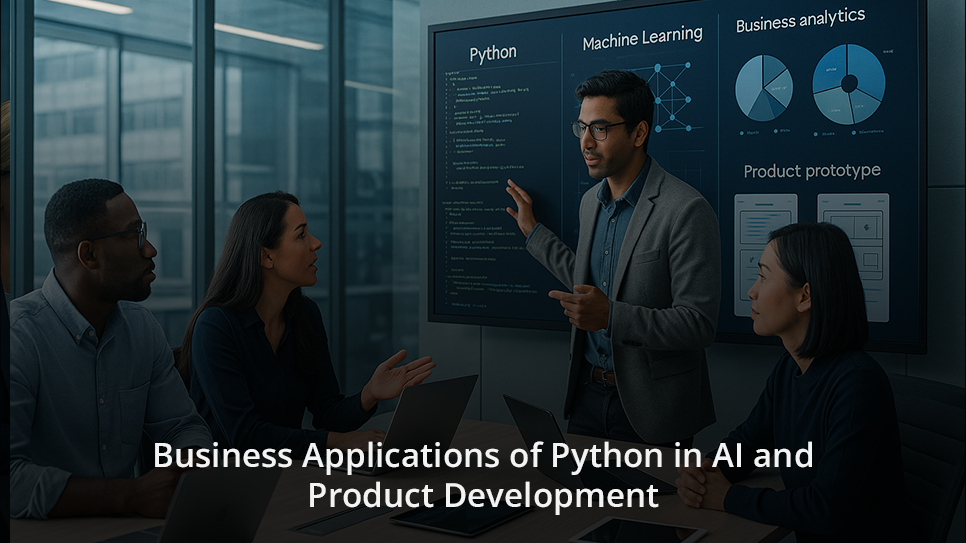
From a business perspective, the popularity of Python in AI/ML translates into concrete advantages. Whether you’re running a startup, a Software-as-a-Service (SaaS) company, or an enterprise organization, there are compelling reasons to leverage Python in software development, especially for products that involve data, automation, or AI-driven features. Here’s why business and product leaders should care about Python:
- Fast Prototyping and Time-to-Market
Python’s simple syntax and vast library ecosystem enable rapid development. Startups can build AI-powered prototypes, like recommendation engines or image classifiers, within days using pre-trained models. This speed helps product teams test ideas quickly and launch features faster than with complex languages. - Cost Efficiency with Ready-to-Use Tools
Python’s AI and ML development tools, like scikit-learn, PyTorch, TensorFlow, and spaCy, are open-source and production-ready. Teams save time and budget by reusing proven tools instead of building from scratch. This reduces development cost, especially for startups and fast-growing SaaS products. - Scalability for Real Products
Python scales. Large-scale companies use frameworks like Django, Flask, and FastAPI to serve millions of users. Python integrates well with big data tools (like Spark) and legacy systems, making it ideal for enterprise software development. You can scale out using microservices or APIs as your user base grows. - Used Across Industries
Python powers real products in finance (for trading algorithms), healthcare (for diagnostics and genomics), e-commerce (for personalization), media (for content recommendations), and manufacturing (for predictive maintenance and IoT). Its flexibility allows companies to build data-driven features across domains. - Lower Maintenance Costs
Readable code and strong community support make Python easy to maintain. New developers can onboard faster, updates are simpler, and there’s no vendor lock-in. Over time, this lowers the total cost of ownership while supporting faster iteration.
Why It Matters
For founders and product managers, Python offers the shortest path to building and scaling smart, AI-powered features. It balances speed, cost, flexibility, and long-term support, making it the go-to choice for AI and product development in 2026.
How FX31 Labs Helps (Our Approach with Python)
As a modern tech partner, FX31 Labs harnesses Python’s full potential to deliver AI, ML, and product development solutions for our clients. We understand that success in AI projects isn’t just about choosing the right language – it’s about having the right expertise and approach. Here’s how we leverage Python to help businesses build smarter products:
- Python Expertise That Delivers
Our team includes experienced Python developers and data scientists who build scalable AI, ML, and data-driven solutions. From Django to TensorFlow, we choose the right tools and write clean, maintainable code that supports rapid development and long-term growth. - End-to-End AI/ML Development
We handle the full lifecycle: data prep, model building, deployment, and integration. Whether you need a quick API-based solution or a custom ML algorithm, we tailor Python for AI and ML to your product’s needs, always focused on speed, quality, and scalability. - Stable, Flexible Codebases
We follow best practices, modular design, testing, and documentation—so your product is easy to update and extend. As your business evolves, our Python codebase is ready to support new features without major rework. - Seamless Integration
We connect Python services to your existing systems through APIs, microservices, or data pipelines. Whether it’s plugging ML into a mobile app or syncing with cloud infrastructure, we ensure smooth, disruption-free integration. - Transparent, Consultative Approach
We guide you through every step, from design to deployment, with clarity and zero jargon. Whether you’re a startup founder or a product manager, you’ll know exactly how our Python solutions align with your goals.
Want to build smarter with Python?
Let FX31 Labs help you turn AI and ML ideas into working, scalable products faster and with less risk.
FAQs
Q1. Why is Python widely used in AI and ML projects?
Python is easy to learn, has clean syntax, and supports major AI/ML libraries like TensorFlow, PyTorch, and scikit-learn. Its large community and rich ecosystem let developers build fast, experiment easily, and solve problems without starting from scratch.
Q2. Is Python the best programming language for AI and ML in 2026?
Yes. Python leads AI/ML in 2026 due to its tools, community support, and ease of use. It balances speed and productivity, integrates well with C/C++, and has wider adoption than R or Julia for AI development.
Q3. What are some real-world products built with Python for AI/ML?
Python powers AI at Instagram (feed ranking), Spotify (music suggestions), Netflix (user recommendations), Uber (demand forecasting), and OpenAI’s ChatGPT (training pipeline). It’s widely used in production, not just for prototyping.
Q4. How does Python handle performance demands in AI/ML?
Python relies on fast, optimized libraries (like NumPy, PyTorch) written in C/C++. For scaling, developers use tools like Dask, Spark, and Cython. Python acts as a high-level controller, with heavy tasks handled by efficient back-end systems.
Q5. How can I get started with Python for AI and ML?
Start with Python basics. Learn NumPy, Pandas, and scikit-learn. Try small projects, use platforms like Coursera and Kaggle, join developer communities, and build a GitHub portfolio. Practice consistently to build real AI skills in Python.