
Single Cloud or Multi-Cloud Strategy: Which Operating Model Fits Best?
Every cloud strategy conversation eventually lands on the same question, usually asked by someone in finance or security: one provider, or several?
In the single cloud vs multi cloud decision, single cloud wins on simplicity, cost predictability, and speed of execution. Multi-cloud wins on resilience, negotiating leverage, and avoiding vendor lock-in. The right answer depends less on which model is “better” and more on your risk tolerance, compliance requirements, and the size of the team managing it.
Here’s how to actually make that call for your organization.
What’s the Real Difference Between Single Cloud and Multi-Cloud?
A single cloud strategy means running your infrastructure on one provider – AWS, Azure, or GCP end to end. Everything from compute to storage to managed services lives inside one ecosystem, which keeps tooling, billing, and support consistent.
A multi-cloud architecture means deliberately running workloads across two or more providers, either splitting different applications across clouds or, in some cases, running the same workload redundantly across providers for resilience. It’s worth noting this is different from hybrid cloud, which combines public cloud with on-premises infrastructure – multi-cloud specifically means multiple public cloud vendors.
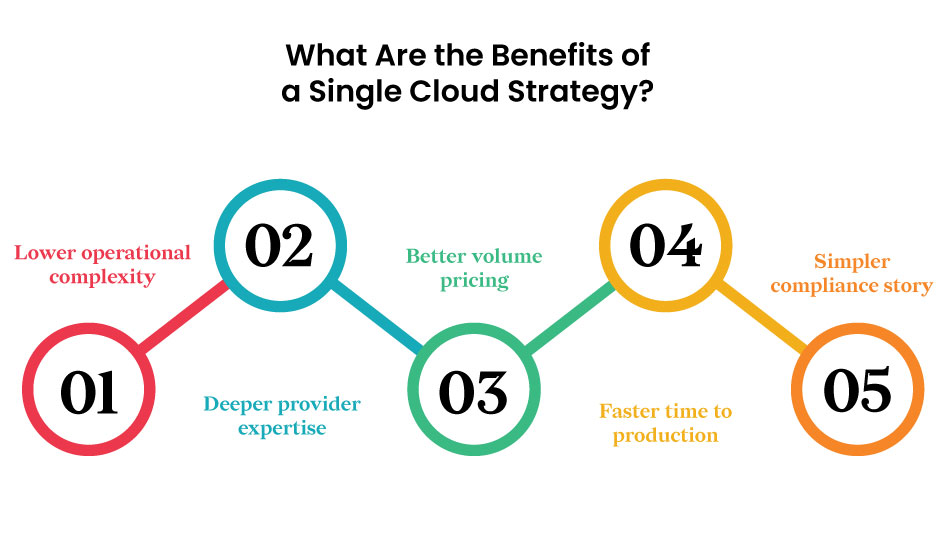
What Are the Benefits of a Single Cloud Strategy?
Simplicity is the whole pitch, and for a lot of organizations, it’s the right one.
- Lower operational complexity – one console, one set of APIs, one billing model, one security posture to manage
- Deeper provider expertise – your team goes deep on one platform instead of spreading thin across three
- Better volume pricing – consolidated spend usually unlocks stronger discount tiers and committed-use pricing
- Faster time to production – no cross-cloud networking, identity federation, or data-sync problems to solve first
- Simpler compliance story – one shared responsibility model, one audit trail, one set of certifications to track
What Are the Benefits of a Multi-Cloud Architecture?
The tradeoff runs the other way: more complexity, but more control over risk.
- No single point of failure – an outage with one provider doesn’t take down everything
- Avoids vendor lock-in – pricing and contract leverage improve when you’re not fully dependent on one vendor
- Best-of-breed selection – use each provider’s strongest service instead of settling for one platform’s weaker offering in a given category
- Regulatory and data residency flexibility – easier to meet region-specific compliance requirements across providers
- Negotiating leverage – enterprise cloud contracts get more competitive when a provider knows you’re not locked in
Single Cloud vs. Multi-Cloud: Side-by-Side Comparison
| Factor | Single Cloud Strategy | Multi-Cloud Architecture |
| Operational complexity | Low | Higher — requires cross-cloud skills and tooling |
| Cost predictability | High — one billing model, volume discounts | Lower initially, but reduces long-term lock-in risk |
| Resilience | Dependent on one provider’s uptime | Higher — workload can shift if one provider fails |
| Vendor lock-in risk | Higher | Lower |
| Talent requirements | Deep expertise in one platform | Broader skill set across multiple platforms |
| Compliance management | Simpler — one shared responsibility model | More complex, but more flexible for data residency needs |
| Time to production | Faster | Slower — cross-cloud integration takes longer to set up |
| Best fit | Startups, mid-size teams, single-region operations | Large enterprises, regulated industries, global operations |
When Does a Single Cloud Strategy Actually Make Sense?
A single cloud strategy is usually the right call when:
- Your team is small or mid-sized and can’t realistically staff multi-cloud expertise
- Speed to market matters more than redundancy at this stage
- Your workloads are concentrated in one region with straightforward compliance needs
- You’re early in cloud adoption and still building operational maturity
- Cost predictability matters more than provider flexibility right now
Most companies migrating to the cloud for the first time are better served starting here and expanding deliberately, rather than architecting for multi-cloud complexity before there’s a workload that actually needs it.
When Does Multi-Cloud Architecture Make Sense?
A multi-cloud strategy earns its complexity when:
- Downtime carries a high financial or reputational cost, and redundancy across providers is worth the overhead
- You operate in multiple regulatory jurisdictions with different data residency rules
- You’re a large enterprise cloud strategy with the team size to actually manage cross-cloud operations
- You’ve hit meaningful vendor concentration risk and need contract leverage
- Different workloads genuinely benefit from different providers’ specialized services (AI/ML tooling, data warehousing, etc.)
The mistake we see most often is enterprises adopting multi-cloud for the idea of flexibility without the team or tooling maturity to run it well – which usually ends up costing more than the lock-in risk it was meant to solve. Our breakdown of how to structure multi-cloud engineering teams across AWS, Azure, and GCP covers what that operational maturity actually requires in practice.
How Do You Decide Which Cloud Operating Model Fits Your Enterprise?
Run through these questions before committing either direction:
- What’s the actual cost of downtime for our critical workloads? If it’s low, a single cloud’s simplicity usually wins.
- Do we have — or can we build — the team to manage cross-cloud operations? Multi-cloud without the right team creates more risk than it removes.
- What are our compliance and data residency requirements? If they vary significantly by region, multi-cloud may be necessary rather than optional.
- How exposed are we to one vendor’s pricing and contract terms? High concentration risk is a real argument for diversification.
- Are we solving for a real requirement, or for flexibility we don’t currently need? This is where most over-engineered cloud strategies start.
Common Mistakes When Choosing a Cloud Operating Model
- Choosing multi-cloud as a default “best practice” instead of a response to a specific business requirement
- Underestimating the skills gap – multi-cloud requires meaningfully broader expertise than most teams currently have, which is often where bringing in outside engineering support makes more sense than trying to build every skill in-house at once
- Ignoring data transfer costs between providers, which can quietly erode the savings multi-cloud was supposed to deliver
- Treating hybrid cloud and multi-cloud as the same decision – they solve different problems and shouldn’t be conflated in planning
- Locking into single cloud without exit planning – even a single-cloud strategy should keep some portability in mind for future negotiating leverage
The Bottom Line
The single cloud vs multi cloud decision isn’t about which model is objectively better; it’s about matching the operating model to your actual risk profile, compliance needs, and team maturity. Most organizations are better served starting with a single cloud strategy and expanding deliberately than adopting multi-cloud complexity before there’s a real requirement driving it.
If you’re evaluating which cloud operating model fits your organization, our cloud and DevOps services team at Fx31 Labs can help assess your current architecture and map out what a realistic transition looks like either way. For teams already leaning toward multi-cloud, our guide on building multi-cloud engineering teams across AWS, Azure, and GCP is a useful next step for planning the operational side, and our cloud migration trends for 2025 post covers how this decision fits into broader CTO cloud strategy.
FAQ
Is multi-cloud always more expensive than single cloud?
Not always, but it’s more expensive to operate well. Licensing and computer costs can be comparable, but the operational overhead; tooling, cross-training, and management complexity – adds real cost that’s easy to underestimate upfront.
What’s the difference between multi-cloud and hybrid cloud?
Multi-cloud means using two or more public cloud providers. Hybrid cloud means combining public cloud with private, on-premises infrastructure. They’re often discussed together but solve different problems and require different planning.
Can a company switch from single cloud to multi-cloud later?
Yes, and many do; starting single cloud and expanding to multi-cloud as scale, compliance needs, or resilience requirements grow is a common and often smarter path than starting with full multi-cloud complexity before it’s needed.
Does multi-cloud actually reduce vendor lock-in?
Yes, meaningfully. Running workloads across providers gives you real negotiating leverage and reduces dependency risk, though it requires deliberate architecture- simply having accounts with multiple providers without designed portability doesn’t achieve this on its own.
Is single cloud a risk for large enterprises?
It can be, particularly for organizations where downtime has a high financial cost or where regulatory requirements span multiple regions. For many large enterprises, the resilience and compliance flexibility of multi-cloud outweighs the added complexity.
How do I know if my team is ready for multi-cloud?
If your team is still building foundational cloud operations expertise on one platform, it’s usually not ready. Multi-cloud readiness shows up as strong automation, infrastructure-as-code maturity, and cross-platform skills already in place- not something to build simultaneously with the migration itself.