
.NET vs Node.js: Choosing the Right Backend Framework for Enterprise Apps in 2026
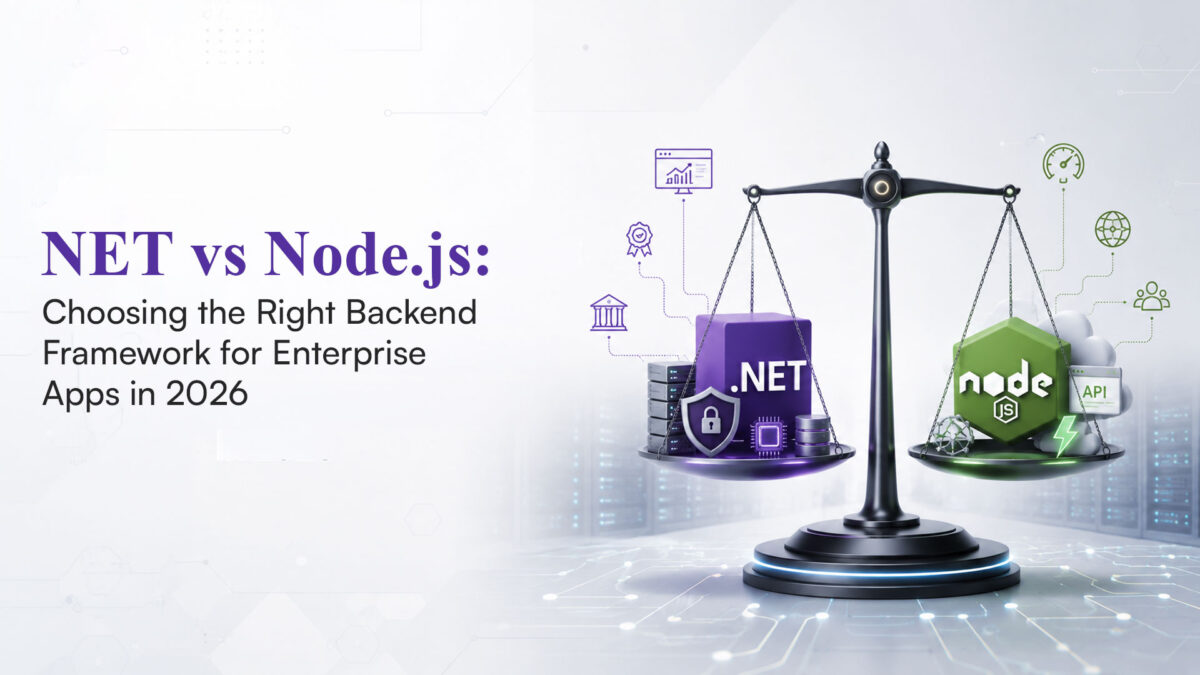
.NET vs Node.js is not a conversation simply reliant on personal preference but more on the type of workload a business handles. .NET is preferable for CPU-heavy and compliance-driven enterprise systems which have built-in security and strong typing.
On the other hand Node.js is suitable for I/O heavy and high-concurrency applications where pace of operating matters.
Most of the modern enterprises are not choosing one option over another, instead they operate according to their workload.
What’s the Real Difference Between .NET and Node.js?
.NET is a stable and statically typed framework curated by Microsoft, running on the CLR (Common Language Runtime) with C# as its primary language. Node.js is a JavaScript runtime built on Chrome’s V8 engine, designed around an event-driven, non-blocking I/O model.
Both these models are tried and tested at enterprise scale, both have large user communities, and both will still be relevant in five years. So the .NET vs Node.js debate isn’t really about which one is better, it’s more about what fits your way of operating and what problem you’re looking to solve.
The distinction that actually matters for enterprise backend development isn’t “which is newer” or “which is more popular”, it’s how each one handles work:
- .NET uses a multi-threaded model well suited to compute-intensive tasks — complex business logic, heavy calculations, large enterprise integrations.
- Node.js uses a single-threaded, event-loop model well suited to I/O-intensive tasks- API gateways, real-time features, high volumes of concurrent, lightweight requests.
Neither is objectively “faster.” They’re optimized for different kinds of load, and that’s the lens enterprise teams should be using instead of raw benchmark numbers.
Why Does Choosing a Backend Framework in 2026 Matter More Than It Used To?

Making the correct choice along with accurate decision making in your backend framework will eventually stack up and show in the status of the business.
Modern businesses aren’t just building single delivery channels and start shipping, they are building distributed systems, AI-integrated platforms and microservices which need continued scalability for years.
Choosing backend framework 2026 decisions now has to account for a few things that weren’t as pressing five years ago:
- Cloud-native deployment as the default, not the exception
- Rising expectations for real-time features (chat, live dashboards, notifications)
- Integration with AI services and third-party APIs at a much higher volume
- Talent availability- hiring for a framework your team can actually staff and maintain
Getting this decision wrong doesn’t usually show up on day one. It shows up eighteen months in, when the team is fighting the framework instead of building on it.
How Does Node.js vs .NET Performance Actually Compare?
Node.js vs .NET performance depends entirely on what you’re measuring. Here’s how they typically compare across common enterprise scenarios:
| Scenario | Node.js | .NET |
| High-concurrency API requests (I/O bound) | Excellent- non-blocking event loop handles thousands of simultaneous connections efficiently | Good, but thread-per-request overhead can add up at extreme scale |
| CPU-intensive processing (reports, calculations, ML inference) | Weaker — single-threaded model bottlenecks under heavy computation | Strong- multi-threaded execution handles compute-heavy work natively |
| Real-time features (chat, live feeds, streaming) | Strong — built for event-driven, low-latency communication | Solid with SignalR, but not its core strength |
| Startup and iteration speed | Fast — smaller footprint, quick to prototype and deploy | Slower to start, but mature tooling pays off at scale |
| Large enterprise system integration | Capable, but often needs more custom tooling | Strong – deep first-party support for enterprise identity, data, and legacy systems |
The takeaway: if your workload is mostly moving data around quickly and handling many simultaneous users, Node.js tends to perform well. If your workload involves heavy processing, complex business rules, or deep integration with existing enterprise infrastructure, .NET usually pulls ahead.
Which Framework Offers Better Enterprise Backend Development for Security and Compliance?
.NET boasts a better structure. It ships with built-in identity management, role-based access control, and mature support for regulated environments – which matters for enterprise backend development in finance, healthcare, and government where audit requirements are non-negotiable.
Node.js can always be secured according to enterprise standards, it generally needs assembling of the stack yourself, middleware for authentication, third-party libraries for managing roles and added manual configuration to reach the same level of compliance.
Neither gap is disqualifying. It’s a difference in how much you build versus how much comes out of the box, and that has a direct effect on project timelines.
How Do You Build a Scalable Backend Architecture With Either Framework?
Scalable backend architecture is not just a function of the framework alone, it’s also about how the system is designed. Each and every framework will nudge you towards different patterns.
With Node.js, scalable backend architecture usually means:
- Horizontal scaling with lightweight, stateless services
- Microservices communicating over message queues
- Offloading CPU-heavy work to separate services or worker processes
With .NET, scalable backend architecture usually means:
- Vertical scaling supported by efficient multi-threaded processing
- Strong support for containerization and orchestration via Kubernetes
- Built-in tooling for caching, load balancing, and distributed systems through Azure or comparable cloud platforms
Both models will provide you with a scalable system, the only difference is in between defaults. Node.js promotes small, fast services whereas .NET gives you room to build fewer yet powerful ones.
Which One Should Enterprises Choose in 2026?
There’s no universal winner in the .NET vs Node.js debate, but there are clear signals for each:
Choose Node.js when:
- You need real-time features (live dashboards, chat, notifications)
- Your team is JavaScript-heavy across front and back end already
- You’re prioritizing fast iteration and rapid MVP delivery
- Your workload is I/O-heavy with high concurrency
Choose .NET when:
- You’re operating in a regulated industry with strict compliance needs
- Your system involves heavy computation or complex business logic
- You need deep integration with existing Microsoft or enterprise infrastructure
- Long-term maintainability by a large team matters more than initial build speed
Consider a hybrid approach when:
- Different parts of your system have genuinely different workload profiles
- You’re modernizing a legacy platform incrementally rather than rewriting it wholesale
Many businesses make the choice tailored to their practise. Using Node.js for customer-facing, high-concurrency layers and .NET for the compliance-heavy backend core, connected through well-defined APIs.
How Do Cloud-Native and AI Workloads Change the .NET vs Node.js Decision in 2026?
Modern enterprise backends rarely run individually or in isolation, most are calling AI services, streaming data to dashboards and running inside contained cloud environments. This makes certain consideration points to shift in the comparison:
Container footprint — Node.js applications operate in a way where they produce smaller container images and faster cold starts, which is essential for serverless and auto-scaling deployments.
- AI/ML integration – .NET has significantly reduced the gap with libraries like ML.NET and strong Azure AI integration, while Node.js is still the faster path for wiring together third-party AI APIs quickly.
- Event-driven architecture – both frameworks support message queues and event streaming well, but Node.js’s non-blocking model maps naturally onto event-driven, cloud-native patterns.
This is why choosing backend framework 2026 decisions increasingly happen at the service level rather than the application level -a single enterprise platform might run Node.js for its AI-integration and real-time layers, and .NET for the transactional core that needs strict consistency and compliance.
How Do Team Skills and Cost Factor Into the Decision?

The .NET vs Node.js choice isn’t only technical – it’s also a staffing decision, and that side of it often gets underweighted.
- Node.js teams are usually cheaper to build because JavaScript talent is abundant, and full-stack developers can move between front-end and back-end work without switching languages. That said, senior Node.js engineers who can architect scalable backend architecture correctly and not just write API routes which are harder to find than the raw talent pool suggests.
- .NET teams tend to cost more per hire in some markets, but the ecosystem’s structure, tooling, and documentation mean mid-level developers can be productive faster within established enterprise patterns.
- Licensing is no longer a major factor, .NET has been open-source and cross-platform since .NET Core, so the old “Node.js is free, .NET costs money” argument doesn’t really hold up in 2026.
For most enterprises, the real cost driver isn’t the framework license – it’s how long it takes to hire, onboard, and retain developers who can maintain the system for the next three to five years.
What Does Migration or Modernization Look Like If You Choose Wrong?
Switching frameworks after a system is live is expensive, but not as rare as it sounds — plenty of enterprises modernize a legacy .NET or Java system as it starts to strain, or migrate performance-critical services into Node.js once real-time demands grow. If you’re already carrying legacy technical debt, that decision connects directly to how you approach legacy code modernization and cloud migration strategy for enterprises more broadly — the backend framework choice is one piece of a larger infrastructure roadmap, not an isolated decision.
Making the Right Call for Your 2026 Roadmap
The .NET vs Node.js decision isn’t about picking the trendier option, it’s more about matching a framework to your actual workload, compliance needs, and team’s long-term ability to maintain the system. Get the fundamentals right- concurrency needs, security requirements, and scalable backend architecture. Either framework can support serious enterprise growth. If you’re weighing this decision for an upcoming project, our teams building with Node.js and .NET can help you assess your specific workload before you commit to an architecture.
Frequently Asked Questions
1. Is Node.js faster than .NET?
It depends on the workload. Node.js vs .NET performance favors Node.js for high-concurrency, I/O-bound tasks like APIs and real-time features. .NET performs better for CPU-intensive processing and complex business logic.
2. Is .NET more secure than Node.js?
.NET has more built-in security and compliance tooling out of the box, which gives it an edge for regulated industries. Node.js can reach the same security standard, but it usually requires more manual setup and third-party libraries.
3. Can Node.js handle enterprise-scale applications?
Yes. Companies like Netflix and PayPal run large-scale production systems on Node.js. It handles enterprise scale well, particularly for high-concurrency, real-time, and API-driven workloads.
4. Is .NET or Node.js better for microservices?
Both work well for microservices. Node.js is often favored for lightweight, fast-scaling services, while .NET is favored when services need heavier processing or tighter integration with enterprise systems.
5. Do I need to choose only one framework for my enterprise app?
No. A growing number of enterprises use both-Node.js for customer-facing, high-concurrency layers and .NET for compliance-heavy or compute-intensive backend services, connected through APIs.