
Generative AI in Healthcare: From Virtual Assistants to Clinical Intelligence
Healthcare is undergoing a profound transformation. What once existed only in research labs and futuristic imagination is now an everyday operational reality powered by Generative AI in Healthcare and advanced digital health technologies. Generative AI in healthcare is leading the way in innovation.
From AI-driven virtual assistants that engage patients 24/7 to intelligent clinical decision support systems that assist with diagnosis and treatment planning, AI in the healthcare industry is reshaping how care is delivered, experienced, and optimised. These innovations enable healthcare providers to improve patient engagement, streamline workflows, and strengthen clinical intelligence across hospitals and care networks.
Generative AI in healthcare is revolutionising patient care and administrative processes.
This evolution is not merely about automation or efficiency gains. It represents intelligent augmentation where healthcare AI solutions enhance human expertise, support evidence-based decision-making, improve patient outcomes, and build scalable, data-driven healthcare systems designed for the future.
Who This Blog Is For
This blog is designed for:
- Healthcare CIOs & CTOs
- Digital Health & Innovation Leaders
- Hospital Administrators
- HealthTech Startups
- Product & Engineering Teams building healthcare AI solutions
If you are exploring AI in healthcare, clinical decision support systems, AI chatbots, predictive analytics, or healthcare automation, this guide will give you clarity and direction.
Why Generative AI Matters in Healthcare
Understanding the role of Generative AI in Healthcare is crucial for modern practices.
Generative AI refers to advanced machine learning models, including large language models (LLMs) and deep learning architectures, capable of generating insights, structured content, and predictive outputs from complex medical data.
In healthcare, this enables:
- Conversational patient engagement
- Automated clinical documentation
- Personalized treatment recommendations
- AI-powered clinical decision support
Unlike traditional rule-based systems, generative AI understands context, medical terminology, and nuanced patient data, making it suitable for real-world clinical environments.
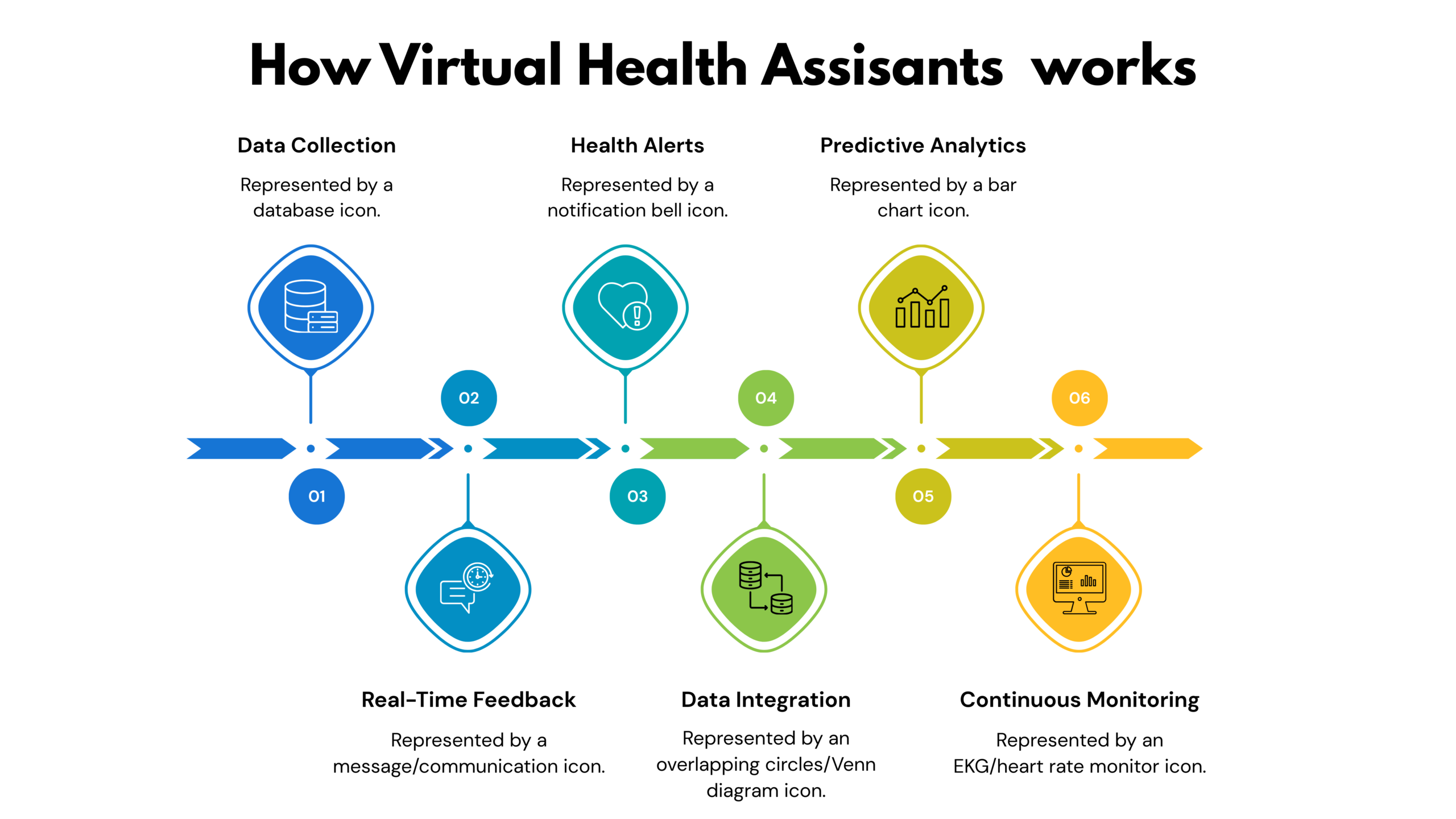
Virtual Assistants & AI Chatbots: The First Line of Interaction
One of the most visible applications of generative AI in healthcare is AI-powered virtual assistants.
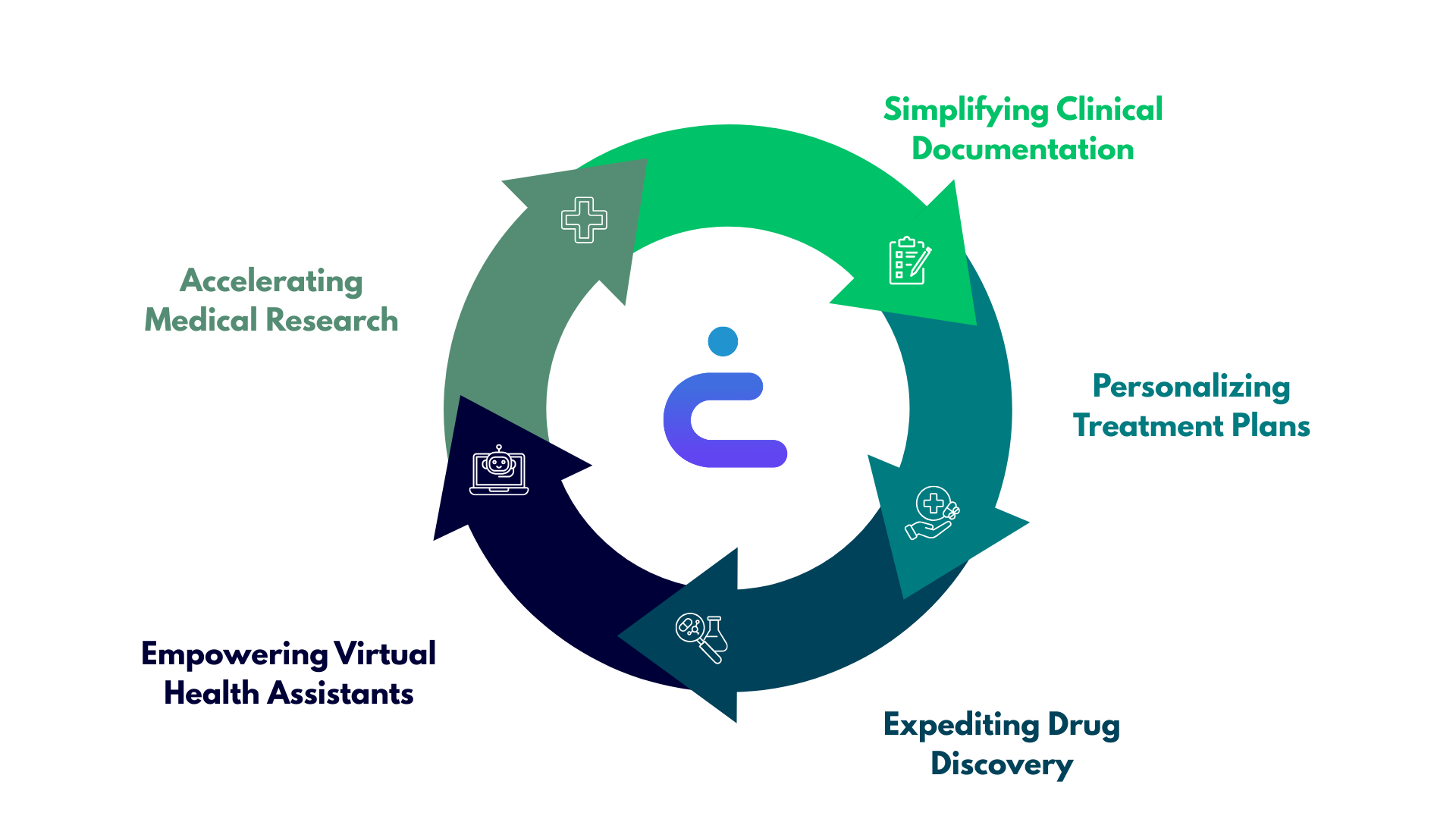
Applications of Generative AI in Healthcare include enhanced patient interactions and tailored treatment plans.
These intelligent healthcare chatbots:
- Answer patient queries instantly.
- Schedule appointments.
- Provide symptom triage guidance.
- Deliver medication reminders.
- Support post-discharge follow-ups.
By leveraging Natural Language Processing (NLP), these systems understand patient concerns conversationally, improving accessibility, especially for remote and underserved populations.
Impact:
- Reduced call center burden
- Improved patient satisfaction
- 24/7 healthcare access
- Lower operational costs
Virtual assistants are no longer optional; they are becoming the digital front door of modern healthcare systems.
Clinical Documentation & Physician Burnout Reduction
Physicians often spend nearly half of their time documenting. Generative AI addresses this pain point directly.
AI-powered systems can:
- Transcribe doctor-patient conversations.
- Generate structured clinical notes.
- Summarise patient histories.
- Auto-fill Electronic Health Records (EHRs)
This reduces cognitive load and administrative fatigue, two major contributors to clinician burnout.
Beyond documentation, AI also assists with:
- Medical coding
- Insurance claims automation
- Revenue cycle management
The result? More time for patient care and less time on paperwork.
Advancing Clinical Intelligence: AI-Augmented Diagnostics and Decision Support
Healthcare is entering a new era where generative AI is no longer limited to administrative assistance; it is becoming an active contributor to clinical insight. This evolution toward AI-powered clinical intelligence enables healthcare systems to move from basic automation to informed decision augmentation.
Generative AI in Healthcare is reshaping diagnostics and treatment options with data-driven insights.
Modern AI models can process vast and complex datasets, including electronic health records (EHRs), diagnostic imaging, lab results, genomic data, and longitudinal treatment histories. By identifying patterns across these diverse data sources, AI systems can surface insights that may otherwise go unnoticed in time-sensitive clinical environments.
These systems assist healthcare professionals by:
- Recognizing subtle disease indicators at earlier stages
- Highlighting potential risk factors based on patient history
- Supporting differential diagnosis with data-backed suggestions
- Recommending evidence-informed treatment options
Importantly, AI functions as a clinical support layer, not a replacement for medical expertise. Physicians remain central to final decision-making, while AI enhances precision, consistency, and speed.
For instance, AI-powered imaging tools can detect anomalies with high sensitivity, predictive analytics can identify patients at risk of readmission, and personalised treatment models can adapt therapies to individual genetic profiles.
This transition from reactive intervention to proactive, predictive healthcare represents a major milestone in digital health innovation.
Personalized & Preventive Healthcare
As we explore Generative AI in Healthcare, we uncover new possibilities for patient engagement.
Generative AI enables hyper-personalised healthcare experiences.
By synthesising patient data with medical research, AI systems can generate:
- Customized care plans
- Lifestyle and diet recommendations
- Preventive health alerts
- Mental health conversational support
AI mental health assistants using CBT-based models are expanding access to therapy support, especially in regions with limited mental health professionals.
This creates a scalable pathway for preventive and continuous care, not just episodic treatment.
With Generative AI in Healthcare, the focus shifts to proactive patient management.
Operational Intelligence & Healthcare Optimization
Beyond patient care, generative AI improves hospital operations.
AI models can optimise:
- Bed allocation
- Staff scheduling
- Emergency room flow
- Supply chain management
- Resource utilization
Predictive analytics also enable proactive intervention for chronic disease management, reducing readmission rates and improving overall system efficiency.
Operational AI is becoming as critical as clinical AI.
Challenges & Responsible AI in Healthcare
Despite the promise, generative AI must be implemented responsibly.
Key challenges include:
Data Quality & Bias
Incomplete or biased datasets can impact fairness and outcomes.
Privacy & Compliance
Strict adherence to HIPAA, GDPR, and healthcare regulations is mandatory.
Clinical Validation
AI recommendations require oversight by qualified medical professionals.
Healthcare AI must balance innovation with governance, transparency, and ethical safeguards.
How FX31 Labs Enables Healthcare AI Transformation
At FX31 Labs, we help healthcare innovators deploy secure, compliant, and scalable generative AI systems.
Our expertise includes:
- AI-powered healthcare chatbots
- Clinical documentation automation
- Intelligent decision-support platforms
- Predictive analytics engines
- AI governance and compliance frameworks
We focus on building enterprise-grade healthcare AI solutions that integrate seamlessly with existing hospital systems while ensuring data privacy and regulatory compliance.
Explore real-world healthcare AI implementations here: FX31 Use Cases
The Future of Generative AI in Healthcare
The future of Generative AI in Healthcare holds immense potential for innovation.
Emerging trends include:
- AI-assisted prescription management
- Advanced clinical co-pilots
- Multimodal AI combining imaging, text, and genomics
- Real-time patient monitoring through AI agents
As AI systems evolve, the shift will move from automation to true clinical augmentation intelligence.
Healthcare organisations that adopt generative AI strategically today will define the standard of care tomorrow.
FAQs
- Is generative AI replacing healthcare professionals
No. It augments clinicians by improving efficiency and supporting better decision-making. - What are the top AI use cases in healthcare?
Virtual assistants, clinical documentation automation, predictive analytics, clinical decision support, and personalised care. - How does AI improve patient outcomes?
Through early detection, personalised treatment plans, reduced administrative delays, and improved access to care. - What are the risks?
Data bias, privacy concerns, and the need for regulatory compliance and clinical validation. - How can hospitals start implementing generative AI?
Begin with high-impact use cases such as documentation automation or patient chatbots, ensure compliance frameworks are in place, and partner with experienced AI solution providers like FX31 Labs.