
Enterprise Digital Transformation with AI: Strategies & Key Challenges
In today’s corporate world, digital transformation is not just a competitive edge—it’s essential for a company’s survival. Artificial Intelligence (AI) is central to this shift, serving as the catalyst that overhauls business processes, customer engagement, and operational effectiveness. To manage this change successfully, organizations must create a strong digital transformation strategy that positions AI not as a mere feature, but as the core of their future operational blueprint.
This detailed guide will outline key strategies for utilizing AI in this transformation and examine the substantial hurdles associated with enterprise AI adoption.
The Imperative of AI in Digital Transformation
Digital transformation is fundamentally about using technology to create new or modify existing business processes, culture, and customer experiences to meet changing business and market requirements. Historically, this involved shifts to cloud computing, mobile enablement, and data analytics. Today, FX31 Labs is driving the next wave powered by AI.
FX31 Labs’ approach to AI in digital transformation moves beyond simple automation. We introduce intelligence at every touchpoint, allowing our clients to:
- Predict and personalize: Anticipate customer needs with unprecedented accuracy, leading to hyper-personalized services and products.
- Optimize complex operations: Use machine learning to find efficiencies in supply chains, manufacturing, and logistics that are invisible to human analysis.
- Innovate rapidly: Accelerate research and development cycles by simulating complex scenarios and generating new product ideas.
- Enhance decision-making: Provide leaders with real-time, data-driven insights, moving away from intuition-based choices.
The integration of FX31 Labs’ AI-driven business solutions is thus the most critical component of a successful, modern digital transformation initiative.
Core Strategies for Successful AI-Powered Digital Transformation
A successful transformation journey requires more than just purchasing AI software; it demands a fundamental shift in organizational structure, skillsets, and mindset.
1. Develop a Digital Transformation Strategy Focused on Value
The starting point must be strategic, not technological. A successful digital transformation strategy must clearly link AI initiatives to measurable business outcomes.
- Identify High-Impact Use Cases: Focus initially on areas where AI can deliver the fastest and highest return on investment (ROI). This might be customer service (via conversational AI), fraud detection, or predictive maintenance. Avoid the temptation to implement AI everywhere at once.
- Define Success Metrics: Before launch, establish key performance indicators (KPIs) such as reduction in operational costs, increase in customer lifetime value, or speed-to-market improvements. These metrics ensure AI projects remain aligned with the larger business goals.
- Iterative, Agile Implementation: Adopt an agile approach. Start with minimal viable products (MVPs), gather feedback quickly, and iterate. This de-risks large investments and builds organizational confidence in AI’s capabilities.
2. Establish Data Governance and Infrastructure Framework
AI is only as good as the data it consumes. For successful enterprise AI adoption, a solid data foundation is non-negotiable.
- Data Quality and Curation: Implement processes to ensure data is accurate, complete, and consistent across all enterprise systems. This often involves migrating fragmented data silos into a unified data lake or data warehouse.
- Ethical AI and Governance: Define clear policies for how data is collected, stored, and used. This addresses privacy concerns (e.g., GDPR, CCPA) and ensures the responsible deployment of AI models, preventing bias and promoting transparency.
- Cloud-Native Infrastructure: Modern AI models require scalable and flexible computing power. Leveraging cloud platforms (AWS, Azure, GCP) provides the necessary infrastructure for rapid experimentation and deployment of complex machine learning models.
3. Cultivate an AI-Ready Culture and Talent Pool
Technology adoption falters without cultural alignment. Transformation is as much about people as it is about technology.
- Upskilling and Reskilling: Invest heavily in training programs to equip existing employees with the skills necessary to work alongside AI. This includes data literacy for all employees and specialized training for data scientists, ML engineers, and prompt engineers.
- Fostering Collaboration: Break down traditional departmental silos. Successful AI projects require close collaboration between IT, data science, and business units to ensure solutions are both technically sound and practically useful.
- Championing Change: Secure executive buy-in and create internal champions who advocate for the transformation. Leadership must communicate a compelling vision of how AI will enhance, not replace, human roles.
Navigating the Key Challenges of AI in Business
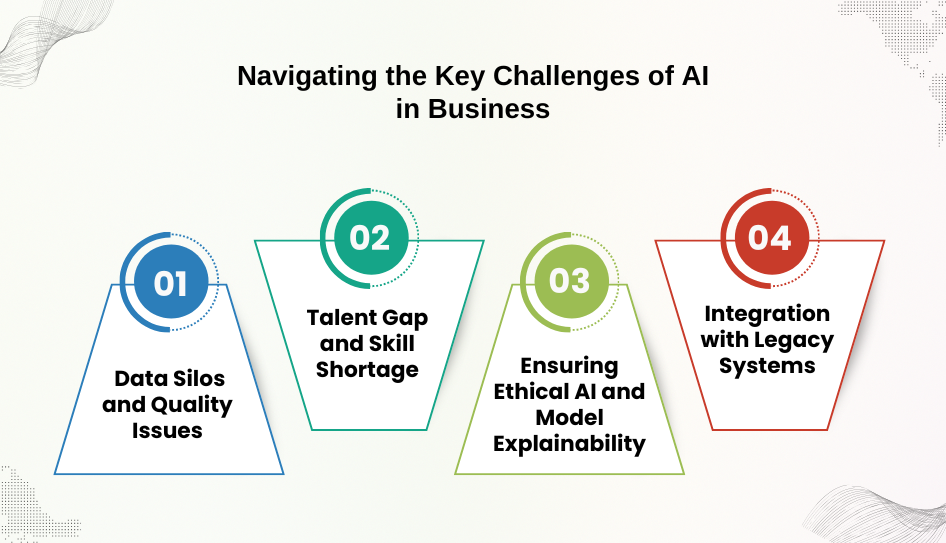
While the opportunities are vast, organizations face significant hurdles when implementing AI in digital transformation. Addressing these challenges of AI in business proactively is essential for success.
Challenge 1: Data Silos and Quality Issues
Many enterprises struggle with legacy systems that trap data in isolated departmental silos, making it inaccessible for training effective AI models. Furthermore, historical data often suffers from inconsistencies, missing values, or inherent biases.
- Mitigation: Prioritize data unification projects. Invest in Master Data Management (MDM) tools and data cataloging solutions to map, clean, and standardize data assets across the organization.
Challenge 2: Talent Gap and Skill Shortage
The demand for specialized AI talent (data scientists, ML engineers) far outstrips supply. Even if external talent is secured, integrating them into the existing organizational structure can be difficult.
- Mitigation: Focus on creating a Center of Excellence (CoE) for AI within the organization. This allows specialized talent to support various business units and facilitates the transfer of knowledge. Simultaneously, double down on upskilling existing IT and business analysts.
Challenge 3: Ensuring Ethical AI and Model Explainability (Trust)
AI models, particularly complex deep learning networks, can operate as “black boxes,” making it difficult to understand how they arrive at a decision. This lack of transparency poses regulatory and ethical risks, especially in sensitive areas like lending, hiring, or healthcare.
- Mitigation: Adopt Explainable AI (XAI) tools and techniques. Implement rigorous internal auditing procedures to detect and mitigate algorithmic bias. Create a dedicated AI Ethics Committee to oversee the design and deployment of sensitive models.
Challenge 4: Integration with Legacy Systems
Existing IT infrastructure is often rigid, making the integration of modern, flexible AI-driven business solutions difficult, slow, and expensive. This can limit the scalability of successful pilot projects.
- Mitigation: Utilize API-first integration strategies. Modernize core legacy systems incrementally, prioritizing the replacement or refactoring of components that directly interface with AI applications. Focus on microservices architecture to create loosely coupled systems that are easier to update.
The Path Forward for Enterprise AI Adoption
Successful enterprise digital transformation with AI is a marathon, not a sprint. It demands strategic vision, meticulous data preparation, and, most importantly, a commitment to cultural change.
| Strategy Component | Key Action Items | Success Metrics (KPI Examples) |
|---|---|---|
| Strategy & Vision | Define high-impact AI use cases; secure executive buy-in. | ROI on pilot projects; Project alignment score with business goals. |
| Data Foundation | Implement data governance; clean and consolidate data silos. | Data quality scores; Time-to-access critical data. |
| Talent & Culture | Launch organization-wide upskilling programs; establish AI CoE. | Percentage of employees trained in data literacy; Attrition rate for AI specialists. |
| Technology | Adopt cloud-native infrastructure; use API-first integration. | System uptime and scalability; Integration time for new AI applications. |
By systematically addressing these strategies and proactively managing the challenges of AI in business, organizations can move beyond mere experimentation. They can embed intelligence into their core operations, achieving true digital maturity and securing their competitive edge in the AI-driven economy. For companies like FX31 Labs, helping enterprises build this future is the core of their mission, turning complex AI theory into practical, impactful business reality.
FAQs
Q1: What is the primary role of AI in modern enterprise digital transformation?
A: AI acts as the foundational catalyst that moves digital transformation beyond simple automation. Its primary role is to introduce intelligence at every touchpoint, enabling hyper-personalization, optimizing complex operations, accelerating innovation (R&D), and enhancing data-driven decision-making across the organization.
Q2: What are the three core strategies recommended for a successful AI-powered digital transformation?
A: The three core strategies are:
- Develop a Digital Transformation Strategy Focused on Value: Link AI initiatives to measurable business outcomes, focusing on high-impact use cases and using agile implementation (MVPs).
- Establish Data Governance and Infrastructure Framework: Ensure high data quality and curation, define ethical AI policies, and leverage scalable cloud-native infrastructure.
- Cultivate an AI-Ready Culture and Talent Pool: Invest in upskilling and reskilling existing employees, foster collaboration between departments, and secure executive buy-in to champion change.
Q3: What is considered the most significant non-technical challenge in enterprise AI adoption?
A: The most significant non-technical challenge is often the Talent Gap and Skill Shortage, compounded by the need for Cultural Alignment. Transformation requires heavily investing in training (upskilling/reskilling) existing employees and fostering a collaborative culture where IT, data science, and business units work closely together.
Q4: How should organizations address the issue of “black box” AI models?
A: Organizations should address this by adopting Explainable AI (XAI) tools and techniques. This involves implementing rigorous internal auditing procedures to detect and mitigate algorithmic bias and creating a dedicated AI Ethics Committee to oversee the design and deployment of sensitive models, ensuring transparency and trust.
Q5: Why is the integration of AI with existing legacy systems considered a major hurdle?
A: Legacy IT infrastructure is often rigid, making the integration of modern, flexible AI-driven solutions slow and expensive. To mitigate this, the recommended approach is to utilize API-first integration strategies and incrementally modernize core legacy systems, prioritizing a microservices architecture to create loosely coupled, more easily updated applications.