
How Modern Database Architecture Improves Application Performance

Modern database architecture improves application performance by reducing query delays, improving scalability, handling large user traffic efficiently, and enabling faster data processing. Businesses using optimized architectures experience better uptime, smoother user experiences, and improved system reliability across web, mobile, and enterprise applications.
In today’s digital-first environment, users expect applications to load instantly and operate without interruptions. Whether it’s a SaaS platform, fintech solution, AI-powered system, or ecommerce application, performance is directly connected to how efficiently data is stored, processed, and delivered.
At companies like FX31 Labs, modern engineering practices increasingly focus on building scalable, high-performance systems where database architecture plays a foundational role. The company’s technical approach emphasizes scalability, performance optimization, cloud-native systems, and AI-driven solutions.
Why Does Database Architecture Matter for Application Performance?
A poorly designed database can slow down even the most advanced application. When systems struggle with increasing traffic, slow queries, or inefficient data handling, users experience delays, crashes, and inconsistent performance.
A strong database architecture helps applications:
- Process requests faster
- Reduce server load
- Improve data retrieval speed
- Support real-time operations
- Scale during traffic spikes
- Maintain system stability
Modern applications generate massive amounts of data every second. Without a structured approach to storage and processing, performance bottlenecks become inevitable.
What Is Modern Database Architecture?

Modern database architecture refers to the strategic design of databases using scalable, distributed, cloud-native, and performance-focused technologies.
Unlike traditional monolithic systems, modern architectures are designed for:
| Traditional Databases | Modern Database Design |
| Single server dependency | Distributed systems |
| Limited scalability | Horizontal scaling |
| Manual resource handling | Automated optimization |
| High latency under load | Faster query execution |
| Rigid infrastructure | Cloud-native flexibility |
Today’s systems often combine SQL and NoSQL databases, caching layers, microservices, and real-time processing tools to improve overall efficiency.
This evolution in modern database design allows businesses to build applications capable of supporting millions of users without sacrificing speed.
How Does Database Architecture Reduce Application Latency?
Latency refers to the time it takes for an application to process and return data. One of the biggest advantages of optimized database architecture is lower response time.
Modern architectures reduce latency through:
Distributed Databases
Instead of relying on one centralized server, distributed databases store data across multiple nodes. This minimizes delays and improves reliability.
Smart Indexing
Indexes allow databases to retrieve records faster instead of scanning entire tables.
Caching Mechanisms
Caching stores frequently accessed data temporarily, reducing repeated database queries.
Query Optimization
Efficient queries minimize unnecessary processing and reduce server strain.
These strategies are essential for effective database performance optimization, especially in high-traffic applications.
Why Are Scalable Database Solutions Important?
As businesses grow, application traffic increases rapidly. Applications that perform well with 1,000 users may fail under 1 million users without proper planning.
This is where scalable database solutions become critical.
Scalable systems help applications:
- Handle sudden traffic spikes
- Support global user bases
- Process large datasets efficiently
- Maintain consistent performance
- Avoid downtime during expansion
Cloud-native infrastructure has made scalability even more important. Modern businesses need databases that can dynamically adapt to changing workloads.
Companies focused on performance engineering and cloud systems increasingly prioritize flexible architectures that scale without major infrastructure changes.
What Role Do Database Management Systems Play?
A reliable database management systems strategy ensures that applications can organize, retrieve, secure, and process data effectively.
Modern database management systems provide:
- Automated backups
- Data replication
- Security controls
- Transaction management
- High availability
- Disaster recovery support
Popular systems include:
| Database Type | Common Use Cases |
| PostgreSQL | Enterprise applications |
| MongoDB | Flexible document storage |
| MySQL | Web applications |
| Redis | Real-time caching |
| Cassandra | Large-scale distributed systems |
Choosing the right database management system depends on the application’s scalability, speed, and data processing requirements.
How Does Modern Database Design Support Cloud Applications?
Cloud-native applications demand flexibility, resilience, and high availability. Traditional systems often struggle to meet these expectations.
Modern database architecture supports cloud applications through:
Horizontal Scaling
Applications can add more servers instead of upgrading a single machine.
Multi-Region Replication
Data can be replicated across regions for faster access and disaster recovery.
Containerized Deployments
Databases integrate with Kubernetes and Docker environments for improved portability.
Real-Time Monitoring
Modern systems provide visibility into performance bottlenecks and system health.
These capabilities are especially important for AI systems, SaaS platforms, ecommerce applications, and fintech products that require uninterrupted performance.
What Are the Biggest Challenges in Database Performance Optimization?
Even advanced systems can face performance issues without proper optimization.
Common challenges include:
- Poor indexing strategies
- Unoptimized queries
- Excessive joins
- Large data transfers
- Inefficient schema design
- Lack of caching
- High concurrency loads
Effective database performance optimization requires continuous monitoring, testing, and infrastructure improvements.
Here are some proven optimization practices:
Best Practices for Better Database Performance
- Use indexing strategically
- Optimize database queries regularly
- Implement caching layers
- Archive unused data
- Monitor slow queries
- Use load balancing
- Choose the correct storage engine
- Scale infrastructure proactively
Applications with optimized databases often deliver significantly better user experiences and lower operational costs.
How Do Microservices Influence Database Architecture?
Modern applications increasingly rely on microservices architecture instead of monolithic systems.
In microservices-based applications:
- Each service may have its own database
- Systems become independently scalable
- Failures remain isolated
- Development becomes faster
This architectural shift has transformed how developers approach modern database design.
Instead of one massive database handling everything, applications now use specialized databases optimized for specific tasks.
For example:
| Service | Preferred Database |
| User Authentication | PostgreSQL |
| Analytics | Cassandra |
| Real-Time Chat | Redis |
| Product Search | Elasticsearch |
This improves both performance and scalability.
Can Database Architecture Improve User Experience?
Absolutely.
Users may never see the database itself, but they directly experience its impact.
A strong database architecture improves:
- Page load speed
- App responsiveness
- Search functionality
- Checkout performance
- Real-time updates
- System reliability
When applications respond instantly, users stay engaged longer and conversion rates improve.
In competitive industries, performance is no longer optional. Slow applications can directly affect customer retention and revenue.
Future Trends in Modern Database Architecture
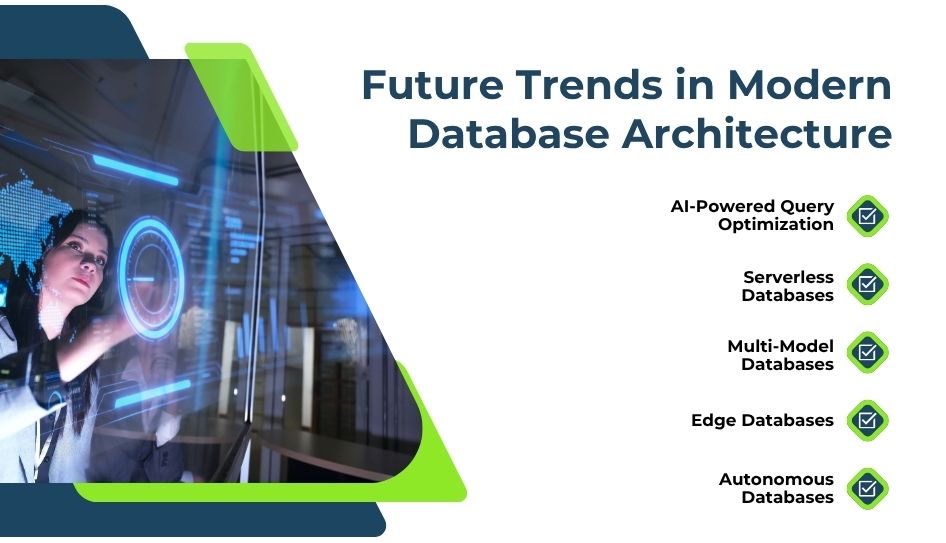
The future of database architecture is moving toward automation, AI-driven optimization, and distributed cloud systems.
Some emerging trends include:
AI-Powered Query Optimization
Machine learning models automatically optimize queries and workloads.
Serverless Databases
Databases scale automatically without manual infrastructure management.
Multi-Model Databases
Single platforms support relational, graph, and document-based data simultaneously.
Edge Databases
Data processing moves closer to users for faster response times.
Autonomous Databases
Self-healing databases reduce manual administration and downtime.
These innovations are redefining how applications achieve speed, scalability, and reliability.
FAQs
What is database architecture?
Database architecture is the structure and design used to organize, store, manage, and retrieve data efficiently within an application or system.
Why is database performance optimization important?
Database performance optimization improves application speed, reduces server load, minimizes downtime, and enhances user experience.
What are scalable database solutions?
Scalable database solutions are systems designed to handle growing amounts of data and traffic without performance degradation.
What are database management systems?
Database management systems are software platforms that help businesses store, organize, secure, and retrieve data efficiently.
What is modern database design?
Modern database design focuses on scalability, distributed systems, cloud-native infrastructure, flexibility, and high-performance data processing.