Langflow vs n8n (2026): Choosing a Builder for LLM Apps and Automation
Quick Answer: Langflow vs n8n at a Glance
- Choose Langflow: Best for building AI applications, RAG pipelines, and agents with greater control over AI logic.
- Choose n8n: Best for automating business workflows, connecting apps, and managing approvals and retries.
- Use both: Combine Langflow’s AI reasoning with n8n’s integrations and business processes.
- Check licensing first: Langflow uses the MIT license, while n8n restricts certain commercial uses.
- Calculate total costs: Include hosting, model usage, monitoring, and maintenance, not just platform fees.
- Production plan: Set up security, evaluations, error handling, and monitoring before launch.
Building an AI workflow is easy to start, but choosing the wrong tool can make it difficult to scale. Langflow and n8n both offer visual builders, yet they solve different problems.
Langflow focuses on designing AI applications, including RAG pipelines and agents, while n8n connects apps and automates business processes. The right choice depends on your use case and how much AI logic your workflow needs.
Many AI pilots work in a demo but never reach production. That’s why it pays to compare Langflow vs n8n on the factors that actually decide success.
In this guide, you’ll learn:
- How Langflow and n8n differ
- A 15-point comparison of their features
- Key differences for AI agents and automation
- Pricing, licensing, and running costs
- When to use either tool or combine both
By the end of this guide, you’ll know which tool fits your project, what to consider before investing, and how to move from prototype to production.
What Is the Difference Between Langflow and n8n?
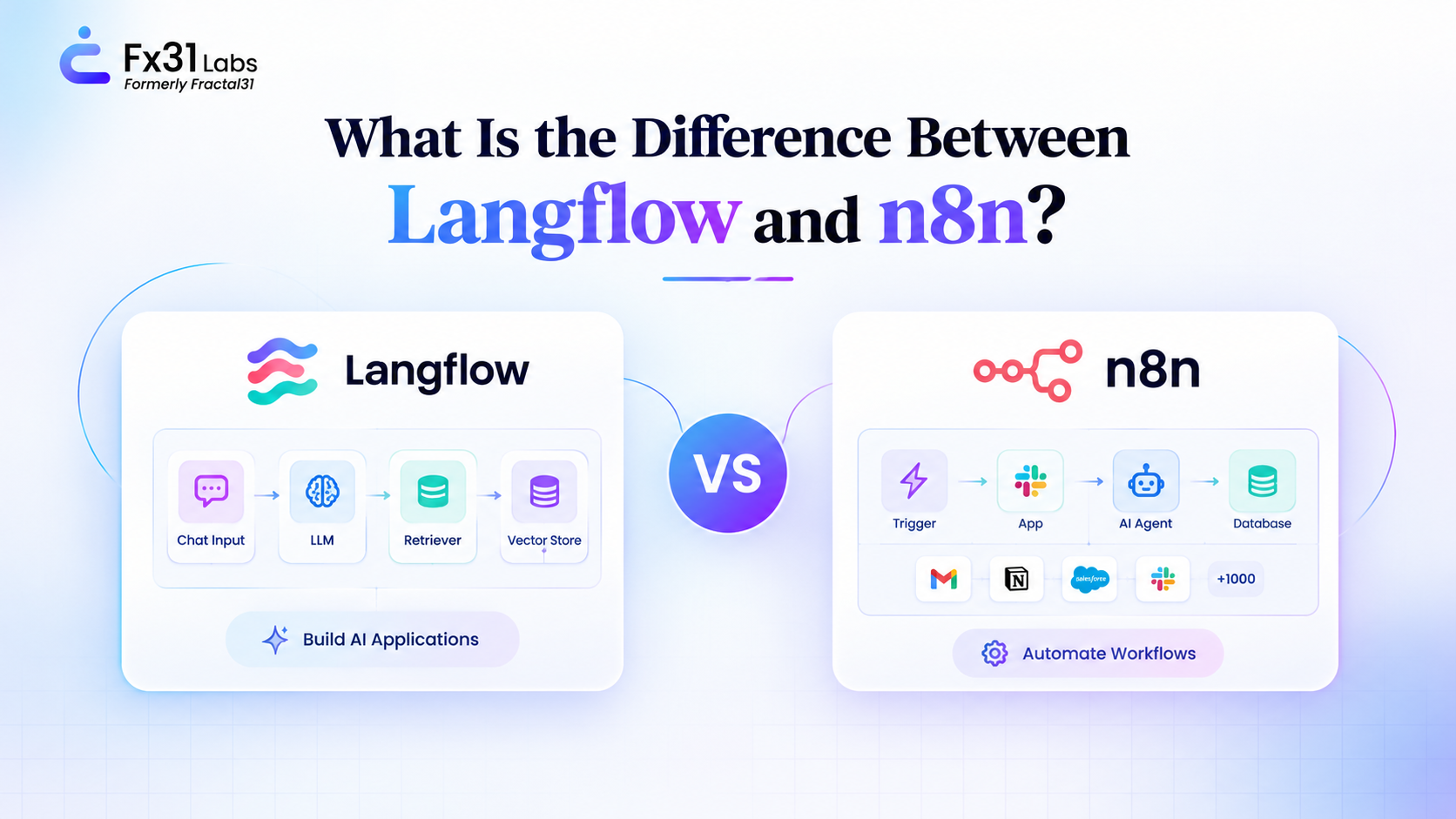
Langflow focuses on building AI applications, while n8n automates workflows across business apps. The main difference between Langflow vs n8n is whether you need to design AI logic or connect systems and automate tasks.
What Is Langflow?
Langflow is an open-source, Python-based visual AI workflow builder for creating RAG pipelines, chatbots, and AI agents. Its drag-and-drop canvas connects models, prompts, retrievers, and vector stores, with a Playground for testing.
Developers can customize components with Python and deploy flows through APIs or expose them as MCP tools. Langflow supports different model providers and uses the MIT license.
What Is n8n?
n8n is a workflow automation platform that connects apps and automates tasks using triggers, visual nodes, and custom JavaScript or Python. It also supports AI agents, memory, and vector store nodes alongside 1,000+ pre-built integrations.
For example, n8n can process a support ticket, retrieve CRM data, request approval, and update a database in one workflow. You can use n8n Cloud or self-host its Community Edition under its Sustainable Use License.
Also Read: Anatomy of an AI Agent
Langflow vs n8n Comparison Table: 15 Criteria Buyers Should Weigh
The right choice depends on whether you need to build AI logic or automate business processes. This table compares 15 criteria to help you decide.
| Criteria | Langflow | n8n |
| Primary job | Builds AI applications, RAG pipelines, and agent logic. | Automates business processes and connects apps. |
| Core language | Python-based, with editable component code. | TypeScript-based, with JavaScript and Python code steps. |
| Best-fit team | AI engineers and Python developers. | Automation engineers, developers, and technical operations teams. |
| AI agents | Builds agents and connects components as tools. | Runs AI agents with memory, tools, and workflows. |
| RAG control | Offers control over chunking, embeddings, and retrieval. | Supports RAG through vector store nodes and templates. |
| Business integrations | Connects business apps through APIs, MCP, and components. | Provides 1,000+ integrations and HTTP requests. |
| Triggers and scheduling | Runs flow through APIs, chat input, and MCP clients. | Supports webhooks, schedules, app events, forms, and chat triggers. |
| Human approvals | Supports human input and resumable approval checkpoints. | Uses approval routes, tool approvals, and the Wait node. |
| Debugging and observability | Provides Playground testing and component-level runs. | Offers execution history, node-level data, and error workflows. |
| MCP and interoperability | Supports MCP servers, clients, and A2A. | Supports MCP servers and clients for connecting tools. |
| Deployment options | Supports Docker, Python packages, desktop, and Kubernetes deployments. | Supports n8n Cloud and self-hosting through Docker, npm, or Kubernetes. |
| Access control and governance | Provides basic user controls; tenant isolation is limited. | Offers projects and roles, with advanced controls on higher plans. |
| License | MIT license allows commercial use. | Sustainable Use License restricts certain commercial uses. |
| Pricing model | Software is free; infrastructure and model usage cost extra. | Offers a free Community Edition and paid execution-based plans. |
| Exit path | Exports flow as JSON with customizable Python components. | Exports workflows as JSON in n8n’s node format. |
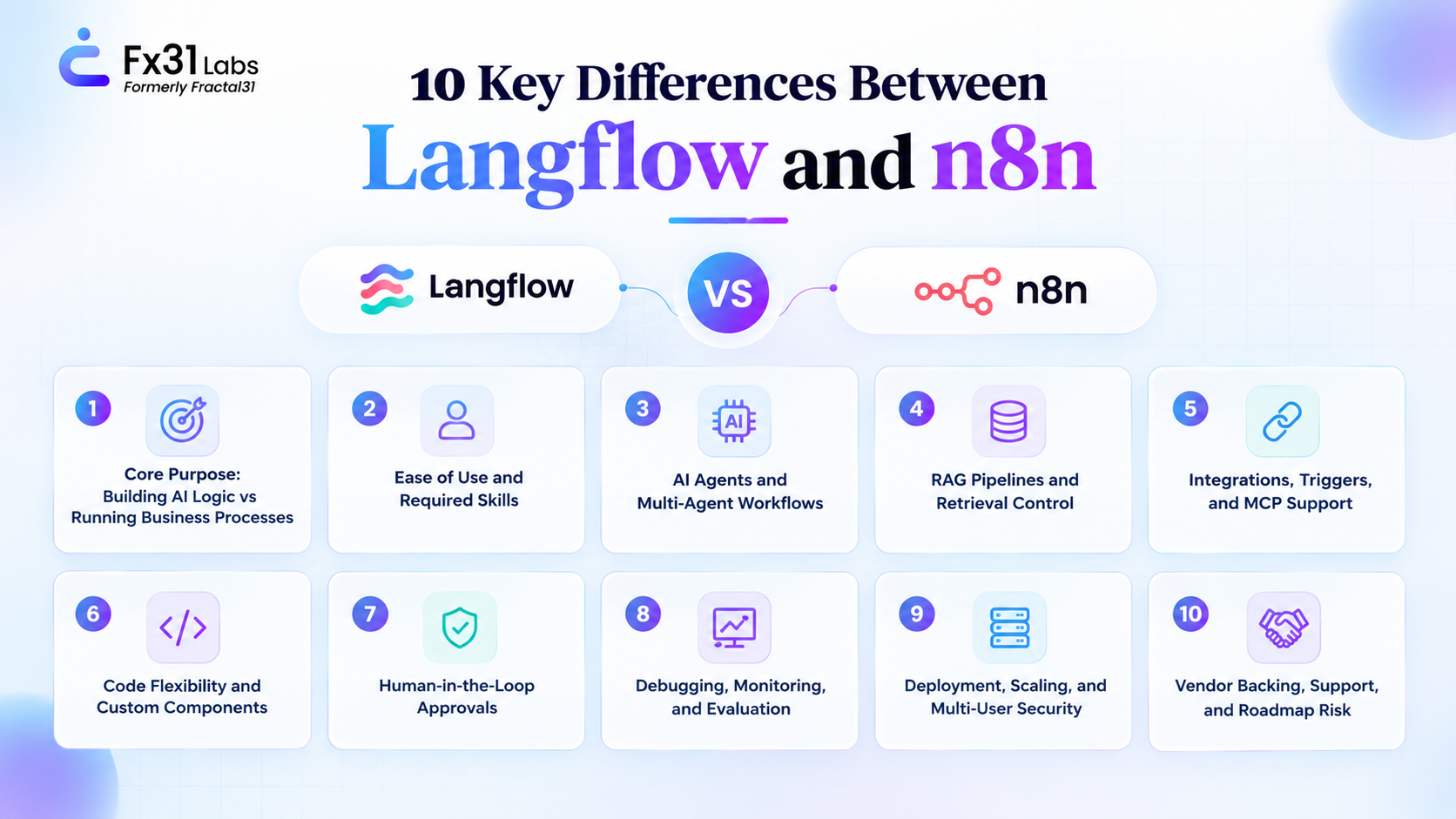
10 Key Differences Between Langflow and n8n
The key differences between Langflow vs n8n become clearer when you compare how each tool handles AI development, automation, and production workflows.
1. Core Purpose: Building AI Logic vs Running Business Processes
Langflow focuses on prompts, retrieval, and agent behavior, making it a strong fit when AI logic is the core of your application.
n8n focuses on triggers, business rules, and data movement, making it better suited to workflows that connect multiple systems.
2. Ease of Use and Required Skills
Langflow’s visual canvas simplifies AI workflow design, but understanding embeddings, retrievers, and Python helps when building complex applications.
n8n suits teams familiar with triggers, fields, and conditions, although advanced workflows still require coding and error handling.
3. AI Agents and Multi-Agent Workflows
For langflow vs n8n for AI agents, Langflow offers flexible agent design, reusable tools, and connections between agents for complex AI tasks.
n8n connects AI agents to business tools, memory, and existing workflows, making it practical for agents that need to take action across systems.
4. RAG Pipelines and Retrieval Control
Langflow provides granular control over document loaders, chunking, embeddings, vector stores, and retrievers. This helps teams tune retrieval for better results when comparing RAG against fine-tuning.
n8n supports document ingestion and retrieval through vector store nodes and templates. Advanced retrieval strategies may require custom code or a dedicated retrieval service.
5. Integrations, Triggers, and MCP Support
Langflow connects AI models and vector databases, while business applications can connect through APIs, MCP, and custom components. It also supports MCP servers and A2A interoperability.
n8n offers 1,000+ pre-built integrations, plus webhooks, schedules, forms, and app triggers. Its MCP support also helps connect AI agents with external tools through the Model Context Protocol.
6. Code Flexibility and Custom Components
Langflow lets developers inspect and customize Python-based components, making it suitable for teams that need control over AI logic and reusable components.
n8n combines visual nodes with JavaScript or Python code steps, expressions, custom nodes, and reusable sub-workflows for more flexible automation.
7. Human-in-the-Loop Approvals
Langflow supports human input checkpoints and approval before selected agent tools run, allowing teams to review sensitive actions before a flow continues.
n8n supports human approval for AI tool calls and workflow pauses through its Wait node, which suits processes involving refunds, contracts, and customer communications.
8. Debugging, Monitoring, and Evaluation
Langflow offers Playground testing and component-level inspection. Production monitoring can use tools such as LangSmith, Langfuse, or Arize.
n8n provides execution history, node-level data, error workflows, and AI evaluations. These features help teams investigate failures and improve workflow reliability.
9. Deployment, Scaling, and Multi-User Security
Langflow supports desktop, Python, Docker, and Kubernetes deployments. Production setups may use PostgreSQL, while multi-tenant deployments need careful isolation because users can share a process.
n8n offers cloud and self-hosted deployment. Queue mode supports scaling with workers on suitable setups, while features such as SSO, LDAP, Git, and audit logs depend on the plan.
10. Vendor Backing, Support, and Roadmap Risk
IBM stewards Langflow, with paid support options available. However, hosted offerings can change, so exporting flows and controlling your deployment can reduce migration risk.
n8n has an active community, workflow templates, and paid Enterprise support. Its Sustainable Use License also places restrictions on certain commercial uses, so review the terms before deployment.
Choosing the right tool for production? Share your use case with our AI engineering team to discuss architecture, running costs, and the path from pilot to production.
How Much Do Langflow and n8n Cost to Run?
Both tools offer free options, but hosting, AI model usage, and maintenance add to the bill. The real langflow vs n8n pricing difference comes down to execution volume and infrastructure.
1. n8n Pricing: Cloud Plans vs Self-Hosted
n8n Cloud charges by workflow executions, not individual steps. Its published annual billing prices are listed in euros on the official pricing page:
- Starter (€20/month): 2,500 executions and 5 concurrent executions.
- Pro (€50/month): 10,000 executions, up to 50 concurrent executions, and admin roles.
- Business (€667/month): 40,000 executions, SSO, LDAP, Git, environments, and queue mode; self-hosted only.
- Enterprise: Custom pricing, higher execution volumes, audit logs, and dedicated support.
- Community Edition (free): Self-hosted, with server, security, and maintenance costs paid separately.
Monthly billing costs more than the annual rates. Business overages cost €4,000 per additional 300,000 executions, and eligible startups with fewer than 20 employees may qualify for a 50% discount.
Execution volume matters: a workflow running every five minutes generates roughly 8,600 executions monthly. A support workflow handling 300 tickets daily uses around 9,000 executions, rising to 18,000 if each ticket triggers an additional workflow. That can push usage beyond the Pro plan’s included limit.
2. Langflow Pricing: Free Software, Paid Infrastructure
Langflow is free under the MIT license, with no per-execution fee. Since DataStax retired its hosted service, production deployments generally require your own cloud infrastructure or servers.
Budget for compute, PostgreSQL, vector databases, model API usage, monitoring, and engineering maintenance. Separate staging and production environments also add costs, while IBM Elite Support is available at an unpublished price.
3. Total Cost of Ownership: The Costs Buyers Miss
Software fees are only part of the budget. Compare the full operating costs before choosing a platform.
| Cost item | Langflow | n8n |
| Software or license | Free under MIT | Free Community Edition or paid plans |
| Hosting and database | Servers and external PostgreSQL | Included with Cloud or self-hosted infrastructure |
| Model and embedding usage | Charged by model providers | Charged by model providers |
| Vector database | Additional cost for RAG workloads | Additional cost for RAG workloads |
| Monitoring and evaluation | Third-party tracing tools may add costs | Execution logs and evaluations, with optional extra tools |
| Engineering and upkeep | Python and infrastructure skills | Automation, coding, and infrastructure skills |
| Support | Community or IBM Elite Support | Community or paid Enterprise support |
AI model usage deserves close attention because long prompts and repeated agent calls can increase spending quickly. See our guides on what it costs to build an AI agent and how to control token consumption for more detail.
Now that you’ve seen where the money goes, let’s take a look at the licensing and compliance questions your legal team will raise next.
Licensing and Compliance: What Your Legal and Security Teams Will Ask
Langflow uses the MIT license, which permits commercial use. n8n uses the Sustainable Use License, which restricts certain commercial applications. In langflow vs n8n, your intended use matters as much as the technical features.
1. MIT vs Sustainable Use License
| Scenario | Langflow | n8n |
| Internal business workflows | Allowed | Allowed |
| Consulting and workflow setup | Allowed | Allowed under license terms |
| Customer-facing SaaS features | Generally allowed | Depends on the use case |
| Customers create workflows | Allowed under MIT terms | May require a commercial license |
If your product exposes n8n functionality to customers, confirm licensing requirements with n8n before deployment.
2. Data Residency and Compliance
Self-hosting gives you more control over data storage, but GDPR, UK GDPR, HIPAA, and SOC 2 requirements depend on your implementation and vendors. Both tools may send data to external AI model providers, so review data handling, access controls, and contractual safeguards.
n8n Cloud uses Azure infrastructure in Frankfurt. Its paid self-hosted plans may also require periodic license-key verification, which matters for air-gapped environments. The EU AI Act requirements depend on your AI system and its use.
For more guidance, read AI Governance and Compliance for Enterprises.
Can You Use Langflow and n8n Together?
Yes. A Langflow and n8n integration combines Langflow’s AI reasoning with n8n’s business automation through APIs or MCP.
1. How a Hybrid Setup Splits the Work
n8n handles triggers, retrieves customer data, and prepares requests. Langflow runs AI logic, retrieves relevant documents, and returns structured answers or drafts.
n8n then routes responses for approval, updates connected systems, and logs results. Use API calls for fixed flows or MCP when an AI agent needs to choose between multiple Langflow flows.
Secure API endpoints with keys and use a shared request ID to trace executions across both tools. Set retries and human handoff for timeouts or low-confidence responses.
2. When Running Both Is Worth the Extra Moving Parts
Use both tools when AI needs custom retrieval or agent logic and the workflow connects multiple business systems. Common examples include support agents, document approvals, and copilots that update internal tools.
Avoid the hybrid setup when n8n’s built-in AI nodes are enough or the workflow stays within the AI stack. Two platforms mean extra upgrades, security reviews, and debugging, so add the second only when needed.
Taking Langflow or n8n to Production: 7 Risks to Plan For
A successful demo doesn’t guarantee a reliable launch. In langflow vs n8n, plan for these seven production risks before deployment.
- Prototype defaults left in place: Disable default logins, use named accounts, and store API keys in a secrets manager rather than inside workflows.
- Untrusted code execution: Keep Langflow updated, limit custom code, and isolate execution from sensitive services. See our guide to LLM security risks.
- Lost memory and state: Container restarts can erase session data. Store persistent memory in an external database such as PostgreSQL or Redis.
- Rate limits and retry storms: Traffic spikes can overwhelm model APIs. Set concurrency limits, use n8n queue mode where appropriate, and add backoff retries.
- Runaway agent loops: Repeated tool calls waste tokens and time. Set iteration limits, timeouts, and spend alerts, with human handoff for stuck runs.
- Silent quality drift: Model or prompt changes can weaken answers without triggering errors. Test real user questions against an evaluation set before each release.
- Upgrades that break flows: Pin versions, export workflows to Git, and test upgrades in staging. Langflow has had a release that affected saved-flow tracking, so verify critical flows after updates.
Also Read: How to Hire LLM Developers Without Overpaying or Under-Scoping
Now that you’ve seen the risks that surface after launch, let’s take a look at which builder fits your project and how to decide.
Langflow vs n8n: Which Should You Choose?
Choose Langflow for complex AI logic, n8n for business automation, or both when AI needs to act across multiple systems.
Choose Langflow If
- AI is your product: You’re building RAG assistants, copilots, or multi-agent systems.
- Retrieval quality matters: You need control over chunking, embeddings, and retrievers.
- Your team uses Python: Developers want visual prototyping with code-level flexibility.
- You need commercial freedom: Its MIT license supports commercial use.
- You can manage infrastructure: Your team can handle hosting, updates, and monitoring.
Choose n8n If
- AI is one step in a larger process: Workflows start with orders, tickets, or app events.
- You connect many systems: CRMs, databases, helpdesks, and messaging tools need to work together.
- Approvals and retries matter: Sensitive actions need review and reliable error handling.
- Teams need visibility: Staff must track workflow runs and investigate failures.
- You prefer managed hosting: n8n Cloud reduces server maintenance.
Use Both If
- Agents need to take action: Langflow handles reasoning while n8n updates tickets, orders, or records.
- Different teams own each layer: AI engineers tune the logic while automation teams manage workflows.
- You need AI with business controls: Combine Langflow’s AI capabilities with n8n’s approvals, logs, and integrations.
When to Move Beyond Both
Visual builders may struggle with long-running agents, complex state, or strict automated testing. Consider LangGraph or a custom service for core AI logic while keeping n8n for surrounding automation.
Before committing, review our framework for deciding whether to build or buy AI agents.
8 Questions to Answer Before You Commit
Use these questions to turn the langflow vs n8n decision into a practical plan. Answer them before funding a pilot to clarify ownership, costs, risks, and long-term flexibility.
- Where is the complexity? Choose Langflow for reasoning and retrieval, or n8n for process automation and integrations.
- How many systems are involved? More app connections often favor n8n.
- Who will maintain it? Match the tool to your team’s skills and long-term ownership.
- Who will use the product? Customer-facing features make licensing especially important.
- What data will it handle? Check data residency, security, and model-provider requirements.
- What happens at 10× volume? Estimate execution, token, and hosting costs before scaling.
- How will failures be handled? Define retries, alerts, approvals, and human fallbacks.
- Can you migrate later? Check export options, code ownership, and workflow documentation.
Where Fx31 Labs Fits in a Langflow or n8n Project
Choosing a builder is only the first step. Fx31 Labs helps turn AI pilots into secure, production-ready solutions through India-based engineering and a US office in New Jersey.
In one project, a two-person team delivered a working in-house HRMS in just five weeks. We bring the same focus on practical results to AI projects:
- The right architecture: Decide where AI logic and business automation belong before choosing a tool.
- Production-ready engineering: Plan evaluation, guardrails, monitoring, and security from day one.
- Seamless integrations: Connect AI with your existing CRM, ERP, helpdesk, and data stores.
- A low-risk start: Validate the idea with a focused pilot or an AI MVP build before increasing investment.
Ready to move your AI project forward? Book a Free Consultation to discuss the right builder, expected running costs, and a practical pilot plan.
Conclusion: Build the Right AI Workflow
Langflow is ideal for complex AI logic, RAG, and agent development, while n8n excels at connecting apps and automating business processes. Use both when your AI needs to reason and take action across multiple systems.
The langflow vs n8n choice depends on your workflow, team skills, licensing needs, and expected running costs. Evaluate these factors before committing to a tool or scaling your pilot.
We hope this guide helps you understand the practical differences and choose a setup that fits your project. Plan for security, monitoring, and maintenance early to avoid costly production issues.
Have a specific AI use case to evaluate? Connect with our experts to discuss your requirements, compare implementation options, and outline a practical development plan.
Frequently Asked Questions
1. Is Langflow or n8n better for building AI agents?
Langflow suits agents that need custom reasoning, tools, and retrieval. n8n is better when agents must act across business apps, approvals, and scheduled workflows.
2. Can n8n replace Langflow for RAG applications?
Yes, for simple knowledge bots using built-in vector store nodes. Langflow offers more control over chunking, retrieval, and testing for complex RAG systems.
3. Is Langflow free for commercial use?
Yes. Langflow uses the MIT license, which permits commercial use while requiring the license notice to be retained. Hosting, databases, and AI model usage still cost money.
4. Can I use n8n inside a SaaS product I sell?
It depends on how you use it. Internal workflows are generally permitted, but customer-facing features that expose n8n or let users create workflows may require a commercial license.
5. Which costs less to run in production, Langflow or n8n?
Langflow has no software license fee but requires hosting and maintenance. n8n Cloud starts at €20/month with annual billing. Model usage and infrastructure affect the total cost of both.
6. Does Langflow still have a managed cloud version?
DataStax retired its hosted Langflow service. Teams can self-host Langflow using Docker or Kubernetes, with IBM Elite Support available for organizations needing additional support.
7. Can I self-host Langflow and n8n for GDPR or HIPAA workloads?
Both support self-hosting, but that alone doesn’t ensure compliance. Review access controls, encryption, data handling, and agreements with model providers before processing regulated data.
8. How does Flowise compare with Langflow and n8n?
In a langflow vs n8n vs flowise comparison, Langflow focuses on AI application development, while n8n emphasizes workflow automation. Verify Flowise’s current maintenance and support status before choosing it for a new project.