
Operating Model Checklist for Your First Global Capability Center
Most first-time Global Capability Center failures aren’t location problems or talent problems. They’re operating model problems – decided too late, too vaguely, or by the wrong stakeholders.
Your global capability center operating model needs to be decided before you sign a lease or post a single job listing. It covers four things: the legal and entity structure, the governance and reporting lines back to headquarters, the talent and org design, and the funding model. Get these four right early, and location and hiring decisions become far easier to make.
Here’s the checklist to work through before you commit to a model.
What Is a GCC Operating Model, Exactly?
A GCC operating model is the structural blueprint for how your global capability center is owned, governed, staffed, and funded – not just where it’s physically located. Two GCCs can sit in the same city and operate completely differently depending on whether one is a wholly owned subsidiary reporting directly into headquarters and the other is a managed-services arrangement run by a third party.
Getting this decided early matters because it determines almost everything downstream: how much control you retain, how fast you can scale, what compliance obligations you carry, and how integrated the center becomes with the rest of the business.
What Are the Core GCC Setup Models to Choose From?
Most global capability centers fall into one of four structural models. Each comes with real tradeoffs.
| Model | How It Works | Best For |
| Build-Operate-Transfer (BOT) | A partner builds and runs the center initially, then transfers ownership to you at an agreed point | First-time GCCs that want reduced risk and a proven playbook before taking full ownership |
| Wholly Owned Subsidiary (Greenfield) | You establish full legal ownership and control from day one | Organizations with the resources and local expertise to manage entity setup and compliance directly |
| Managed Services | A third party owns and operates the center on your behalf, often BPO-style | Enterprises that want capability without taking on entity, HR, or compliance overhead |
| Center of Excellence (CoE) | A smaller, highly specialized unit focused on a specific capability rather than broad operations | Companies scaling a narrow function (e.g., data science, platform engineering) rather than a full offshore operation |
For a first-time center, BOT and managed services tend to reduce early-stage risk, since they don’t require you to build local legal, HR, and compliance expertise from scratch before you’ve proven the operating case internally.
What Should the Global Capability Center Operating Model Checklist Include?
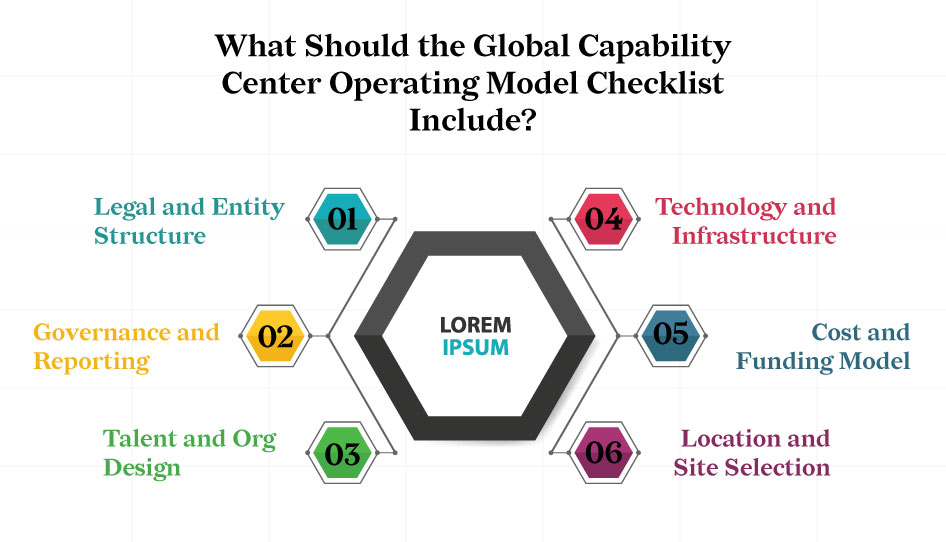
Break the checklist into the categories that actually determine whether the center runs well, not just whether it launches on time.
Legal and Entity Structure
- Confirm entity type (subsidiary, branch, BOT arrangement, or managed-services contract)
- Verify local incorporation, tax registration, and compliance requirements for the chosen jurisdiction
- Clarify IP ownership and data protection obligations across borders
- Define exit and transfer terms upfront if using a BOT model
Governance and Reporting
- Define who the center reports to at headquarters, and how often
- Set decision rights ; what the center can approve locally vs. what requires HQ sign-off
- Establish shared KPIs between the center and the business units it supports
- Build a communication cadence that prevents the center from operating in isolation
Talent and Org Design
- Decide on org structure: functional, matrixed, or embedded within global teams
- Define career pathing so the center isn’t seen internally as a cost center with no growth trajectory
- Plan leadership – a strong local site leader is one of the highest-leverage early hires
- Set compensation benchmarks against the local market, not headquarters pay scales
Technology and Infrastructure
- Confirm network, security, and access architecture aligns with global IT standards
- Plan for tooling parity so the center isn’t working with a degraded version of headquarters systems
- Define data residency and security controls specific to the jurisdiction
Cost and Funding Model
- Decide whether the center is funded centrally, cross-charged to business units, or self-funded on a P&L basis
- Model total cost of ownership across setup, operating, and scaling phases – not just year-one cost
- Build in currency and inflation assumptions for multi-year cost projection
Location and Site Selection
- Weigh talent availability against cost, not cost alone
- Assess time zone overlap with the teams the center will support
- Factor in regulatory stability and ease of doing business, especially for first-time GCCs
GCC Checklist by Phase: Pre-Launch, Launch, and Scale
A global capability center strategy typically moves through three distinct phases, and the checklist priorities shift at each one.
| Phase | Primary Focus | Key Milestones |
| Pre-launch | Model selection, entity setup, location decision | Operating model confirmed, legal entity registered, site selected |
| Launch | Hiring, infrastructure, initial governance | Leadership hired, first team onboarded, reporting cadence established |
| Scale | Expanding scope, deepening capability, cost optimization | Function maturity beyond back-office work, retention benchmarks met, ROI validated |
Most first-time GCCs underinvest in the pre-launch phase and try to make up for it during launch – which is usually the more expensive place to fix a structural decision.
How Do You Choose the Right GCC Operating Structure for a First-Time Center?
Ask these questions before committing to a model:
- How much control do we need from day one? Full control favors a wholly owned subsidiary; lower risk tolerance favors BOT or managed services.
- Do we have in-house expertise in the target market’s legal and HR landscape? If not, a partner-led model reduces early execution risk.
- What’s our realistic time-to-value expectation? Managed services and BOT models typically launch faster than building a subsidiary from scratch.
- Is this a broad operating center or a narrow capability build? A narrow, specialized need often fits a Center of Excellence model better than a full GCC.
- What does our multi-year cost and ownership plan look like? If you expect to take full ownership eventually, BOT is worth structuring for that transition from the start.
Common Mistakes First-Time GCCs Make
- Choosing location before operating model – the model should inform where a center makes sense, not the other way around
- Treating the center as purely cost arbitrage – the strongest GCCs deliver capability and innovation value, not just lower headcount cost
- Underestimating governance needs – a center without clear reporting lines and decision rights tends to drift from headquarters priorities
- Skipping career pathing for local talent – this is one of the biggest drivers of early attrition in first-time centers
- No defined transition plan for BOT arrangements – ambiguous transfer terms create friction right when the center starts proving value
The Bottom Line
A global capability center operating model decided carefully upfront saves far more time and cost than one decided reactively after the center is already hiring. Work through the legal structure, governance, talent design, technology standards, and funding model before location conversations even start – and pick a GCC setup approach that matches how much control and risk your organization can realistically take on in year one.
FAQ
What’s the difference between a GCC and a captive center?
The terms are often used interchangeably. A captive center is generally a wholly owned offshore or nearshore unit, while “GCC” (Global Capability Center) is the broader umbrella term that also covers BOT, managed-services, and Center of Excellence structures.
Which GCC operating model is best for a first-time setup?
There’s no universal answer, but Build-Operate-Transfer and managed-services models tend to reduce first-time risk because they don’t require building local legal, HR, and compliance expertise from scratch before the center has proven its value internally.
How long does it take to set up a global capability center?
Timelines vary by model and location, but a managed-services or BOT setup can often reach initial operating capability in 3–6 months, while a wholly owned subsidiary typically takes longer due to entity registration and compliance setup.
What’s included in a global capability center operating model framework?
At minimum: legal and entity structure, governance and reporting lines, talent and organizational design, technology and infrastructure standards, funding model, and location strategy. Skipping any of these tends to surface as an operational problem later.
Do GCCs only handle back-office work?
Not anymore. While early GCCs were largely cost-arbitrage back-office operations, most now handle higher-value functions like engineering, R&D, data science, and product development, especially as the operating model matures past the initial launch phase.
How is a GCC operating model different from simply outsourcing?
Outsourcing typically hands a function entirely to a third-party vendor with limited operational control. A GCC, even under a managed-services model, is built as a dedicated extension of your own organization, with governance and integration into your broader business – not just a vendor relationship.