
Legacy System Modernization: A Practical Roadmap for Enterprises
Legacy system modernization is a standardised update of outdated software, existing infrastructure and architecture. These updates support business by reducing cost, risk and maintenance processes which older systems tend to carry.
This update or change in systems takes place in different stages rather than all at once. The correct approach to bring about these operative changes, is to evaluate how significant the existing system is and how much technical debt it has built around it.
What Is Legacy System Modernization, and Why Does It Matter?
The core definition of legacy system modernization is basically updating and bringing about change in existing applications, platforms or pieces of infrastructure which are aging and cannot match current market standards. This update is desired to improve performance, enhance security, smooth and seamless integration with new tools and overall reduced costs of maintenance.
It matters more now than it probably did a decade ago, for a few reasons that tend to come up in almost every conversation we have with enterprise teams:
- Older systems are often harder and more expensive to secure, which becomes a bigger liability every year regulations tighten
- Legacy platforms rarely integrate cleanly with modern cloud services, APIs, or AI tooling
- Specialized skills for maintaining old languages and frameworks are getting harder to find and more expensive to retain
- Technical debt tends to compound – the longer a system goes untouched, the more expensive it becomes to eventually fix
None of this means every legacy system needs to be replaced immediately. Some genuinely still do the job well. The point of modernization isn’t change for its own sake – it’s reducing risk and unlocking room to grow. We’ve gone deeper into the specific frameworks and cost drivers behind this in modernizing legacy codebases, if you want the more technical breakdown alongside this roadmap.
How Do You Know It’s Time to Modernize?
There’s rarely one single moment that makes the decision obvious, but a few patterns tend to show up when a system has crossed the line from “stable” to “a growing liability.”
| Signal | What It Usually Means |
| Maintenance costs are rising year over year | The system is consuming a growing share of the IT budget just to stay operational |
| New features take longer than they should | Technical debt is slowing development, sometimes significantly |
| Security patches are delayed or unavailable | The platform or vendor support may be aging out, raising real risk |
| Integration with newer tools requires workarounds | The architecture wasn’t built for today’s APIs, cloud services, or AI tools |
| Fewer people on the team understand the system | Institutional knowledge is thinning, which raises the risk of the current setup |
If two or three of these sound familiar, it’s probably worth starting a modernization conversation — even if it’s just a scoping exercise rather than a full commitment.
What Are the Common Approaches to Legacy System Modernization?
Most legacy system modernization projects fall into one of a handful of recognized strategies. None of them is universally “correct” – the right one usually depends on budget, timeline, and how much risk the business can tolerate.
| Approach | What It Involves | Best Fit When |
| Rehosting (“lift and shift”) | Moving the application to new infrastructure with minimal code changes | You need a quick win, often as a first step toward cloud |
| Replatforming | Making moderate changes to take advantage of a new platform, without a full rewrite | The core logic still works, but the underlying platform is holding it back |
| Refactoring | Restructuring the existing code to improve performance and maintainability | The application works but has accumulated significant technical debt |
| Rearchitecting | Substantially redesigning the system, often around microservices or cloud-native patterns | You need better scalability than the current architecture allows |
| Replacing | Retiring the old system entirely in favor of a new build or a commercial product | The system is too outdated, risky, or narrow in scope to be worth saving |
In modern market trends, many existing companies adapt more than one of the above mentioned methods, instead of choosing and limiting themselves to a single strategy for everything.
What Does a Practical Legacy Application Modernization Roadmap Look Like?
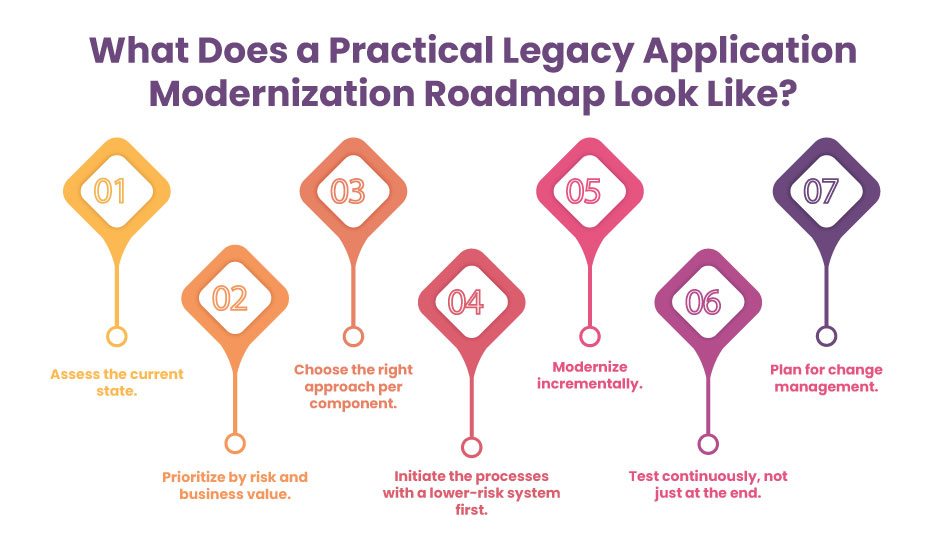
An ideal roadmap for legacy modernization roadmap for any business should be done in different phases rather than treating it as a single large project. Here’s a structure that tends to hold up reasonably well in practice:
- Assess the current state. Evaluate your existing inventory, what you already hold, dependencies on existing workmaps and get a clear reading on where the technical debt in your system actually lies, no assumptive measures.
- Prioritize by risk and business value. It is not necessary that every prior system will require the same urgency. Create a valid component ranking based on how much risk they carry and how much value will the modernization add to it.
- Choose the right approach per component. Some parts may need a full rearchitecture; others might only need replatforming. Mixing strategies is normal.
- Initiate the processes with a lower-risk system first. Before touching any mission-critical process, start with low-risk or lower value identified systems.
- Modernize incrementally. Where possible, avoid a single high-stakes cutover. Gradual migration tends to reduce risk and gives the team room to adjust.
- Test continuously, not just at the end. Automated testing throughout the process tends to catch problems earlier, when they’re cheaper to fix.
- Plan for change management. New systems usually mean new workflows. Training and communication matter as much as the technical work itself.
This kind of roadmap isn’t rigid – most teams adjust it as they go, based on what the assessment phase actually reveals.
How Is AI Code Modernization Changing the Process?
AI code modernization has become a genuinely valuable part of any business toolkit over the recent years, but it also comes with its own real-time problems and challenges.
Where it tends to help:
- Code analysis and documentation -AI tools can scan a legacy codebase and generate documentation far faster than manual review, which is often one of the biggest early bottlenecks
- Automated refactoring suggestions – some tools can identify redundant or risky code patterns and propose cleaner alternatives
- Language and framework translation -AI-assisted migration between languages (say, older COBOL or Java frameworks into more current ones) can speed up a process that used to take much longer manually
Where it still needs a human in the loop:
- Business logic that isn’t well documented and lives mostly in people’s heads
- Decisions about architecture and long-term system design
- Validating that AI-suggested changes actually preserve the original behavior, especially in regulated environments
AI code modernization is to be treated and fits well as a fast-tracker or an accelerator for the human-led processes, instead of replacing them. Enterprises which treat it this way tend to see significantly faster timelines without taking any increased risk.
If AI tools are touching production code in a regulated environment, it’s worth pairing that with the kind of oversight we outline in our AI governance framework for responsible enterprise AI, so validation isn’t an afterthought.
How Do You Approach Technical Debt Reduction Without Stalling the Business?
Technical debt reduction is often where modernization projects stall, mostly because it’s tempting to try to fix everything before shipping anything new. A more sustainable approach tends to look like this:
- Treat technical debt reduction as ongoing, not a one-time cleanup – build it into regular development cycles rather than a separate initiative
- Prioritize the debt that’s actively slowing the team down or creating real risk, rather than debt that’s just aesthetically frustrating
- Use the “Boy Scout rule” where practical – leave code a little better than you found it whenever you’re already working in that area
- Track technical debt the same way you’d track any other backlog item, with visibility for leadership, not just engineering
Reducing technical debt to zero usually isn’t realistic, and chasing that goal can quietly stall the roadmap. The more workable target is keeping it manageable enough that it isn’t the thing determining how fast the business can move.
What Does an Enterprise Software Upgrade Cost, and How Do You Budget for It?
An enterprise software upgrade rarely comes with a single, predictable price tag, which tends to make budgeting one of the harder parts of the process. A few factors that usually drive the cost:
- The size and complexity of the existing system
- How much of the process can be automated versus how much needs manual rewriting
- Whether the modernization happens incrementally or as a larger, more compressed effort
- The extent of testing and validation required, especially in regulated industries
It’s usually worth budgeting for the assessment phase separately from the rest of the project – a proper technical assessment often reveals scope that wasn’t visible at the outset, and it’s better to find that out early than three months into implementation. If cloud infrastructure is part of the plan, it’s also worth budgeting modernization and migration together rather than as two separate line items – our cloud migration strategy for enterprises covers how those costs tend to overlap.
What Are Common Pitfalls in Legacy System Modernization Projects?
A handful of mistakes tend to show up repeatedly across legacy system modernization efforts:
- Trying to modernize everything at once, rather than sequencing by risk and value
- Skipping the assessment phase to save time upfront, which usually costs more later
- Underestimating change management – the technical migration can succeed while user adoption still fails
- Treating it as a one-time project instead of an ongoing discipline, which tends to let new technical debt creep back in
- Not involving the people who actually use the system in planning, which often surfaces requirements nobody on the technical side would have guessed
Most of these are avoidable with a bit more planning upfront, which is really the argument for treating modernization as a roadmap rather than a single push.
Where to Go From Here
Legacy system modernization isn’t really a one-time project with a clear finish line — it’s closer to an ongoing discipline that most enterprises end up returning to every few years as technology, compliance requirements, and business needs shift. Starting with an honest assessment, sequencing the work by risk, and pairing AI code modernization tools with human oversight tends to keep the process realistic rather than overwhelming. If you’re mapping out where to start, our team’s work on legacy code modernization walks through the frameworks in more depth, and if you’d rather bring in outside capacity to run the assessment or execution, our software outsourcing team is a reasonable place to start that conversation.
Frequently Asked Questions
What is legacy system modernization?
Legacy system modernization is defined as the process of updating existing infrastructure, outdated software and prior architecture to lower risk levels, reduced costs of maintenance and improve compatibility with current market standards and tools.
How long does a legacy system modernization project usually take?
It varies widely depending on scope – a focused replatforming effort might take a few months, while a full rearchitecture of a large enterprise system can take a year or more. Phased roadmaps tend to make the timeline more predictable.
Is AI code modernization reliable enough to use on production systems?
It can be, when it’s paired with human review and thorough testing. AI code modernization tends to work well for analysis, documentation, and first-pass refactoring, but validation still matters, especially for business-critical logic.
What’s the difference between refactoring and rearchitecting?
Refactoring improves existing code without changing its overall structure. Rearchitecting involves a more substantial redesign, often to support better scalability or cloud-native patterns. Refactoring is generally less risky and less expensive.
Do we need to modernize everything at once?
No, and in most cases it’s better not to. A phased legacy application modernization roadmap that prioritizes the highest-risk or highest-value systems first tends to be more manageable and less disruptive than a single large-scale rewrite.