
Anti-Corruption Layers Explained for Teams Modernizing Legacy Applications
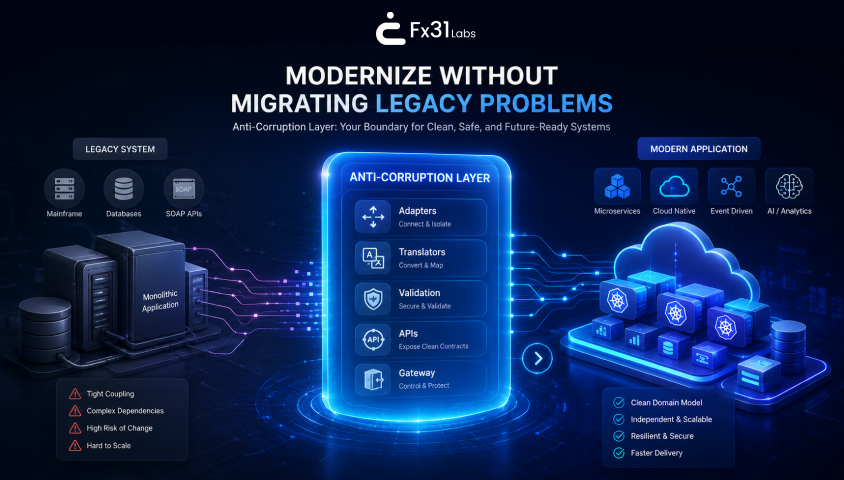
The hardest part of modernization is usually not writing the new service.
That is the job of an anti-corruption layer. Think of it as a translator and customs checkpoint, not a wall. The legacy side may call something a customer, encode status as a numeric flag, expose nine joined tables, or require an older protocol. The new domain does not need to inherit any of that. It can keep its own model, while the boundary translates what crosses over.
That matters because most modernization work happens under pressure. Legacy applications keep serving customers, fixes still land, and revenue does not pause while the new slice is being built. So teams choose incremental migration instead of a big-bang rewrite. That reduces blast radius, but it creates a dangerous overlap period where old and new systems coexist. The hidden failure is not the coexistence itself. It is semantic contamination, where raw legacy records, enums, IDs, error codes, and business assumptions become part of the new codebase.
Once that happens, you have not modernized the system so much as repackaged the coupling. The deployment may look newer, but the model is still old. That is the problem an ACL is meant to prevent.
The world before an anti-corruption layer
An ACL makes sense only when you look at the forces that create the need for it.
First, different systems often model the same business concept differently. An accounting system may center on taxpayer ID while a CRM cares more about address and phone data. A legacy order may be a set of relational rows, while a new order aggregate is a cohesive business object. Neither is automatically wrong. They just reflect different contexts.
Second, old schemas carry history. Nullable fields, overloaded columns, flags, and obsolete concepts usually represent years of compatibility decisions. If you copy that shape into the new domain, you are importing history instead of extracting capability.
Third, the technology may not line up. The old side might expose SOAP, a mainframe transaction, a proprietary message, or a database procedure. The new side may use a different protocol or deployment model.
Fourth, vocabulary collides. The same word can mean different things to sales, finance, fulfillment, and the new service. A shared DTO can hide that conflict rather than resolve it.
Fifth, ownership is often unclear during migration. Both systems may read or write related data, and a “temporary” integration can quietly become a permanent dual-write arrangement.
Sixth, the business still expects parallel delivery. The modernization team builds the new slice while other teams keep shipping.
Seventh, operational coupling sneaks in through synchronous calls. If the new service calls the legacy system directly, it imports the old system’s latency, availability, throughput, and failure behavior.
That is why the problem is not just “one system is old and one is new.” The real issue is that they are semantically different.
What is an anti-corruption layer?
An anti-corruption layer is a mediation boundary that translates between two subsystems or bounded contexts with different semantics. Its purpose is simple: keep the new domain model intact by preventing the legacy model from becoming a dependency of the new domain.
The translation can cover:
- domain concepts and names
- data shapes and field structures
- identifiers, statuses, units, dates, and nullability
- commands, queries, and method signatures
- request and response protocols
- error and timeout semantics
- authentication and trust-boundary validation
- synchronous calls or asynchronous messages
The word “corruption” is a shorthand. It does not mean the legacy data is bad or malicious. It means importing a foreign model can distort the vocabulary, invariants, and design of the receiving domain.
A useful way to picture it: the ACL is a customs checkpoint for meaning. Everything crosses, but nothing crosses unchanged.
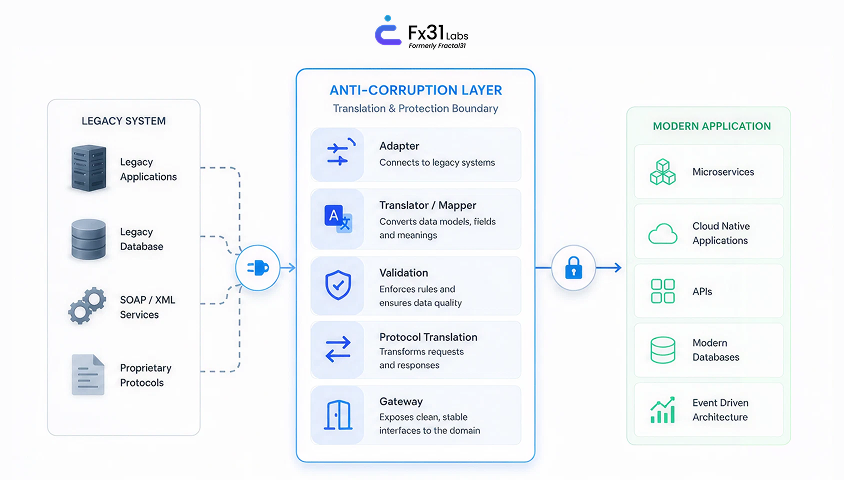
What the ACL owns
The ACL owns translation and compatibility knowledge. It should make mapping explicit, testable, observable, and removable when the old dependency disappears.
It should not own the new domain’s core business rules. It should not become a second domain service. And it should not turn into a general-purpose orchestration engine. If it has to make important business decisions, that logic belongs in the domain model or application service.
Where it can live
There is no single correct deployment shape. An ACL can be:
- A component inside the new application
- A class or module inside a monolith during a slice migration
- An independent integration service
- A gateway or adapter around an external system
- A message-processing boundary for asynchronous communication
Placement depends on ownership, security, throughput, and how many consumers need the translation. A separate service is not automatically more isolated. It can just add a network hop, another deployment, and more failure surface.
What happens inside the layer?
An ACL is not one thing. It is usually a set of responsibilities held together at the same seam.
| Part | Responsibility | What good looks like | What to avoid |
|---|---|---|---|
| New-domain port or contract | Defines what the new domain needs in its own terms | Small, stable interface based on new concepts | Reusing legacy DTOs as the new contract |
| Gateway or connection | Handles transport, auth, endpoint access, and low-level protocol details | The domain does not know how the external call is serialized or authorized. | Transport code scattered through business logic |
| Facade | Presents a simple interface over a complicated legacy subsystem | Hides legacy call sequences and returns a usable result | Assuming a facade alone solves semantic mismatch |
| Adapter | Converts one interface into another | Callers keep their interface while the target gets the one it expects. | Treating a method rename as full model protection |
| Translator or mapper | Converts data and concepts between models | Mapping rules are explicit, versioned, validated, and tested. | Silent defaults, lossy conversion, or raw legacy objects leaking inward |
| Validation and error mapper | Rejects invalid boundary data and translates errors into new-domain meaning | Unknown values fail visibly with useful context. | Turning every legacy error into a generic 500 |
| Routing/proxy | Sends a request to the legacy or new implementation during migration | Routing can change by capability without changing callers | Hard-coded routing that cannot be reversed |
| Telemetry | Makes translation, latency, retries, and mismatches visible | Correlation IDs, structured logs, metrics, traces, and mapping-version context | Watching only the new service and ignoring the seam |
| Retirement mechanism | Removes the temporary path after the slice and data are migrated | Clear exit criteria and an owner for deletion | Letting a “temporary” ACL become undocumented infrastructure |
A translator changes meaning across systems. A message translator can do that too, but ACL is the broader architectural intent. It is about keeping one model from bleeding into another, not just changing a payload shape.
Why ACLs matter during incremental migration
An anti-corruption layer earns its place during incremental migration because coexistence is where model contamination tends to happen.
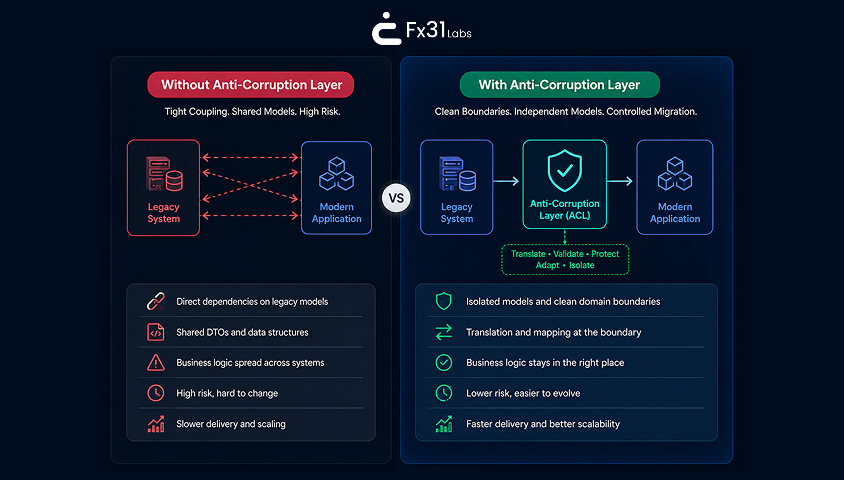
Without an ACL:
- new code imports legacy entities, flags, and error codes
- Every model change becomes a cross-team negotiation
- The new service looks modern but carries old coupling
- Caller changes and migration changes land in the same release
- Legacy latency and availability are hidden inside business logic
- Rollback means unwinding changes spread across many components
- Temporary mappings get copied into multiple teams
With an ACL:
- The new domain uses its own contract
- Translation knowledge stays at one boundary
- The new service can evolve while compatibility remains at the edge
- Existing callers can often keep their interface while routing changes happen behind it
- Dependency behavior is explicit and measurable
- Rollback can be changed at a seam if the data has not already been irreversibly cut over
- One owned boundary becomes the place to standardize mappings and retire them later
That is the real value. The ACL does not make parallel work free. It makes parallel work governable.
It is also why ACL is not the same thing as the Strangler Fig pattern. The strangler fig is the migration strategy. The ACL is one of the mechanisms that keeps the old and new sides semantically separated while the strategy runs.
ACL versus neighboring patterns
A lot of migration confusion comes from treating every integration construct as the same thing. It is not.
| Pattern | The primary question it answers | Relationship to an ACL |
|---|---|---|
| Adapter | How do I make one interface fit another? | An ACL may use an adapter, but it also protects domain semantics and ownership. |
| Facade | How do I offer a simple interface over a complex subsystem? | A facade may be the entry point inside an ACL, but it does not guarantee semantic translation. |
| Translator or Message Translator | How do I convert one message or data format to another? | This is a narrower mechanism often used inside an ACL. |
| Gateway | How does my code access an external service without knowing its internals? | A gateway can encapsulate connection and translation in the new context. |
| Strangler Fig | How do I replace a legacy application a slice at a time? | This is the migration strategy; ACL is one of the boundaries that helps it work. |
| ETL or CDC | How do I move or synchronize data? | These move data, but they do not by themselves protect a model from foreign semantics. |
| Transactional outbox | How do I keep a database change and outgoing message consistent? | It can support migration messaging, but it is not an ACL. |
| API gateway | How do I provide ingress, routing, and policy boundaries? | It may sit in front of an ACL, but routing alone is not semantic translation. |
The shorthand to avoid is “ACL equals wrapper.” A wrapper may hide a call. An ACL prevents a foreign model from shaping the new model.
A practical migration sequence
There is no universal recipe, but there is a disciplined way to reduce risk.
1. Choose a capability slice and define ownership.
Start with one business capability that has a clear outcome and manageable dependencies. Record:
- Current callers and downstream consumers
- Legacy entry points, tables, procedures, queues, and external dependencies
- The new service or bounded context boundary
- Who owns the new model and who owns the legacy system
- The current source of truth for important data
- Availability, latency, consistency, and audit requirements
- What must continue working during the migration
- What would make the slice unsafe to extract
This is a good place to say something many teams resist hearing: not every monolith should become microservices. Sometimes the right target is a modular monolith.
2. Define the new contract before copying the old schema.
Write the new commands, queries, events, and values in the new context’s language first. Then build a mapping inventory.
| Mapping concern | Questions to answer |
|---|---|
| Name | What does the old term mean, and what is the new term? |
| Cardinality | One old record to one new object, one-to-many, many-to-one, or conditional? |
| Identity | Are IDs equivalent, translated, or associated through a cross-reference? |
| State | How do old flags or statuses map to new states? What happens for unknown values? |
| Null/default | Is an empty legacy value meaningful, missing, or invalid? |
| Units/time | What about currency, timezone, precision, rounding, and date semantics? |
| Validation | Which constraints are rejected at the boundary and which belong in the new domain? |
| Errors | How do legacy codes, timeouts, and partial results become new-domain errors? |
| Ownership | Which system is authoritative in each phase? |
| Versioning | What happens when either contract changes? |
| Reversibility | Can the mapping be reversed for rollback, or is it intentionally lossy? |
Unknown or unsupported values should be represented explicitly or rejected with a diagnostic. Silent defaulting is a data-quality defect, not compatibility.
3. Put a narrow ACL around legacy access.
Create the new-domain port and keep raw legacy types, protocol code, and connection details out of the new domain. The ACL should be narrow enough that a reader can see which parts are translation and which parts are business policy.
4. Add routing and preserve the old caller contract.
During coexistence, a route can direct a capability to either the legacy or new implementation. Existing callers may keep their old interface while the ACL translates the call behind the scenes. A new client may also call the new contract and be translated back toward the legacy side until that slice moves.
The key is that routing has to be reversible. Transparent redirection is only safe when request, response, side effects, authorization, and data ownership have been tested.
5. Plan data movement separately from translation.
Do not confuse model translation with data migration. Decide, for each dataset, whether you are using:
- Legacy as the system of record while the new side reads through the ACL
- An initial load followed by change-data capture
- An event or queue-based synchronizer
- New ownership with temporary feedback to the legacy system
- A bounded read model or cache
- A final cutover after consistency validation
If a synchronization agent updates the old database from events, that can preserve coexistence. It also creates eventual consistency and possible data redundancy. Treat it as tactical, not permanent.
If the new system changes its database and publishes an event, a transactional outbox can help keep the database update and message publication atomic. It still does not eliminate duplicate delivery, ordering, replay, or idempotency concerns.
Avoid uncoordinated dual writes from application code. If a phase truly requires two writes, document the source of truth, recovery path, retry behavior, reconciliation plan, and retirement date.
6. Characterize behavior before changing it
Capture both success and failure behavior before you modernize. Useful cases include:
- ordinary records and boundary values
- null, missing, malformed, and unknown fields
- every legacy status and error code
- duplicate and out-of-order messages
- timezone, currency, rounding, and precision issues
- large payloads and pagination
- timeouts, rate limits, partial responses, and downtime
- authorization failures and trust-boundary violations
- retry and replay behavior
- data that should not be copied into the new domain
Test at multiple levels:
- pure mapping tests
- characterization tests for compatibility
- contract tests at the boundary
- integration tests against a representative legacy dependency
- end-to-end tests for business-critical journeys
- reconciliation tests between old and new representations
- resilience tests for timeout, retry, circuit breaker, duplicate, and dead-letter paths
The goal is simple: make it safe to change the new domain without accidentally changing the legacy contract.
7. Release in small slices and keep routing reversible.
Move one operation or capability at a time. Use a controlled switch where appropriate. Before each switch, define:
- Success criteria
- Acceptable error and latency behavior
- Data consistency checks
- Dashboards and alerts
- Who can reverse the route
- What must be replayed if you reverse it
- A time limit for the temporary path
Shadow reads can help when side effects are controlled, but they should not duplicate irreversible writes.
8. Establish observability at the boundary.
Use a correlation ID across the caller, ACL, legacy system, and new service. Structured logs should record the operation, mapping version, source and target model, outcome, retry count, and a safe reference to the affected entity.
Track at least:
- translation success and failure by rule or version
- unknown enum or unmappable-field count
- request rate, payload size, and throughput
- boundary latency
- legacy dependency latency and availability
- timeout, retry, circuit-breaker, and dead-letter counts
- synchronization lag
- old/new reconciliation mismatches
- route share by operation or cohort
- Rollback frequency and error budget impact
There is no universal threshold for these numbers. The right values come from the capability’s SLOs, data criticality, and business tolerance.
9. Cut over, then remove the translation path.
Once the new behavior and data are validated:
- Make the new domain the system of record for the migrated capability
- direct reads and writes to the new owner
- Stop synchronization for the retired legacy slice after consumers are accounted for
- Remove obsolete legacy tables, procedures, routes, and dependencies only after rollback risk is accepted
- Reconfigure callers to use the new contract directly where appropriate
- Remove the ACL and its dashboards, credentials, queues, and deployment artifacts
- Update architecture documentation and ownership records
Deletion is the milestone. A temporary ACL that never gets removed is just another piece of permanent complexity.
Why this pattern matters in real programs
The abstract version is useful, but the operational version is where teams feel the difference.
Imagine a retailer extracting checkout from a monolith. The legacy application uses a numeric account key, separate address rows, and single-letter order statuses. The new Checkout domain needs a customer identity, a validated delivery address, and clear states such as PendingPayment, Paid, and Fulfilled.
The ACL maps the new checkout request into the old account and address calls while the legacy system remains authoritative. Sales and support continue using the old workflow. The checkout team ships new payment and delivery features against its own model. Later, a data phase loads the new store, synchronizes changes, validates reconciliation, switches ownership, and removes the translation path.
What is hard here is not the endpoint. It is the mapping of identity, status, idempotency, and source of truth.
A real-world reference point makes the same lesson visible. In one engineering narrative, a team working with a legacy relational schema found nine associated tables joined by foreign keys, while the planned modern application would store most of that data in one PostgreSQL record with a JSONB column. The ACL used a facade, an adapter, and a translator to bridge the systems, and the migration moved slice by slice. The point is not that one schema is universally better. The point is that the translation layer kept the new shape from inheriting the old one.
Trade-offs and failure modes
An ACL is useful, but it is not free.
Benefits
- Protects the new model from legacy semantics
- Localizes translation knowledge
- Lets old and new systems coexist during phased migration
- Reduces the need to change every caller at once
- Makes compatibility logic testable and observable in one place
- Supports a path toward independent deployment and data ownership
- Creates an explicit deletion point for legacy knowledge
Costs and risks
- Extra code, deployment, testing, monitoring, and on-call ownership
- Added latency and another failure boundary
- Potential bottleneck if all traffic funnels through one seam
- Harder diagnosis without good telemetry
- More consistency complexity when both systems need related data
- Mapping drift when either model evolves without contract governance
- Security risk if validation is weak
- A tendency to accumulate business logic and become a second monolith
- A “temporary” boundary that outlives its purpose
Synchronous ACLs are simpler to explain, but they couple latency and availability. Asynchronous ACLs reduce some coupling, but they bring eventual consistency, ordering, duplicate handling, replay, dead letters, and schema evolution into the picture. Event-driven is not automatically safer.
Also, not every case needs an ACL. If both systems truly share the same model, if the conversion is trivial, or if the target is small enough for a direct rewrite, a smaller adapter or translator may be enough. And if the ACL would contain so much business policy that it is really a domain service, the design has drifted.
FAQ
Is an anti-corruption layer just an adapter?
No. An adapter changes an interface. An ACL is the broader boundary and design intent of protecting one model from another. It may use adapters, facades, gateways, and translators.
Does an ACL only apply to microservices?
No. It can sit between a new module and a legacy monolith, between a monolith and an extracted service, or between an application and a third-party system. The key issue is semantic difference, not deployment style.
Does an ACL migrate the data for us?
No. It translates calls and representations. Data ownership, initial loading, CDC, synchronization, reconciliation, cutover, and deletion need a separate plan.
Will an ACL make the new system independent right away?
It protects the new model from semantic dependence, but the new system may still depend on legacy availability, latency, and data. Independence increases only as functionality and ownership move.
Should the ACL be permanent?
A migration ACL should normally have an exit plan and be removed after the relevant functionality, callers, and data have moved. A boundary around a permanent third-party system may be long-lived, but it should still be small and owned.
Does an ACL add performance overhead?
Usually, yes. It adds translation work and often another call or hop. It can also become a bottleneck or single point of failure, so it should be measured against existing service-level objectives.
Where should business logic live?
Core policy and invariants belong in the domain model or application service. The ACL should validate and translate. If it starts accumulating policy, it is probably hiding a missing domain service.
The strategic takeaway
Modernization maturity is not measured by how quickly a team can declare the monolith dead. It is measured by whether the team can change the system while preserving customer-facing delivery, data correctness, operational visibility, and the ability to reverse a risky step.
That is why an anti-corruption layer is worth understanding. It is not a badge of microservice sophistication. It is a deliberate investment in controlled change. Used selectively, it gives teams a place to contain legacy semantics, learn from each migrated slice, and keep the target domain coherent. Used without an exit plan, it becomes another layer of accidental complexity.
The advantage goes to the teams that can draw the boundary, use it well, and retire it when its job is done.
Need help with your AI-powered MVP?
Trusted partner in GenAI evolution
Share your email and we’ll reach out with tailored ideas.
Destination: On-page lead capture form submission.