
AI Powered QA: How Automation Testing Is Transforming Software Quality
In modern day markets, Artificial Intelligence has completely transformed how industries operate as to how they build, test and release softwares. AI powered QA Testing is the mix of artificial intelligence and standard quality assurance methods to automate test creation, execution, maintenance, defect prediction, and reporting.
Modern day software is becoming more complex as days pass. AI-driven testing allows you to release at faster rates, covering more tests and have better software quality while cutting costs and minimising effort.
In 2026, organisations are adopting AI powered QA Testing at an increasing rate. This is due to its ability of providing quality software at an impressive speed without reducing accuracy and reliability.
Whether you’re a startup, enterprise, or software development company, AI is no longer a future concept—it is becoming a core component of modern quality assurance strategies.
With the use of artificial intelligence and machine learning, AI powered QA Testing handles and automates software testing tasks such as generating, executing, detecting and maintaining tests. It enhances quality by improving testing speed, reducing human errors and enabling predictive analytics, and providing continuous testing support within modern DevOps and Agile development environments.
What Is AI Powered QA Testing?
AI powered QA Testing is the application of a mix of AI technologies such as ML, natural language processing and predictive analysis. This results in improved quality and faster testing rate.
Very different from traditional automation, AI-driven systems analyse and learn from past data, adapt to sudden changes in software, identify risks and continuous optimization of test execution.
AI-enabled testing platforms do not rely on predefined scripts. They analyze prior patterns, predict potential error or failure, suggest test cases and also repair defective automation scripts.
This makes AI in software testing significantly smarter than conventional automation frameworks.
Why Is AI Becoming Essential for Software Quality?
In 2026, software releases are happening faster than ever before.
Businesses have started deploying applications now multiple times in a day. This leaves manual testing increasingly impractical.
Traditional automation also faces challenges such as:
- Frequent UI updates
- Constant script maintenance
- Growing regression suites
- Short release cycles
- Increasing application complexity
AI restricts limitations through automation that continuously monitors and adapts to changing software.
Instead of requiring manual updates every time an interface changes, AI-powered tools identify changes and adapt to change in script.
The result is:
- Faster Release rate
- Higher accuracy
- Low maintenance effort
- Enhanced customer experience
How Does AI Work in Software Testing?
Artificial intelligence improves almost every software testing cycle.
Instead of replacing QA engineers, AI assists them by automating repetitive tasks while providing space for testers to focus on exploratory testing and strategic decisions.
A standard AI testing workflow includes:
- Analyze application requirements.
- Identify and reflect on defect patterns.
- Create intelligent test cases.
- Prioritize high-risk areas.
- Execute automated tests.
- Detecting anomalies.
- Predict potential failures.
- Generate detailed reports.
- Recommend fixes.
- Continuously improve future testing.
Each testing cycle improves the AI model, making future testing more efficient.
What Makes AI Different from Traditional Automation Testing?
Traditional testing automation is entirely dependent on predefined scripts.
Even small changes such as a button changing its position or name, the script will fail.
AI-powered automation helps by understanding application behaviour, identifying similar elements and then adapting to UI changes.
| Traditional Automation | AI Powered QA Testing |
| Structured-based | Learning-based |
| Manual script maintenance | Self-healing scripts |
| Static execution | Adaptive execution |
| Limited analytics | Predictive insights |
| Reactive testing | Proactive testing |
| Human-driven prioritization | AI-driven prioritization |
| Fixed workflows | Intelligent workflows |
This shift makes AI in software testing significantly more scalable.
Why Are Enterprises Investing in AI Powered QA Testing?
Due to market demands businesses are under constant pressure to release software at a faster rate while ensuring top notch quality.
Consumers have certain expectations such as bug-free user experience across web, mobile, cloud and enterprise applications.
AI assists organisations in achieving these goals through enhanced automation.
Key business benefits include:
1. Faster Release Cycles
Newer AI systems have reduced regressive testing time.
Tasks which took several days to get done are now getting done in a span of few hours.
Constant testing helps in rapid deployment without compromising on quality.
2. Better Test Coverage
AI does an analysis of existing systems and workflows and then identifies missing test scenarios.
This increases coverage while reducing manual effort.
Critical business activities receive higher testing priority.
3. Reduced Maintenance Costs
One of the major concerns regarding automation testing tools is maintenance of the script.
AI-driven self-sustaining abilities help in repairing broken locators and update scripts of the test.
This significantly helps in cost cutting.
4. Intelligent Risk Prediction
Machine learning models help in identifying components which carry chances of failing based on previous release history.
This allows teams to focus on testing resources which matter the most, which ultimately leads to better source utilization.
5. Improved Defect Detection
AI has the ability to recognize unusual or abnormal application behavior that may be overlooked during manual testing.
This improves the accuracy of bug detection.
Defects are discovered earlier in the development lifecycle.
6. Enhanced Decision Making
AI provided dashboards give you actionable data and useful insights.
Managers gain clarity on:
- Testing health
- Release readiness
- Defect trends
- Levels of Risk
- Efficiency of Automation
This promotes faster and strategic business decisions.
What Are the Biggest Benefits of AI Powered QA Testing?
Businesses who are adopting QA automation 2026 strategies have reported significant measurable improvements across multiple performance metrics.
Major advantages include:
- Faster rate of software delivery
- Reduced cost of testing
- Lower levels of manual effort
- Self-healing automation
- Intelligent regression testing
- Improved customer satisfaction
- Higher software reliability
- Increased test coverage
- Better defect prediction
- Enhanced reporting accuracy
These benefits continue growing as AI models learn from every testing cycle.
What Are the Best Use Cases for AI Powered QA Testing?
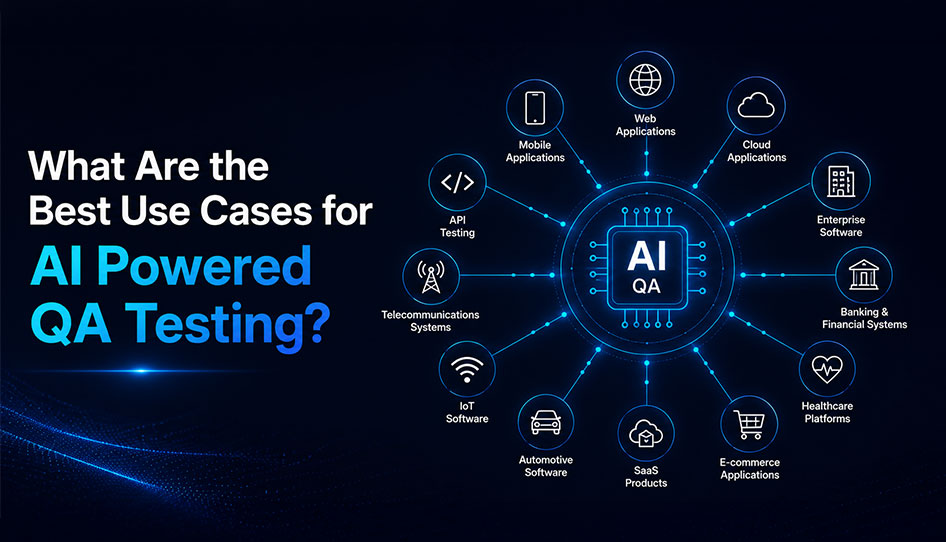
Modern day software products are benefitting heavily from AI powered QA Testing. Its crucial impact is in departments of speed, scale and reliability.
Industries with frequent software releases get the most value as AI can adapt to changing applications without any script updates.
Common use cases include:
- Web application testing
- Mobile application testing
- API testing
- Cloud application testing
- Enterprise software
- Banking and financial systems
- Healthcare platforms
- E-commerce applications
- SaaS products
- IoT software
- Automotive software
- Telecommunications systems
Software testing trends are continuing to advance, AI has become the go-to option for businesses who want to digitally transform.
How Does AI Improve Regression Testing?
One of the most time taking and draining aspects of software quality assurance is Regression Testing.
Each and every new feature or bug fix needs testers to verify that existing functions still work correctly.
AI simplifies regression testing by identifying test cases which are eligible for each software update and ones which are most relevant.
Instead of mindless execution of every available set, AI does an analysis of code change, past defects and consumer behavior to give priority to high-risk situations.
How Does AI Help with Test Maintenance?
Maintaining test scripts has been a major challenge of traditional automation.
Small interface changes can even cause multiple automated tests to fail. AI introduces self-healing automation.
Instead of stopping when an element changes, AI will identify similar objects based on their characteristics such as text, position, attributes and relationships within the page.
For example, if a “Login” button changes its identifier after a software update, AI can often locate the new button automatically and continue executing the test.
This helps in reducing maintenance efforts and allow the QA teams to focus on quality improvements instead of making repairs.
Can AI Improve Performance Testing?
Yes. Artificial intelligence is enhancing performance, making it more intelligent, technically sound and predictive in nature.
Instead of measuring response times, AI evaluates system behavior under different workflows and identifies any performance bottlenecks. All this is done before impacting UI.
AI-driven performance testing helps organizations:
- Predict any possible Failures
- Detect memory leaks
- Identify CPU bottlenecks
- Forecast scalability issues
- Optimize cloud resources
These insights allow development teams to address performance concerns early in the software lifecycle.
What Skills Will QA Engineers Need in 2026?
QA professionals’ role has transformed immensely over the years, specially in the modern market.
Instead of spending the majority of their time doing repetitive script tests, they are becoming quality strategists who can handle whole AI-driven testing ecosystems.
Key skills for QA automation 2026 include:
- AI-assisted test automation
- Programming fundamentals
- API testing
- CI/CD integration
- Cloud testing
- Data analysis
- Prompt engineering for Generative AI
- Security testing
- Performance testing
- Risk-based testing
Professionals who have technical expertise along with AI literacy can be well-positioned for future software quality roles.
Which Industries Benefit the Most from AI Powered QA Testing?
Although every software-driven organization can benefit, few industries have benefitted significantly due to strict quality, compliance regulations and reliability.
Banking and Financial Services
Financial applications process millions of transactions daily.
AI helps in validating payment systems, fraud detection systems, online banking mediums and regulatory compliance with increased speed and accuracy.
Healthcare
Any healthcare software has to operate with utmost reliability due to risk-factors being of high intensity.
AI assists in testing:
- Electronic Health Records (EHR)
- Telemedicine platforms
- Medical device software
- Hospital management systems
- Patient portals
This reduces software risks while maintaining regulatory compliance.
E-commerce
Online retailers tend to release new features on a more frequent basis.
AI improves testing for:
- Shopping carts
- Payment gateways
- Product recommendations
- Inventory systems
- Mobile commerce applications
The result is a smoother customer experience and fewer production issues.
Manufacturing
Manufacturers have started relying heavily on IoT devices, automation and smart factories.
AI testing authenticates and verifies industry software, production monitoring systems, robotics and other equipment with enhanced efficiency.
Telecommunications
Telecom providers have to handle complex infrastructures that need continuous validation. AI accelerates testing for:
- Customer portals
- Billing systems
- Network management
- Mobile applications
- 5G services
This helps improve reliability and reduce downtime.
Software-as-a-Service (SaaS)
SaaS companies often deploy updates weekly or even daily.
AI powered QA Testing enables continuous testing, rapid feedback, and faster feature releases without compromising software quality.
FAQs
1. What do you mean by AI Powered QA Testing?
AI powered QA Testing refers to the usage of AI and ML to create optimized and automated software testing. Unlike traditional automation, AI can curate test cases, prioritize fast execution, identify changes, predict failures and maintain test scripts automatically. This allows faster software release and enhanced quality.
2. How is software testing AI different from traditional automation?
Traditional automation works on a predefined script and manual maintenance whenever there are changes in an application’s interface or functionality.
AI in software testing works beyond a rule-based regime by learning from previous testing data, adapting to user-interface changes through their self-repairing abilities. They also have the ability to recommend new test cases and predict risk factors. This helps AI-driven testing become more scalable, efficient and reliable.
4. Can AI completely replace manual software testers?
No. AI is based on augmenting, not replacing human testing. It is much more efficient at repetitive, high workload tasks which have huge data inputs. The tasks include regression testing, maintaining scripts and predicting defects.
Human involvement is very important for exploratory testing, accessibility testing, business verification and overall strategic planning.
The future of QA lies in collaboration between AI and skilled testing professionals.
5. Is AI powered QA Testing suitable for small businesses?
Yes. Cloud-based AI testing platforms have made advanced testing capabilities accessible to organizations of all sizes. Small businesses can start by automating repetitive regression tests and gradually expand AI adoption as their applications and testing needs grow.