
Cloud Migration Strategy for Enterprises: A Step-by-Step 2026 Framework
A cloud migration strategy is an organized program which helps organisations and businesses in moving applications, company workload, data and IT infrastructure from on-ground level to the cloud with minimal effort.
Modern day market trends have resulted in businesses turning to cloud migration strategy in hopes to improve their scalability, measures of security and overall efficiency in operations.
An ideal cloud migration strategy will help you reduce downtime, manage risks, optimise spending and ensure business stability.
A cloud migration strategy can be termed as a path for moving business applications and storage of data and workloads.
It ensures safety and security while maintaining efficiency. It involves analysing existing infrastructure, opting the correct cloud model, planning phases of migration, cost optimization and continuous performance monitoring.
All this improves business value while reducing operational risks.
Why Is Cloud Migration More Important Than Ever in 2026?
The cloud has quickly transformed from a role of an IT feature into a business strategy. Modern advancements take place regularly in an organisation, continuous development of AI-powered apps, processing large databases and maintaining a hybrid workforce through scalable digital infrastructure.
Existing data centers are rigid and do not provide flexibility. Hardware procurement, maintenance costs, capacity limits and recovery issues all make this infrastructure increasingly difficult to handle.
A cloud migration strategy provides businesses an access to computing resources, enhance security measures, automation of deployments and scale globally without any significant investments. Cloud platforms also provide in-built AI interfaces, cybersecurity measures, machine learning and analysis of overall functioning, this improves operation efficiency.
As enterprises continue embracing digital transformation, enterprise cloud migration has become a strategic necessity rather than an optional IT project.
A well-planned cloud migration strategy has its technical plans aligning with their business goals and aims. It analyses existing infrastructure, applications, security walls, migration priorities and post-migration optimization. All this helps organisations to enhance scalability, performance and cost efficiency.
Why Do Enterprises Move to the Cloud?
Organizations have switched to cloud not only for infrastructure reasons but also because cloud adoption directly affects innovation, consumer experience, efficiency of tasks and better data handling which naturally boost revenue growth.
Some of the biggest business drivers include:
- Infrastructure Cost Reduction
- Faster Execution of Softwares
- Global Scalability
- Enhance Risk Management
- Strong Cybersecurity
- AI and analytics integration
- Business stability
- Enabling Remote Working
- Improved operational agility
These benefits become even more significant when enterprises operate across multiple regions or manage complex application ecosystems.
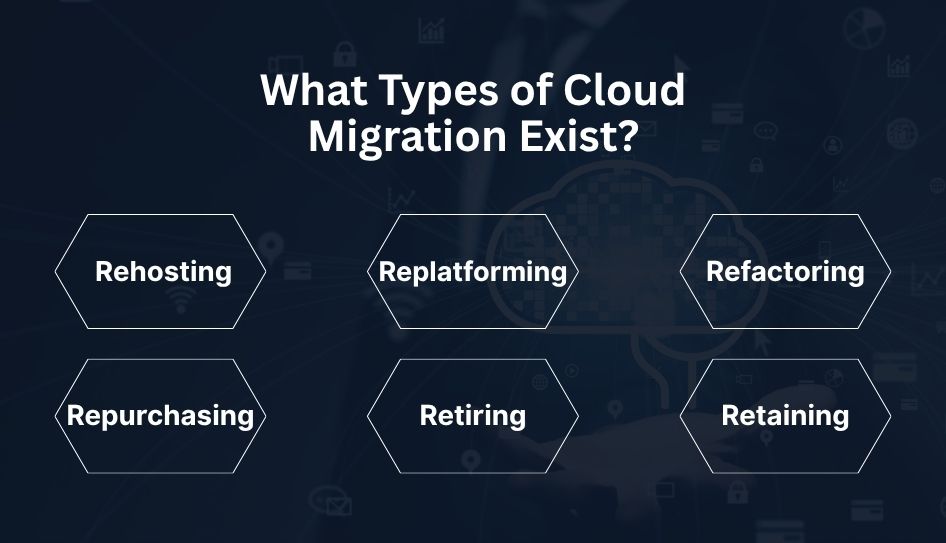
What Types of Cloud Migration Exist?
Different work measures need different migration methods.
Opting for the incorrect model will increase your costing and project risks.
The most common migration approaches include
1. Rehosting (Lift and Shift)
Minimal modifications are done to applications while moving.
This approach is quick to execute, it is for organizations seeking rapid migration.
However, it may not fully leverage cloud-native capabilities.
2. Replatforming
Applications go through minor modifications before migrating.
Businesses get performance enhancement while avoiding complete redeveloping.
This mixes speed with optimization during operations.
3. Refactoring
Applications go through redesign specifically for cloud-native environments.
Although this requires a significant investment, it provides you with improved scalability, automation and prolonged cost savings.
4. Repurchasing
Existing software will get replaced by Software-as-a-Service(SaaS) solutions.
For example, replacing locally hosted CRM software with Salesforce or Microsoft Dynamics.
5. Retiring
Old and existing softwares are no longer valuable for businesses.
Instead of migrating them, these systems are removed completely from the enterprise database.
6. Retaining
Not every workload belongs in the cloud.
Applications with regulatory, latency, or hardware dependencies may remain on-premises within a hybrid architecture.
Which Cloud Deployment Model Should Enterprises Choose?
This answer is solely dependent on your business objectives, work compliance and total budget.
The four primary deployment models include:
| Cloud Model | Best For |
| Public Cloud | Startups, digital businesses, scalable workloads |
| Private Cloud | Highly regulated industries |
| Hybrid Cloud | Enterprises balancing cloud and on-premises systems |
| Multi-Cloud | Organizations seeking vendor flexibility and resilience |
Most enterprises in 2026 are adopting hybrid and multi-cloud strategies to avoid vendor lock-in while improving availability.
What Are the Biggest Benefits of Enterprise Cloud Migration?
A successful enterprise cloud migration provides both short-term gains and long-term business stability.
Some of the most significant advantages include:
Greater Scalability
Cloud infrastructure naturally increases your workload scale based on your business demands.
Companies avoid purchasing expensive hardware that may not be of utility.
Improved Business Agility
Deployment of applications and software gets fast-paced due to automation, cloud-driven services and CI/CD pipelines.
This fast-tracks launch of products and boosts innovation.
Enhanced Security
Leading cloud providers in the global market invest heavily on cybersecurity services.
Organizations can now identify management points, detect threats, monitor security levels and use compliance tools.
Better Disaster Recovery
Cloud platforms create multiple replicas of workload across multiple platforms and regions.
Businesses can now retrieve data after outages at a much faster rate than traditional infrastructure.
Lower Infrastructure Costs
Instead of purchasing servers every now and then, businesses now only have to pay for computing resources they consume during their operations.
This makes budgeting much easier.
AI Readiness
New and advanced AI applications require flexible resources for computing.
Cloud infrastructure provides AI development tools, managed databases, learning platforms and organized databases without any additional hardware purchase.
The major benefits of enterprise cloud migration involve increased scalability, improvement in cybersecurity, quick app deployments, reduced infrastructure cost, AI readiness, faster disaster recovery and flexible operating.
When combined with a structured cloud migration strategy, companies can transform IT systems while improving overall performance.
Why Do Some Cloud Migration Projects Fail?
In spite of consistent investments, quite a few migration initiatives fail to deliver according to expectations.
The problem rarely lies in cloud technology.
Most failures originate from poor planning.
Common reasons include:
- Lack of Clarity On Business Goals
- Lack of executive sponsorship
- Incorrect Infrastructure Assessment
- Application Dependency underestimation
- Low Monitoring of Operations
- Security oversights
- No post-migration optimization
Avoiding these issues begins with adopting a structured framework instead of migrating workloads randomly.
What Does a Modern Cloud Migration Strategy Look Like?
In the modern day market, cloud migration is not just an IT project or service.
Instead, organizations follow a continuous lifecycle that includes:
- Assessment
- Planning
- Prioritization
- Migration
- Validation
- Optimization
- Governance
- Continuous improvement
Each stage progresses to the next one, which reduces risk while improving business value.
How Can Enterprises Build a Successful Cloud Migration Strategy?
A successful cloud migration strategy works on regulated processes throughout rather than handling every workload at once. Each stage minimizes technological risks, maintains business efficiency and curates an environment for continued cloud success.
Below is a practical step-by-step framework that enterprises can follow in 2026.
Step 1: How Should You Assess Your Current IT Environment?
Taking the initial step is based on getting clarity about your existing digital infrastructure. Without proper understanding of current systems, you cannot build an effective migration setup.
During your assessment, these are few key considerations-
- Business-critical applications
- Legacy software
- Hardware dependencies
- Application owners
- Compliance requirements
- Data sensitivity
- Performance bottlenecks
- Existing licensing costs
- Disaster recovery capabilities
This assessment phase will build the foundation for the rest of your cloud migration strategy.
Step 2: How Do You Define Clear Business Objectives?
Cloud migration isn’t just about modernizing technology but a complete business solution.
Before selecting cloud platforms or tools, have your business outcomes already defined.
Typical objectives include:
- Reduce infrastructure costs by 30%
- Improve application availability
- Accelerate software deployment
- Enable AI initiatives
- Security Enhancement
- Improve disaster recovery
- Promotes hybrid work
- Global Expansion
- Reduce hardware maintenance
Every migration decision should align with one or more of these goals.
Step 3: Which Applications Should Be Migrated First?
Immediate shift of all the applications should not be done on the cloud.
Prioritize workloads according to business impact and migration complexity.
A common prioritization matrix looks like this:
| Priority | Workload |
| High | Internal collaboration tools |
| High | Customer portals |
| Medium | Analytics platforms |
| Medium | Development environments |
| Low | Legacy ERP systems |
| Low | Highly customized applications |
Starting with low-risk work systems allows the teams to get familiar with the cloud, before migrating important work systems.
Step 4: How Do You Map Application Dependencies?
Applications operate mostly on human intervention.
Majority of the systems have exchange of data with databases, different servers,API’s, payment gateways and other third-party platforms.
Migrating an application without understanding its dependencies creates more chances of errors and unpredictable mistakes.
Dependency mapping identifies:
- Database connections
- Shared storage
- Authentication services
- Internal APIs
- External integrations
- Network traffic
- Background jobs
- Batch processing systems
Advanced discovery tools have the ability to generate dependency maps before the migration processes.
Application dependency mapping helps you get clarity on how different systems communicate before migrating. Understand work databases,API’s, storage spaces and network relationships. This helps in executing a safe and secure enterprise cloud migration.
Step 5: Which Cloud Deployment Model Is Best?
Opting for the correct cloud variant and model relies heavily on workload characteristics.
Companies mostly evaluate these four options
Public Cloud
Ideal for scalable applications, development environments, and startups.
Examples include AWS, Microsoft Azure, and Google Cloud.
Private Cloud
Suitable for domains which have strict guidelines and business compliances such as healthcare sectors, finance and banking and defense sector.
Hybrid Cloud
A combination of in-house infrastructure clubbed with public cloud services.
Many enterprises opt for this model as it offers the right mix of flexibility and regulatory compliance.
Multi-Cloud
Work systems which involve usage of multiple cloud providers simultaneously.
This workflow improves efficiency without depending on a single service provider or vendor.
Step 6: How Should Enterprises Choose a Cloud Provider?
Opting for the cheaper service provider is not the correct approach.
Evaluate providers based on long-term business requirements.
Important evaluation criteria include:
- Global Availability
- Certified Security
- Full-fledged AI services
- Data residency
- Data and Disaster Recovery
- Service-level agreements
- Managed databases
- Kubernetes support
- Integration capabilities
- Transparent Prices
- Consumer Support
Organizations should consider future potential clubbed with current business needs.
Step 7: How Do You Build a Migration Roadmap?
Once your workload is prioritized, now you can curate a well-planned migration roadmap.
Do not start migrating everything simultaneously.
A phased roadmap typically follows this order:
- Discovery
- Assessment
- Planning
- Pilot migration
- Testing
- Production migration
- Validation
- Optimization
- Continuous monitoring
Each phase should include clearly defined success metrics.
Step 8: How Can Enterprises Prepare Their Security Strategy?
Security should be integrated into every migration stage rather than added afterward.
A secure enterprise cloud migration includes:
- Identity and Access Management (IAM)
- Multi-factor authentication
- Encryption at rest
- Encryption in transit
- Network segmentation
- Security monitoring
- Vulnerability assessments
- Zero Trust architecture
- Backup policies
- Incident response planning
Security teams should participate from the earliest planning stages.
Step 9: Why Is Data Migration Planning Critical?
Data is considered to be an important enterprise possession.
Migrating data inaccurately only results in a chance of corruption of data , violation of compliances and even permanent data loss.
A well orchestrated migration plan includes:
- Classifying Data
- Creating Backups
- Validating Data
- Sequencing Migration
- Data synchronization
- Rollback planning
Organizations should do a verification of data integrity after every migration phase.
Step 10: Why Should Enterprises Start with a Pilot Migration?
Instead of migrating a huge chunk of applications instantly, start with a pilot project.
A pilot migration ensures execution while also showcasing any technical issues at an early stage.
Good pilot candidates include:
- Internal HR applications
- Collaboration platforms
- Development environments
- Reporting systems
- Employee portals
Lessons learned during initial projects improve future migration phases.
Pilot migrations reduce risk by testing cloud infrastructure with low-impact applications before enterprise-wide deployment. They help IT teams validate security controls, migration tools, application performance, and rollback procedures while identifying issues early in the overall cloud migration strategy.
Step 11: How Do You Execute Enterprise-Wide Migration?
On successful completion of the pilot project, begin phased production migration.
Avoid migration of every domain simultaneously.
Instead, migrate by:
- Business unit
- Geographical Aspect
- Type of Application
- Risk category
- Dependency on Infrastructure
This controlled rollout minimizes disruption while simplifying troubleshooting.
Conclusion
In 2026, Cloud migration is not limited to simply shifting workloads from on-premise platforms to the cloud– it is more about building scalable and efficient digital foundations. A successful cloud migration strategy mixes technology decision making with business goals, allowing enterprises to make innovations at a faster rate, improves security and adapt to changing market requirements.
By working on a well-structured plan, you first start with infrastructure assessment , identify workloads, opt for the correct cloud model, implementing security measures and continuous monitoring of performance. Companies can now significantly reduce migration risks while maintaining business value. Another crucial process is adopting a proactive approach to cloud cost optimization, ensuring cloud investments are efficient and sustainable over time.
Ultimately, businesses should treat cloud migration as a continuous improvement rather than a one-off project. Regular monitoring, training employees and compliance checks will help you build your ideal cloud migration checklist 2026. With the correct strategy, enterprise cloud migration will go on to become an essential driver of innovation, operative competence and prolonged business growth.
FAQs
1. What is a cloud migration strategy?
A cloud migration strategy is an organized pathway that guides businesses in allocating applications, databases and infrastructure from on-premises workflow to digital cloud platforms. It aids planning, executing, security and optimization of activities. This ensures an error free and smooth migration.
2. Why is enterprise cloud migration important?
Enterprise cloud migration assists businesses to increase scalability, improve cybersecurity, reduce operations costing, and promote innovation. All this is achieved by supporting AI, automation of workflows and advanced analytics. It also increases flexibility and ease of work.
3. What are the biggest cloud migration challenges?
Cloud migration challenges are very common if left unsupervised, they include legacy applications, data breach concerns, compliance alignment, and budget overruns. Organised planning, phased migration and supervised execution help overcoming these challenges.
4. How can organizations achieve cloud cost optimization?
Cloud cost optimization involves right-sizing resources, automating workload scheduling, monitoring usage, removing idle resources, leveraging reserved capacity for predictable workloads, and regularly reviewing cloud spending. Continuous optimization ensures enterprises maximize value while minimizing unnecessary expenses.
5. How long does enterprise cloud migration take?
The timeline depends on infrastructure complexity, application dependencies, data volume, compliance requirements, and migration strategy. Small projects may take a few weeks, while large enterprise migrations often span several months or even years through phased implementation.