
How Much Does It Cost to Build an AI Agent in 2026?
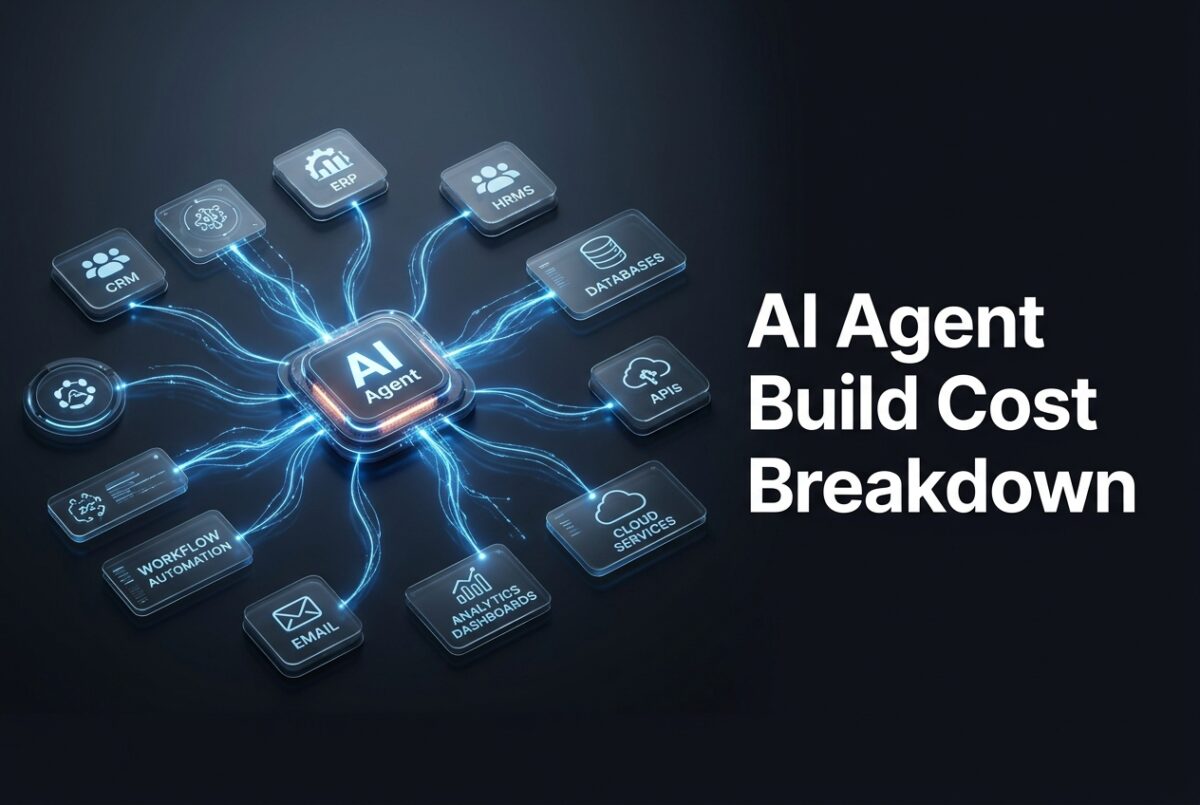
If you are budgeting for an AI agent right now, the hard part is not the model choice. It is separating the real build cost from the run rate, then deciding how much complexity your business actually needs. That distinction matters because an AI agent is not a feature toggle. It is closer to a small software system with recurring operating costs, integration debt, and security obligations.
That is why the question “How much does it cost to build an AI agent?” needs a sharper answer than “It depends.” In 2026, the budget range is wide enough to sink a board conversation if you walk in unprepared. A thin wrapper can be inexpensive. A business-ready system with orchestration, integrations, memory, evals, and compliance can move into six figures quickly. The buyer’s job is to know which version they are buying before they sign.
What you are actually paying for
An AI agent budget is not one line item. It is a stack of decisions that determine whether the agent can work in production.
At the simplest level, you are paying for:
- problem framing and scope control
- model selection and routing
- data preparation and retrieval
- integrations with business systems
- interface design
- testing and evals
- deployment, observability, and maintenance
That is why AI development services quotes vary so much. Two vendors can say they build “the same” agent and still be quoting very different things. One may be pricing only engineering hours. The other may include model usage, infra, and support. If you do not normalize scope, you are not comparing quotes. You are comparing labels.
Think of an agent like an operating layer for a workflow. The model is only one part of it. The business value comes from the surrounding system: what it can access, what it can do, what it should not do, and how you know when it is wrong.
The headline budget ranges
For a business-ready AI agent in 2026, the practical tiers are clear.
| Tier | What it is | Indicative one-time build cost | Indicative monthly run-rate |
|---|---|---|---|
| MVP / Pilot | Single-use case, off-the-shelf RAG, limited integrations, basic UI | $15,000 – $60,000 | $500 – $3,000 / month |
| Production-grade single agent | Custom orchestration, tool use, persistent memory, observability, eval pipeline, security review | $60,000 – $180,000 | $3,000 – $10,000 / month |
| Multi-agent enterprise platform | Multiple cooperating agents, custom evals, RBAC, SOC 2/HIPAA posture, multi-tenant infra | $180,000 – $500,000+ | $10,000 – $100,000+ / month |
The realistic spread across the market runs from roughly $5,000 for a thin wrapper around an existing model to $500,000+ for a regulated, multi-agent enterprise deployment. A lot of vendor disclosures in 2026 cluster in the $20,000 – $300,000 band for the build itself, with $3,000/month cited as a common single-agent operating cost.
The simplest budget rule is this: year-one total is usually build cost times 1.5 to 2.0. In plain English, if you spend $60,000 to build, do not be surprised if the first year lands closer to $90,000 – $120,000 once you include run-rate, infra, and iteration.
The six variables that move the price
If you want to know how much does it cost to build an AI agent, do not start with the vendor. Start with these six variables.
1) Agent type and complexity
Complexity is the first price lever.
- Simple reflex or rule-based agent: $10,000 – $30,000
- Model-based reflex agent: $40,000 – $80,000+
- Goal-based agent: $40,000 – $150,000+
- Utility-based agent: $80,000 – $200,000
- Learning agent: $100,000 – $500,000+
- Multi-agent system: typically $250,000+
A scripted FAQ bot is not in the same class as an agent that plans, chooses tools, remembers state, and adapts over time. The more decisions the system makes on its own, the more you are paying for design, evaluation, and control.
2) Integrations
This is where many budgets break.
Read-only connectors are cheap. Write-back systems are not. If the agent only reads data from a CRM or ticketing system, the work is straightforward. If it updates records, retries failed calls, handles idempotency, and writes audit logs, the price rises fast.
- Read-only connector: low thousands
- Bi-directional, write-back integration: $5,000 – $25,000 each
- Enterprise systems such as SAP, Salesforce, Workday, ServiceNow, or custom ERP: $15,000 – $60,000 each
For many buyers, the largest single line item is not the model. It is the integration into the system of record.
For many buyers, the largest single line item is not the model. It is the integration into the system of record.
3) Data work
Bad data is expensive, and the expense usually shows up late.
Data collection, cleaning, deduplication, labeling, and PII redaction typically account for 20-30% of total project cost. On top of that, embedding pipelines, chunking strategy, and re-indexing on schema changes create ongoing engineering work.
This is one of the easiest places to underbudget. It is also one of the easiest ways to ship an agent that demos well and fails in real use.
4) Model choice
Model selection is not just about performance. It is about economics.
The market usually breaks into four practical layers:
- Frontier proprietary models for the hardest reasoning tasks
- Mid-tier proprietary models as the production workhorse
- Small proprietary models for routing, classification, and bulk calls
- Open-weight self-hosted models for predictable unit economics at scale
The cost pattern is simple. Use the expensive model where reasoning matters. Use the cheap model where it does not. A single mis-routed call, multiplied across volume, can 10x the API bill.
That is one reason AI development services should be evaluated on routing logic, not just model access. If the team cannot explain when they use a frontier model and when they do not, they are not controlling cost.
5) Security, compliance, and observability
Production systems need guardrails.
- SOC 2 Type II, HIPAA, GDPR, EU AI Act posture: $15,000 – $100,000+
- Eval and observability stack: $500 – $5,000 / month
- Red-teaming, prompt-injection defense, content moderation: $5,000 – $50,000 initial, plus ongoing
If your agent can touch customer data, internal workflows, or irreversible actions, this is not optional. It is part of the build.
6) Team geography
Rates vary sharply by region.
- US / Canada: $150 – $300 / hour
- Western Europe: $80 – $200 / hour
- Eastern Europe: $40 – $100 / hour
- Latin America: $50 – $90 / hour
- India / South / Southeast Asia: $25 – $60 / hour
These are blended engineering rates. ML and LLM specialists usually command a premium inside each band.

How the budget splits across the build
A serious agent build does not happen in one block. It moves through phases, and each phase eats a different share of the budget.
| Phase | % of total budget | Typical duration | What is actually delivered |
|---|---|---|---|
| Discovery & strategy | 10-15% | 2-4 weeks | Problem framing, success metrics, ROI model, architecture diagram, build-vs-buy recommendation, fixed-price SOW |
| UX / conversation & prompt design | 10-15% | 2-4 weeks | Conversation flows, persona/tone, system prompts, guardrails, error/edge UX, voice or chat surfaces |
| Core development & integration | 40-50% | 6-16 weeks | Model wiring, RAG pipeline, tool/function calls, agent orchestration, frontend, auth, integrations |
| Testing, evals & hardening | 10-15% | 2-4 weeks | Automated eval suite, regression tests, red-team prompts, hallucination/PII checks, load testing, security review |
| Deployment & MLOps | 5-10% | 1-2 weeks | Cloud infra, CI/CD, observability, cost dashboards, fallback paths, rollout plan |
| Maintenance & iteration | 15-25% / year | ongoing | Drift monitoring, content updates, model upgrades, bug fixes, roadmap |
This is the most useful lens for a buyer because it mirrors how vendors should quote. If a proposal ignores discovery, evals, or maintenance, it is not cheaper. It is incomplete.
The practical recommendation is also simple: fixed-price discovery, then time and materials for build, then retainer support after launch.
What a credible team actually looks like
A real MVP does not get built by “a developer.” It usually needs a small, multi-role team.
| Role | What they do | FTE share on an MVP |
|---|---|---|
| Solutions / AI architect | Model selection, RAG design, eval strategy | 0.25-0.5 |
| ML / LLM engineer | Prompting, evals, fine-tuning, orchestration | 1 |
| Backend / integrations engineer | APIs, auth, data pipelines | 1 |
| Frontend engineer | Chat UI, admin console | 0.5-1 |
| Data engineer | ETL, embeddings, indexing | 0.5 |
| QA / eval engineer | Eval harness, red-team, regression | 0.5 |
| UX / conversation designer | Flows, prompts, error UX | 0.25-0.5 |
| PM / product owner | Sprints, stakeholder sync | 0.25 |
| DevOps / MLOps | Infra, CI/CD, observability | 0.25-0.5 |
For a three-month MVP, the total fully loaded team is usually 3-5 people. For an enterprise multi-agent build, it is 8-12 people sustained over 6-9 months.
This is where many founders get misled by a low initial quote from an AI agent development company. If the team does not include the roles above, they are not quoting a production build. They are quoting a prototype.
The run-rate watch list buyers forget
The biggest mistake is treating launch as the finish line. It is not. A live agent creates recurring costs.
| Line item | Typical range |
|---|---|
| LLM API spend, single agent, low traffic | $500 – $15,000 / month |
| LLM API spend, multi-agent, high traffic | $10,000 – $100,000+ / month |
| Vector database | $50 – $5,000 / month |
| Cloud compute | $200 – $10,000 / month |
| Cloud storage | $100 – $3,000 / month |
| Observability / eval platform | $200 – $5,000 / month |
| Security & compliance tooling | $500 – $10,000 / month |
| Human-in-the-loop review & QA | $2,000 – $15,000 / month |
| Model retraining / fine-tuning cycles | $5,000 – $50,000 per cycle |
| Ongoing maintenance retainer | 15-25% of build cost per year |
For first-time buyers, the surprise is usually LLM API spend at scale. It can dwarf the build cost within a year if routing, caching, and spend controls are weak.
A practical use-case lens
The right budget depends on the job the agent is expected to do.
A support team building FAQ deflection may only need a single-use-case MVP with a limited integration set and a basic UI. That sits in the lower tier if scope stays tight.
A sales team asking the agent to read the CRM, qualify leads, and write back to the pipeline is in a different category. Write-back logic, auditability, and workflow confidence push the project into production-grade territory.
A product team using the agent for internal knowledge access, ticket triage, or workflow automation needs strong retrieval, clear escalation rules, and reliable evals. Once you add multiple business systems, persistent memory, and policy controls, the budget climbs.
The same pattern applies across functions. The more the agent can change state in your business, the more you pay for control, testing, and compliance.
Build, buy, or configure?
This is the decision frame that matters before you sign with any AI agent development company.
| Dimension | Build custom | Buy SaaS | Configure low-code |
|---|---|---|---|
| Time to first value | 3-9 months | 1-4 weeks | 2-8 weeks |
| Upfront cost | $60K – $500K+ | $0 – $5K setup + monthly | $1K – $20K + usage |
| Differentiates the core product | Yes | No | Partial |
| Lock-in risk | Low | High | Medium |
| Customization ceiling | Unlimited | Limited | Moderate |
| Best when | Agent is the product | Standard workflow, fast ROI | Internal tool, prototype |
The hybrid pattern wins most often in 2026: buy or configure commodity workflows like FAQ deflection, lead routing, or ticket triage.
If you are asking how much it costs to build an AI agent, the follow-up question should be whether you should build it at all. Sometimes the cheapest correct answer is to configure. Sometimes the right answer is to build only the part that differentiates the product.
Engagement model matters too
How a vendor sells the work changes the risk profile.
| Model | When it fits | Risk for the buyer |
|---|---|---|
| Fixed price | Clear scope, prototype / MVP | Scope creep is the #1 dispute |
| Time & materials | Discovery, R&D-heavy phases, ambiguous scope | Easy to overrun without active product ownership |
| Dedicated team / retainer | Ongoing iteration after launch | Quality depends on the named resumes |
| Outcome / success fee | Narrow, measurable workflows | KPI definitions must be airtight |
| Hybrid | Most common | Needs clear phase gates |
The practical recommendation is fixed-price discovery, then T&M build, then retainer support. That structure gives you enough control to protect the budget without freezing the project.
How to keep cost under control after launch
If you want the spend to stay rational, ask vendors for these tactics from day one:
- Route by complexity. Use cheap models for classification, routing, and extraction.
- Prompt and response caching can cut API spend 30-60%.
- Trim context. Smaller chunks, summaries, and retrieval filters reduce token spend.
- Batch and stream. Batch non-urgent calls; stream user-facing responses.
- Self-host at scale. Once call volume is high enough, open weights can beat API pricing.
- Compress prompts. Reusable system prompts and JSON-mode outputs cut waste.
- Set hard ceilings. Put per-user, per-session, and per-day caps in place.
- Use eval-driven iteration. Lock a regression set before tuning so cost and quality move together.
- These are not optimization tricks. They are how you stop a useful agent from becoming an uncontrolled expense.
Buyer diligence checklist before you sign
If you are about to hire AI development services, use this checklist before the statement of work is signed.
- One-sentence problem statement and one measurable success metric
- Inventory of data sources, owners, and access controls
- List of required integrations, split into read-only vs. write-back
- Stated build vs. configure vs. buy decision with rationale
- Budget range and hard ceiling
- 90-day evaluation window with go/no-go criteria
- Contract requires: eval harness, observability, runbook, code and prompt ownership on day one, no lock-in
- Run-rate forecast for inference, infra, and maintenance separated from build cost
- Quarterly model and cost review built into the engagement
If a vendor cannot answer these points clearly, they are not ready to own a production budget.
FAQ
How much does it cost to build an AI agent in 2026?
Most business-ready agents land between $15,000 and $500,000+. A single-use-case MVP typically runs $15K-$60K. A production-grade single agent usually runs $60K-$180K. A regulated, multi-agent enterprise platform runs $180K-$500K+.
What is the monthly cost of running an AI agent?
Expect $500-$3,000/month for a low-traffic single agent and $10,000-$100,000+/month for a high-traffic multi-agent system. LLM API spend is usually the largest line item at scale.
What factors most influence the price?
Agent complexity, number and depth of integrations, data readiness, model choice, compliance posture, and the geography and rates of the team you hire.
Should I buy, configure, or build custom?
Buy SaaS when the workflow is standard and ROI is fast. Configure for internal tools and prototypes. Build custom only when the agent is the product or the moat, or when compliance, data residency, or differentiation require it.
How do I keep AI agent costs under control after launch?
Route by complexity, cache aggressively, trim context, batch and stream, set hard spend ceilings, self-host open weights when scale justifies it, and run a regression eval set on every change.
What red flags should I watch for when hiring a partner?
Vague scope, no eval methodology, no runbook, no maintenance plan, unclear IP or prompt ownership, single-provider single-cloud designs, and quotes that mix build cost with run-rate without separation.
The strategic takeaway
Building an AI agent in 2026 is no longer a research bet. It is a budgeting discipline.
The teams that win treat it like a product launch: a clear problem statement, a measurable success metric, a phased budget tied to milestones, and a vendor engagement model that protects the buyer. That is the difference between a useful system and an expensive experiment.
The real question is not whether to build. It is how to build without overspending or underbuilding. Organizations that master that discipline will move faster, control risk better, and compound an advantage as agentic systems become the default layer underneath product workflows.
Need help with your AI-powered MVP?
Trusted partner in GenAI evolution
Share your email and we’ll reach out with tailored ideas.
Destination: On-page lead capture form submission.