
How Much Does It Cost to Build ESG Reporting Software?
If you are trying to budget ESG reporting software, treat it less like a sustainability project and more like an enterprise data and controls programme. That is the real shape of the work. The reporting layer is just the visible surface. Underneath, you are wiring finance, supply chain, HR, utility, and supplier data into a system that has to stand up to audits, framework mapping, and disclosure deadlines.
That is why the cost question is harder than it looks. ESG reporting software is not one tool with one price. It sits somewhere between an ERP extension and a disclosure engine. And with the market moving from about $1.3 billion in 2023 toward $5.6 billion by 2029 in one analyst’s view and $4.78 billion in 2026 toward $10.31 billion by 2031 in another, buyers are clearly treating it as budgeted infrastructure, not a nice-to-have.
The practical question is not “Should we buy ESG reporting software?” It is “How much scope are we really buying, and what will it take to make it defensible?”
Why ESG reporting software costs what it costs
The world before ESG reporting software was messy in a familiar way. Data lived in separate systems. Emissions numbers were assembled in spreadsheets. Evidence was scattered across email, shared drives, and local exports. That worked when reporting was light and voluntary. It does not work when the disclosure regime asks for traceable, machine-readable, assurance-ready output.
The cost is driven by five realities:
- You are not just storing data, you are collecting it from many source systems.
- You are not just calculating carbon, you are supporting multiple scopes and methodologies.
- You are not just filling out a report, you are mapping into frameworks like CSRD, ISSB, GRI, TCFD, CDP, and SEC.
- You are not just approving a number, you are preserving lineage and audit evidence.
- You are not just producing a PDF, you may need iXBRL or XBRL-tagged output.
In other words, the budget goes toward plumbing, controls, and reproducibility. That is why the scope of your integration surface matters more than your sustainability messaging.
What ESG reporting software actually has to do
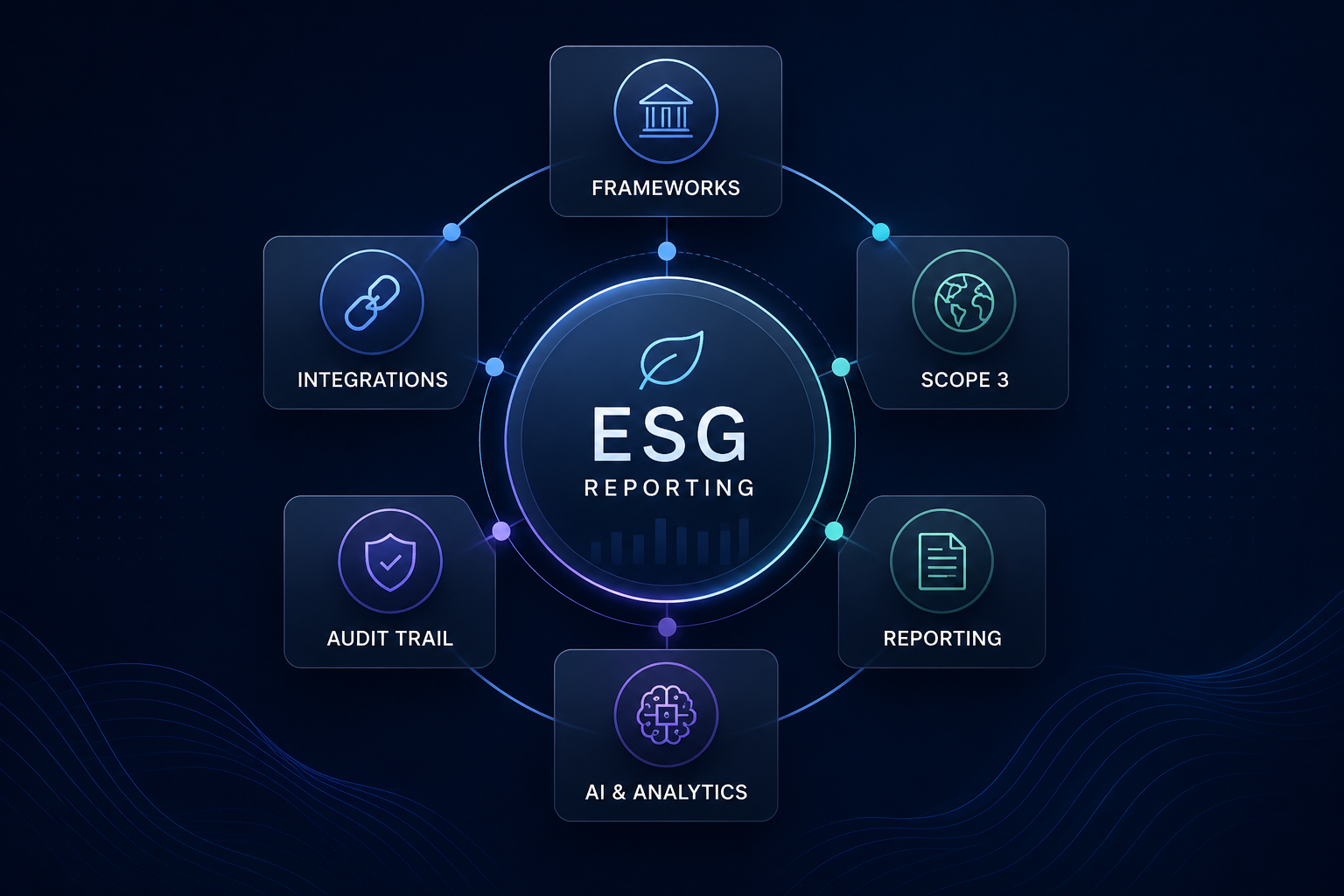
Before comparing vendors or estimating a build, it helps to define the system itself. A real ESG reporting software platform usually has six layers.
1. Data ingestion
This is the connective tissue. The platform has to pull data from ERP, HRIS, utility billing, IoT or OT sensors, supplier portals, sustainability exchanges, and CSV or Excel uploads.
If your company runs a lot of systems, this layer becomes a real line item. SAP, Oracle, NetSuite, Microsoft Dynamics, Workday, and Success Factors are not interchangeable in practice. Every connector takes time to implement and maintain.
2. Carbon accounting engine
This is where Scope 1, Scope 2, and all 15 Scope 3 categories are calculated using GHG Protocol methods. The engine has to handle activity data, emission factors, unit conversion, and different calculation methods such as spend-based, supplier-specific, and hybrid approaches.
If you need version pinning for emission-factor libraries, that adds another layer of discipline. It also adds cost, because methodology changes cannot be treated casually.
3. Framework mapping layer
This is where raw ESG data gets translated into reporting formats required by CSRD and ESRS, ISSB IFRS S1 and S2, GRI, SASB, TCFD, CDP, SEC, and rating agencies like MSCI and Sustainalytics.
This layer is often underestimated. It is not just a template. It is a crosswalk problem across frameworks with different definitions and disclosure logic.
4. Workflow and approvals
A serious platform needs data owner assignment, review chains, evidence linking, comments, and segregation of duties. If the business wants confidence in reported numbers, this layer is not optional.
5. Audit trail and lineage
This is the part that makes the software defensible. Immutable logs should show where each reported number came from, who approved it, which methodology was used, and which factor library version was in play. For reasonable assurance, this is mandatory.
6. Disclosure output
The platform then has to export the result in the right form: iXBRL-tagged filings for CSRD and ESRS, regulator-formatted XBRL where needed, templated PDF or HTML reports, and machine-readable exports for investors or rating agencies.
That is the core stack. Anything else is a feature on top.
The biggest cost drivers in ESG software development
If you are estimating ESG reporting software development, these are the levers that move the number fastest.
Frameworks in scope
Every additional framework multiplies mapping rules and validation logic. A one-framework MVP is a very different job from a multi-framework enterprise platform.
Scope 3 ambition
This is usually the biggest cost driver. If you want supplier engagement, primary data collection, and hybrid methods instead of spend-based estimates, the work expands fast. Supplier portals, reminders, intake forms, and data exchange all add budget.
Integration surface
The harder the source systems, the higher the cost. ERP, HRIS, utility feeds, IoT, and supply-chain systems each add connector work and ongoing maintenance.
Assurance-grade audit trail
If your system must support limited assurance now and reasonable assurance later, you need immutability, version control, evidence storage, and reproducible calculations. That is not a small add-on.
XBRL and iXBRL tagging
CSRD reporting requires machine-readable digital tagging. Building or maintaining a tagging pipeline is its own subproject.
AI features
OCR on invoices and utility bills, anomaly detection, narrative drafting, and scenario modeling all add cost. They also add governance work, because the output still has to be reviewed by humans.
Change management
This one gets missed often. Training finance, procurement, HR, sustainability, and operations teams takes time. If you do it badly, the software becomes a nicer interface on top of bad data.
ESG reporting software pricing bands
Most enterprise ESG vendors do not publish clean list prices, so the numbers below should be read as anchors, not universal quotes.
Entry band
This is roughly $40,000 to $70,000 per year. It is generally where you land for a mid-market setup with a single framework, Scope 1 and 2 reporting, and no real assurance complexity.
Mid-market band
This is roughly $100,000 to $250,000 per year. At this level, you are usually looking at Scope 1, 2, and lighter Scope 3, one or two frameworks, and a basic audit trail.
Enterprise band
This starts around $250,000 per year and can run to $1 million or more annually before services. That is the territory for multi-entity, multi-framework, full Scope 3, assurance-grade controls, and deep integration with ERP, HRIS, and GRC systems.
What buyers actually see from major vendors
A few market examples help anchor expectations.
Workiva
Workiva commonly uses a per-module and per-seat model. An entry ESG deployment is roughly $50,000 per year. Larger enterprise deployments can start around $250,000 per year and move into the $500,000 to $1 million plus range before services.
It is strongest where ESG reporting must sit close to SEC, SOX, and audit workflows. The tradeoff is that its non-financial ESG content depth can be thinner than specialist platforms.
Salesforce Net Zero Cloud
Salesforce offers tiered pricing. Starter is $48,000 per year, with 3 CRM licenses and basic carbon accounting. Growth is $210,000 per year, with 5 CRM licenses, a Scope 3 hub, advanced analytics, and AI-assisted disclosure authoring.
It fits well if the business already runs on Salesforce. But if ESG is the only use case, the per-CRM mechanics can feel awkward.
Microsoft Sustainability Manager
Microsoft starts from about $4,000 per tenant per month, or about $48,000 per year at the base Essential tier. It fits best in Microsoft-heavy environments, especially where Power Platform extensibility matters.
The sustainability-specific depth is not as broad as best-of-breed specialist vendors, and Scope 3 usually needs partner configuration.
Watershed
Watershed is quote-based, with an indicative entry around $40,000 per year and large deployments above $500,000 per year before services. It is known for strong Scope 3 supplier workflows and audit-grade data assurance.
Persefoni
Persefoni is unusual because its Pro tier is free for a single user with basic carbon accounting. Enterprise tiers are quote-based and materially above that. It is appealing for smaller teams, but enterprise Scope 3 supplier engagement is not its strongest lane.
Sphera
Sphera is enterprise-only and quote-based. Reviewers have reported narrow-use cases around $16,000 plus per year, while industrial enterprise deployments can run from $200,000 to $500,000 per year depending on scope.
It is strongest in LCA and industrial contexts, though the enterprise sales motion is heavier.
Sustainalytics
Sustainalytics is not a reporting platform. It is an ESG risk ratings subscription, with indicative pricing from $220,000 to $480,000 per year depending on coverage and scope. It can complement a platform, but it does not solve data collection or disclosure output.
What it costs to build ESG reporting software
If you are considering custom development, the budget depends on how much of the stack you need to own.
Compliance MVP
Scope: one framework, usually one ESRS set or GRI, Scope 1 and 2, manual data entry, basic dashboard, basic audit log
Cost: $60,000 to $120,000
Timeline: 4 to 6 months
Mid-Market Platform
Scope: 2 to 3 frameworks, partial Scope 3, one ERP connector, approval workflows, structured audit trail
Cost: $120,000 to $250,000
Timeline: 6 to 9 months
Enterprise System
Scope: multi-framework mapping, supplier Scope 3 portal, immutable audit trail, multi-entity consolidation, ESRS iXBRL export
Cost: $250,000 to $500,000
Timeline: 9 to 14 months
AI-Enabled Enterprise
Scope: everything above plus anomaly detection, narrative drafting, scenario modeling, predictive emissions forecasting
Cost: $500,000 to $750,000 plus
Timeline: 12 to 18 months
If you are evaluating an enterprise software development effort, this is the zone where the architecture, controls, and change management begin to matter more than the visible interface.
Where the build budget goes
A mid-market build typically breaks down like this:
- Discovery, data mapping, architecture: about 15%
- Backend, calculation engine, integrations: about 40%
- Frontend, dashboards, disclosure builder: about 15%
- QA, security, calculation validation: about 15%
- Deployment, integration, data migration: about 8%
- Training, handover, change management: about 7%
That mix is useful because it shows what buyers often miss. The calculation engine is important, but the integrations and validation are usually where the complexity lives.
You can also think of the work by module:
- User management and RBAC: $6,000 to $14,000
- ESG data collection engine: $20,000 to $45,000
- Carbon accounting engine: $25,000 to $55,000
- Framework mapping layer: $18,000 to $40,000
- Supplier portal and Scope 3 workflows: $30,000 to $70,000
- Dashboards and analytics: $12,000 to $28,000
- Custom report or disclosure builder: $15,000 to $35,000
- Workflow and approvals: $10,000 to $22,000
- Audit trail and evidence management: $14,000 to $32,000
- Third-party integrations: $15,000 to $50,000
- AI features: $28,000 to $60,000
- Security and compliance controls: $10,000 to $25,000
A custom software development company should be able to explain how those modules interact, not just quote them separately.
Ongoing costs after launch
Year 1 is not the end of the spend. Expect annual run costs of about 15% to 20% of the initial build cost for maintenance, infrastructure, factor library updates, minor regulatory changes, and security patching.
If a major framework changes, the update can trigger another project that runs roughly 10% to 30% of the original build cost, depending on the scope of the change.
This matters because ESG software is not a one-time implementation. It is a living system that has to stay aligned to regulations, methodologies, and internal controls.
Buy vs build: a practical comparison
| Decision factor | Buy ESG reporting software | Build custom ESG software |
|---|---|---|
| Time to first value | Faster | Slower |
| Best fit | Single entity, single framework, lighter Scope 3 | Multi-entity, multi-framework, deep controls |
| Integration needs | Moderate | Heavy and custom |
| Assurance posture | Often strong out of the box | Strong if designed well |
| Flexibility | Limited by vendor model | High |
| Upfront cost | Lower in many cases | Higher |
| Long-term fit | Good for standard needs | Better for proprietary workflows |
Here is the simple test.
Buy when the first reporting cycle is close, the scope is narrow, and the business can live with vendor opinionated workflows.
Build when the company needs deep ERP reconciliation, proprietary decarbonization logic, data residency control, or multi-entity complexity that a standard platform will not handle well.
Most teams end up in the middle. They buy the framework content and assurance layer, then build the proprietary data and workflow layer on top. That hybrid model is often the most realistic answer.
A realistic implementation pattern
For a mid-market manufacturer, the first version might pull utility bills, ERP activity data, and supplier emissions data into a common warehouse. Finance and sustainability teams review the numbers in a workflow layer. The platform maps that data into CSRD or GRI outputs. A board dashboard tracks progress. Audit evidence is stored beside the reported values.
For a software-heavy enterprise, the shape is different. The team may prioritize internal controls, cross-entity consolidation, and disclosure consistency before it touches advanced AI features. In that case, the software is less about flashy automation and more about making sure numbers can survive challenge.
That is the practical lesson: the value of ESG reporting software is not in generating a prettier report. It is in making the reporting process defensible, repeatable, and scalable across teams.
How to estimate your own budget
Use this sequence if you are comparing vendors or sizing a custom project:
- List the frameworks you must support now and in the next two reporting cycles.
- Map each source system that must feed the platform.
- Decide how much Scope 3 has to be primary data versus spend-based approximation.
- Define the assurance target: limited now, reasonable later, or both.
- Clarify whether the output needs iXBRL or only PDF and HTML.
- Decide whether the platform must reconcile to the GL or internal controls.
- Estimate the amount of change management required across finance, procurement, HR, and operations.
- Treat ongoing maintenance as part of the real budget, not an afterthought.
If you do that honestly, the budget usually becomes much less mysterious.
FAQ
How much does ESG reporting software cost for a mid-market company?
A common mid-market band is $100,000 to $250,000 per year for SaaS, or $120,000 to $250,000 for a custom platform in the mid-market range, depending on scope and integration needs.
Is custom ESG reporting software cheaper than buying a vendor?
Usually not for standard needs. Custom is most defensible when you have multi-entity complexity, deep internal controls, proprietary analytics, or data residency requirements that a vendor cannot meet cleanly.
What drives cost up the fastest?
Scope 3 ambition, framework count, integration complexity, and assurance-grade audit trails are the biggest drivers. Change management is often the most underestimated one.
Do we need iXBRL or XBRL support?
If you are in CSRD and ESRS scope, machine-readable digital tagging is part of the requirement. If your disclosure needs are narrower, the answer depends on the reporting regime you must support.
What is the typical ongoing annual cost after launch?
A good rule of thumb is 15% to 20% of the initial build cost each year for maintenance, infrastructure, and regulatory updates.
Should we start with a vendor or a custom build?
Start by defining the framework-and-data gap. If the first cycle is soon and the scope is narrow, vendor SaaS is usually the faster path. If the program is multi-entity and controls-heavy, custom or hybrid may be the better fit.
Final take
ESG reporting software is becoming a core enterprise system, not a side project for sustainability teams. Once you see it as a controls, data, and assurance problem, the pricing starts to make sense.
That is also the strategic point. The companies that treat ESG reporting as disciplined enterprise software development will build something repeatable and defensible. The ones that treat it like a reporting template will keep paying for the same pain every cycle.
If you want the short version, it is this: the right budget is the one that matches your regulatory scope, data complexity, and assurance target. Anything less usually gets expensive later.
Need help with your AI-powered MVP?
Trusted partner in GenAI evolution
Share your email and we’ll reach out with tailored ideas.