
AI Token Consumption: Why Enterprise AI Costs Are Rising and How to Optimize Them
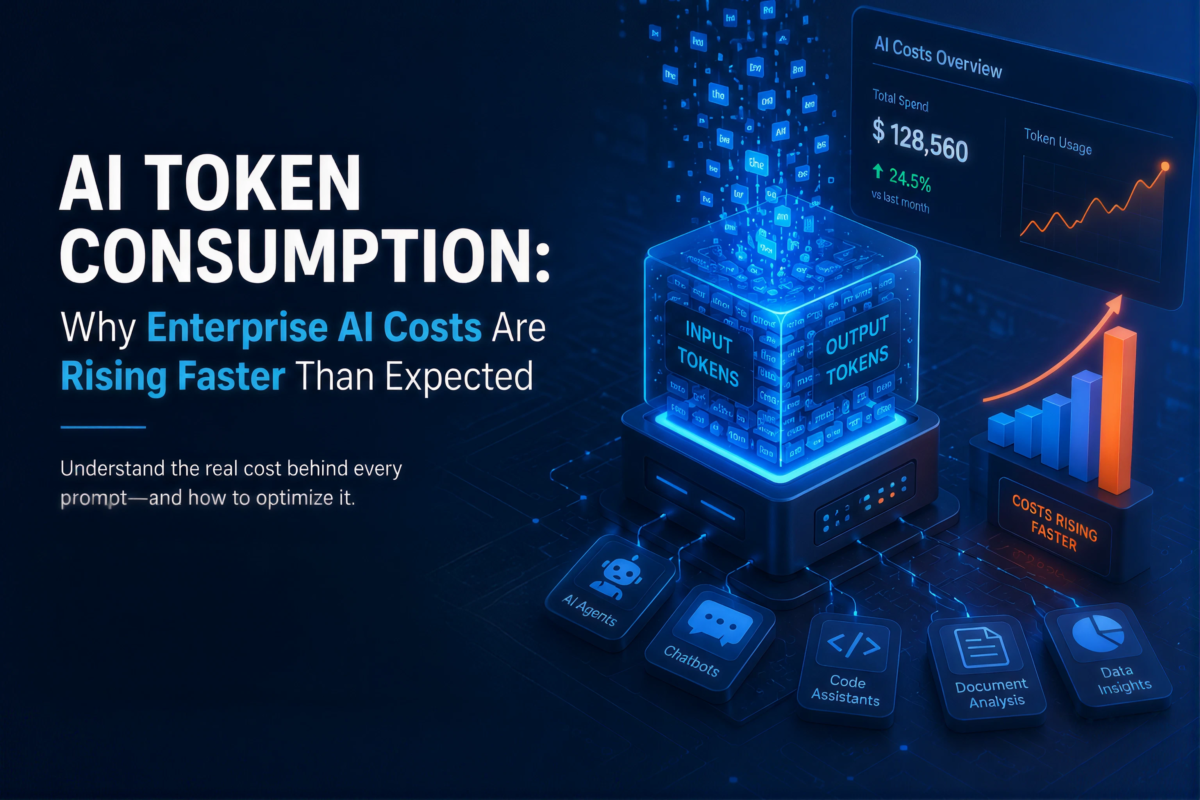
Artificial intelligence has become one of the biggest technology investments for enterprises over the past few years. Organizations are integrating AI into customer support, software development, HR, finance, cybersecurity, and business intelligence to improve productivity and automate repetitive work. With powerful large language models (LLMs) becoming more accessible, many business leaders assumed that falling model prices would naturally reduce the cost of running AI at scale.
Instead, the opposite is happening.
Enterprise AI budgets are growing faster than expected, and many organizations are discovering that their monthly AI spending continues to increase despite lower API pricing. The primary reason isn’t the price of AI models it’s AI token consumption.
Every interaction with an AI model consumes tokens. Every prompt, response, uploaded document, system instruction, and conversation history contributes to token usage. As businesses deploy AI assistants across multiple departments and thousands of employees, token consumption grows exponentially. Without proper governance and optimization, enterprises can end up spending significantly more than originally planned.
This shift is changing how organizations think about AI adoption. The discussion is no longer just about choosing the best language model; it is about building AI systems that are efficient, scalable, and financially sustainable. Companies that actively manage AI token consumption are able to scale AI initiatives while maintaining predictable operational costs. Those that ignore it often face rising infrastructure expenses, inefficient workflows, and lower returns on their AI investments.
In this article, we’ll explore why enterprise AI costs are increasing, what drives token consumption, and why optimizing AI usage has become just as important as implementing AI itself.
What Is AI Token Consumption?
Before understanding why AI costs continue to rise, it’s important to understand what a token actually is.
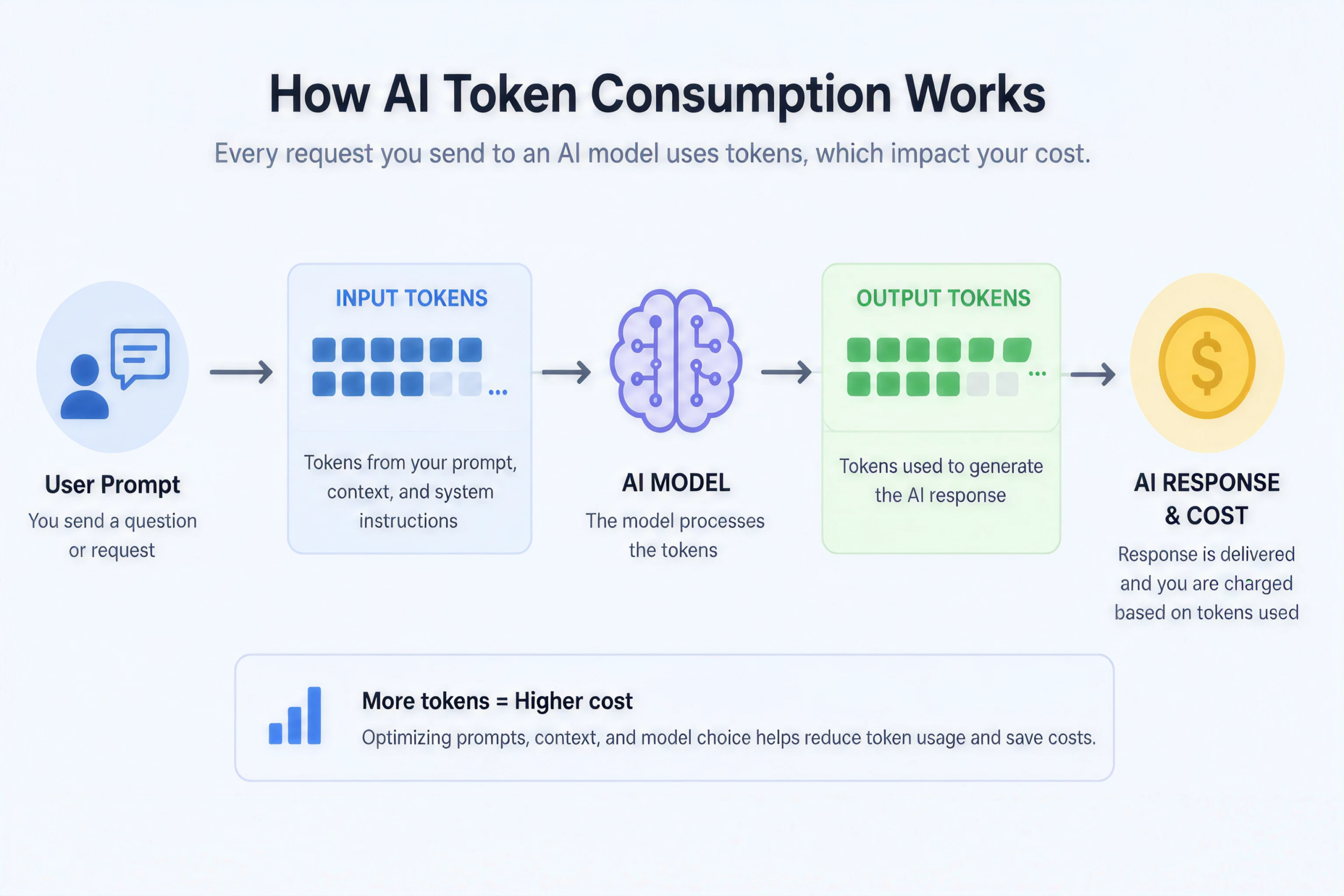
A token is the smallest unit of text that an AI model processes. Rather than reading complete words or sentences, large language models break text into smaller units called tokens. These tokens can represent whole words, parts of words, punctuation marks, numbers, or even spaces. Every request sent to an AI model includes input tokens, while every response generated by the model produces output tokens. Together, these determine how much an AI interaction costs.
For an individual user asking a few questions, token usage may seem insignificant. However, enterprise environments operate at an entirely different scale. Imagine an organization with 5,000 employees using AI assistants throughout the day. Each employee might generate hundreds or thousands of prompts daily, upload documents for analysis, summarize meetings, write code, create reports, and automate workflows. Each of these activities consumes thousands or even millions of tokens over time.
Modern AI applications also rely on much larger context windows than earlier models. Instead of processing a single question and answer, today’s enterprise AI systems often include conversation history, uploaded files, internal documentation, retrieved knowledge, and system instructions within every request. While this improves response quality, it also significantly increases token usage.
This is why AI token consumption has become one of the most important operational metrics for organizations investing in generative AI. Monitoring token usage provides visibility into how AI is being consumed across departments, which workflows generate the highest costs, and where optimization opportunities exist.
As AI adoption expands, token consumption becomes less of a technical metric and more of a business KPI that directly impacts operational spending, budgeting, and return on investment.
Why Enterprise AI Costs Are Rising Faster Than Expected
Many executives expected enterprise AI to become cheaper as competition increased among AI providers. Over the last two years, several model providers have reduced API pricing while introducing faster and more efficient models. On paper, this should have lowered AI expenses.
Yet enterprise spending continues to rise.
The reason lies in the rapid growth of AI usage rather than the cost per token. Organizations are embedding AI into nearly every business function, dramatically increasing the total volume of requests processed every day.
Customer support teams use AI to resolve tickets, summarize conversations, and draft responses. Software engineering teams rely on coding assistants for code generation, debugging, documentation, and testing. Marketing departments generate content, analyze campaigns, and personalize customer communications using AI. HR teams screen resumes, prepare interview summaries, and automate internal communications. Finance teams leverage AI for forecasting, reporting, and document analysis.
Each of these workflows consumes tokens continuously throughout the day.
At the same time, enterprise AI applications have become more sophisticated. Instead of asking a single question, users now expect AI to remember previous conversations, analyze lengthy documents, access company knowledge bases, generate structured reports, and perform multi-step reasoning. Every additional capability increases the number of tokens processed during each interaction.
The rise of multimodal AI has added another layer of complexity. AI systems can now analyze PDFs, presentations, spreadsheets, images, videos, and audio recordings. Processing these inputs often requires substantially more tokens than traditional text-based prompts, further increasing infrastructure costs.
As organizations deploy AI at enterprise scale, even small inefficiencies become expensive. A slightly longer system prompt, unnecessary conversation history, repeated requests, or inefficient workflow design may appear insignificant individually. Across millions of requests every month, these inefficiencies translate into substantial operational costs.
This explains why many enterprises are experiencing a growing gap between expected AI budgets and actual AI spending. The challenge isn’t that AI has become more expensive it is that organizations are consuming far more AI than they initially anticipated.
The Hidden Cost of AI Agents
One of the biggest drivers of enterprise AI costs in 2026 is the rapid adoption of AI agents.
Unlike traditional chatbots that respond only when prompted, AI agents operate autonomously. They retrieve information, make decisions, execute workflows, coordinate with other systems, and complete tasks with minimal human intervention. While this significantly improves productivity, it also creates continuous AI activity behind the scenes.
Consider a customer support agent that automatically retrieves customer history, searches product documentation, generates a personalized response, checks compliance policies, and updates a CRM system. What appears to be a single response for the user actually involves multiple AI interactions, each consuming input and output tokens.
Similarly, a software development agent may review source code, generate new code, perform security analysis, create documentation, execute test cases, and suggest improvements. A sales AI agent might analyze CRM records, summarize meetings, draft follow-up emails, forecast revenue, and recommend the next best action. Each workflow involves several AI calls rather than one.
As enterprises adopt multiple specialized AI agents across departments, total token consumption increases dramatically. A company may simultaneously run agents for customer service, HR, finance, legal, software engineering, procurement, and internal knowledge management. Individually, these agents appear cost-effective. Collectively, they can process billions of tokens every month.
Another hidden challenge is agent-to-agent communication. Modern enterprise AI systems increasingly rely on multiple AI agents collaborating to complete complex tasks. Each interaction between agents generates additional prompts, responses, and context exchanges, all contributing to token consumption. Without careful orchestration, organizations can unknowingly multiply their AI costs.
This is why enterprise leaders are shifting their attention from simply deploying AI agents to managing them efficiently. Optimizing prompts, selecting the right model for each task, limiting unnecessary context, and monitoring token usage have become essential practices for controlling AI expenses without sacrificing performance.
Why Lower Token Prices Don’t Mean Lower AI Bills
One of the biggest misconceptions about enterprise AI is that falling token prices automatically lead to lower operating costs. While major AI providers have reduced pricing and introduced more efficient language models, enterprise AI spending continues to rise. The reason is simple: AI usage is growing much faster than token prices are falling.
Think of it like cloud computing. Over the years, the cost of cloud storage and compute has decreased, yet most enterprises spend more on cloud services today than ever before because they store more data, run more applications, and support more users. AI follows the same pattern. Lower prices encourage wider adoption, leading organizations to deploy AI across more departments, workflows, and customer-facing applications.
For example, a company that started with a single AI chatbot for customer support may now use AI for software development, HR recruitment, legal document review, marketing content generation, financial reporting, cybersecurity analysis, and executive decision support. Each new application increases the number of AI requests processed every day. Even if the cost per token falls by 50%, overall spending can still double if token usage grows by 300%.
Another factor is the shift toward richer AI experiences. Businesses no longer expect AI to answer simple questions they expect it to understand context, analyze documents, generate reports, retrieve enterprise knowledge, and interact with multiple business systems. These advanced capabilities consume significantly more tokens than traditional chatbot interactions.
As enterprises continue to embed AI into core business operations, token consumption becomes the primary driver of costs. Organizations that focus only on model pricing often overlook the bigger picture: sustainable AI adoption depends on controlling usage, not just negotiating lower API rates.
The Biggest Reasons Enterprises Waste AI Tokens
Reducing AI token consumption starts with understanding where waste occurs. In many organizations, unnecessary token usage happens quietly in the background, adding thousands or even millions of extra tokens every day. While these inefficiencies may seem minor individually, they create substantial costs when multiplied across enterprise-scale operations.
One of the most common issues is overly long prompts. Many AI applications include large system instructions, repeated context, and unnecessary background information with every request. While detailed prompts can improve accuracy, excessive context often increases token usage without delivering proportional value.
Another major source of waste is repeated processing of the same information. Employees frequently ask similar questions, summarize identical documents, or generate recurring reports. Without caching or reusable AI outputs, the system processes the same data repeatedly, consuming additional tokens each time.
Organizations also waste tokens by using their most powerful language model for every task. Not every workflow requires an advanced reasoning model. Simple tasks such as grammar correction, formatting, email drafting, or FAQ responses can often be handled by smaller, lower-cost models. Using premium AI models for routine work significantly increases operational expenses.
Large document uploads are another hidden contributor to token consumption. Many enterprises upload entire contracts, policy manuals, technical documentation, or knowledge bases when only a small section is actually needed. Processing hundreds of pages for a simple question dramatically increases token usage.
Poor workflow design can also create inefficiencies. In some AI-powered systems, multiple agents perform similar tasks independently rather than sharing results. This duplication leads to repeated AI calls, unnecessary processing, and higher infrastructure costs.
Finally, many organizations lack visibility into AI usage. Without dashboards, reporting, or governance policies, teams rarely know which departments, applications, or workflows are consuming the most tokens. As a result, AI spending continues to grow unnoticed until monthly invoices reveal unexpectedly high costs.
How Enterprises Can Reduce AI Token Consumption
Reducing AI costs does not require limiting innovation. Instead, it requires designing AI systems that use resources intelligently. Enterprises that prioritize efficiency often achieve the same or better outcomes while significantly lowering operational expenses.
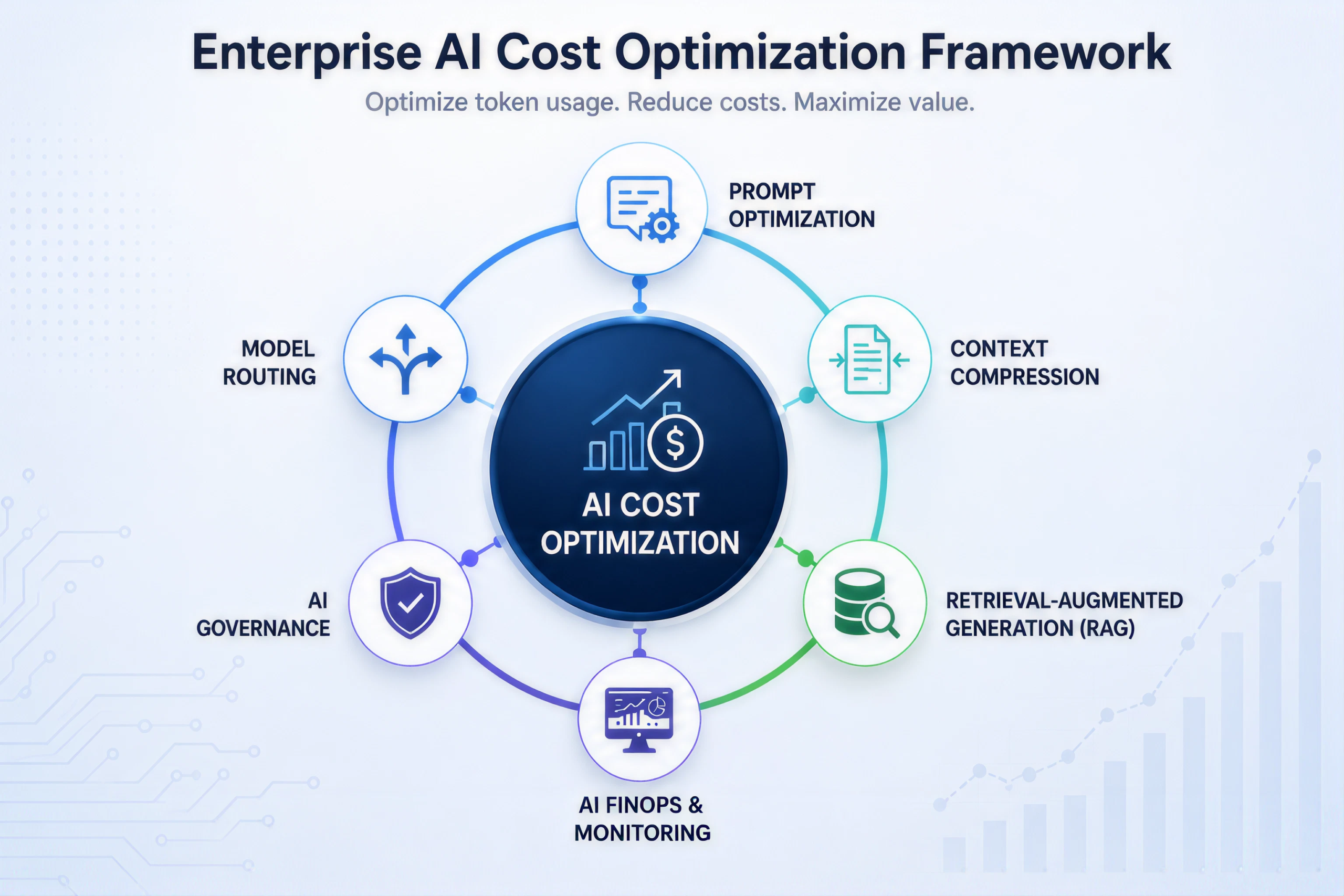
One of the most effective strategies is prompt optimization. Well-designed prompts provide the AI with only the information required to complete a task. Removing redundant instructions, shortening system prompts, and avoiding unnecessary conversation history can substantially reduce token usage while maintaining response quality.
Another important technique is context compression. Rather than sending complete conversation histories or lengthy documents with every request, organizations can summarize previous interactions and include only the most relevant information. This approach reduces token consumption without sacrificing context.
Many enterprises are also adopting Retrieval-Augmented Generation (RAG). Instead of loading an entire knowledge base into every prompt, RAG retrieves only the specific documents or sections required to answer a user’s query. This significantly reduces input tokens while improving response accuracy.
Model routing has become another essential optimization strategy. Instead of relying on one premium AI model for every task, organizations can route requests to different models based on complexity. Lightweight models handle routine activities such as classification, formatting, or summarization, while advanced reasoning models are reserved for complex decision-making. This approach balances performance with cost efficiency.
Caching is equally important. Frequently requested outputs, recurring reports, and commonly used responses can be stored and reused rather than regenerated every time. By avoiding duplicate AI requests, organizations reduce token consumption and improve response times.
Governance also plays a critical role. Establishing policies around prompt design, approved AI models, usage limits, and workflow standards helps prevent unnecessary token consumption across departments. Enterprises that treat AI as a managed business capability rather than an experimental tool are far more successful at controlling long-term costs.
Enterprise AI FinOps: The Missing Layer
As cloud computing gave rise to cloud FinOps, enterprise AI is driving the emergence of AI FinOps, the discipline of managing, monitoring, and optimizing AI spending across an organization.
AI FinOps combines financial accountability with operational insights. Instead of simply tracking monthly invoices, organizations continuously monitor token consumption, identify cost drivers, allocate AI expenses to business units, and measure the return on AI investments.
A mature AI FinOps strategy typically includes real-time dashboards that display token usage by department, application, AI model, and workflow. Budget alerts notify teams when spending exceeds predefined thresholds, while analytics help identify inefficient prompts, duplicate requests, and underutilized AI systems.
AI FinOps also enables organizations to compare cost against business value. Rather than measuring success solely by token usage, enterprises evaluate how AI contributes to productivity, revenue growth, customer satisfaction, and operational efficiency. This ensures that AI investments deliver measurable outcomes instead of becoming uncontrolled operational expenses.
As AI adoption continues to grow, AI FinOps will become as essential as cybersecurity or cloud governance. Organizations that implement cost management practices early will be better positioned to scale AI sustainably.
How FX31 Labs Helps Enterprises Build Cost-Efficient AI Systems
At FX31 Labs, we believe successful enterprise AI is not measured by the number of AI models deployed but by the business value they deliver. Our approach focuses on designing intelligent AI systems that balance performance, scalability, and cost efficiency from day one.
We help organizations build custom AI solutions, AI-powered workflow automation, and enterprise AI platforms that minimize unnecessary token consumption while maximizing operational impact. By combining prompt engineering, model routing, Retrieval-Augmented Generation (RAG), AI governance, and scalable cloud architecture, we create AI ecosystems that remain cost-effective as businesses grow.
Rather than treating AI as a standalone tool, we integrate it into existing enterprise workflows, ensuring that every AI interaction supports measurable business objectives. This enables organizations to improve productivity, reduce infrastructure costs, and achieve stronger returns on their AI investments.
Whether you’re developing AI assistants, enterprise copilots, intelligent automation platforms, or industry-specific AI applications, our team helps build solutions that are designed for long-term efficiency, not just short-term deployment.
The Future of AI Cost Optimization
The next generation of enterprise AI will focus not only on smarter models but also on smarter resource management. As organizations continue to expand AI adoption, efficiency will become a key competitive advantage.
Future AI platforms will automatically select the most cost-effective model for each task, compress context before sending requests, reuse previously generated responses through intelligent caching, and continuously monitor token usage across workflows. AI gateways and orchestration platforms will optimize requests in real time, ensuring that enterprises achieve maximum performance with minimal resource consumption.
Organizations that embrace these practices today will be better prepared for a future where AI is embedded into every business process. The companies that succeed won’t necessarily be those spending the most on AI they’ll be the ones using it most efficiently.
Final Thoughts
Enterprise AI is transforming the way organizations operate, innovate, and compete. However, as AI adoption accelerates, managing AI token consumption has become just as important as choosing the right language model.
Lower token prices alone will not solve the growing challenge of enterprise AI costs. Sustainable AI adoption requires thoughtful architecture, optimized workflows, intelligent model selection, and continuous governance. Businesses that proactively manage AI token consumption can scale their AI initiatives with confidence while maintaining predictable costs and maximizing return on investment.
As AI becomes a core part of enterprise operations, cost optimization will no longer be optional it will be a strategic necessity. Organizations that build efficient, scalable, and well-governed AI systems today will be the ones that lead the next wave of AI-driven innovation.
Related Article: Discover practical techniques to reduce AI infrastructure costs and improve enterprise AI efficiency in our guide, How Product & Engineering Leaders Reduce AI Costs Without Slowing Innovation.
FAQs
1. What is AI token consumption?
AI token consumption refers to the number of text tokens processed by an AI model when it receives a prompt and generates a response. Every interaction with a large language model (LLM), including user queries, system instructions, uploaded documents, and AI-generated outputs, consumes tokens that directly impact usage costs.
2. Why are enterprise AI costs rising despite lower token prices?
Enterprise AI costs are increasing because organizations are using AI across more business functions than ever before. AI assistants, autonomous AI agents, document analysis, software development, and customer support all generate millions of tokens daily. Although token prices have decreased, overall AI token consumption has grown significantly, leading to higher operational expenses.
3. How can businesses reduce AI token consumption?
Businesses can reduce AI token consumption by optimizing prompts, implementing Retrieval-Augmented Generation (RAG), using caching, selecting the right AI model for each task, compressing context, and continuously monitoring AI usage through governance and AI FinOps practices. These strategies help lower costs while maintaining AI performance.
4. What is AI FinOps, and why is it important?
AI FinOps is the practice of managing and optimizing enterprise AI spending. It involves tracking token usage, monitoring AI costs, allocating budgets, selecting cost-effective models, and measuring the business value generated by AI applications. AI FinOps helps organizations scale AI responsibly while keeping operational costs under control.
5. Do AI agents consume more tokens than chatbots?
Yes. AI agents typically consume more tokens because they perform multiple tasks within a single workflow, such as retrieving data, analyzing documents, generating responses, and interacting with business applications. Each of these actions requires additional AI requests, increasing overall token consumption.
6. Which industries benefit the most from AI cost optimization?
Industries such as banking, healthcare, retail, manufacturing, SaaS, logistics, insurance, and enterprise software benefit significantly from AI cost optimization. Organizations operating at scale can reduce operational expenses while improving productivity by implementing efficient AI architectures and governance strategies.
7. How does FX31 Labs help enterprises optimize AI costs?
FX31 Labs helps organizations design scalable AI solutions with a focus on token efficiency, intelligent model routing, AI workflow automation, and enterprise AI governance. By optimizing AI architecture and workflows, businesses can reduce unnecessary AI spending while maximizing long-term ROI.