
MCP (Model Context Protocol): The Future Standard for AI Integrations
Model Context Protocol (MCP) is an open standard that defines how AI models connect to external tools, data sources, and systems in a consistent, secure, and interoperable way. Instead of building a custom integration every time you want an AI agent to talk to a database, an API, or a business application, MCP gives developers a universal protocol that works across models, platforms, and vendors the same way HTTP standardized how browsers talk to web servers.
If you’re building AI agents, deploying LLMs in production, or thinking seriously about enterprise AI infrastructure in 2026, MCP is the most important architectural development you need to understand right now.
Why Did MCP Emerge and Why Does It Matter Now?
Before MCP, connecting an AI model to your enterprise systems was a custom engineering project every single time.
Want your LLM to query your CRM? Build a custom connector. Want it to read from your internal knowledge base? Build another one. Want it to trigger a workflow in your ERP, pull data from your data warehouse, or check the status of a support ticket? Three more custom integrations each with its own authentication logic, error handling, data formatting, and maintenance burden.
This fragmentation was manageable when AI was limited to isolated, single-purpose applications. It became a serious problem when enterprises started building AI agents that need to interact with dozens of systems simultaneously to complete a task. The integration layer became the bottleneck not the model, not the compute, not the data. The plumbing.
Anthropic introduced MCP in late 2024 as an open standard to solve exactly this problem. The core idea is simple but powerful: define one protocol for how AI models communicate with external context sources, and every tool, database, or service that implements that protocol becomes instantly accessible to every model that supports it.
The adoption has been fast. By mid-2026, MCP support has been built into major AI development frameworks, adopted by hundreds of tool providers, and implemented by enterprises across industries as the foundation layer of their enterprise AI infrastructure. It’s moving from emerging standard to assumed baseline faster than most enterprise technology transitions do.
How Does the Model Context Protocol Actually Work?
MCP operates on a client-server architecture with three core components:
MCP Hosts are the AI applications or agents that need to access external context your LLM-powered assistant, your AI agent, your enterprise chatbot. The host initiates connections and decides which servers to connect to.
MCP Clients are protocol clients that live inside the host application and manage the actual communication with MCP servers. They handle the connection, the request formatting, and the response parsing.
MCP Servers are lightweight services that expose specific capabilities a tool, a data source, an API in a standardized way that any MCP-compatible client can consume. A server might expose your company’s internal knowledge base, your CRM’s contact records, your calendar, your code repository, or any external service with an API.
The communication between them follows a defined protocol that standardizes four types of capabilities:
- Tools — actions the AI can take, like sending an email, creating a ticket, or running a query
- Resources — data the AI can read, like documents, database records, or file contents
- Prompts — reusable prompt templates that can be invoked consistently across contexts
- Sampling — allowing servers to request completions from the host model when needed
What makes this powerful is the standardization. An MCP server built to expose your Salesforce data works with any MCP-compatible AI model Claude, GPT, Gemini, a locally hosted LLaMA — without any model-specific customization. Build the server once, use it everywhere.
What Problems Does MCP Solve for Enterprise AI?
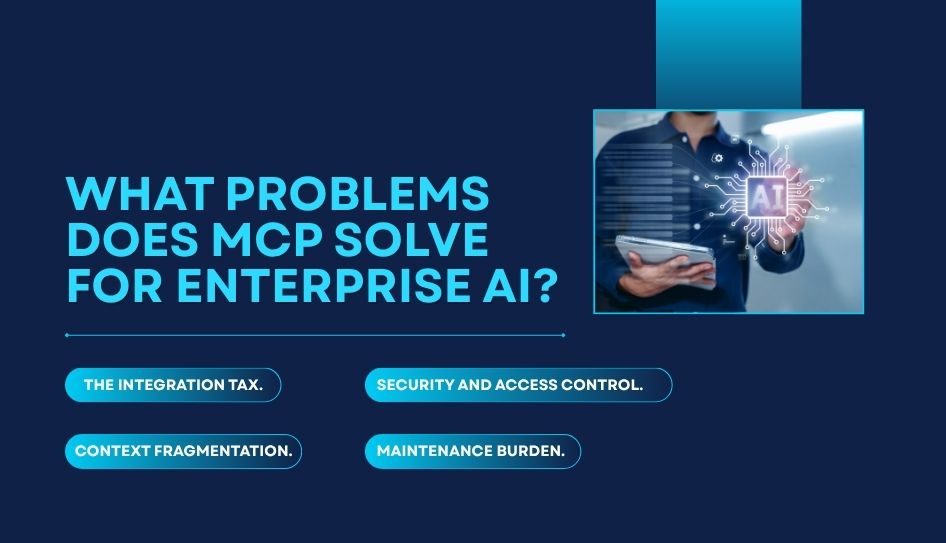
The integration tax. Before MCP, every AI integration was a bespoke project. With MCP, a tool or data source built once is usable across every AI application in your stack. The cumulative engineering time saved across a large enterprise is significant.
Vendor lock-in. Custom integrations built for a specific AI model create dependency on that model. If you want to switch models or run different models for different tasks you rebuild your integrations. MCP-based integrations are model-agnostic by design.
Context fragmentation. AI agents that can’t reliably access the right information at the right time produce unreliable outputs. MCP provides a consistent, structured mechanism for giving models the context they need from any source without the agent needing to know the implementation details of each system.
Security and access control. MCP servers can implement authentication, authorization, and data filtering at the server level meaning you control exactly what data each AI application can access, regardless of which model is making the request. This is a meaningful improvement over approaches where the model has broad API access and data filtering happens (or doesn’t happen) at the prompt layer.
Maintenance burden. Custom integrations break when the underlying system changes. With MCP, updates to a data source or tool are handled at the server level the AI applications consuming that server don’t need to be updated. One change propagates automatically to every consumer.
This is the kind of infrastructure investment that, done properly, compounds in value over time which is exactly why it sits at the center of serious thinking about generative AI in enterprise software development.
MCP vs Traditional AI Integrations: What’s the Difference?
| Dimension | Traditional Integration | MCP-Based Integration |
| Build effort | Custom per model and per tool | Build once, use across all MCP-compatible models |
| Model portability | Tied to specific model | Model-agnostic by design |
| Maintenance | Each integration maintained separately | Updates at server level propagate to all consumers |
| Security | Access control varies by implementation | Standardized auth and permissions at server layer |
| Discovery | Manual developers must know what’s available | Servers can expose capability descriptions dynamically |
| Ecosystem | Isolated | Growing library of pre-built MCP servers |
| Agent support | Limited agents need custom orchestration | Native designed for multi-step agent workflows |
The shift from traditional to MCP-based integration is comparable to what happened when REST APIs standardized web service communication. Before REST, every web service had its own communication pattern. After REST, the ecosystem exploded because everyone was building on shared conventions. MCP is doing the same thing for AI integrations.
How Are Enterprises Using MCP in Practice?
Internal knowledge access. Enterprises are building MCP servers that expose internal documentation, wikis, policy documents, and knowledge bases giving AI assistants structured, permission-aware access to institutional knowledge without dumping everything into a context window.
CRM and ERP integration. Sales and operations teams are connecting AI agents to Salesforce, SAP, and similar systems via MCP, enabling agents to look up customer records, update deal stages, trigger workflows, and generate reports without leaving their AI interface.
Developer tooling. Engineering teams are using MCP to give AI coding assistants access to internal repositories, CI/CD systems, issue trackers, and deployment pipelines enabling agents to understand the full context of a codebase and take meaningful actions, not just generate code in isolation.
Customer support automation. Support AI agents connected via MCP to ticketing systems, product databases, and customer history can resolve a far higher percentage of requests autonomously than agents working from static context alone.
Cross-system orchestration. This is where MCP’s value is most obvious for agentic AI in enterprise workflow agents that need to pull data from one system, process it, update another system, and trigger a downstream workflow can do so through a consistent protocol rather than a brittle chain of custom API calls.
What Does MCP Mean for AI Agent Frameworks?
MCP is particularly significant for enterprises building or deploying AI agent frameworks systems where AI models take sequences of actions to complete complex, multi-step tasks.
The fundamental challenge of AI agents has always been grounding. An agent that can reason well but can’t reliably access current, accurate information about the systems it’s supposed to act on is an agent that hallucinates actions and produces unreliable results. MCP addresses this directly by giving agents a standardized, reliable mechanism for accessing real-world context and taking real-world actions.
This is why MCP is increasingly the foundation layer for serious enterprise agent deployments — not a nice-to-have but the infrastructure that makes agents actually trustworthy in production. The complete playbook for agentic AI in enterprises increasingly assumes MCP as the integration standard, because without it, agent orchestration at scale requires prohibitive amounts of custom engineering.
The practical implication: if your enterprise is planning significant investment in AI agents in the next 12 to 18 months, building your integration layer on MCP now isn’t premature it’s the decision that prevents you from rebuilding everything later.
How Do You Start Adopting MCP in Your Enterprise?
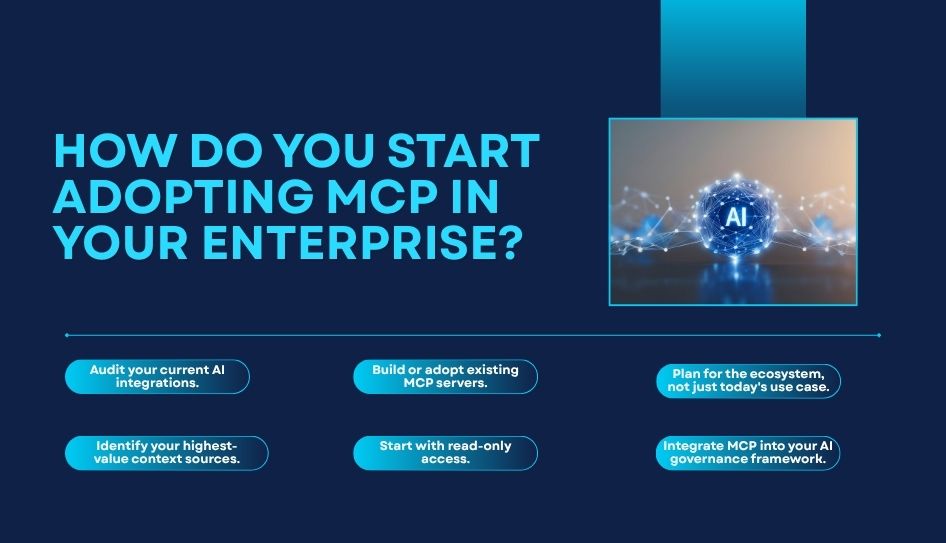
Audit your current AI integrations. List every custom integration your AI applications currently rely on. These are your candidates for migration to MCP prioritized by maintenance burden and reuse potential.
Identify your highest-value context sources. Which data sources, tools, and systems would provide the most value if reliably accessible to your AI applications? Your internal knowledge base, your CRM, your ticketing system start here.
Build or adopt existing MCP servers. The MCP ecosystem already includes pre-built servers for many common tools and platforms. Before building from scratch, check whether a server already exists for the systems you need to connect. The open-source community has moved quickly here.
Start with read-only access. When deploying MCP servers that expose sensitive internal systems, start with read-only capabilities. Validate that access controls, logging, and data filtering work as expected before enabling write operations or action execution.
Integrate MCP into your AI governance framework. Every MCP server your enterprise runs is a surface area that needs to be governed what data it exposes, who can access it, how it’s audited. Fold MCP server management into your existing AI integration services and governance processes rather than treating it as a standalone technical project.
Plan for the ecosystem, not just today’s use case. The real leverage of MCP comes from building infrastructure that multiple AI applications can consume. Design your MCP servers with reuse in mind well-documented, properly versioned, and accessible to any authorized AI application in your stack.
This kind of forward-looking infrastructure planning is a core part of what distinguishes reactive AI adoption from mature AI strategy for CTOs and CEOs the difference between solving today’s integration problem and building a foundation that scales with your AI ambitions.
Frequently Asked Questions
What is the Model Context Protocol?
MCP is an open standard introduced by Anthropic in late 2024 that defines how AI models connect to external tools, data sources, and systems. It provides a universal protocol so any MCP-compatible AI can interact with any MCP-compatible tool without custom integration work for each combination.
Who created MCP and is it open source?
MCP was introduced by Anthropic and released as an open standard. The specification and reference implementations are publicly available, and the ecosystem has grown significantly through community contributions and adoption by major AI tool providers.
Is MCP only for Claude?
No. MCP is model-agnostic by design. While Anthropic introduced the protocol, it has been adopted across the AI ecosystem. MCP servers work with any AI model or application that implements the MCP client specification.
How is MCP different from function calling?
Function calling is a model-level capability that lets an AI invoke predefined functions during inference. MCP is a broader infrastructure standard that defines how AI applications discover, connect to, and communicate with external systems. MCP can use function calling as part of its tool execution mechanism, but it operates at a higher level of abstraction standardizing the entire integration layer, not just the model’s ability to invoke a function.
What are MCP servers?
MCP servers are lightweight services that expose specific capabilities tools, data sources, APIs in a standardized format that any MCP-compatible AI client can consume. They handle authentication, data formatting, and access control, and they can be built for any system with an accessible API or data interface.
Is MCP ready for enterprise production use?
Yes. By mid-2026, MCP has moved well past early-adopter status. Major AI development platforms support it natively, significant tooling exists for building and deploying MCP servers, and enterprises across financial services, healthcare, technology, and other industries are running MCP-based integrations in production.