
Data Readiness for AI: Why Most Enterprise AI Projects Fail Before They Start
Data readiness for AI means having data that is accurate, accessible, well-governed, and structured in a way that AI models can actually learn from and operate on. Most enterprise AI projects don’t fail because the algorithm was wrong or the model was poorly chosen. They fail because the data feeding those systems was never ready to begin with — and nobody caught it until months of budget had already been spent.
Why Do So Many Enterprise AI Projects Fail at the Data Stage?
Here’s a number that should make every enterprise AI leader uncomfortable: according to Gartner, roughly 85% of AI projects fail to move from pilot to production. And when you dig into the post-mortems, the same culprit shows up again and again — not the model, not the infrastructure, not the team. The data.
It’s a strange failure mode when you think about it. Enterprises spend months evaluating AI vendors, debating which large language model to use, hiring ML engineers, and building business cases — and then the whole thing quietly collapses because the data sitting in their CRM was entered inconsistently for five years, or because three different departments have three different definitions of what a “customer” is, or because the historical records needed to train the model are split across a legacy system that nobody has touched since 2019.
The uncomfortable truth is this: AI is only as intelligent as the data it runs on. A world-class model trained on mediocre data will consistently produce mediocre — or dangerous — outputs. And in enterprise environments, where data has typically been collected across decades, across mergers and acquisitions, across dozens of incompatible systems, the data problem is almost always worse than anyone expects.
This is the part of enterprise data management that doesn’t get enough airtime in AI conversations. Everyone wants to talk about the model. Almost nobody wants to talk about the pipeline that feeds it.
What Does “Data Readiness for AI” Actually Mean?
Data readiness for AI is not the same as having a lot of data. Enterprises that have collected petabytes of operational data over decades are often the least AI-ready, because that data is fragmented, inconsistently labeled, and stored in formats that make machine learning pipelines incredibly difficult to build.
True data readiness for AI means your data meets five fundamental conditions:
It exists where you need it. Not locked in a legacy system with no API, not sitting in a spreadsheet on someone’s desktop, not distributed across twelve SaaS platforms with no unified access layer.
It’s accurate enough to trust. Garbage in, garbage out is the oldest cliché in computing — but it becomes catastrophically true in AI. A model trained on inaccurate data doesn’t just make mistakes; it makes confident mistakes at scale.
It’s labeled or structured appropriately. Supervised learning requires labeled training data. Even unsupervised or semi-supervised approaches need data that’s been structured in a way the model can interpret. Raw operational data almost never meets this standard without significant preprocessing.
It’s governed. Someone owns it. Its lineage is documented. There’s a clear answer to who can access it, how it was collected, and whether using it for AI training is legally and ethically permissible.
It’s fresh enough to be relevant. A model trained on data from five years ago will reflect the patterns of five years ago. If your business has changed — if your customers have changed — stale data produces a model that’s confidently solving yesterday’s problems.
Understanding this definition is the starting point for any honest conversation about enterprise digital transformation with AI. The transformation can’t happen if the data foundation isn’t ready to support it.
The 6 Dimensions of AI Data Readiness Every Enterprise Must Assess
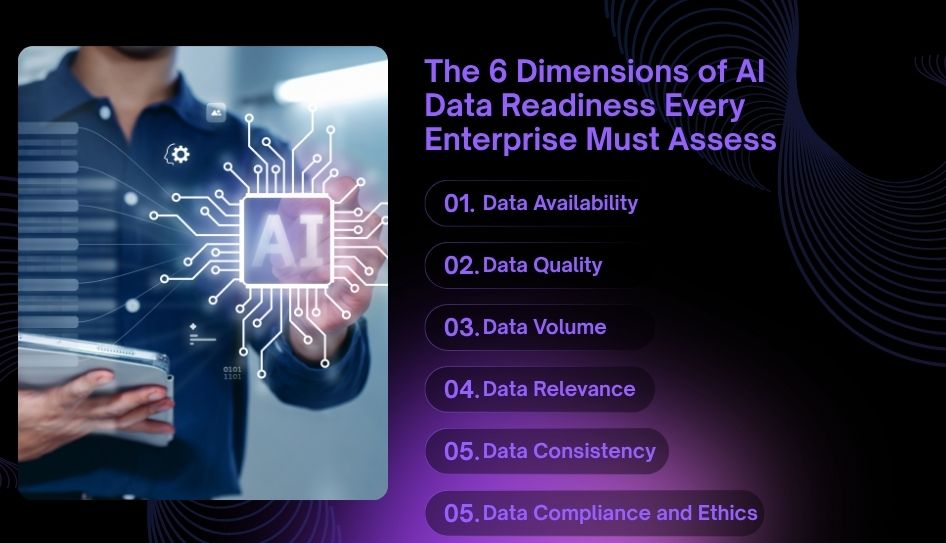
Before committing budget to any AI initiative, enterprises need to run an honest assessment across six dimensions. Each one is a potential failure point. Most organizations have significant gaps in at least two or three.
- Data Availability
Can you actually access the data you need? This sounds like a basic question, but in practice, enterprise data is scattered across ERP systems, CRMs, data warehouses, SaaS applications, on-premise databases, and spreadsheets maintained by individual employees. Pulling it together into a coherent dataset for AI training is often a months-long engineering project before any model work begins.
Questions to ask: Where does the relevant data live? Is there an API or pipeline to access it? Are there contractual or technical restrictions on moving or using it?
- Data Quality
Quality problems come in many forms: duplicate records, missing values, inconsistent formatting, outdated entries, measurement errors, and data that was entered correctly for one purpose but is misleading in another context. For data quality for AI, even a small percentage of corrupted records can have outsized effects on model performance.
Questions to ask: What percentage of records have missing values in key fields? Are there known data entry inconsistencies across systems or time periods? When was the data last audited for accuracy?
- Data Volume
AI models — especially deep learning models — are hungry for data. The amount you need depends heavily on the task: a simple classification model might perform well with thousands of examples, while a custom language model for a specialized domain might need hundreds of thousands or millions of data points to generalize reliably.
Questions to ask: Do we have enough historical data to train a model that will generalize beyond our training set? If not, can we augment with synthetic data or transfer learning from a pre-trained model?
- Data Relevance
Having large volumes of data doesn’t mean you have the right data. An enterprise might have ten years of transactional records that are irrelevant to the prediction task they’re trying to solve. Relevance is about whether the signals in your data actually contain information that predicts the outcome you care about.
Questions to ask: Does our data contain the features that are causally or correlatively related to what we’re trying to predict? Are there important variables we’re simply not capturing?
- Data Consistency
In large enterprises, the same real-world entity is often represented differently across systems. A customer might be identified by a name in one system, an account number in another, and an email address in a third. Product names differ between the ERP and the CRM. Regional teams use different taxonomies. All of this inconsistency makes joining data across sources — which is almost always required for AI — significantly harder.
Questions to ask: Do we have a unified identifier for key entities (customers, products, locations) across systems? Is our taxonomy consistent across departments and geographies?
- Data Compliance and Ethics
Even if data is technically available and technically high quality, you might not be allowed to use it for AI training. GDPR, CCPA, India’s DPDP Act, and sector-specific regulations like HIPAA all place restrictions on how personal data can be processed, what consent is required, and what rights individuals have over automated decisions made about them. Using data you’re not entitled to use isn’t just a legal risk — it’s a trust risk.
Questions to ask: Was this data collected with consent for the use we’re now intending? Does using it for AI training comply with the applicable privacy regulations? Can we demonstrate lawful basis if audited?
How Do You Build an AI Data Strategy That Actually Works?
An AI data strategy is not the same as a general data strategy, though the two need to be aligned. A general data strategy focuses on how data is collected, stored, and governed across the enterprise. An AI data strategy layers on top of that — it defines how data will be prepared, structured, and maintained specifically to support AI and machine learning workloads.
Here’s how to build one that’s actually executable:
Start with use cases, not datasets.
The most common mistake enterprises make is trying to “get their data in order” in the abstract before committing to specific AI use cases. This leads to sprawling, unfocused data programs that never deliver AI results. Instead, start with two or three high-priority AI use cases, define exactly what data those models will need, and work backward to assess readiness for those specific requirements.
Map your current data landscape honestly.
You can’t fix what you haven’t mapped. Invest in a genuine data audit — not a wishful inventory of what systems exist, but an honest assessment of data quality, completeness, accessibility, and ownership for each relevant data source. Bring in engineers, data stewards, and business users. The picture will be messier than leadership expects.
Assign data ownership that’s real, not nominal.
Data governance fails when ownership exists on paper but not in practice. Every dataset that feeds an AI system needs a real owner — someone whose job performance is actually connected to the quality and maintenance of that data. Without that accountability, data quality degrades the moment attention shifts elsewhere.
Build a data pipeline as a first-class engineering asset.
The pipeline that cleans, transforms, and delivers data to your AI systems is not a one-time script someone writes during the prototype phase. It’s a production system that needs to be designed, documented, tested, and maintained with the same rigor as any other production software. This is where database architecture that supports AI workloads becomes a genuine competitive advantage — the enterprises that invest in it early don’t constantly fight fires later.
Plan for ongoing data quality monitoring.
Data quality is not a state you achieve and then forget. It’s something you monitor continuously. Customer data goes stale. Product catalogs change. Business definitions evolve. Build quality checks into your data pipelines — automated validation rules, anomaly detection, regular audits — so that degradation is caught before it affects model performance.
Document data lineage from day one.
For every dataset feeding an AI system, you should be able to trace exactly where it came from, how it was transformed, who owns it, and when it was last validated. This isn’t just good practice — it’s increasingly a regulatory requirement, and it’s essential for debugging when a model starts behaving unexpectedly.
What Role Does Data Governance Play in AI Success?
Data governance is one of those terms that gets thrown around in enterprise technology conversations so frequently that it starts to lose meaning. In the context of AI, it’s worth being specific about what governance actually does and why its absence is so costly.
Data governance for AI defines:
- Who can access which data — and under what conditions
- How data quality is defined, measured, and maintained for each dataset
- What data is permissible for AI training — from a legal, ethical, and business policy standpoint
- How data lineage is documented — so AI outputs can be explained and audited
- How long data is retained — and when it must be deleted or anonymized
- Who is accountable when data quality issues affect AI system performance
Without governance, you get what most enterprises currently have: a patchwork of data that multiple teams have partial ownership of, inconsistent quality standards, no clear process for resolving data disputes, and no mechanism for ensuring that what goes into an AI model is accurate, current, and permissible.
The connection to AI outcomes is direct. When a model produces biased outputs, poor governance means you can’t trace why. When a regulator asks how your AI made a decision, poor governance means you can’t answer. When the model starts degrading because the underlying data changed, poor governance means nobody notices until it’s already caused harm.
Strong data governance isn’t bureaucracy. It’s the difference between AI systems you can trust and AI systems that look good in the demo. This principle connects directly to the broader questions around AI governance that end-to-end AI integration services need to address from the very first engagement.
The Real Cost of Poor Data Quality for AI
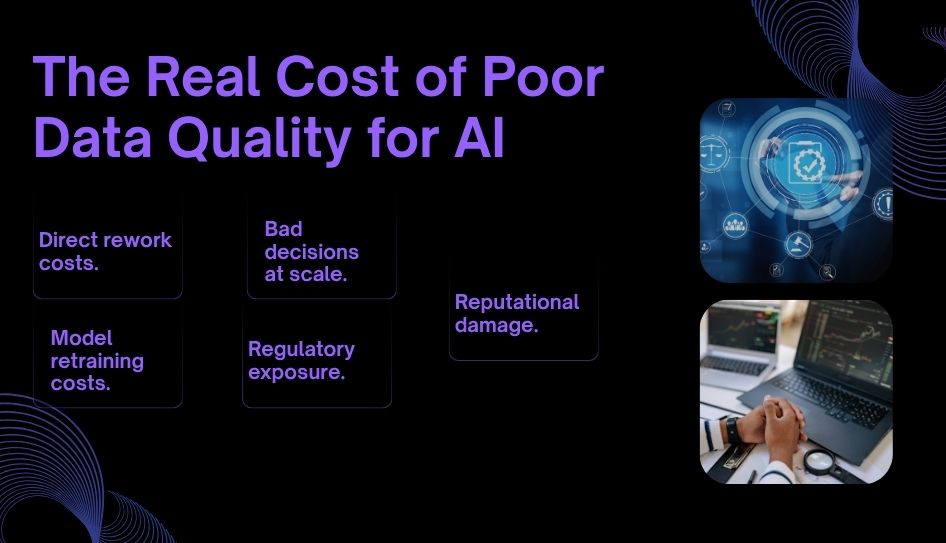
Let’s get concrete about what bad data actually costs, because “data quality is important” is the kind of statement everyone nods at and nobody acts on until there’s a painful incident.
Direct rework costs. The average enterprise AI project that hits data quality problems mid-implementation requires three to six months of additional work to remediate. That’s engineering time, consultant time, and delayed value realization — all of which were avoidable.
Model retraining costs. When a model is trained on bad data, you don’t just fix the data and continue. You retrain from scratch, which means more compute, more time, and more engineering effort. In production environments, this also means downtime or degraded performance during the transition.
Bad decisions at scale. This is the most underappreciated cost. An AI model doesn’t make one bad decision — it makes millions of them at the speed and scale that only automation enables. A biased training dataset doesn’t produce one unfair outcome; it produces systematically unfair outcomes across every inference the model runs. At enterprise scale, that’s not a bug — it’s a business risk that can reach existential proportions.
Regulatory exposure. Data quality problems that produce discriminatory outputs in credit scoring, hiring, or healthcare aren’t just operational problems. They’re legal problems. In jurisdictions with strong AI regulations, documented data quality failures that lead to harmful outputs can result in significant fines and enforcement actions.
Reputational damage. Customers, employees, and partners who experience the downstream effects of AI systems trained on poor data — wrong recommendations, unfair decisions, inaccurate predictions — don’t typically know or care that the root cause was data quality. They experience it as the enterprise treating them carelessly. That’s a trust deficit that’s hard to recover.
This is one of the core AI implementation challenges that separates enterprises with strong data foundations from those that are still fighting for basic data hygiene while trying to run machine learning models on top of it.
How Do You Know If Your Enterprise Data Is AI-Ready?
Honest self-assessment is hard. Here’s a diagnostic framework to run before committing to any AI initiative:
Can you describe your data in clear business terms? If your team struggles to articulate what data you have, where it is, and what it represents — without looking at a technical data dictionary — your data is probably not governed well enough to be AI-ready.
Do you have a single source of truth for key entities? Customer, product, employee, transaction — can you point to one authoritative system for each? Or does the answer to “how many active customers do we have?” depend on who you ask?
How long would it take to pull a training dataset? If the honest answer is “several weeks and at least one data engineering sprint,” your data infrastructure is a bottleneck. AI-ready enterprises can access and prepare data in days, not months.
What happens when data quality degrades? Is there an automated alert? A human who notices? Or does bad data silently flow through the system until something breaks downstream? The answer tells you a lot about your monitoring maturity.
Have you used this data for analytics before? If your data hasn’t been reliable enough to support good business analytics, it’s almost certainly not reliable enough to train AI models. Analytics is a useful proxy for AI data readiness — if you can’t trust your dashboards, don’t trust your training sets.
Do you know the legal basis for using this data for AI? Not “we assume it’s fine” — do you know, documented and reviewed by legal? For enterprises operating in regulated industries or with European customers, this isn’t optional.
These questions are the foundation of what how AI is reshaping product decisions conversations need to address before technology choices are ever made — because product leaders who skip the data readiness audit tend to inherit the consequences six months later.
Common AI Implementation Challenges That Trace Back to Data
Most AI implementation challenges that teams diagnose as model problems, integration problems, or tooling problems are actually data problems in disguise. Here’s what that looks like in practice:
“The model performs well in testing but poorly in production.” Almost always a data distribution problem. The training data didn’t represent the diversity of real-world inputs, or production data has characteristics the model was never exposed to. The model didn’t fail — the data preparation did.
“The model keeps producing biased outputs.” The training data encoded historical biases — because the historical decisions it was trained on were themselves biased. Fixing the model without fixing the data that created it solves nothing. This is why designing the right database architecture from the ground up, with AI use cases in mind, matters far more than retrofitting later.
“The AI project took twice as long as planned.” In most post-mortems, the timeline overrun traces back to data wrangling — accessing data from disparate systems, cleaning it, resolving definitional inconsistencies, getting governance sign-off. None of this was accounted for in the original project plan because nobody wanted to be the person who said “our data isn’t ready.”
“Business users don’t trust the AI outputs.” Often because they know the underlying data has problems — they’ve been working around those problems manually for years. When an AI system produces a recommendation that contradicts their instincts, they assume (sometimes correctly) that the model is reflecting data they already know is unreliable.
“We can’t explain the model’s decision to the regulator.” Not a model interpretability problem — a data lineage problem. If you can’t trace what data went into the training set, how it was transformed, and what it actually represents, you can’t explain the model’s outputs. This is governance failure, not algorithm failure.
Frequently Asked Questions
What is data readiness for AI?
Data readiness for AI refers to the state in which an organization’s data is accurate, accessible, well-governed, appropriately structured, and compliant enough to support the development, training, and operation of AI systems. It’s a prerequisite for any AI initiative — without it, even the best models will produce unreliable results.
Why do most enterprise AI projects fail?
The most common root causes trace back to data — poor data quality, inaccessible data, lack of data governance, insufficient data volume, and misaligned data definitions across systems. Technical and organizational challenges also play a role, but data problems are the most frequently cited reason AI projects fail to move from pilot to production.
How much data do you need to build an enterprise AI system?
There’s no universal answer — it depends entirely on the task, the model type, and the complexity of the domain. Simple classification tasks can work with thousands of labeled examples. Complex language or prediction models may require millions. More important than raw volume is data quality and relevance: a smaller, clean, well-labeled dataset almost always outperforms a massive dataset with significant quality problems.
What is an AI data strategy?
An AI data strategy is a plan that defines how an organization will collect, prepare, govern, and maintain data specifically to support AI and machine learning initiatives. It covers data sourcing, quality standards, labeling processes, pipeline architecture, governance frameworks, and ongoing monitoring — all aligned to specific AI use cases rather than data management in the abstract.
What is data governance and why does it matter for AI?
Data governance is the set of policies, processes, roles, and standards that define how data is managed across an organization — including who owns it, how quality is maintained, who can access it, and how it’s documented. For AI, governance is critical because it determines whether AI outputs are trustworthy, auditable, and legally defensible. Poor governance is one of the most common reasons AI systems produce unreliable or biased results.
How do you assess data quality for AI?
Assess data quality across several dimensions: completeness (are there missing values in critical fields?), accuracy (does the data reflect real-world truth?), consistency (is the same entity represented the same way across systems?), timeliness (is the data current enough to be relevant?), and uniqueness (are there duplicate records?). Most enterprises find significant quality gaps once they run a systematic assessment rather than assuming the data is usable.
Can you start an AI project before your data is fully ready?
Yes — but with clear eyes about what that means. You can run proofs of concept and evaluate model approaches while data remediation work is in progress. What you can’t do is skip data readiness work and expect a production AI system to perform reliably. The earlier in the project lifecycle you address data gaps, the less expensive they are to fix.
What is the difference between data readiness and data maturity?
Data maturity is a broader measure of how sophisticated an organization’s overall data capabilities are — governance, infrastructure, culture, analytics, and more. Data readiness is a more specific, use-case-oriented assessment: is this particular dataset, or collection of datasets, ready to support this particular AI initiative? An organization can have high data maturity overall but still have readiness gaps for a specific AI project.