
RAG vs Fine-Tuning: Which AI Approach Delivers Better ROI for Enterprises?
When it comes to RAG vs fine-tuning, there’s no universal winner — but there is almost always a right answer for your specific situation. RAG (Retrieval-Augmented Generation) gives AI models real-time access to your data without retraining. Fine-tuning rewires the model itself to think and respond like your domain expert. The one that delivers better ROI depends entirely on what problem you’re actually trying to solve.
Why Is the RAG vs Fine-Tuning Decision Such a Big Deal Right Now?
Because enterprises are no longer experimenting with AI — they’re deploying it into production and being held accountable for the results.
The era of “we ran a pilot” is over. In 2026, boards are asking about AI ROI in the same breath as they ask about quarterly revenue. And the single biggest driver of whether an enterprise AI deployment succeeds or burns budget is the architectural decision made early on: do we give the model access to our data, or do we train the model on our data?
That question is exactly what the RAG vs fine-tuning debate is about.
Get it right and you have a system that works reliably, scales predictably, and justifies its cost. Get it wrong and you’re three months into a fine-tuning project wondering why the model still hallucinates your product specifications, or you’ve built a RAG pipeline that can retrieve documents but can’t write in your company’s voice to save its life.
Neither approach is inherently superior. Both are genuinely powerful. But they solve different problems — and confusing one for the other is one of the most expensive mistakes in enterprise AI implementation strategy.
What Is Retrieval-Augmented Generation (RAG) and How Does It Work?
Retrieval-Augmented Generation is an architecture where an AI model doesn’t rely solely on what it learned during training. Instead, it queries an external knowledge base — your documents, databases, product catalogs, internal wikis, support tickets — retrieves the most relevant pieces of information, and then uses that context to generate a response.
Think of it this way: the model is a brilliant generalist analyst. RAG gives that analyst instant access to your entire document library before they answer a question. They don’t need to have memorized everything — they just need to be able to find and use it on demand.
Here’s what the basic flow looks like:
- A user asks a question
- The system converts the question into a vector embedding
- It searches a vector database for the most semantically similar chunks of your data
- Those chunks are injected into the model’s context window as reference material
- The model generates an answer grounded in that retrieved content
The result is an AI that can answer questions about things that happened last week, reference your latest pricing document, cite your internal compliance policy, and stay current without ever being retrained.
Where RAG works exceptionally well:
- Internal knowledge bases and enterprise search
- Customer support systems that need to reference live product documentation
- Legal and compliance Q&A where answers must be traceable to source documents
- Any use case where the underlying data changes frequently
- Situations where you need to show the model’s sources for auditability
The major advantage of retrieval-augmented generation is that it separates the intelligence layer (the model) from the knowledge layer (your data). Updating your knowledge base is fast, cheap, and doesn’t require any model retraining.
What Is Fine-Tuning and When Does It Actually Make Sense?
Fine-tuning is the process of taking a pre-trained large language model and continuing its training on a curated dataset specific to your domain, tasks, or communication style. You’re not building a model from scratch — you’re reshaping an existing one to behave differently.
After fine-tuning, the model has internalized your domain knowledge. It doesn’t need to be told how to write a clinical summary in the style your radiologists prefer — it just does it. It doesn’t need context about your internal code review standards — those patterns are baked in.
Think of it as the difference between handing an analyst a reference manual every time they answer a question (RAG) versus hiring an analyst who spent six months embedded in your business before they ever talked to a client (fine-tuning).
Where fine-tuning a LLM works exceptionally well:
- Specialized tone, format, or communication style that must be consistent at scale
- Domain-specific reasoning that goes beyond what a generalist model can handle (radiology reports, legal contract drafting, semiconductor design reviews)
- Tasks where response latency matters and you can’t afford a retrieval step
- Classification, extraction, or transformation tasks with a well-defined input-output pattern
- Building a custom AI model that behaves like a domain expert, not a generalist
The tradeoff is real, though. Fine-tuning requires high-quality labeled training data, compute budget, machine learning expertise, and ongoing maintenance as your domain evolves. You don’t just build it once — you maintain it.
RAG vs Fine-Tuning: A Direct Comparison Across the Factors That Matter
| Factor | RAG | Fine-Tuning |
| Knowledge currency | Real-time — always reflects current data | Static — reflects data at training time |
| Setup cost | Low to medium — build a pipeline, chunk data, set up vector DB | High — requires quality training data, compute, and ML expertise |
| Time to deploy | Days to weeks | Weeks to months |
| Ongoing maintenance | Update the knowledge base; model unchanged | Retrain when domain shifts significantly |
| Hallucination risk | Lower — grounded in retrieved documents | Higher if training data is sparse or noisy |
| Response latency | Slightly higher — retrieval step adds time | Lower — no retrieval step required |
| Tone and style control | Moderate — prompt engineering required | Excellent — style is baked into the model |
| Domain reasoning depth | Dependent on quality of retrieved content | Deep — model has internalized domain logic |
| Auditability | High — sources are citable | Lower — model reasoning is opaque |
| Best for | Dynamic knowledge, Q&A, search, compliance | Specialized tasks, style, latency-critical workflows |
One thing this table makes clear: these are genuinely different tools. The question isn’t which is better — it’s which fits the problem.
Which Approach Wins on ROI for Enterprises?
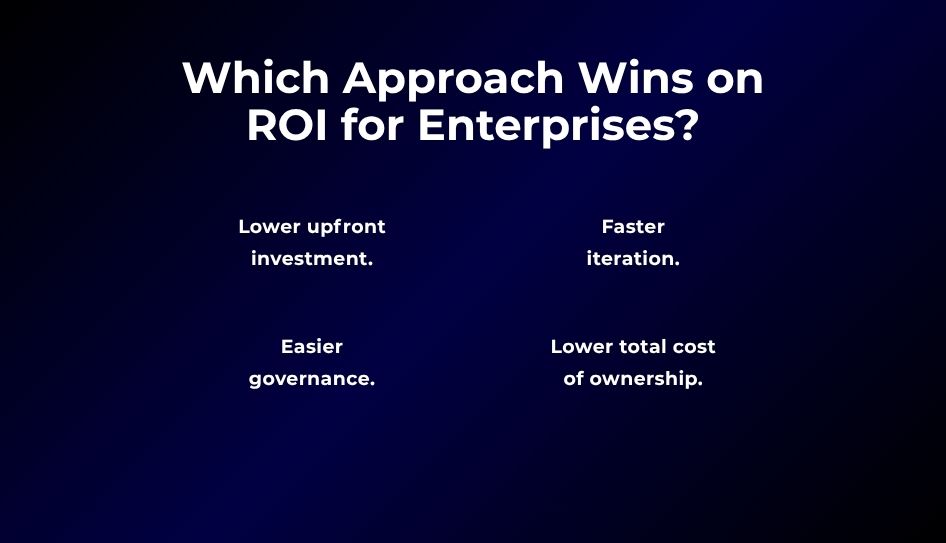
Straight answer: RAG typically delivers faster, more predictable ROI for most enterprise use cases. Fine-tuning wins on ROI when the task is highly specialized and RAG genuinely can’t get you there.
Here’s why RAG tends to win on ROI in most deployments:
Lower upfront investment. You’re not paying for large-scale compute training runs. You’re building a pipeline around an existing model. For most teams, this means going from idea to production in weeks, not quarters.
Faster iteration. When your product catalog changes or your compliance policy is updated, you update the knowledge base. There’s no retraining cycle. The business can move at business speed, not model training speed.
Easier governance. Because RAG outputs can be traced back to source documents, it’s far easier to audit, explain, and defend AI-generated responses. That matters enormously in regulated industries and connects directly to having a solid responsible deployment of AI systems framework in place.
Lower total cost of ownership. Fine-tuning isn’t a one-time cost. Models drift as domains evolve. Unless you’re committed to continuous retraining, the fine-tuned model you deployed 18 months ago may be giving confidently wrong answers today.
That said, fine-tuning wins on ROI when:
- The task requires consistent specialized reasoning that RAG simply can’t provide through retrieval alone
- Latency is a hard constraint (real-time applications, high-throughput processing pipelines)
- You have a clear, stable task definition and high-quality training data already available
- The model needs to internalize a style or format so consistently that prompt engineering isn’t reliable enough
The honest framing for any AI implementation strategy is this: start with RAG, prove the use case, and only reach for fine-tuning when RAG demonstrably can’t close the gap.
Can You Use RAG and Fine-Tuning Together?
Yes — and for sophisticated enterprise deployments, this is often the right answer.
The combination looks like this: you fine-tune a base model on your domain’s language patterns, terminology, and reasoning style, then deploy it with a RAG architecture on top so it can access current knowledge.
The result is a model that thinks and communicates like your domain expert (fine-tuning) and always has access to the latest information (RAG).
A practical example: a financial services firm builds a research assistant. They fine-tune a model on thousands of analyst reports so it understands financial reasoning, valuation frameworks, and the specific way their analysts communicate. Then they layer RAG on top so the model can pull current market data, recent filings, and live news when answering questions.
Neither approach alone would have delivered this. Together, they do.
This kind of combined architecture is increasingly what enterprises building custom AI models are converging on for mission-critical applications. It’s more complex and more expensive — but when the use case justifies it, the performance ceiling is significantly higher than either approach in isolation.
How Do You Choose the Right Approach for Your Use Case?
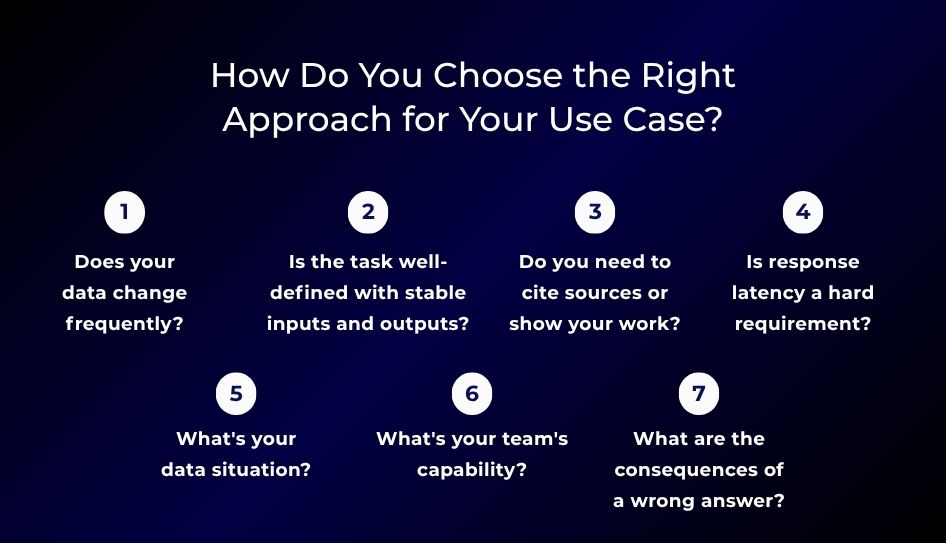
Work through these questions before committing to either path:
Does your data change frequently? If yes, lean toward RAG. Retraining a fine-tuned model every time your knowledge base updates is expensive and slow.
Is the task well-defined with stable inputs and outputs? If yes, fine-tuning is worth evaluating. Classification tasks, structured extraction, consistent summarization in a specific format — these are fine-tuning sweet spots.
Do you need to cite sources or show your work? RAG. Full stop. Fine-tuned models can’t tell you which document they drew an answer from.
Is response latency a hard requirement? If you’re building a real-time application where every millisecond matters, fine-tuning removes the retrieval step and gives you speed.
What’s your data situation? Fine-tuning requires high-quality, labeled, domain-specific training data at scale. If you don’t have that data — or the infrastructure to curate it — RAG is the more realistic path.
What’s your team’s capability? RAG can be built by a strong software engineering team with good API skills. Fine-tuning requires machine learning engineers who understand training pipelines, evaluation metrics, and model behavior. Be honest about what your team can execute.
What are the consequences of a wrong answer? In high-stakes environments, RAG’s source traceability makes errors easier to detect and correct. Fine-tuned models can be confidently wrong in ways that are harder to catch.
This decision framework is part of what separates mature AI strategy for technical leaders from teams that pick an approach based on what they’ve recently read about rather than what their use case actually demands.
Common Mistakes Enterprises Make When Choosing Between RAG and Fine-Tuning
Choosing fine-tuning because it sounds more impressive. Fine-tuning is a more technically sophisticated approach, which sometimes makes it feel like the more serious choice. But sophistication isn’t the goal — results are. Many enterprise use cases that got pushed through expensive fine-tuning projects could have been solved with well-architected RAG in a fraction of the time.
Underestimating RAG’s complexity. RAG isn’t just “connect the model to your database.” The quality of your chunking strategy, embedding model, retrieval logic, and re-ranking approach directly determines how well it works. Bad RAG is worse than no RAG — it creates the illusion of grounding while still producing unreliable outputs.
Treating fine-tuning as a one-time project. A fine-tuned model is a product, not a project. It requires monitoring, evaluation, and periodic retraining. Teams that don’t budget for this end up with a model that quietly degrades over time while the business assumes it’s still performing.
Starting with the technology instead of the problem. The question is never “should we use RAG or fine-tuning?” The question is “what outcome do we need, what does success look like, and which approach gets us there most reliably?” Start with the problem definition.
Skipping evaluation rigor. Whichever approach you choose, you need a proper evaluation framework — domain-specific test sets, clear quality metrics, human review for edge cases. Enterprises that skip this step deploy systems that perform well in demos and poorly in production. This is one of the core reasons why understanding how enterprises are building custom AI models matters — the evaluation layer is where real-world ROI gets made or lost.
Frequently Asked Questions
What is the main difference between RAG and fine-tuning?
RAG gives an AI model access to external knowledge at inference time — it retrieves relevant information from your data and uses it to answer questions. Fine-tuning changes the model’s internal weights through additional training, making it behave differently by default. RAG updates what the model knows; fine-tuning changes how the model thinks and communicates.
Is RAG cheaper than fine-tuning?
Generally, yes — especially upfront. RAG requires building a retrieval pipeline and vector database, but avoids the compute costs of training runs and the data curation effort needed for fine-tuning. Over time, the cost comparison depends on how often your fine-tuned model needs retraining vs. how much it costs to maintain your knowledge base infrastructure.
Can RAG hallucinate?
Yes, though typically less than a base model without retrieval. RAG reduces hallucination by grounding the model in retrieved documents, but it doesn’t eliminate it entirely. The model can still misinterpret retrieved content, fail to retrieve the right document, or fill gaps with generated content. Retrieval quality and prompt design both affect hallucination rates significantly.
How much data do you need to fine-tune an LLM?
It depends on the task and the base model. For style and tone adaptation, a few hundred to a few thousand high-quality examples can be sufficient. For deep domain reasoning — medical, legal, scientific — you typically need tens of thousands of examples, with careful attention to data quality. More data isn’t always better; noisy training data creates noisy models.
Which approach is better for a customer support chatbot?
RAG is almost always the right first choice for customer support. Product information, pricing, and policies change frequently, and customers expect accurate, current answers. RAG lets you update the knowledge base without any retraining cycle. Fine-tuning can be layered on top later to match your brand voice, but start with RAG.
What does RAG stand for?
RAG stands for Retrieval-Augmented Generation. It was introduced in a 2020 research paper from Meta AI and has since become one of the most widely adopted architectures for enterprise AI applications because of how well it handles the challenge of keeping AI systems grounded in accurate, current information.
Is fine-tuning the same as training a model from scratch?
No they’re very different in cost and complexity. Training from scratch means building a model’s entire knowledge base from random initialization, requiring massive datasets and compute budgets that typically only large research labs or well-funded AI companies can afford. Fine-tuning starts from a pre-trained model and continues training on a smaller, focused dataset to adapt behavior for a specific task or domain.