
How Generative AI Is Transforming Enterprise Operations in 2026
The year 2026 marks a pivotal moment in the history of enterprise technology. While discussions around Artificial Intelligence (AI) have been common for decades, the advent and rapid maturity of Generative AI in enterprise operations have fundamentally rewritten the playbook for how businesses function, innovate, and compete. This isn’t merely an incremental upgrade; it is a full-scale AI transformation in enterprises, driving unprecedented levels of efficiency, creativity, and speed.
Generative AI, the subset of AI focused on creating new content—be it text, images, code, data, or synthetic media—is moving rapidly out of the experimental lab and into the core of mission-critical business processes. Its unique capability to produce novel, contextually relevant outputs on demand is what sets it apart from previous generations of AI, which were primarily focused on analysis and prediction.
The Core Shift: From Analysis to Creation
Traditional enterprise AI systems excelled at tasks like forecasting sales, classifying customer complaints, or detecting fraud. They were powerful analytical tools. Generative AI, however, is a creative engine. It doesn’t just analyze past data; it generates solutions, drafts content, prototypes designs, and even writes and debugs software. This shift from analytical support to creative and functional output is the engine behind the current surge in AI-driven enterprise automation.
Generative AI Business Applications Across the Enterprise
The impact of Generative AI is not confined to a single department; it is rippling across every facet of the modern enterprise. Below is a snapshot of its most transformative Generative AI business applications:
1. Revolutionizing Software Development and IT
Perhaps the most immediate and profound impact is being felt in IT and software engineering. Generative AI models, often referred to as ‘AI pair programmers,’ are fundamentally changing how code is written, tested, and deployed.
- Code Generation and Completion: AI can generate boilerplate code, suggest complex function implementations, and translate between programming languages, boosting developer productivity by up to 50% in some cases.
- Legacy Modernization: Enterprises are leveraging GenAI to analyze and automatically rewrite vast troves of legacy code into modern frameworks, dramatically accelerating critical modernization projects.
- Security and Testing: AI models can simulate complex attack scenarios and automatically generate comprehensive test scripts, identifying vulnerabilities and bugs far faster than human teams alone.
2. Marketing, Sales, and Customer Experience (CX)
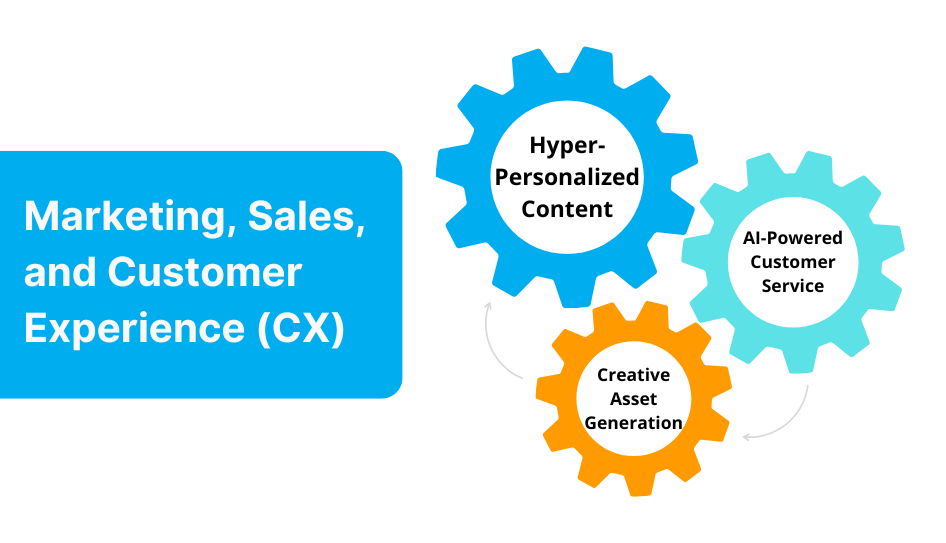
For customer-facing functions, Generative AI is the ultimate personalization tool, moving beyond simple segmentation to true one-to-one content creation.
- Hyper-Personalized Content: Marketing teams use GenAI to instantly create customized ad copy, email subject lines, and landing page layouts based on individual user behavior and psychographics.
- AI-Powered Customer Service: Sophisticated GenAI chatbots and virtual agents now handle complex, multi-turn conversations, offering personalized troubleshooting and support. Crucially, they can synthesize information from multiple knowledge bases to provide accurate, novel solutions, moving beyond scripted responses.
- Creative Asset Generation: From generating visual concepts for campaigns to drafting social media posts and blog content, AI accelerates the content creation pipeline, allowing marketing teams to operate at an unprecedented scale.
3. Streamlining Back-Office Operations (Finance, HR, Legal)
Generative AI is tackling the high-volume, knowledge-intensive tasks that have long been a bottleneck in administrative functions.
- Financial Reporting and Analysis: AI can draft first-pass financial reports, summarize complex regulatory documents, and identify variances in budgets, freeing up analysts for high-level strategy.
- HR and Talent Management: AI assists in drafting job descriptions, personalizing employee training paths, and summarizing performance review data, creating a more tailored employee experience.
- Legal Document Generation: In the legal field, GenAI is being used to draft standard contracts, summarize case law, and review vast document sets for compliance, significantly reducing time and legal expenditure.
4. Innovation and Product Design
Generative AI is a co-pilot for innovation, allowing enterprises to explore design spaces that were previously too time-consuming or expensive to consider.
- Synthetic Data Generation: For highly regulated industries or those with sensitive data, GenAI creates realistic, synthetic datasets for training models and testing applications without compromising privacy.
- Accelerated Prototyping: In manufacturing and engineering, AI can rapidly generate multiple design iterations for physical products (e.g., lightweighting components or optimizing airflow), drastically cutting down the design cycle from months to days.
The Strategic Benefits of Generative AI in Business
The widespread adoption of this technology is driven by compelling and measurable strategic Benefits of generative AI in business. These advantages are creating a significant competitive divide between early adopters and laggards.
| Benefit | Description | Impact Metric |
|---|---|---|
| Productivity Gains | Automating routine and knowledge-intensive tasks across all departments (e.g., drafting, coding, summarizing). | Time saved on repetitive tasks; Developer output increase (e.g., lines of code per day). |
| Cost Reduction | Lowering the operational costs associated with manual labor, content creation, and resource allocation. | Reduction in customer support costs; Lower spend on external agencies/contractors. |
| Innovation Speed | Accelerating the cycle of ideation, design, prototyping, and market testing. | Time-to-market reduction for new products or features; Increase in successful experimental projects. |
| Enhanced Personalization | Delivering tailored experiences, content, and services at scale. | Higher customer satisfaction (CSAT/NPS); Improved marketing conversion rates. |
| Knowledge Management | Making internal corporate knowledge searchable, synthesizable, and actionable through natural language interfaces. | Faster access to critical information; Reduction in time spent searching for internal documents. |
Addressing the Challenges: Governance and Ethics
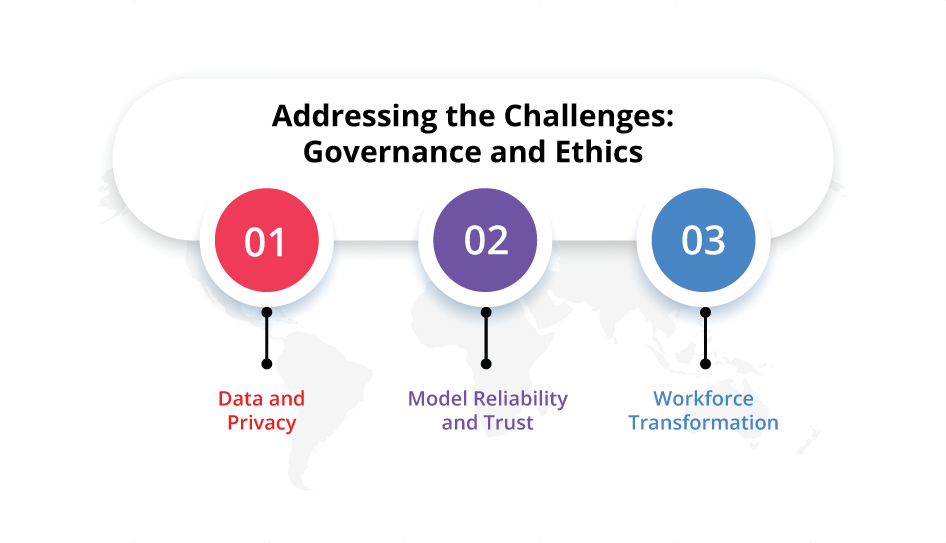
The transformation enabled by Generative AI is not without its risks. As enterprises integrate these powerful models into core operations, challenges related to data security, model accuracy (‘hallucinations’), and ethical deployment become paramount.
Data and Privacy: Generative AI models require immense amounts of data to train. Enterprises must implement rigorous data governance frameworks to ensure proprietary and customer data is handled securely and ethically, especially when using models that interact with private or confidential information.
Model Reliability and Trust: The risk of ‘hallucinations’—where a model produces factually incorrect or nonsensical output—is a constant concern, particularly in high-stakes applications like legal drafting or financial analysis. Strategies like Retrieval-Augmented Generation (RAG) and human-in-the-loop validation are essential for building trust and reliability.
Workforce Transformation: The ultimate success of Generative AI hinges on the ability of the workforce to adapt. Enterprises must focus on upskilling employees, not just in using AI tools, but in mastering the critical thinking and prompt engineering skills needed to effectively guide AI output. The goal is augmentation, not pure replacement.
The Future is Generative
The enterprise landscape of 2026 is one defined by generative capabilities. Businesses that successfully navigate this AI transformation in enterprises are doing so by adopting a strategic, holistic approach. They are treating Generative AI not as a feature to be bolted on, but as a new infrastructural layer that permeates every system and process.
The era of simply asking “Can AI do this?” is over. The question today is, “How quickly can we leverage Generative AI to create a decisive competitive advantage?” For the modern enterprise, the ability to generate new solutions, content, and code at scale is no longer a luxury—it is the essential cost of doing business in a dynamically changing global market. The transformative power of Generative AI is here, and it is reshaping what is possible in enterprise operations.
FAQs
1. What is the fundamental difference between traditional enterprise AI and Generative AI as described in the document?
The core shift is from analysis to creation. Traditional enterprise AI focused primarily on analytical tasks like forecasting, classification, and detection (e.g., analyzing past sales data or detecting fraud). Generative AI, by contrast, is a creative engine that generates novel, functional output, such as writing code, drafting content, designing product prototypes, and generating personalized customer responses.
2. Which enterprise department is experiencing the most immediate and profound impact from Generative AI?
The document indicates that the most immediate and profound impact is being felt in Software Development and IT. Generative AI models are functioning as ‘AI pair programmers’ to generate and complete code, accelerate legacy system modernization, and significantly improve security and testing procedures.
3. What are the main strategic benefits enterprises are gaining from Generative AI adoption?
The primary strategic benefits include Productivity Gains (automating knowledge-intensive tasks), Cost Reduction (lowering operational costs), Innovation Speed (accelerating the design and prototyping cycle), Enhanced Personalization (delivering tailored content at scale), and Improved Knowledge Management (making internal corporate data actionable).
4. What are the key challenges enterprises must address when integrating Generative AI?
The three paramount challenges are Data and Privacy (implementing rigorous governance for proprietary and customer data), Model Reliability and Trust (mitigating the risk of ‘hallucinations’ through strategies like RAG and human-in-the-loop validation), and Workforce Transformation (upskilling employees to master prompt engineering and critical thinking for effective AI augmentation).