
AI in Recruitment: Executive Search AI Tools for Smarter Hiring of Senior Talent

Recruitment of senior management is the most vital mission of any company. In the existing, rivalry-ridden job market, the process of recruitment of C-suite executives has reached greater complexity and a longer timeline than ever. The companies should find the right combination of experience, skills, and culture for the high-risk positions. The old-fashioned ways, which are mainly resume examination, networking, and manual screening, can take a long time and often overlook top-notch candidates. AI in recruitment provides smarter, data-based techniques to discover and assess senior candidates. Just consider, for instance, that AI-based recruiting programs can “enhance hiring by reducing the time spent on automating tasks like screening resumes, sourcing candidates, and communicating”.
Organizations that have incorporated AI into their recruitment process can not only discover hidden candidates but also fill executive positions in days instead of months. For quite a few Chief Human Resources Officers, the use of AI in recruiting has made the choosing of talent a matter of data-driven science instead of intuition.
The Challenges of Executive Search
Executive search has the toughest challenges. There is a very limited number of senior candidates with the needed qualifications for hiring, and the clients want the perfect fits for the top positions, like the CEO or CTO. The need for extraordinary qualifications in terms of both skills and leadership experience is so high that the recruiters usually have no option but to search through numerous sources and networks to find even a few prospects. Often, the searches are international; for instance, a head of AI might necessitate looking into the talent market of the entire world.
Time is critical: losing a months-long search to a competitor can be extremely costly. Even after identifying strong candidates, vetting them thoroughly for cultural fit and proven leadership is essential. As Cochran & Yale note, traditional executive search involves “combing through vast amounts of data, much of it manually”, making the process thorough but extremely time-consuming. In short, legacy methods are laborious, which is why executive recruiters are turning to Executive search AI for efficiency.
AI-Powered Executive Search Solutions
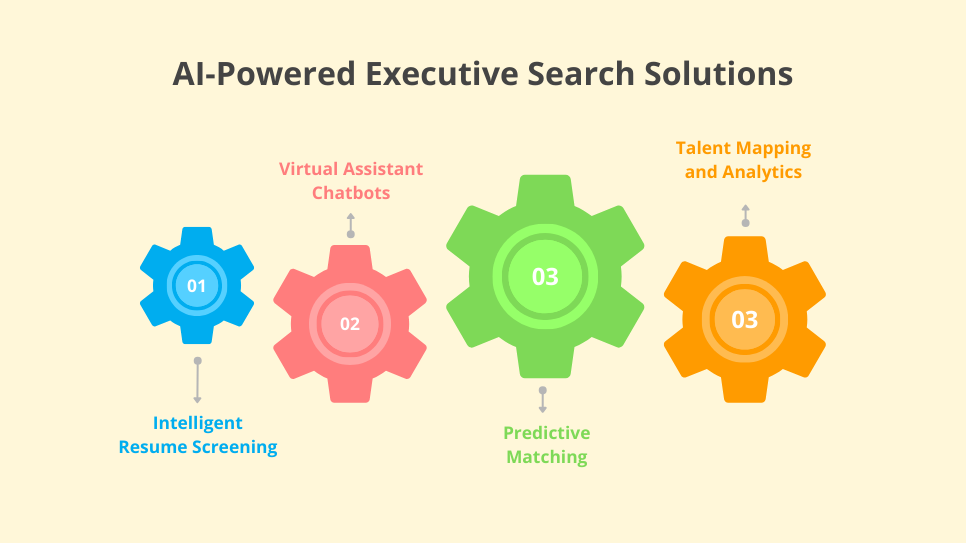
Executive search AI solutions bring powerful capabilities to senior talent acquisition. Modern AI recruiting tools can automate resume screening, analyze professional profiles, and match candidate qualifications to job requirements far faster than humans. For example, intelligent search engines use natural language processing to scan millions of resumes and identify those with the desired experience and skills. AI platforms can also deploy virtual assistants to handle candidate outreach and preliminary Q&A. These AI-driven features include:
- Intelligent Resume Screening: AI parses CVs and LinkedIn profiles to filter out unqualified applicants and surface candidates who meet the technical and leadership criteria.
- Virtual Assistant Chatbots: Automated agents conduct preliminary Q&A with candidates and schedule interviews, streamlining communication so recruiters focus on strategic tasks.
- Predictive Matching: Machine learning models analyze historical hiring data to forecast a candidate’s suitability. For instance, recruiters note that AI can “forecast a candidate’s future success” in a role by comparing skills and background to past placements.
- Talent Mapping and Analytics: AI-driven analytics tools identify where qualified executives are currently employed and what career moves they might make. This talent mapping helps build an on-demand pipeline of high-potential leaders.
Together, these AI-powered features accelerate sourcing and vetting, showing how AI in recruitment and executive search tools is transforming senior hiring.
Benefits of AI in Executive Search
Incorporating AI in recruitment and other advanced hiring solutions into the executive search process yields major advantages. For example, many companies report that integrating AI in recruitment can slash the time-to-fill for key leadership roles by half. One benefit is faster hiring: automated screening and scheduling drastically reduce time-to-hire. AI-driven tools can sift through large candidate databases in hours, while manual review takes weeks. This lets recruiters interview top candidates sooner and fill critical roles quickly.
Another advantage is improved candidate quality: sophisticated matching algorithms focus on candidates whose skills and experiences align with the role, increasing the chance of a good hire. In fact, AI systems help identify not just qualifications, but leadership traits and cultural fit patterns that might be missed by keyword searches alone.
AI in recruitment also helps reduce bias and increase diversity. Automated screening can anonymize applications by ignoring names and photos, focusing instead on objective criteria. This encourages a fairer, more merit-based evaluation of leadership prospects. Additionally, AI-driven tools can flag biased language in job descriptions and enforce inclusive hiring practices.
Finally, AI provides better data insights and candidate engagement. Recruiters get dashboards showing metrics like pipeline health and sourcing effectiveness. Intelligent chatbots and personalized communications keep executive candidates engaged with timely updates, improving the candidate experience. These data-driven insights help organizations continuously refine their search strategies and make more informed hiring decisions.
Considerations and Best Practices

As organizations adopt recruitment automation and AI hiring solutions, experts emphasize balancing technology with human insight. AI should augment, not replace, recruiters. For example, while AI excels at processing data and screening resumes, “human judgment remains essential” for assessing cultural fit and leadership potential. This means using AI to handle repetitive tasks like initial filtering, while experienced recruiters continue interviews and final evaluations. Effective use of AI for talent acquisition also requires training models on clean, diverse data and aligning algorithms with clear hiring goals. Poor or biased input data can lead AI to make flawed recommendations.
Data privacy and ethics are also critical. AI models are only as good as the information they use. If past hiring data was incomplete or biased, the AI may inherit those issues. Firms must audit their AI tools regularly and ensure models are trained on representative, up-to-date candidate data. Candidate confidentiality is especially important for high-level roles; any AI platform must comply with regulations like GDPR and use strong security.
In practice, recruiters should complement AI recruiting tools with oversight: many AI recruiting tools include bias-detection features, but recruiters should verify results. Ongoing training and transparency are key. In short, companies should use AI hiring solutions responsibly, striking the right balance between automation and human judgment.
Future Outlook
Looking ahead, AI in recruitment will continue to transform how companies find senior talent. Advances in machine learning and natural language processing will enable even deeper assessments of leadership qualities. For example, future recruitment automation platforms might proactively recommend industry executives who fit upcoming roles, even before those positions are posted. However, one thing is clear: AI is a tool, not a replacement. As one expert predicts, AI will handle more of the screening and analytical tasks, allowing recruiters to focus on roles requiring emotional intelligence and strategic thinking. As a result, recruitment automation is a strategic imperative that offloads routine tasks and provides data to make recruiters more effective. The most successful firms will use AI hiring solutions to support recruiters, combining the speed of technology with the critical human touch needed for C-suite hires.
FAQs
1. What is AI in recruitment?
AI in Recruitment (or AI for talent acquisition) means using technologies like machine learning, NLP, and automation to support hiring. This includes algorithms for resume parsing, candidate matching, chatbots, and analytics. It automates tasks such as screening applications and scheduling interviews, helping companies find and assess candidates faster.
2. How does AI help in executive search?
AI accelerates high-level hiring. In executive search, AI can analyze vast data (news, profiles, patents) to identify passive senior candidates. For instance, specialized Executive search AI tools can scan competitor data to find passive leaders. It automates candidate outreach and research, allowing firms to engage ideal C-level candidates more efficiently.
3. Do AI recruiting tools replace human recruiters?
No, AI recruiting tools are assistants, not replacements. These tools take over repetitive tasks (data entry, initial screening) so recruiters can focus on human-centric work. As one source notes, AI is a “strategic multiplier” – it increases recruiters’ impact but does not replace their judgment. The final hiring decisions and relationship-building are still led by people.
4. Are AI recruiting tools unbiased?
AI tools can help reduce bias if used carefully. For example, some companies see up to ~48% more diverse hires after using AI-based screening. However, AI can also reflect biased historical data if not managed. The key is to ensure diverse training data and keep humans in the loop. Used responsibly, AI in recruitment can improve fairness and widen the talent pool.
5. How should companies start implementing AI hiring solutions?
Begin by identifying the pain points in your executive search workflow. Then choose AI for talent acquisition tools that target those areas, like resume-screening software or candidate-engagement chatbots. Ensure your data is clean and comprehensive. Train your team on the new system and set clear metrics for success. In some cases, an AI hiring solution can automatically rank candidates by fit, helping recruiters focus on top matches and streamline their pipeline. Keep human recruiters involved at every stage.