
AI in Retail: Beyond Personalized Recommendations to Intelligent Supply Chains
The application of AI in retail has totally transformed the industry through its different uses apart from product recommendations. Present-day retailers have AI-based solutions in all their operational areas. Foreseeing market demand, controlling stock, and improving logistics are just some of the areas where AI technology comes in handy. Using AI in retail allows for better management of stock while making the supply chain more efficient and resilient. AI Retail today is not only confined to making suggestions for shoppers; it actually empowers the whole network from end to end. Vendors are indeed the source of the different AI retail solutions that various companies are evaluating. The Artificial Intelligence in Retail market worldwide is experiencing an upward trend: it was appraised at $31.1B in 2024 and is likely to exceed $164.7 by 2030. Such an increase indicates that AI in retail has become a core pillar of contemporary strategy.
The Evolution of AI in Retail
The first users of AI in retail mainly relied on customer-oriented applications like individualized recommendations and chatbots. These recommendation systems utilize purchase information to propose items, thus enhancing customer interaction and generating revenue. On the other hand, AI-supported digital customer service representatives can take care of customer inquiries around the clock, which means better customer service. Still, these use cases are just a small part of the vast potential of AI in retail. Presently, our AI is shifting from marketing to operations as it provides retail AI solutions for forecasting, inventory management, and supply chain planning.
AI-Powered Inventory Management and Demand Forecasting
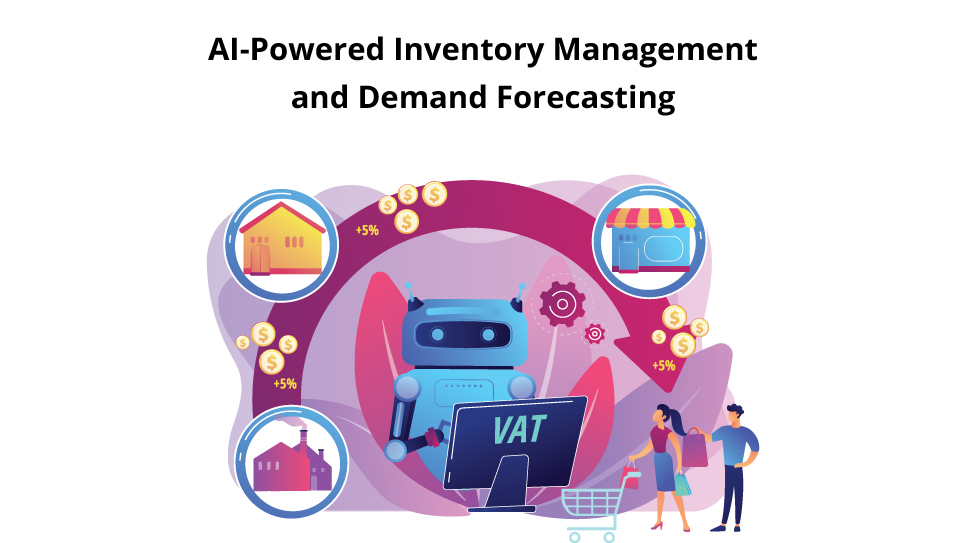
The optimization of inventory and demand forecasting remains the most critical area of AI application in the retail sector. AI’s role in inventory management incorporates predictive analytics that estimate demand with very high precision. These models are able to predict how much stock will be needed by considering various factors such as sales history, seasonality, market trends, and even weather. Retailers with accurate forecasts can eliminate expensive stockouts, and they also have lower inventories.
AI-powered forecasting, for instance, can lead to a 30–40% increase in precision, thus mitigating overstocking to a large extent. Demand change being a major factor in AI supply chain optimization, smart reorder systems instantly initiate the replacements. Retailers applying AI to stock planning declare as much as a 25% decrease in excess inventory and an increase in turnover.
The Retail Supply Chain is now on autopilot
Logistics and warehousing are the other areas, besides the retail floor, where AI enhances the retail case. Suppliers resort to AI supply chain optimization in deciding delivery routes, managing stockpiling, and orchestrating distribution. The AI route-planning implements the most efficient delivery routes in real time, cutting transit times and lowering the cost of fuel. In case of any delay, AI will dynamically change the schedule so that the shipment remains punctual. The use of robots equipped with AI and smart cameras in warehouses for stocking and retrieval leads to quick order fulfillment and minimizes mistakes. Retail automation through AI is taking place even in stores with the introduction of cashier-less checkout and shelf-monitoring cameras. All these activities, the upstream and downstream, are all connected through the AI solution in the retail chain, and thus the network becomes more efficient, responsive, and less costly.
Key Benefits of AI in Retail Operations
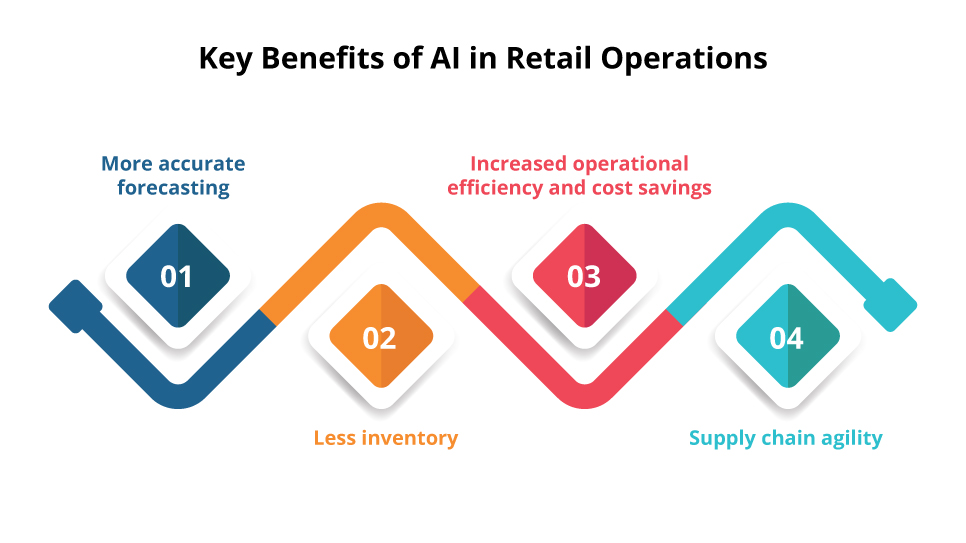
AI, being a Retailer’s Ally in the retail operation,s has a lot of benefits for retailers adopting it.
- More accurate forecasting: AI predictions become demand forecasts that are up to 30–40% more accurate thanks to simultaneous analysis of different data sources by AI models, which, in turn, the company saves on stockouts and markdowns.
- Less inventory: To avoid overstock and lost sales, automated replenishment is used to keep excess stock at 25% less
- Increased operational efficiency and cost savings: AI is taking care of repetitive tasks and optimizing the routes, thus cutting down labor and logistics costs while increasing the profit margins.
- Supply chain agility: AI supply chain optimization enables quick response to disruptions (like supplier delays) by rerouting and dynamic scheduling, ensuring a high on-time delivery rate.
The right retail AI solutions deliver these benefits across the business.
Implementing AI in Retail Strategies
For retailers adopting AI in retail, a clear strategy is key. Start by identifying core pain points, like frequent stockouts or late deliveries, and pilot an AI solution that addresses them. Integrating data from online and offline channels is essential so the AI model has a complete view of demand and inventory. According to industry research, 37% of retailers cite high implementation costs as a top challenge, highlighting the need for careful planning and ROI justification. However, retailers that succeed often see quick payoffs: even small efficiency gains in forecasting or stocking can lead to substantial savings and happier customers. For example, using AI in retail to automate replenishment of trending products can prove ROI quickly.
Future Trends: Generative AI and Beyond
Generative AI is adding powerful new capabilities to retail supply chains. For example, AI can auto-generate demand plans or simulate disruptions (like a storm) to stress-test the network. Next-generation tools might even create purchase-order schedules or dynamic sourcing plans automatically. On the store floor, smarter computer vision and IoT sensors will track stock and merchandising automatically. In short, artificial intelligence in retail is expanding beyond chatbots: future AI agents will orchestrate entire operations. AI supply chain optimization is truly transforming retail operations.
In fact, AI for inventory management is a key component of this expansion, enabling automatic reordering and waste reduction. Retailers embracing these advanced strategies will gain a significant competitive edge.
Conclusion
AI in retail has evolved from simple personalization tools to a core strategic asset. Companies adopting AI report major gains in efficiency, cost savings, and customer satisfaction. By using AI for inventory management, supply chain optimization, and store automation, retailers can deliver the right products at the right time while lowering waste. Looking ahead, artificial intelligence in retail will only grow in importance, giving forward-thinking businesses a clear competitive advantage. For many businesses, integrating AI in retail into daily operations is now essential for competitiveness.
For example, companies worldwide, from department stores in Europe to online retailers in India, are investing in AI in retail solutions. Globally, artificial intelligence in retail is proving to be a core driver of efficiency.
FAQs
Q: What is AI in retail, and why is it important?
A: AI in retail (artificial intelligence in retail) means using AI tech to improve both customer experience and store operations. It includes product recommendation engines and chatbots. It also powers backend functions: demand forecasting, pricing, and supply chain planning. With AI in retail, businesses can better predict demand, manage inventory, and streamline logistics, not just recommend products.
Q: How does AI supply chain optimization improve retail operations?
A: AI in retail’s supply chain optimization means using AI to analyze data from suppliers, inventory, and customers to make smarter decisions. For example, AI can forecast demand and automatically adjust orders. Companies see ~30–40% more accurate forecasts and ~25% higher on-time deliveries. AI systems can re-route shipments around delays and rebalance stock across stores in real time, leading to faster deliveries and lower costs.
Q: What are some retail AI solutions for inventory management?
A: Retail AI solutions for inventory include predictive forecasting tools, automated reorder systems, and analytics dashboards. These use sales data and trends to keep stock at optimal levels. For example, many retailers use AI in retail inventory tools to analyze sales and decide when to reorder. AI can identify slow-moving items and suggest promotions. Retailers using AI for inventory report ~30% fewer stockouts and ~25% lower holding costs.
Q: What is meant by retail automation with AI?
A: Retail automation with AI refers to using AI-driven machines and software to handle routine tasks. Examples include warehouse robots and autonomous forklifts that move products, and AI chatbots for customer queries. These tools speed up operations and cut manual effort. For example, Amazon Go’s cashier-less stores truly exemplify AI in retail by tracking exactly the items customers take.
Q: Are there challenges to implementing AI in retail?
A: Yes, implementing AI in retail has challenges. A major issue is the upfront cost and need for technical expertise. Retailers must ensure they have good-quality data across all channels; fragmented or inaccurate data can hinder AI. Additionally, staff need training on new AI tools. Despite these hurdles, successful AI initiatives yield efficiency gains, cost savings, and improved customer satisfaction, making the investment worthwhile in the long run.